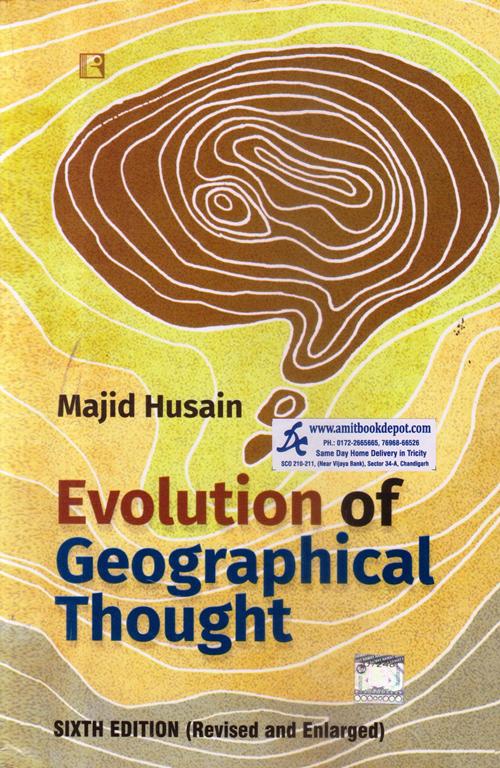
It adds updated content on feminist geography, contemporary movements, and revised bibliographic notes, ensuring coverage of recent paradigm shifts and modern themes.
It analyses Puranic cosmology, Jain and Buddhist geography, including concepts of continents, oceans, and Mount Meru as the cosmic axis.
Thales, Anaximander, Hecataeus, Herodotus, Aristotle, and Eratosthenes, focusing on their contributions to mapmaking, climatic zones, and regional description.
Yes, it covers the shift from descriptive to statistical and mathematical methods, including theory construction, hypothesis testing, and spatial science.
Determinism holds nature controls human activity; possibilism argues humans can choose among multiple alternatives within environmental limits.
German (Humboldt, Ritter), French (Vidal de la Blache), British (Mackinder), American (Sauer, Hartshorne), and Soviet schools.
It discusses physical vs. human, systematic vs. regional, historical vs. functional, and idiographic vs. nomothetic dualisms.
Yes, including descriptive, explanatory, and predictive models such as gravity, diffusion, von Thünen, Weber, and Christaller’s central place.
Contributions of Al-Masudi, Al-Biruni, Al-Idrisi, and Ibn Battuta in cartography, regional geography, and pilgrimage route documentation.
They provided empirical data challenging classical authorities, leading to new map projections, ocean currents study, and global spatial frameworks.
No Description Added
It adds updated content on feminist geography, contemporary movements, and revised bibliographic notes, ensuring coverage of recent paradigm shifts and modern themes.
It analyses Puranic cosmology, Jain and Buddhist geography, including concepts of continents, oceans, and Mount Meru as the cosmic axis.
Thales, Anaximander, Hecataeus, Herodotus, Aristotle, and Eratosthenes, focusing on their contributions to mapmaking, climatic zones, and regional description.
Yes, it covers the shift from descriptive to statistical and mathematical methods, including theory construction, hypothesis testing, and spatial science.
Determinism holds nature controls human activity; possibilism argues humans can choose among multiple alternatives within environmental limits.
German (Humboldt, Ritter), French (Vidal de la Blache), British (Mackinder), American (Sauer, Hartshorne), and Soviet schools.
It discusses physical vs. human, systematic vs. regional, historical vs. functional, and idiographic vs. nomothetic dualisms.
Yes, including descriptive, explanatory, and predictive models such as gravity, diffusion, von Thünen, Weber, and Christaller’s central place.
Contributions of Al-Masudi, Al-Biruni, Al-Idrisi, and Ibn Battuta in cartography, regional geography, and pilgrimage route documentation.
They provided empirical data challenging classical authorities, leading to new map projections, ocean currents study, and global spatial frameworks.