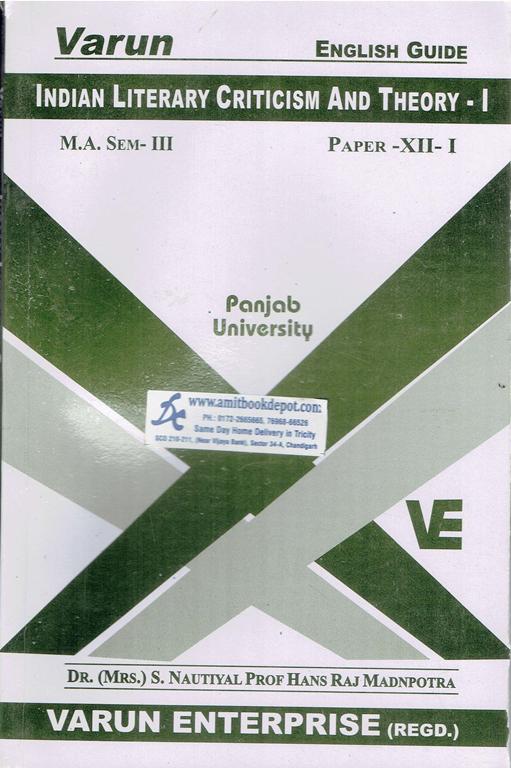
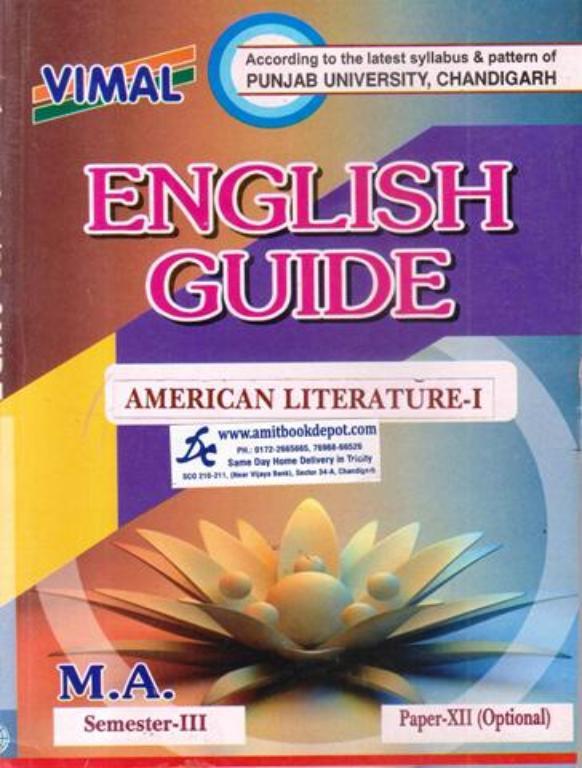
Varun English Guide Indian Literary Criticism and Theory 1 For MA 3rd Semester Paper 12 (1) Panjab University Chandigarh
Varun English Guide Indian Literary Criticism and Theory 1 For MA 3rd Semester Paper 12 (1) Panjab University Chandigarh
by Madhurima
₹350₹350.00(-/
off)
Rating & Reviews
23 Customer Review
This comprehensive guide for Panjab University's MA English 3rd Semester, Paper 12 (1): Indian Literary Criticism and Theory – I, authored by Dr. S. Nautiyal, provides complete syllabus coverage. It offers detailed explanations of key concepts from major schools of Indian poetics, including Rasa (Bharatmuni), Dhvani (Anandvardhana), and Vakrokti (Kuntak). It also covers foundational essays by Tagore and Krishna Rayan, alongside A.K. Ramanujan's work on Ancient Tamil Poetics. Designed to foster conceptual understanding and analytical skills, this book is an indispensable resource for mastering the syllabus and excelling in university examinations.
Master Indian Literary Criticism and Theory with the Definitive Guide for Panjab University MA English Semester 3
The "Latest Syllabus of English Guide Indian Literary Criticism and Theory 1 for MA 3rd Semester Paper 12 (1) Panjab University (PU) Chandigarh," authored by Dr. S. Nautiyal and published by Varun Enterprises, is an indispensable academic resource meticulously crafted to align with the prescribed Panjab University syllabus. This comprehensive guide is engineered to provide postgraduate students of English with a deep, structured, and analytical understanding of the foundational concepts of Indian poetics and literary theory.
This guide singularly focuses on the rich and diverse tradition of Indian literary criticism, offering students an essential indigenous perspective to counterpoint Western theoretical frameworks. The book is structured into five distinct units, each dedicated to a pivotal school of thought or a seminal theorist, ensuring a systematic and thorough coverage of the syllabus. The content is designed not only to help students pass their examinations but also to genuinely comprehend the nuanced and profound ideas that form the bedrock of Indian aesthetic philosophy.
Unit I initiates the exploration with fundamental questions about the nature of art and literature. It features Rabindranath Tagore's profound essay "What is Art?" which delves into the spiritual and emotional origins of artistic creation. This is complemented by Krishna Rayan's "What is Literariness?", a critical text that investigates the unique qualities that define a piece of writing as 'literary' within the Indian context, establishing a crucial conceptual groundwork for the units that follow.
Unit II is dedicated to the cornerstone of Sanskrit aesthetic theory: the Rasa Siddhanta. This section provides an in-depth analysis of Bharatmuni's Natyashastra, specifically focusing on the theory of 'Rasa' (aesthetic relish) and its application in dramatic experience. The guide breaks down the complex interplay between Bhava (emotions), Vibhava (determinants), and Anubhava (consequents), enabling students to grasp this seminal concept with clarity.
Unit III advances to the Dhvani Siddhanta, as propounded by Anandvardhana. The chapter on "Dhvani: Structure of Meaning" from the Dhvanyaloka is meticulously explained. This unit focuses on the concept of suggested meaning (Dhvani) as the soul of poetry, distinguishing it from literal and metaphorical meanings. The guide aids students in understanding how this theory prioritizes resonance and suggestion as the highest form of poetic expression.
Unit IV explores the concept of poetic obliquity through Kuntak's Vakrokti Siddhanta. The chapter "Language of Poetry and Metaphor" from Vakroktijivita is thoroughly examined. This section elucidates the theory of 'Vakrokti' (strikingness of expression) as the fundamental principle of all poetic language, covering its various types and its role in creating aesthetic beauty.
Unit V broadens the scope beyond Sanskrit poetics by introducing students to the traditions of Ancient Tamil poetics through A.K. Ramanujan's seminal essay. This unit provides a valuable comparative perspective, exploring the unique literary conventions and aesthetic principles of the Tamil Sangam tradition, thereby presenting a more pan-Indian view of literary theory.
This guide by Dr. S. Nautiyal is more than a compilation of texts; it is a pedagogical tool. It includes detailed explanations, critical commentary, and potential examination questions to foster a deep conceptual understanding as mandated by the university. The content emphasizes analytical skills and the application of theoretical concepts to literary texts, preparing students for both theoretical and practical questions in their examination. For any MA English student at Panjab University navigating Paper XII, this book is an essential, authoritative, and syllabus-specific key to academic success.
Is this guide a replacement for the original texts anthologized in G.N. Devy's "Indian Literary Criticism"?
A1
No, this guide is a critical companion and study aid. It provides explanations, summaries, and analysis, but students are strongly advised to refer to the original essays in the prescribed anthology (G.N. Devy's edited book) for primary reading and direct quotations.
Q2
How does this guide help in answering practical/applied questions mentioned in the syllabus?
A2
The product description notes the guide fosters analytical skills for practical application. It likely includes examples or guidance on how to apply theoretical concepts like Rasa or Dhvani to analyze specific poems or plays, which is crucial for the practical nature of some exam questions.
Q3
Is the content written in a simplified language for better understanding?
A3
Yes, the guide is described as being designed to explain complex concepts with clarity. It is intended to break down sophisticated theories from Sanskrit and Tamil poetics into more digestible language for postgraduate students.
Q4
Are there any notes or critical commentary on A.K. Ramanujan's essay on Tamil Poetics, which can be challenging?
A4
Yes, Unit V specifically covers A.K. Ramanujan's work. The guide provides a detailed explanation and critical commentary to help students understand the unique conventions of ancient Tamil literature and its differences from Sanskrit traditions.
Q5
Is the entire syllabus, including all five units, covered in a single volume?
A5
Yes, according to the provided Table of Contents and description, this single volume comprehensively covers all five units prescribed for Paper 12 (1) by Panjab University.
Q6
Does the guide explain the internal choice pattern in the exam paper?
A6
The description confirms the exam pattern, stating that each of the five questions will carry 16 marks and have an internal choice, and the guide is structured to prepare students for this specific format.
Q7
How current is the syllabus covered in this guide?
A7
The title "Latest Syllabus" indicates that it is updated to match the most recent curriculum prescribed by Panjab University for the current or upcoming academic years.
Q8
Does this book provide a comparative analysis between Indian and Western literary theories?
A8
The syllabus and this guide focus singularly on providing an "indigenous perch." While it establishes an alternative perspective, its primary goal is a deep dive into Indian Poetics rather than a systematic comparison with Western theory.
Q9
Is the theory of Rasa explained in the context of modern literature or only classical drama?
A9
The guide focuses on the original theory from the Natyashastra. However, to foster critical understanding and application, it may include insights or prompts on how these ancient theories can be relevant to analyzing postcolonial or modern texts.
Q10
What is the page count and physical format of the book (e.g., paperback)?
A10
This specific information (page count, binding type) is not provided in the description and should be checked in the product details section on the website or with the retailer.
0.00
0 Overall Rating
5
0
4
0
3
0
2
0
1
0
Try this product & share your review &
thoughts
UNIT - I
1. Rabindranath Tagore: What is Art?
2. Krishna Rayan: What is Literariness?
UNIT - II
1. Bharatmuni: Rasa Siddhant, On Natyashastra
UNIT - III
1. Anandvardhana: Dhavni: Structure of Meaning
UNIT - IV
1. Kuntak: Vakrokti Siddhanta
UNIT - V
1. A.K. Ramanujan: On Ancient Tamil Poetics
Latest Syllabus of English Guide Indian Literary Criticism and Theory 1 For MA 3rd Semester Paper 12 (1) Panjab University (PU) Chandigarh
Paper XII
(Choose any one of the options.)
(1) Indian Literary Criticism and Theory –I
This paper shall focus singularly on Indian poetics—its various schools and theories—so as to provide an alternative perspective of literary theory from an indigenous perch. The corpus of Indian poetics is very rich and multivalent; the paper shall, however, deal with basic concepts and would therefore be introductory in nature and scope. From essays on what constitutes ‘literariness’ in the Indian context, the course offers a critical understanding of major concepts of Sanskrit aesthetics like rasa, dhvani, and vakrokti. There is one unit on ancient Tamil poetics too. The prescribed texts are available in English translation, and there is no dearth of secondary material also. The students would be encouraged to take a critical view of ancient ‘poetics’ and its relevance in the postcolonial contexts.
Testing: The paper shall consist of five questions of 16 marks each, one from each unit. The questions shall be designed in such a way that they focus more on the
candidate’s understanding of the issues involved in literary studies, and not just his/her capability for memorizing information. Also, there could be questions of
practical nature in which the candidate may be asked to apply his/her analytical skills to literary texts. Each question shall have an internal choice and is to be answered in 500-600 words. The paper shall carry a total of 80 marks.
Unit I
1. Rabindranath Tagore, “What is Art?”, anthologized in G.N. Devy’s edited book Indian Literary Criticism (Hyderabad, Orient Longman, 2002), 137-152.
2. Krishna Rayan, “What is Literariness?” anthologized in G.N. Devy’s edited book Indian Literary Criticism (Hyderabad, Orient Longman, 2002) 177-183.
Unit II
• Rasa-Siddhanta with special reference to Bharatmuni, “On Natya and Rasa: Aesthetic of Dramatic Experience” from the Natyashastra, anthologized in G.N. Devy’s edited book Indian Literary Criticism (Hyderabad, Orient Longman, 2002), 3-14.
Unit III
• Dhavni–Siddhanta with special reference to Anandvardhana, “Dhavni: Structure of Meaning” from Dhavanyaloka, anthologized in G.N. Devy’s edited book Indian Literary Criticism (Hyderabad, Orient Longman, 2002) 31-40.
Unit IV
• Vakrokti-Siddhanta with special reference to Kuntak, “Language of Poetry and Metaphor” from VakroktiJivita, anthologized in G.N. Devy’s edited book Indian Literary Criticism (Hyderabad, Orient Longman, 2002) 46-60.
Unit V
• A.K. Ramanujan, “On Ancient Tamil Poetics,” anthologized in G.N. Devy’s edited book Indian Literary Criticism (Hyderabad, Orient Longman, 2002), 346-374.
Master Indian Literary Criticism and Theory with the Definitive Guide for Panjab University MA English Semester 3
The "Latest Syllabus of English Guide Indian Literary Criticism and Theory 1 for MA 3rd Semester Paper 12 (1) Panjab University (PU) Chandigarh," authored by Dr. S. Nautiyal and published by Varun Enterprises, is an indispensable academic resource meticulously crafted to align with the prescribed Panjab University syllabus. This comprehensive guide is engineered to provide postgraduate students of English with a deep, structured, and analytical understanding of the foundational concepts of Indian poetics and literary theory.
This guide singularly focuses on the rich and diverse tradition of Indian literary criticism, offering students an essential indigenous perspective to counterpoint Western theoretical frameworks. The book is structured into five distinct units, each dedicated to a pivotal school of thought or a seminal theorist, ensuring a systematic and thorough coverage of the syllabus. The content is designed not only to help students pass their examinations but also to genuinely comprehend the nuanced and profound ideas that form the bedrock of Indian aesthetic philosophy.
Unit I initiates the exploration with fundamental questions about the nature of art and literature. It features Rabindranath Tagore's profound essay "What is Art?" which delves into the spiritual and emotional origins of artistic creation. This is complemented by Krishna Rayan's "What is Literariness?", a critical text that investigates the unique qualities that define a piece of writing as 'literary' within the Indian context, establishing a crucial conceptual groundwork for the units that follow.
Unit II is dedicated to the cornerstone of Sanskrit aesthetic theory: the Rasa Siddhanta. This section provides an in-depth analysis of Bharatmuni's Natyashastra, specifically focusing on the theory of 'Rasa' (aesthetic relish) and its application in dramatic experience. The guide breaks down the complex interplay between Bhava (emotions), Vibhava (determinants), and Anubhava (consequents), enabling students to grasp this seminal concept with clarity.
Unit III advances to the Dhvani Siddhanta, as propounded by Anandvardhana. The chapter on "Dhvani: Structure of Meaning" from the Dhvanyaloka is meticulously explained. This unit focuses on the concept of suggested meaning (Dhvani) as the soul of poetry, distinguishing it from literal and metaphorical meanings. The guide aids students in understanding how this theory prioritizes resonance and suggestion as the highest form of poetic expression.
Unit IV explores the concept of poetic obliquity through Kuntak's Vakrokti Siddhanta. The chapter "Language of Poetry and Metaphor" from Vakroktijivita is thoroughly examined. This section elucidates the theory of 'Vakrokti' (strikingness of expression) as the fundamental principle of all poetic language, covering its various types and its role in creating aesthetic beauty.
Unit V broadens the scope beyond Sanskrit poetics by introducing students to the traditions of Ancient Tamil poetics through A.K. Ramanujan's seminal essay. This unit provides a valuable comparative perspective, exploring the unique literary conventions and aesthetic principles of the Tamil Sangam tradition, thereby presenting a more pan-Indian view of literary theory.
This guide by Dr. S. Nautiyal is more than a compilation of texts; it is a pedagogical tool. It includes detailed explanations, critical commentary, and potential examination questions to foster a deep conceptual understanding as mandated by the university. The content emphasizes analytical skills and the application of theoretical concepts to literary texts, preparing students for both theoretical and practical questions in their examination. For any MA English student at Panjab University navigating Paper XII, this book is an essential, authoritative, and syllabus-specific key to academic success.
Is this guide a replacement for the original texts anthologized in G.N. Devy's "Indian Literary Criticism"?
A1
No, this guide is a critical companion and study aid. It provides explanations, summaries, and analysis, but students are strongly advised to refer to the original essays in the prescribed anthology (G.N. Devy's edited book) for primary reading and direct quotations.
Q2
How does this guide help in answering practical/applied questions mentioned in the syllabus?
A2
The product description notes the guide fosters analytical skills for practical application. It likely includes examples or guidance on how to apply theoretical concepts like Rasa or Dhvani to analyze specific poems or plays, which is crucial for the practical nature of some exam questions.
Q3
Is the content written in a simplified language for better understanding?
A3
Yes, the guide is described as being designed to explain complex concepts with clarity. It is intended to break down sophisticated theories from Sanskrit and Tamil poetics into more digestible language for postgraduate students.
Q4
Are there any notes or critical commentary on A.K. Ramanujan's essay on Tamil Poetics, which can be challenging?
A4
Yes, Unit V specifically covers A.K. Ramanujan's work. The guide provides a detailed explanation and critical commentary to help students understand the unique conventions of ancient Tamil literature and its differences from Sanskrit traditions.
Q5
Is the entire syllabus, including all five units, covered in a single volume?
A5
Yes, according to the provided Table of Contents and description, this single volume comprehensively covers all five units prescribed for Paper 12 (1) by Panjab University.
Q6
Does the guide explain the internal choice pattern in the exam paper?
A6
The description confirms the exam pattern, stating that each of the five questions will carry 16 marks and have an internal choice, and the guide is structured to prepare students for this specific format.
Q7
How current is the syllabus covered in this guide?
A7
The title "Latest Syllabus" indicates that it is updated to match the most recent curriculum prescribed by Panjab University for the current or upcoming academic years.
Q8
Does this book provide a comparative analysis between Indian and Western literary theories?
A8
The syllabus and this guide focus singularly on providing an "indigenous perch." While it establishes an alternative perspective, its primary goal is a deep dive into Indian Poetics rather than a systematic comparison with Western theory.
Q9
Is the theory of Rasa explained in the context of modern literature or only classical drama?
A9
The guide focuses on the original theory from the Natyashastra. However, to foster critical understanding and application, it may include insights or prompts on how these ancient theories can be relevant to analyzing postcolonial or modern texts.
Q10
What is the page count and physical format of the book (e.g., paperback)?
A10
This specific information (page count, binding type) is not provided in the description and should be checked in the product details section on the website or with the retailer.
Latest Syllabus of English Guide Indian Literary Criticism and Theory 1 For MA 3rd Semester Paper 12 (1) Panjab University (PU) Chandigarh
Paper XII
(Choose any one of the options.)
(1) Indian Literary Criticism and Theory –I
This paper shall focus singularly on Indian poetics—its various schools and theories—so as to provide an alternative perspective of literary theory from an indigenous perch. The corpus of Indian poetics is very rich and multivalent; the paper shall, however, deal with basic concepts and would therefore be introductory in nature and scope. From essays on what constitutes ‘literariness’ in the Indian context, the course offers a critical understanding of major concepts of Sanskrit aesthetics like rasa, dhvani, and vakrokti. There is one unit on ancient Tamil poetics too. The prescribed texts are available in English translation, and there is no dearth of secondary material also. The students would be encouraged to take a critical view of ancient ‘poetics’ and its relevance in the postcolonial contexts.
Testing: The paper shall consist of five questions of 16 marks each, one from each unit. The questions shall be designed in such a way that they focus more on the
candidate’s understanding of the issues involved in literary studies, and not just his/her capability for memorizing information. Also, there could be questions of
practical nature in which the candidate may be asked to apply his/her analytical skills to literary texts. Each question shall have an internal choice and is to be answered in 500-600 words. The paper shall carry a total of 80 marks.
Unit I
1. Rabindranath Tagore, “What is Art?”, anthologized in G.N. Devy’s edited book Indian Literary Criticism (Hyderabad, Orient Longman, 2002), 137-152.
2. Krishna Rayan, “What is Literariness?” anthologized in G.N. Devy’s edited book Indian Literary Criticism (Hyderabad, Orient Longman, 2002) 177-183.
Unit II
• Rasa-Siddhanta with special reference to Bharatmuni, “On Natya and Rasa: Aesthetic of Dramatic Experience” from the Natyashastra, anthologized in G.N. Devy’s edited book Indian Literary Criticism (Hyderabad, Orient Longman, 2002), 3-14.
Unit III
• Dhavni–Siddhanta with special reference to Anandvardhana, “Dhavni: Structure of Meaning” from Dhavanyaloka, anthologized in G.N. Devy’s edited book Indian Literary Criticism (Hyderabad, Orient Longman, 2002) 31-40.
Unit IV
• Vakrokti-Siddhanta with special reference to Kuntak, “Language of Poetry and Metaphor” from VakroktiJivita, anthologized in G.N. Devy’s edited book Indian Literary Criticism (Hyderabad, Orient Longman, 2002) 46-60.
Unit V
• A.K. Ramanujan, “On Ancient Tamil Poetics,” anthologized in G.N. Devy’s edited book Indian Literary Criticism (Hyderabad, Orient Longman, 2002), 346-374.
0.00
0 Overall Rating
5
0
4
0
3
0
2
0
1
0
Try this product & share your review &
thoughts
Top Trending Product
Related
Product
Related Product
Related Blog Posts
Latest Blogs
Latest Blogs
Classic Literature Reimagined: Discuss modern twists on classic novels.
Lorem ipsum dolor sit amet, consectetur adipiscing elit, sed
do
eiusmod tempor incididunt ut labore et dolore magna aliqua. Ut enim ad minim
veniam, quis nostrud exercitation ullamco Lorem ipsum dolor sit amet,
consectetur adipiscing elit, sed do eiusmod tempor incididunt ut labore et
dolore magna aliqua. Utenim ad minim veniam, quis nostrud exercitation
ullamco
Lorem ipsum dolor sit amet, consecte...
Classic Literature Reimagined: Discuss modern twists on classic novels.
Lorem ipsum dolor sit amet, consectetur adipiscing elit, sed
do
eiusmod tempor incididunt ut labore et dolore magna aliqua. Ut enim ad minim
veniam, quis nostrud exercitation ullamco Lorem ipsum dolor sit amet,
consectetur adipiscing elit, sed do eiusmod tempor incididunt ut labore et
dolore magna aliqua. Utenim ad minim veniam, quis nostrud exercitation
ullamco
Lorem ipsum dolor sit amet, consecte...
Classic Literature Reimagined: Discuss modern twists on classic novels.
Lorem ipsum dolor sit amet, consectetur adipiscing elit, sed
do
eiusmod tempor incididunt ut labore et dolore magna aliqua. Ut enim ad minim
veniam, quis nostrud exercitation ullamco Lorem ipsum dolor sit amet,
consectetur adipiscing elit, sed do eiusmod tempor incididunt ut labore et
dolore magna aliqua. Utenim ad minim veniam, quis nostrud exercitation
ullamco
Lorem ipsum dolor sit amet, consecte...



.jpg)