-
Mon-Fri: 10AM to 8PM 01722665665
-
My Account
-
-
0
Total :
₹ 0.00

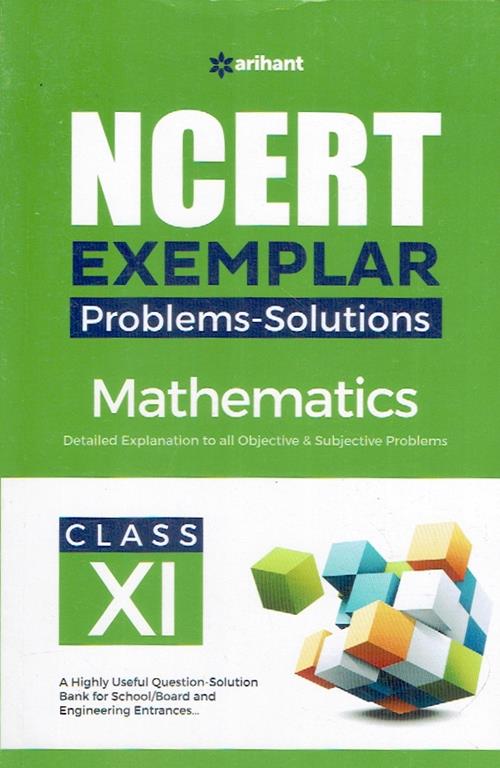
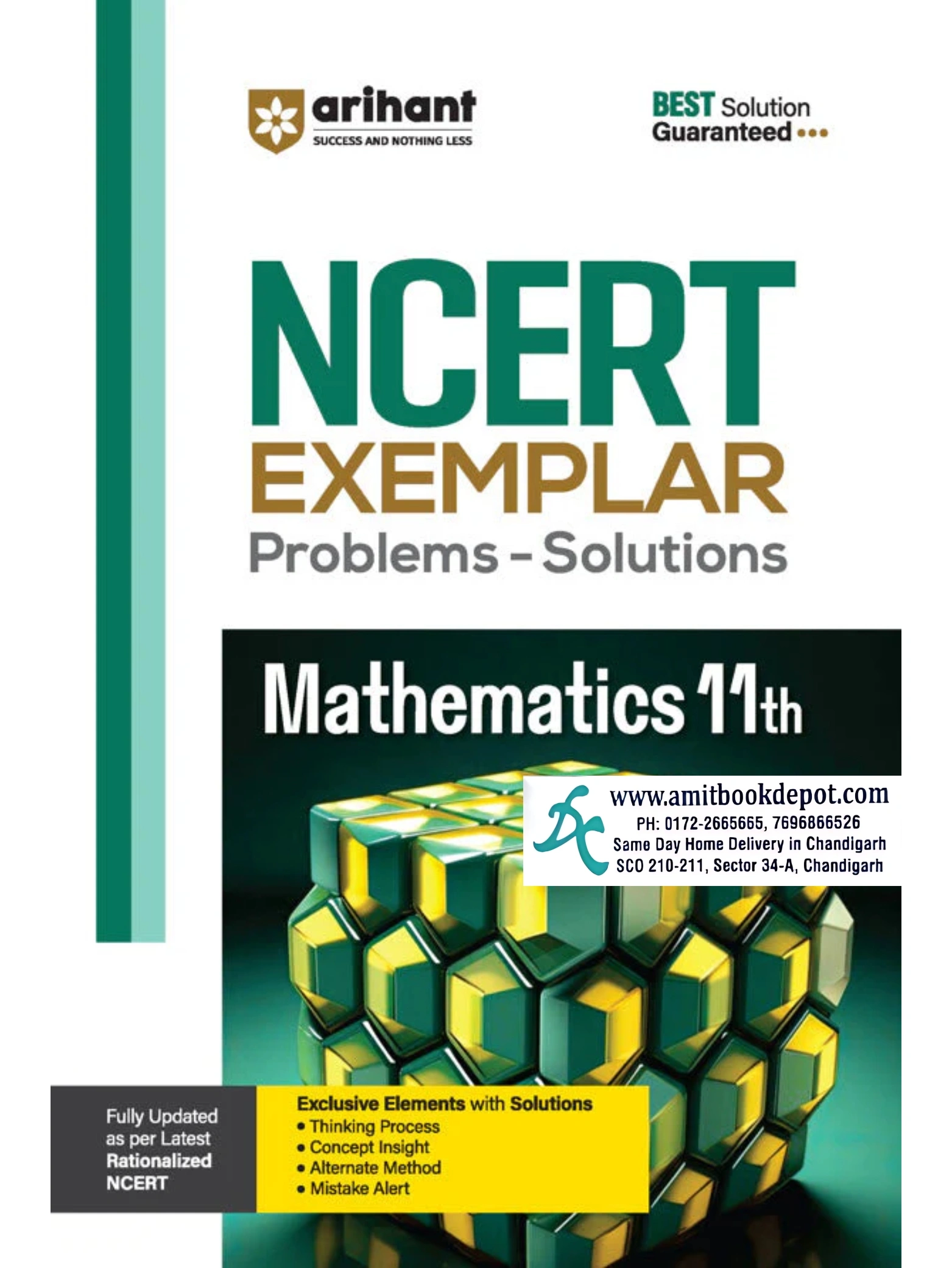
Yes, it provides step-by-step solutions for all problem types—MCQs, VSA, SA, and LA—covering every exercise in the official NCERT Exemplar.
Yes. The book covers algebraic properties, polar representation, Argand plane, square roots, and quadratic equation solutions in the complex number system.
Absolutely. It provides detailed graphical methods for solving systems of linear inequalities in two variables with number line representation.
Yes. Includes unit circle definition, sign conventions, graphs of sin/cos/tan, and general solutions for equations like sinθ = sinα.
Yes. It motivates induction using natural numbers and provides proof-based problems with stepwise verification and inductive hypothesis application.
Yes. Limits and derivatives chapter includes derivative definition, slope of tangent, and derivatives of polynomial and trigonometric functions.
Yes. Covers point-slope, slope-intercept, two-point, intercept, normal form, general equation, and distance of a point from a line.
Yes. Includes sections of cones, standard equations, and simple properties of parabolas, ellipses, hyperbolas, plus degenerated cases.
Yes. Based on fundamental counting principle and factorial n, it provides derivation-based solutions for permutations and combinations.
Absolutely. High-order thinking problems and HOTS questions match competitive exam patterns, making it ideal for JEE Main and school exams.
No Description Added
Yes, it provides step-by-step solutions for all problem types—MCQs, VSA, SA, and LA—covering every exercise in the official NCERT Exemplar.
Yes. The book covers algebraic properties, polar representation, Argand plane, square roots, and quadratic equation solutions in the complex number system.
Absolutely. It provides detailed graphical methods for solving systems of linear inequalities in two variables with number line representation.
Yes. Includes unit circle definition, sign conventions, graphs of sin/cos/tan, and general solutions for equations like sinθ = sinα.
Yes. It motivates induction using natural numbers and provides proof-based problems with stepwise verification and inductive hypothesis application.
Yes. Limits and derivatives chapter includes derivative definition, slope of tangent, and derivatives of polynomial and trigonometric functions.
Yes. Covers point-slope, slope-intercept, two-point, intercept, normal form, general equation, and distance of a point from a line.
Yes. Includes sections of cones, standard equations, and simple properties of parabolas, ellipses, hyperbolas, plus degenerated cases.
Yes. Based on fundamental counting principle and factorial n, it provides derivation-based solutions for permutations and combinations.
Absolutely. High-order thinking problems and HOTS questions match competitive exam patterns, making it ideal for JEE Main and school exams.