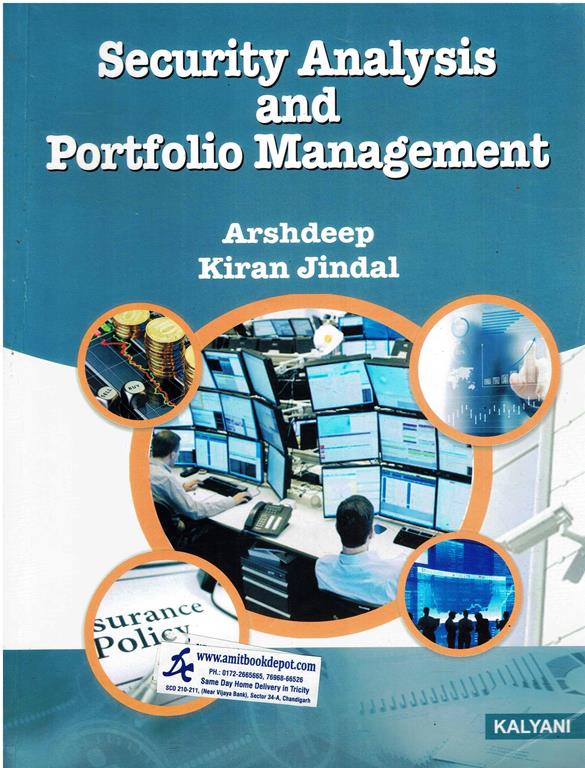
Yes, this book is specifically written and structured to cover the entire prescribed syllabus for paper MC. 414, Security Analysis and Portfolio Management, for Panjab University.
Yes, the book dedicates a section to the analysis of risk in bonds, which includes a detailed explanation of advanced concepts like duration and convexity, making them accessible for MCom-level students.
Absolutely. The book contains dedicated chapters for both the Markowitz Risk-Return Optimization model and Sharpe's Single Index Model, explaining their principles, applications, and differences.
Yes, the Arbitrage Pricing Theory is covered in the unit on Portfolio Theory, Construction & Evaluation, as mandated by the Panjab University syllabus.
While covering universal financial theories, the book includes a specific chapter on Derivatives Trading in India, providing a contextual understanding of the Indian market landscape.
The book has a dedicated chapter on Technical Analysis that covers its core principles, though for an extensive collection of complex chart patterns, students might need to supplement with specialized texts.
The book is written in a clear, academic style tailored for university students. Its structured chapters and inclusion of previous papers make it highly suitable for self-study.
Yes, the syllabus unit on bond portfolio management strategies—passive, semi-active, active, and immunization—is thoroughly covered in the book.
Yes, there is a complete chapter on the Efficient Market Hypothesis that details the Random Walk Theory and the three forms of market efficiency (weak, semi-strong, and strong).
The book explains key portfolio models with their underlying mathematics. However, the number of fully solved numerical examples may be limited, and students are advised to practice using the question papers.
No Description Added
Yes, this book is specifically written and structured to cover the entire prescribed syllabus for paper MC. 414, Security Analysis and Portfolio Management, for Panjab University.
Yes, the book dedicates a section to the analysis of risk in bonds, which includes a detailed explanation of advanced concepts like duration and convexity, making them accessible for MCom-level students.
Absolutely. The book contains dedicated chapters for both the Markowitz Risk-Return Optimization model and Sharpe's Single Index Model, explaining their principles, applications, and differences.
Yes, the Arbitrage Pricing Theory is covered in the unit on Portfolio Theory, Construction & Evaluation, as mandated by the Panjab University syllabus.
While covering universal financial theories, the book includes a specific chapter on Derivatives Trading in India, providing a contextual understanding of the Indian market landscape.
The book has a dedicated chapter on Technical Analysis that covers its core principles, though for an extensive collection of complex chart patterns, students might need to supplement with specialized texts.
The book is written in a clear, academic style tailored for university students. Its structured chapters and inclusion of previous papers make it highly suitable for self-study.
Yes, the syllabus unit on bond portfolio management strategies—passive, semi-active, active, and immunization—is thoroughly covered in the book.
Yes, there is a complete chapter on the Efficient Market Hypothesis that details the Random Walk Theory and the three forms of market efficiency (weak, semi-strong, and strong).
The book explains key portfolio models with their underlying mathematics. However, the number of fully solved numerical examples may be limited, and students are advised to practice using the question papers.