-
Mon-Fri: 10AM to 8PM 01722665665
-
My Account
-
-
0
Total :
₹ 0.00

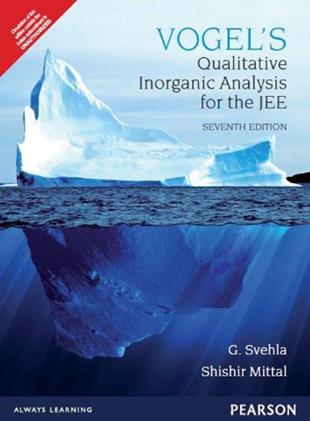
Pearson Vogel's Qualitative Inorganic Analysis for the JEE 7th Edition by G. Svehle and B. Sivasankar (Pearson Education) is a streamlined reference for JEE Main & Advanced aspirants. It covers systematic analysis of acid and basic radicals, the H₂S scheme, zero group cations, and confirmatory tests like chromyl chloride and the ring test. Chapters on experimental techniques, selected separations, and less common ions build practical lab skills and conceptual clarity. Updated for modern JEE patterns, it replaces memorisation with reasoning. Includes appendix of key data. Essential for mastering inorganic salt analysis in both theory and practical exams.
Groups I to VI cations, including zero group (NH₄⁺), with detailed confirmatory tests and interference removal strategies.
It presents the classic H₂S scheme with updated reagent concentrations, pH control via common ion effect, and group separation logic.
Yes, Chapter 6 covers vanadate, molybdate, titanate, and other ions appearing in advanced JEE problems.
With freshly prepared FeSO₄ solution and concentrated H₂SO₄ along test tube wall; brown ring at junction confirms nitrate.
Chromyl chloride test (CrO₂Cl₂) — red vapours that turn yellow in NaOH, then give yellow precipitate with Pb(CH₃COO)₂.
Chapter 5 provides specific separation schemes before proceeding to regular group analysis.
Preparation of original solution, handling of centrifuge, spot tests on filter paper, and semimicro analysis.
By Nessler’s reagent (brown precipitate) or by releasing NH₃ gas using NaOH and testing with moist red litmus.
Yes — blue lake with blue litmus solution, red lake with aluminon reagent, confirming Group III cation.
It focuses on conceptual reasoning behind group separations, not just steps, directly matching JEE Advanced patterns.
Groups I to VI cations, including zero group (NH₄⁺), with detailed confirmatory tests and interference removal strategies.
It presents the classic H₂S scheme with updated reagent concentrations, pH control via common ion effect, and group separation logic.
Yes, Chapter 6 covers vanadate, molybdate, titanate, and other ions appearing in advanced JEE problems.
With freshly prepared FeSO₄ solution and concentrated H₂SO₄ along test tube wall; brown ring at junction confirms nitrate.
Chromyl chloride test (CrO₂Cl₂) — red vapours that turn yellow in NaOH, then give yellow precipitate with Pb(CH₃COO)₂.
Chapter 5 provides specific separation schemes before proceeding to regular group analysis.
Preparation of original solution, handling of centrifuge, spot tests on filter paper, and semimicro analysis.
By Nessler’s reagent (brown precipitate) or by releasing NH₃ gas using NaOH and testing with moist red litmus.
Yes — blue lake with blue litmus solution, red lake with aluminon reagent, confirming Group III cation.
It focuses on conceptual reasoning behind group separations, not just steps, directly matching JEE Advanced patterns.