-
Mon-Fri: 10AM to 8PM 01722665665
-
My Account
-
-
0
Total :
₹ 0.00

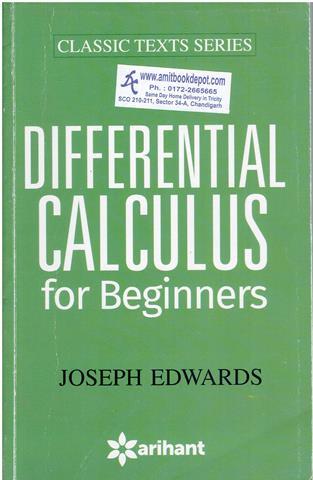
Differential Calculus for Beginners by Joseph Edwards, published by Arihant Prakashan, is a classic, step-by-step guide to mastering core calculus concepts. Starting from limiting value and differentiation from definition, it covers successive differentiation, tangents and normals, asymptotes, curvature, maxima and minima, and undetermined forms. The book includes clear explanations of standard forms, expansions, and even the limitations of Taylor’s theorem. Packed with solved examples and exercises, this text is ideal for high school and early university students seeking a rigors yet beginner-friendly approach to differential calculus.
The book first explains limiting value and tackles elementary undetermined forms, ensuring students understand limits before learning derivative rules.
He introduces differentiation from the definition (first principle), building derivative rules logically rather than presenting them as isolated formulas.
Chapter 5, Successive Differentiation, explains higher-order derivatives, including Leibniz’s theorem, essential for Taylor series and curvature.
Chapter 6, Expansions, covers Maclaurin and Taylor series, deriving standard expansions for trigonometric, logarithmic, and exponential functions.
Chapter 8, Tangents and Normals, teaches how to derive tangent and normal line equations using the first derivative as slope.
Yes, Chapter 9 systematically covers asymptotes for algebraic curves, including methods for finding oblique and vertical asymptotes.
Chapter 11, Envelopes, shows how to eliminate parameters from curves to find boundaries touched by every member of that family.
Yes, Chapter 14 covers undetermined forms systematically using L’Hôpital’s rule, extending the elementary examples from Chapter 1.
Multiple chapters: Tangents (Ch.8), Asymptotes (Ch.9), Curvature (Ch.10), and Maxima-Minima (Ch.13) collectively enable detailed curve sketching.
After Expansions (Ch.6) and Infinitesimals (Ch.7), the book moves to geometric applications: Tangents, Asymptotes, Curvature, and Envelopes.
The book first explains limiting value and tackles elementary undetermined forms, ensuring students understand limits before learning derivative rules.
He introduces differentiation from the definition (first principle), building derivative rules logically rather than presenting them as isolated formulas.
Chapter 5, Successive Differentiation, explains higher-order derivatives, including Leibniz’s theorem, essential for Taylor series and curvature.
Chapter 6, Expansions, covers Maclaurin and Taylor series, deriving standard expansions for trigonometric, logarithmic, and exponential functions.
Chapter 8, Tangents and Normals, teaches how to derive tangent and normal line equations using the first derivative as slope.
Yes, Chapter 9 systematically covers asymptotes for algebraic curves, including methods for finding oblique and vertical asymptotes.
Chapter 11, Envelopes, shows how to eliminate parameters from curves to find boundaries touched by every member of that family.
Yes, Chapter 14 covers undetermined forms systematically using L’Hôpital’s rule, extending the elementary examples from Chapter 1.
Multiple chapters: Tangents (Ch.8), Asymptotes (Ch.9), Curvature (Ch.10), and Maxima-Minima (Ch.13) collectively enable detailed curve sketching.
After Expansions (Ch.6) and Infinitesimals (Ch.7), the book moves to geometric applications: Tangents, Asymptotes, Curvature, and Envelopes.