Yes, it provides a dedicated section on Einstein’s Summation Convention and the Kronecker Delta, forming the basis of tensor algebra.
Yes, the text clearly explains the transformation laws for vectors and distinguishes between contravariant and covariant tensors in detail.
Chapter 4, "Curvature Tensor," is exclusively dedicated to the Riemann-Christoffel Tensor and the Covariant Curvature Tensor.
Absolutely. The Metric Tensor and the Fundamental Contravariant Tensor are covered in-depth in Chapter 2.
Yes, Chapter 3 is fully dedicated to Christoffel Symbols and the covariant differentiation of vectors, tensors, and scalars.
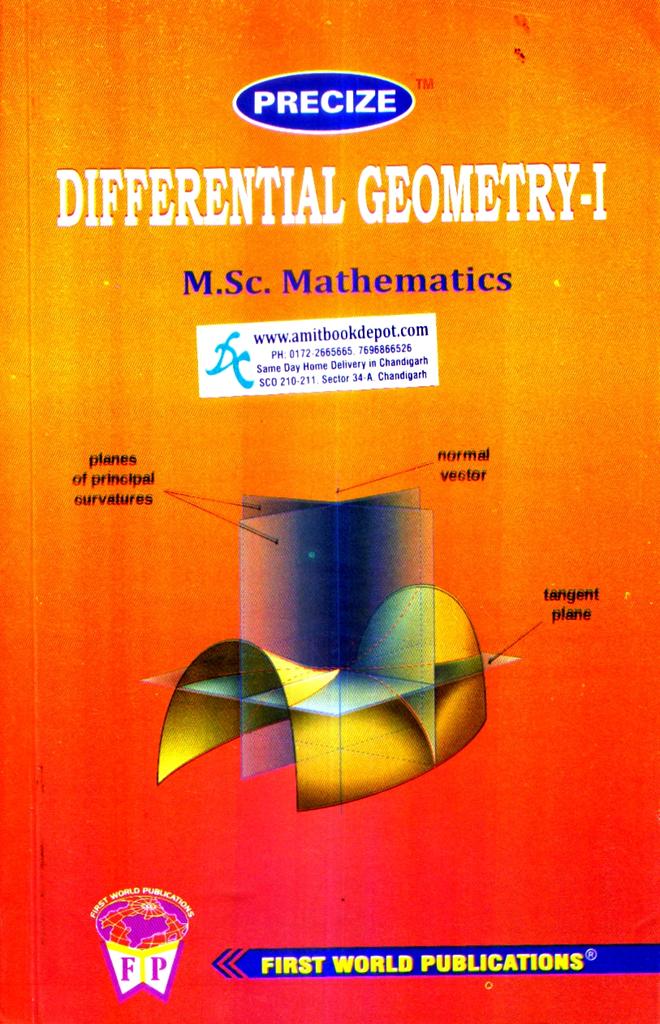
Yes, the book covers involutes and evolutes in detail within the "Space Curves" section as per the syllabus.
Yes, the final chapter is devoted to Envelopes and Developable Surfaces, including the Edge of Regression.
Yes, the "Derived Vector," also known as the Intrinsic Derivative of a vector, is explained in the text.
This topic is covered in Unit-II, within the broader discussion of curves with torsion and their properties.
Yes, the "Order of Contact of a Curve and a Surface" is a key concept explained in the Space Curves section.
No Description Added
Yes, it provides a dedicated section on Einstein’s Summation Convention and the Kronecker Delta, forming the basis of tensor algebra.
Yes, the text clearly explains the transformation laws for vectors and distinguishes between contravariant and covariant tensors in detail.
Chapter 4, "Curvature Tensor," is exclusively dedicated to the Riemann-Christoffel Tensor and the Covariant Curvature Tensor.
Absolutely. The Metric Tensor and the Fundamental Contravariant Tensor are covered in-depth in Chapter 2.
Yes, Chapter 3 is fully dedicated to Christoffel Symbols and the covariant differentiation of vectors, tensors, and scalars.
Yes, the book covers involutes and evolutes in detail within the "Space Curves" section as per the syllabus.
Yes, the final chapter is devoted to Envelopes and Developable Surfaces, including the Edge of Regression.
Yes, the "Derived Vector," also known as the Intrinsic Derivative of a vector, is explained in the text.
This topic is covered in Unit-II, within the broader discussion of curves with torsion and their properties.
Yes, the "Order of Contact of a Curve and a Surface" is a key concept explained in the Space Curves section.