Categories
College Bookssss >
BA PU Chandigarh
BSC PU Chandigarh
MSC PU Chandigarh
BBA PU Chandigarh
MA PU Chandigarh
Medical Books
Engineering Books
Management Books
PGDCA Books
BCOM PU Chandigarh
MCOM PU Chandigarh
BCA PU Chandigarh
MCA PU Chandigarh
animate-books

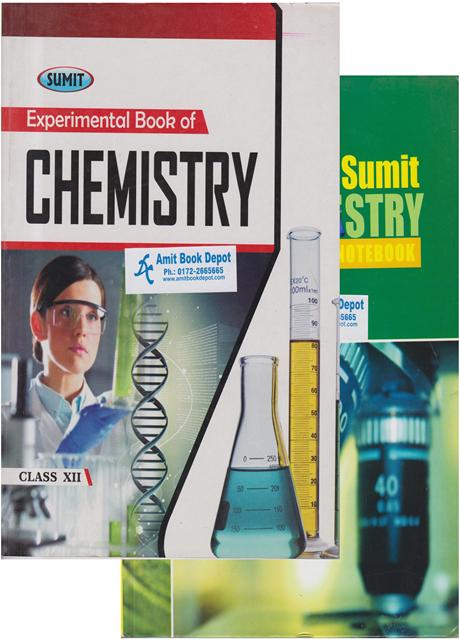
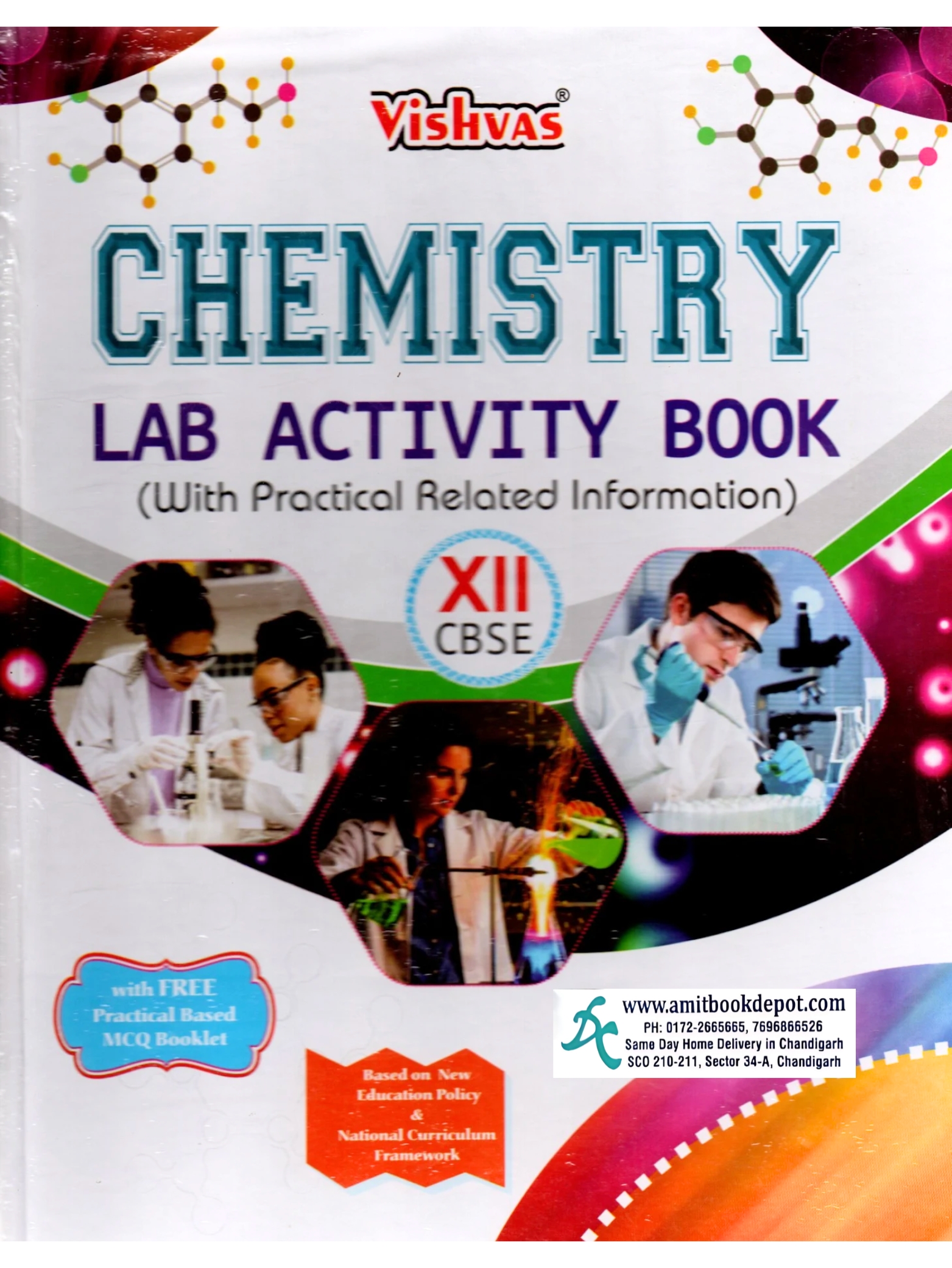
Vishvas Chemistry Lab Activity Book with Practical Related Information for Class 12th

by Madhurima
₹425 ₹425.00(-/ off)

Rating & Reviews

23 Customer Review

The Vishvas Chemistry Lab Activity Book with Practical Related Information for Class 12 by Sukhwinder Kaur and Sangeeta Goyal (Vishvas Publications Pvt. Ltd.) is a complete laboratory manual for CBSE Class 12 students. It covers surface chemistry, chemical kinetics, thermochemistry, electrochemistry, paper chromatography, preparation of inorganic (Mohr’s salt, potash alum) and organic compounds (acetanilide, iodoform), functional group tests, carbohydrate/fat/protein analysis, volumetric titration for molarity and percentage purity, and qualitative salt analysis. The book also includes investigatory projects on food adulterants, oxalate ions in guava, and enzyme activity. Each experiment provides step-by-step procedures, observation tables, and viva questions.

Have Doubts Regarding This Product ? Ask Your Question

  • Q1
    How does this book help in understanding colloidal solutions?
    A1

    It includes seven experiments on preparing sols of starch, egg albumin, gum, ferric hydroxide, and arsenious sulfide, plus dialysis for purification.

  • Q2
    Does it cover chemical kinetics experiments?
    A2

    Yes, it covers effect of concentration and temperature on sodium thiosulphate-HCl reaction, iodide-hydrogen peroxide reaction, and iodine clock reaction.

  • Q3
    Which thermochemistry experiments are included?
    A3

    Determination of enthalpy of dissolution (KNO₃/CuSO₄), heat of neutralization (HCl-NaOH), and enthalpy change for acetone-chloroform interaction.

  • Q4
    Are electrochemistry practicals present?
    A4

    Yes, one detailed experiment on variation of cell potential in Zn/Zn²⁺ || Cu²⁺/Cu cell with changing electrolyte concentrations at room temperature.

  • Q5
    Does it teach chromatography?
    A5

    Yes, three paper chromatography experiments: flower juice components, Cu²⁺/Cd²⁺ mixture separation, and Co²⁺/Ni²⁺ ion separation with Rf calculation.

  • Q6
    Which inorganic compounds are prepared in this book?
    A6

    Mohr’s salt (ferrous ammonium sulfate), potash alum (K₂SO₄·Al₂(SO₄)₃·24H₂O), and potassium ferric oxalate.

  • Q7
    What organic syntheses are covered?
    A7

    Acetanilide, dibenzalacetone, p-nitroacetanilide, aniline yellow, β-naphthol aniline dye, and iodoform (CHI₃).

  • Q8
    Are foodstuff analysis experiments included?
    A8

    Yes, testing carbohydrates, fats, proteins in pure form and in given foodstuffs, plus glucose and starch identification.

  • Q9
    What volumetric titrations are explained?
    A9

    Redox titrations of KMnO₄ against oxalic acid and ferrous ammonium sulfate to determine molarity, strength, and percentage purity.

  • Q10
    Does it cover qualitative salt analysis?
    A10

    Yes, systematic analysis for 13 cations (Pb²⁺, Cu²⁺, Al³⁺, Fe³⁺, etc.) and 11 anions (CO₃²⁻, NO₃⁻, Cl⁻, Br⁻, CH₃COO⁻, etc.).

0.00

0 Overall Rating
  • 5
    0
  • 4
    0
  • 3
    0
  • 2
    0
  • 1
    0

Try this product & share your review & thoughts

SECTION A: SURFACE CHEMISTRY

1. To prepare a sample of colloidal solution of starch (or starch solution.)
2. To prepare a sample of colloidal solution of egg albumin.
3. To prepare a sample of colloidal solution of gum.
4. To prepare a sample of ferric hydroxide sol.
5. To prepare a sample of aluminum hydroxide sol.
6. To prepare a sample of arsenious sulfide sol.
7. To purify a starch solution containing NaCl as an impurity by the process of dialysis through cellophane or parchment paper.
8. To study the role of emulsifying agents in stabilizing the emulsions of different oils.

SECTION B: CHEMICAL KINETICS

1. To study the effect of concentration on the rate of reaction between sodium thiosulphate and hydrochloric acid.
2. To study the effect of temperature on the rate of reaction between sodium thiosulphate and hydrochloric acid.
3. To study the effect of concentration of iodide ions on the rate of reaction between iodide ions and hydrogen peroxide at room temperature using different concentrations of iodide ions.
4. To study the effect of concentration and temperature on the rate of reaction between potassium iodate and sodium sulfite using starch as an indicator (clock reaction).

SECTION - C: THERMOCHEMISTRY

1. To determine the enthalpy of dissolution of potassium nitrate (or copper sulfate) in water.
2. To determine heat of neutralization of hydrochloric acid with sodium hydroxide solution.
3. To determine enthalpy change during interaction (hydrogen bond formation) between acetone and chloroform.

SECTION - D: ELECTROCHEMISTRY

1. To study the variation of cell potential in Zn/Zn²⁺ and Cu²⁺/Cu with change in concentration of electrolytes (CuSO₄ or ZnSO₄) at room temperature.

SECTION E: CHROMATOGRAPHY

1. To separate the colored components in the given flower juice by paper chromatography and determine their Rf values.
2. To separate the constituents of the given inorganic mixture containing Cu²⁺ and Cd²⁺ ions by paper chromatography.
3. To separate Co²⁺ and Ni²⁺ ions in a given mixture by paper chromatography

SECTION - F: PREPARATION OF INORGANIC COMPOUNDS

1. To prepare crystals of ferrous ammonium sulfate (Mohr’s salt)
2. To prepare crystals of potash alum, K₂SO 4. AI2(SO4) 3. 24H₂O.
3. To prepare a sample of potassium ferric oxalate.

SECTION - G: PREPARATION OF ORGANIC COMPOUNDS

SECTION-G: Preparation of Organic Compounds
1. To prepare a sample of acetanilide, C6H5NHCOCH3
2. To prepare a sample of dibenzalacetone, C6H5-CH=CH-CO-CH=CHC6H5.
3. To prepare a sample of p-nitroacetanilide.
4. To prepare a sample of aniline yellow.
5. To prepare a sample of B-Naphthol aniline dye.
6. To prepare a sample of iodoform (CHI)

SECTION-H: Tests for functional groups present in organic compounds

1. To identify the functional group (i.e., unsaturated, alcoholic group, phenolic group, aldehyde group, 61 ketonic group, carboxylic group, amino group) in the given organic compound. Show the confirmatory test to the teacher/examiner and record your observations.

SECTION-1: Study of carbohydrates, fats, and proteins in pure form and detection of their presence in the given foodstuff

1. To study the simple reactions of carbohydrates, fats, and proteins in pure form.
2. You are given two test tubes, one containing protein and the other containing fat. By performing 66 suitable tests, identify the substances.
3. You are provided with two packets, A and B, said to contain starch and protein, respectively. Perform 66 chemical tests to find out which packet contains starch.
4. Identify the presence of glucose in one of two given samples of A and B. Show the test to the teacher 66 and record your observations.
5. To test the presence of carbohydrates, fats, and proteins in the given foodstuffs.

SECTION-J: Determination of concentration/molarity of KMnO₄ solution by titrating it against a standard solution of (i) oxalic acid (ii) ferrous ammonium sulfate

1. (Students will be required to prepare standard solutions themselves by weighing.) Prepare a standard solution of M/50 ferrous ammonium sulfate. Using this solution, find out the 71 molarity of the given solution of KMnO₄..
2. Prepare a standard solution (M/50) of oxalic acid. Using this solution, determine the molarity of the 74 g solution of KMnO₄.
3. Prepare an M/50 KMnO₄ solution. Using this solution, find out the molarity of the given solution of 76% ferrous ammonium sulfate.
4. Prepare M/20 KMnO₄ solution. Using this solution, find the molarity of the given oxalic acid solution. 77
5. Prepare a solution of ferrous sulfate containing 17 g of salt in one liter. Using this solution, determine the concentration of KMnO in grams per liter in the given solution.
6. Prepare M/20 oxalic acid solution. Find out the percentage purity of impure KMnO₄, a sample whose 1 g has been dissolved per liter of the solution.
7. Prepare M/20 KMnO₄ solution. With its help, find out the percentage purity of an impure sample of oxalic acid whose 4 g have been dissolved per liter of the solution.
8. Carrying out volumetric titrations, find out which one of the two solutions of KMnO₄, (A) and that of oxalic acid (B), is more concentrated. Calculate the strength of a more concentrated solution in terms of per liter. Prepare an M/20 oxalic acid solution.
9. A dealer has supplied a hydrated sample of oxalic acid containing 'X' water molecules. Find out volumetrically the percentage of water in the sample of oxalic acid whose 6.3 g has been dissolved per liter of the solution. Use an M/20 solution of KMnO₄ prepared by yourself.
10. You are provided a solution containing 1.6 g of an alkali metal permanganate dissolved per liter of the solution. Determine volumetrically the atomic mass of the alkali metal. Ask for your requirement.

SECTION-K: Qualitative Analysis

1. To determine one cation and one anion from the following:
- Cations: Pb²⁺, Cu²⁺, As³⁺, Al³⁺, Fe³⁺, Mn²⁺, Zn²⁺, Co²⁺, Ni²⁺, Ca²⁺, Sr²⁺, Ba²⁺, Mg²⁺, NH₁⁺
- Anions: CO₂⁻, S, SO, SO, NO, NO, Cl, Br, PO, CO, CH, COO
(Note: Insoluble salts are excluded.)

Investigatory Projects

1 To study the presence of oxalate ions in guava fruit at different stages of ripening.
2. To prepare soyabean milk and compare it with natural milk with respect to curd formation, effect of temperature, etc.
3 Determination of the minimum quantity of manganese dioxide required as a catalyst for the preparation of oxygen gas.
4. To study digestion of starch by salivary amylase and effect of temperature and pH.
5 Study of common food adulterants in fat, oil, butter, sugar, turmeric powder, chili powder, and pepper.

The Vishvas Chemistry Lab Activity Book with Practical Related Information for Class 12th is a meticulously structured laboratory manual designed to bridge theoretical concepts with hands-on experimental skills. Authored by experienced educators Sukhwinder Kaur and Sangeeta Goyal and published by Vishvas Publications Pvt. Ltd., this activity book serves as an indispensable resource for Class 12 science students preparing for their board practical examinations and competitive assessments.

This lab manual comprehensively covers all major sections of the Class 12 Chemistry curriculum. The content is systematically divided into thematic sections—Surface Chemistry, Chemical Kinetics, Thermochemistry, Electrochemistry, Chromatography, Preparation of Inorganic and Organic Compounds, Functional Group Tests, Study of Carbohydrates/Fats/Proteins, Volumetric Analysis (Concentration/Molarity Determination), Qualitative Analysis, and Investigatory Projects.

In Section A: Surface Chemistry, students learn to prepare colloidal solutions of starch, egg albumin, gum, ferric hydroxide, and arsenious sulfide. The manual also guides learners through the process of dialysis for purifying soils and the role of emulsifying agents—key practical related information for understanding real-world emulsions.

Section B: Chemical Kinetics focuses on rate law experiments. Students study the effect of concentration and temperature on reactions such as sodium thiosulphate with hydrochloric acid, iodide ions with hydrogen peroxide, and the iodine clock reaction using potassium iodate and sodium sulfite. These activities reinforce core concepts of reaction rates and activation energy.

The Thermochemistry (Section C) and Electrochemistry (Section D) sections enable precise determination of enthalpy of dissolution, heat of neutralization, hydrogen bond formation between acetone and chloroform, and variation of cell potential in Zn-Cu electrochemical cells with changing electrolyte concentrations.

Section E: Chromatography introduces paper chromatography techniques to separate colored components from flower juice and inorganic mixtures containing Cu²⁺/Cd²⁺ ions and Co²⁺/Ni²⁺ ions, along with the calculation of Rf values—essential for analytical chemistry.

For synthetic chemistry, Sections F and G provide step-by-step procedures for preparing inorganic compounds like Mohr’s salt, potash alum, potassium ferric oxalate, and organic compounds including acetanilide, dibenzalacetone, p-nitroacetanilide, aniline yellow, β-naphthol aniline dye, and iodoform.

Section H offers systematic confirmatory tests for functional groups: unsaturated bonds, alcoholic, phenolic, aldehyde, ketonic, carboxylic, and amino groups. Section I focuses on biochemistry, allowing students to study reactions of carbohydrates, fats, and proteins in pure form and detect their presence in common foodstuffs—integrating chemistry with nutrition science.

Section J: Determination of Concentration/Molarity is a comprehensive volumetric analysis module. Students prepare standard solutions of oxalic acid, ferrous ammonium sulfate, and potassium permanganate (M/20, M/50) to determine molarity, percentage purity of impure samples, hydration number in oxalic acid, and even atomic mass of alkali metal permanganates through redox titrations. This section builds advanced titration skills.

Section K: Qualitative Analysis covers systematic salt analysis for one cation and one anion from a wide range (Pb²⁺, Cu²⁺, Al³⁺, Fe³⁺, Mn²⁺, Zn²⁺, Co²⁺, Ni²⁺, Ca²⁺, Ba²⁺, Mg²⁺, NH₄⁺, and anions like CO₃²⁻, S²⁻, SO₃²⁻, SO₄²⁻, NO₂⁻, NO₃⁻, Cl⁻, Br⁻, PO₄³⁻, and CH₃COO⁻).

The Investigatory Projects section includes practical research topics such as studying oxalate ions in ripening guava, preparing soybean milk versus natural milk, determining the minimum catalyst (MnO₂) for oxygen preparation, digestion of starch by salivary amylase under varying temperature and pH, and detecting common food adulterants in fat, oil, butter, sugar, turmeric, chili, and pepper.

Every activity includes observation tables, calculations, precautions, and viva-voce questions. This chemistry lab activity book is aligned with the latest CBSE syllabus, making it suitable for school laboratories, home tutoring, and competitive exam preparation. The practical, related information provided before each experiment ensures conceptual clarity and error-free execution.

SECTION A: SURFACE CHEMISTRY

1. To prepare a sample of colloidal solution of starch (or starch solution.)
2. To prepare a sample of colloidal solution of egg albumin.
3. To prepare a sample of colloidal solution of gum.
4. To prepare a sample of ferric hydroxide sol.
5. To prepare a sample of aluminum hydroxide sol.
6. To prepare a sample of arsenious sulfide sol.
7. To purify a starch solution containing NaCl as an impurity by the process of dialysis through cellophane or parchment paper.
8. To study the role of emulsifying agents in stabilizing the emulsions of different oils.

SECTION B: CHEMICAL KINETICS

1. To study the effect of concentration on the rate of reaction between sodium thiosulphate and hydrochloric acid.
2. To study the effect of temperature on the rate of reaction between sodium thiosulphate and hydrochloric acid.
3. To study the effect of concentration of iodide ions on the rate of reaction between iodide ions and hydrogen peroxide at room temperature using different concentrations of iodide ions.
4. To study the effect of concentration and temperature on the rate of reaction between potassium iodate and sodium sulfite using starch as an indicator (clock reaction).

SECTION - C: THERMOCHEMISTRY

1. To determine the enthalpy of dissolution of potassium nitrate (or copper sulfate) in water.
2. To determine heat of neutralization of hydrochloric acid with sodium hydroxide solution.
3. To determine enthalpy change during interaction (hydrogen bond formation) between acetone and chloroform.

SECTION - D: ELECTROCHEMISTRY

1. To study the variation of cell potential in Zn/Zn²⁺ and Cu²⁺/Cu with change in concentration of electrolytes (CuSO₄ or ZnSO₄) at room temperature.

SECTION E: CHROMATOGRAPHY

1. To separate the colored components in the given flower juice by paper chromatography and determine their Rf values.
2. To separate the constituents of the given inorganic mixture containing Cu²⁺ and Cd²⁺ ions by paper chromatography.
3. To separate Co²⁺ and Ni²⁺ ions in a given mixture by paper chromatography

SECTION - F: PREPARATION OF INORGANIC COMPOUNDS

1. To prepare crystals of ferrous ammonium sulfate (Mohr’s salt)
2. To prepare crystals of potash alum, K₂SO 4. AI2(SO4) 3. 24H₂O.
3. To prepare a sample of potassium ferric oxalate.

SECTION - G: PREPARATION OF ORGANIC COMPOUNDS

SECTION-G: Preparation of Organic Compounds
1. To prepare a sample of acetanilide, C6H5NHCOCH3
2. To prepare a sample of dibenzalacetone, C6H5-CH=CH-CO-CH=CHC6H5.
3. To prepare a sample of p-nitroacetanilide.
4. To prepare a sample of aniline yellow.
5. To prepare a sample of B-Naphthol aniline dye.
6. To prepare a sample of iodoform (CHI)

SECTION-H: Tests for functional groups present in organic compounds

1. To identify the functional group (i.e., unsaturated, alcoholic group, phenolic group, aldehyde group, 61 ketonic group, carboxylic group, amino group) in the given organic compound. Show the confirmatory test to the teacher/examiner and record your observations.

SECTION-1: Study of carbohydrates, fats, and proteins in pure form and detection of their presence in the given foodstuff

1. To study the simple reactions of carbohydrates, fats, and proteins in pure form.
2. You are given two test tubes, one containing protein and the other containing fat. By performing 66 suitable tests, identify the substances.
3. You are provided with two packets, A and B, said to contain starch and protein, respectively. Perform 66 chemical tests to find out which packet contains starch.
4. Identify the presence of glucose in one of two given samples of A and B. Show the test to the teacher 66 and record your observations.
5. To test the presence of carbohydrates, fats, and proteins in the given foodstuffs.

SECTION-J: Determination of concentration/molarity of KMnO₄ solution by titrating it against a standard solution of (i) oxalic acid (ii) ferrous ammonium sulfate

1. (Students will be required to prepare standard solutions themselves by weighing.) Prepare a standard solution of M/50 ferrous ammonium sulfate. Using this solution, find out the 71 molarity of the given solution of KMnO₄..
2. Prepare a standard solution (M/50) of oxalic acid. Using this solution, determine the molarity of the 74 g solution of KMnO₄.
3. Prepare an M/50 KMnO₄ solution. Using this solution, find out the molarity of the given solution of 76% ferrous ammonium sulfate.
4. Prepare M/20 KMnO₄ solution. Using this solution, find the molarity of the given oxalic acid solution. 77
5. Prepare a solution of ferrous sulfate containing 17 g of salt in one liter. Using this solution, determine the concentration of KMnO in grams per liter in the given solution.
6. Prepare M/20 oxalic acid solution. Find out the percentage purity of impure KMnO₄, a sample whose 1 g has been dissolved per liter of the solution.
7. Prepare M/20 KMnO₄ solution. With its help, find out the percentage purity of an impure sample of oxalic acid whose 4 g have been dissolved per liter of the solution.
8. Carrying out volumetric titrations, find out which one of the two solutions of KMnO₄, (A) and that of oxalic acid (B), is more concentrated. Calculate the strength of a more concentrated solution in terms of per liter. Prepare an M/20 oxalic acid solution.
9. A dealer has supplied a hydrated sample of oxalic acid containing 'X' water molecules. Find out volumetrically the percentage of water in the sample of oxalic acid whose 6.3 g has been dissolved per liter of the solution. Use an M/20 solution of KMnO₄ prepared by yourself.
10. You are provided a solution containing 1.6 g of an alkali metal permanganate dissolved per liter of the solution. Determine volumetrically the atomic mass of the alkali metal. Ask for your requirement.

SECTION-K: Qualitative Analysis

1. To determine one cation and one anion from the following:
- Cations: Pb²⁺, Cu²⁺, As³⁺, Al³⁺, Fe³⁺, Mn²⁺, Zn²⁺, Co²⁺, Ni²⁺, Ca²⁺, Sr²⁺, Ba²⁺, Mg²⁺, NH₁⁺
- Anions: CO₂⁻, S, SO, SO, NO, NO, Cl, Br, PO, CO, CH, COO
(Note: Insoluble salts are excluded.)

Investigatory Projects

1 To study the presence of oxalate ions in guava fruit at different stages of ripening.
2. To prepare soyabean milk and compare it with natural milk with respect to curd formation, effect of temperature, etc.
3 Determination of the minimum quantity of manganese dioxide required as a catalyst for the preparation of oxygen gas.
4. To study digestion of starch by salivary amylase and effect of temperature and pH.
5 Study of common food adulterants in fat, oil, butter, sugar, turmeric powder, chili powder, and pepper.
Have Doubts Regarding This Product ? Ask Your Question

  • Q1
    How does this book help in understanding colloidal solutions?
    A1

    It includes seven experiments on preparing sols of starch, egg albumin, gum, ferric hydroxide, and arsenious sulfide, plus dialysis for purification.

  • Q2
    Does it cover chemical kinetics experiments?
    A2

    Yes, it covers effect of concentration and temperature on sodium thiosulphate-HCl reaction, iodide-hydrogen peroxide reaction, and iodine clock reaction.

  • Q3
    Which thermochemistry experiments are included?
    A3

    Determination of enthalpy of dissolution (KNO₃/CuSO₄), heat of neutralization (HCl-NaOH), and enthalpy change for acetone-chloroform interaction.

  • Q4
    Are electrochemistry practicals present?
    A4

    Yes, one detailed experiment on variation of cell potential in Zn/Zn²⁺ || Cu²⁺/Cu cell with changing electrolyte concentrations at room temperature.

  • Q5
    Does it teach chromatography?
    A5

    Yes, three paper chromatography experiments: flower juice components, Cu²⁺/Cd²⁺ mixture separation, and Co²⁺/Ni²⁺ ion separation with Rf calculation.

  • Q6
    Which inorganic compounds are prepared in this book?
    A6

    Mohr’s salt (ferrous ammonium sulfate), potash alum (K₂SO₄·Al₂(SO₄)₃·24H₂O), and potassium ferric oxalate.

  • Q7
    What organic syntheses are covered?
    A7

    Acetanilide, dibenzalacetone, p-nitroacetanilide, aniline yellow, β-naphthol aniline dye, and iodoform (CHI₃).

  • Q8
    Are foodstuff analysis experiments included?
    A8

    Yes, testing carbohydrates, fats, proteins in pure form and in given foodstuffs, plus glucose and starch identification.

  • Q9
    What volumetric titrations are explained?
    A9

    Redox titrations of KMnO₄ against oxalic acid and ferrous ammonium sulfate to determine molarity, strength, and percentage purity.

  • Q10
    Does it cover qualitative salt analysis?
    A10

    Yes, systematic analysis for 13 cations (Pb²⁺, Cu²⁺, Al³⁺, Fe³⁺, etc.) and 11 anions (CO₃²⁻, NO₃⁻, Cl⁻, Br⁻, CH₃COO⁻, etc.).
No Syllabus Added

0.00

0 Overall Rating
  • 5
    0
  • 4
    0
  • 3
    0
  • 2
    0
  • 1
    0

Try this product & share your review & thoughts

Top Trending Product

Related Product

Related Product

Related Blog Posts

Latest Blogs

Latest Blogs

blog-img
Classic Literature Reimagined: Discuss modern twists on classic novels.
Lorem ipsum dolor sit amet, consectetur adipiscing elit, sed do eiusmod tempor incididunt ut labore et dolore magna aliqua. Ut enim ad minim veniam, quis nostrud exercitation ullamco Lorem ipsum dolor sit amet, consectetur adipiscing elit, sed do eiusmod tempor incididunt ut labore et dolore magna aliqua. Utenim ad minim veniam, quis nostrud exercitation ullamco Lorem ipsum dolor sit amet, consecte...
Read more
Author name | 10 jan, 2025
blog-img
Classic Literature Reimagined: Discuss modern twists on classic novels.
Lorem ipsum dolor sit amet, consectetur adipiscing elit, sed do eiusmod tempor incididunt ut labore et dolore magna aliqua. Ut enim ad minim veniam, quis nostrud exercitation ullamco Lorem ipsum dolor sit amet, consectetur adipiscing elit, sed do eiusmod tempor incididunt ut labore et dolore magna aliqua. Utenim ad minim veniam, quis nostrud exercitation ullamco Lorem ipsum dolor sit amet, consecte...
Read more
Author name | 10 jan, 2025
blog-img
Classic Literature Reimagined: Discuss modern twists on classic novels.
Lorem ipsum dolor sit amet, consectetur adipiscing elit, sed do eiusmod tempor incididunt ut labore et dolore magna aliqua. Ut enim ad minim veniam, quis nostrud exercitation ullamco Lorem ipsum dolor sit amet, consectetur adipiscing elit, sed do eiusmod tempor incididunt ut labore et dolore magna aliqua. Utenim ad minim veniam, quis nostrud exercitation ullamco Lorem ipsum dolor sit amet, consecte...
Read more
Author name | 10 jan, 2025
blog-img
Classic Literature Reimagined: Discuss modern twists on classic novels.
Lorem ipsum dolor sit amet, consectetur adipiscing elit...
Read more
Author Name | 10 Jan, 2025
blog-img
Classic Literature Reimagined: Discuss modern twists on classic novels.
Lorem ipsum dolor sit amet, consectetur adipiscing elit...
Read more
Author Name | 10 Jan, 2025
blog-img
Classic Literature Reimagined: Discuss modern twists on classic novels.
Lorem ipsum dolor sit amet, consectetur adipiscing elit...
Read more
Author Name | 10 Jan, 2025
blog-img
Classic Literature Reimagined: Discuss modern twists on classic novels.
Lorem ipsum dolor sit amet, consectetur adipiscing elit...
Read more
Author Name | 10 Jan, 2025
blog-img
Classic Literature Reimagined: Discuss modern twists on classic novels.
Lorem ipsum dolor sit amet, consectetur adipiscing elit...
Read more
Author Name | 10 Jan, 2025
blog-img
Classic Literature Reimagined: Discuss modern twists on classic novels.
Lorem ipsum dolor sit amet, consectetur adipiscing elit...
Read more
Author Name | 10 Jan, 2025
blog-img
Classic Literature Reimagined: Discuss modern twists on classic novels.
Lorem ipsum dolor sit amet, consectetur adipiscing elit...
Read more
Author Name | 10 Jan, 2025
blog-img
Classic Literature Reimagined: Discuss modern twists on classic novels.
Lorem ipsum dolor sit amet, consectetur adipiscing elit...
Read more
Author Name | 10 Jan, 2025
blog-img
Classic Literature Reimagined: Discuss modern twists on classic novels.
Lorem ipsum dolor sit amet, consectetur adipiscing elit...
Read more
Author Name | 10 Jan, 2025