Categories
College Bookssss >
BA PU Chandigarh
BSC PU Chandigarh
MSC PU Chandigarh
BBA PU Chandigarh
MA PU Chandigarh
Medical Books
Engineering Books
Management Books
PGDCA Books
BCOM PU Chandigarh
MCOM PU Chandigarh
BCA PU Chandigarh
MCA PU Chandigarh
animate-books

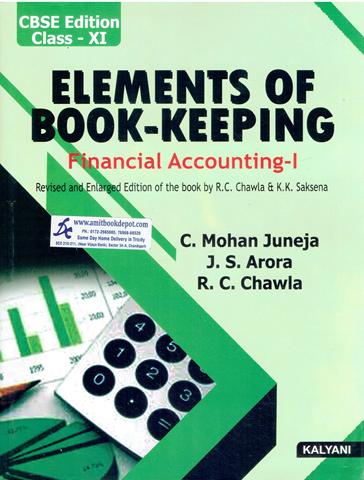
Elements of Book Keeping Financial Accounting for Class 11th (CBSE Edition) (NEW)

by Madhurima
₹625 ₹650.00(-/ off)

Rating & Reviews

23 Customer Review

Master the fundamentals of commerce with Elements of Bookkeeping & Financial Accounting for Class 11th (CBSE Edition) by Meenakshi Bhardwaj, published by Kalyani Publishers. This book is a 100% up-to-date guide, strictly following the latest CBSE Class 11 Accountancy syllabus. It covers all key topics from journals, ledgers, and subsidiary books to financial statements and GST. With a focus on the rectification of errors, depreciation, and the bank reconciliation statement (BRS), it simplifies complex concepts through numerous illustrations. The book also includes solved D.A.V. Board Papers (2023-2025) and a dedicated section for Project Work to ensure complete exam readiness. Build your concepts and secure top marks with this authoritative and student-friendly book.

Have Doubts Regarding This Product ? Ask Your Question

  • Q1
    What is the meaning of "Goods" in accounting terms as per the Class 11 syllabus?
    A1

    In accounting, "Goods" refers to the products or commodities purchased by a business for the purpose of reselling them to its customers. It is a stock-in-trade item.

  • Q2
    What is the Accounting Equation and how is it significant?
    A2

    The Accounting Equation is Assets = Liabilities + Capital. It signifies that all assets of a business are claimed by either its owners (capital) or external parties (liabilities), forming the foundation of the double-entry bookkeeping system.

  • Q3
    Why is a Journal called the "Book of Original Entry" or "Primary Book"?
    A3

    A Journal is called the Book of Original Entry because it is the first place where every financial transaction is formally recorded in chronological order, based on source documents, before being posted to the respective ledgers.

  • Q4
    What is the main purpose of preparing a Bank Reconciliation Statement (BRS)?
    A4

    The main purpose of a Bank Reconciliation Statement is to identify the causes of disagreement between the bank balance as per the Cash Book and the balance as per the Pass Book and to confirm the accuracy of both records.

  • Q5
    How does the Goods and Services Tax (GST) affect the recording of a purchase transaction?
    A5

    Under GST, when recording a purchase, the input GST paid is not treated as an expense but is recorded separately in a GST account (e.g., Input CGST and Input SGST), which can be set off against output GST on sales.

  • Q6
    What is a "Trial Balance" and what does its agreement indicate?
    A6

    A Trial Balance is a statement containing the balances of all ledger accounts to verify the arithmetical accuracy of the books. Its agreement provides a check that total debits equal total credits.

  • Q7
    When is a "Journal Proper" used in modern accounting?
    A7

    A Journal Proper is used for recording transactions that cannot be entered in any other special-purpose book, such as opening entries, closing entries, rectification entries, and credit purchase or sale of fixed assets.

  • Q8
    What is the formula for calculating the amount of depreciation under the Straight Line Method (SLM)?
    A8

    Under the Straight Line Method, the annual depreciation is calculated using the formula: (Original Cost of Asset - Estimated Scrap Value) / Estimated Useful Life of the Asset in Years.

  • Q9
    In the context of Financial Statements, what are "Outstanding Expenses"?
    A9

    Outstanding expenses are expenses that have been incurred during the current accounting year but have not yet been paid. In final accounts, they are added to the respective expense in the Profit & Loss Account and shown as a liability in the Balance Sheet.

  • Q10
    What is a "Cash Book" and why does it serve as both a journal and a ledger?
    A10

    A Cash Book is a special purpose book that records all cash and bank transactions. It acts as a journal (subsidiary book) when transactions are first recorded and as a ledger because it maintains a separate account for cash and bank balances.

0.00

0 Overall Rating
  • 5
    0
  • 4
    0
  • 3
    0
  • 2
    0
  • 1
    0

Try this product & share your review & thoughts

PART A 
FINANCIAL ACCOUNTING - I

1. Introduction to Accounting
2. Theory Base of Accounting
3. Accounting Equation, Rules of Debit and Credit, and Origin of Transactions
4. Journal
5. Accounting for Goods and Services Tax (GST)
6. Ledger
7. Subsidiary Books - Cash Books
8. Other Subsidiary Books
9. Journal Proper
10. Trial Balance
11. Bank Reconciliation Statement
12. Depreciation
13. Provisions and Reserves
14. Rectification of Errors

PART - B
FINANCIAL ACCOUNTING - II

15. Financial Statements – (Without Adjustments)
16. Financial Statements—(With Adjustments)
17. Accounts for Incomplete Records
Values Involved in Accounting
Value-Based Questions

PART - C
PROJECT WORK

Project Work
D.A.V. Board Paper – 2023, 2024, and 2025
Question Paper

Elements of Bookkeeping & Financial Accounting for Class 11th (CBSE Edition) by Meenakshi Bhardwaj is a meticulously crafted book designed to meet the latest requirements of the Central Board of Secondary Education (CBSE) for the academic session. Published by Kalyani Publishers, this comprehensive guide serves as the perfect foundation for students embarking on their journey in commerce. Aligned strictly with the CBSE Class 11 Accountancy syllabus, this book demystifies the complex world of financial accounting through a structured, student-friendly approach.

The content is thoughtfully divided into three parts to ensure a systematic learning progression. Part A: Financial Accounting—I covers the essential theoretical framework and the complete accounting process. It begins with the fundamentals in Introduction to Accounting and the Theory Base of Accounting, including GAAP and basic concepts. Students are then guided through the practical aspects of the accounting cycle, starting with the accounting equation and the rules of debit and credit. The book provides extensive practice on the journal, ledger, and all subsidiary books, such as cash books, purchase books, and sales books. A dedicated chapter on Accounting for Goods and Services Tax (GST) ensures learners are updated with the modern tax structure. Key topics like the Bank Reconciliation Statement (BRS), Depreciation (including SLM and WDV methods), Provisions and Reserves, and the critical skill of Rectification of Errors are explained with clarity and numerous illustrations.

Part B: Financial Accounting II focuses on the preparation of final accounts. It provides step-by-step guidance on creating financial statements for sole proprietorships, both without adjustments and with adjustments. This section helps students master the trading account, profit & loss account, and balance sheet. It also covers the unique challenges of accounting for incomplete records, ensuring students are prepared for all types of questions. To reinforce conceptual clarity, the book includes a dedicated section on Values Involved in Accounting and a bank of Value-Based Questions, aligning with CBSE's emphasis on holistic education.

Finally, Part C: Project Work provides invaluable support for the practical component, offering guidelines and ideas to help students score full marks in their internal assessment. To aid exam preparation, the book includes solved D.A.V. Board Papers for 2023, 2024, and 2025, giving students insight into the latest exam patterns and question typologies.

Whether you are aiming for a perfect score in your final exams or building a strong foundation for Class 12, CA, or other commerce-related careers, Elements of Bookkeeping & Financial Accounting for Class 11th is an indispensable resource. Its clear explanations, abundance of practical questions, and strict adherence to the CBSE curriculum make it a must-have for every Class 11 commerce student.

PART A 
FINANCIAL ACCOUNTING - I

1. Introduction to Accounting
2. Theory Base of Accounting
3. Accounting Equation, Rules of Debit and Credit, and Origin of Transactions
4. Journal
5. Accounting for Goods and Services Tax (GST)
6. Ledger
7. Subsidiary Books - Cash Books
8. Other Subsidiary Books
9. Journal Proper
10. Trial Balance
11. Bank Reconciliation Statement
12. Depreciation
13. Provisions and Reserves
14. Rectification of Errors

PART - B
FINANCIAL ACCOUNTING - II

15. Financial Statements – (Without Adjustments)
16. Financial Statements—(With Adjustments)
17. Accounts for Incomplete Records
Values Involved in Accounting
Value-Based Questions

PART - C
PROJECT WORK

Project Work
D.A.V. Board Paper – 2023, 2024, and 2025
Question Paper

Have Doubts Regarding This Product ? Ask Your Question

  • Q1
    What is the meaning of "Goods" in accounting terms as per the Class 11 syllabus?
    A1

    In accounting, "Goods" refers to the products or commodities purchased by a business for the purpose of reselling them to its customers. It is a stock-in-trade item.

  • Q2
    What is the Accounting Equation and how is it significant?
    A2

    The Accounting Equation is Assets = Liabilities + Capital. It signifies that all assets of a business are claimed by either its owners (capital) or external parties (liabilities), forming the foundation of the double-entry bookkeeping system.

  • Q3
    Why is a Journal called the "Book of Original Entry" or "Primary Book"?
    A3

    A Journal is called the Book of Original Entry because it is the first place where every financial transaction is formally recorded in chronological order, based on source documents, before being posted to the respective ledgers.

  • Q4
    What is the main purpose of preparing a Bank Reconciliation Statement (BRS)?
    A4

    The main purpose of a Bank Reconciliation Statement is to identify the causes of disagreement between the bank balance as per the Cash Book and the balance as per the Pass Book and to confirm the accuracy of both records.

  • Q5
    How does the Goods and Services Tax (GST) affect the recording of a purchase transaction?
    A5

    Under GST, when recording a purchase, the input GST paid is not treated as an expense but is recorded separately in a GST account (e.g., Input CGST and Input SGST), which can be set off against output GST on sales.

  • Q6
    What is a "Trial Balance" and what does its agreement indicate?
    A6

    A Trial Balance is a statement containing the balances of all ledger accounts to verify the arithmetical accuracy of the books. Its agreement provides a check that total debits equal total credits.

  • Q7
    When is a "Journal Proper" used in modern accounting?
    A7

    A Journal Proper is used for recording transactions that cannot be entered in any other special-purpose book, such as opening entries, closing entries, rectification entries, and credit purchase or sale of fixed assets.

  • Q8
    What is the formula for calculating the amount of depreciation under the Straight Line Method (SLM)?
    A8

    Under the Straight Line Method, the annual depreciation is calculated using the formula: (Original Cost of Asset - Estimated Scrap Value) / Estimated Useful Life of the Asset in Years.

  • Q9
    In the context of Financial Statements, what are "Outstanding Expenses"?
    A9

    Outstanding expenses are expenses that have been incurred during the current accounting year but have not yet been paid. In final accounts, they are added to the respective expense in the Profit & Loss Account and shown as a liability in the Balance Sheet.

  • Q10
    What is a "Cash Book" and why does it serve as both a journal and a ledger?
    A10

    A Cash Book is a special purpose book that records all cash and bank transactions. It acts as a journal (subsidiary book) when transactions are first recorded and as a ledger because it maintains a separate account for cash and bank balances.


0.00

0 Overall Rating
  • 5
    0
  • 4
    0
  • 3
    0
  • 2
    0
  • 1
    0

Try this product & share your review & thoughts

Top Trending Product

Related Product

Related Product

Related Blog Posts

Latest Blogs

Latest Blogs

blog-img
Classic Literature Reimagined: Discuss modern twists on classic novels.
Lorem ipsum dolor sit amet, consectetur adipiscing elit, sed do eiusmod tempor incididunt ut labore et dolore magna aliqua. Ut enim ad minim veniam, quis nostrud exercitation ullamco Lorem ipsum dolor sit amet, consectetur adipiscing elit, sed do eiusmod tempor incididunt ut labore et dolore magna aliqua. Utenim ad minim veniam, quis nostrud exercitation ullamco Lorem ipsum dolor sit amet, consecte...
Read more
Author name | 10 jan, 2025
blog-img
Classic Literature Reimagined: Discuss modern twists on classic novels.
Lorem ipsum dolor sit amet, consectetur adipiscing elit, sed do eiusmod tempor incididunt ut labore et dolore magna aliqua. Ut enim ad minim veniam, quis nostrud exercitation ullamco Lorem ipsum dolor sit amet, consectetur adipiscing elit, sed do eiusmod tempor incididunt ut labore et dolore magna aliqua. Utenim ad minim veniam, quis nostrud exercitation ullamco Lorem ipsum dolor sit amet, consecte...
Read more
Author name | 10 jan, 2025
blog-img
Classic Literature Reimagined: Discuss modern twists on classic novels.
Lorem ipsum dolor sit amet, consectetur adipiscing elit, sed do eiusmod tempor incididunt ut labore et dolore magna aliqua. Ut enim ad minim veniam, quis nostrud exercitation ullamco Lorem ipsum dolor sit amet, consectetur adipiscing elit, sed do eiusmod tempor incididunt ut labore et dolore magna aliqua. Utenim ad minim veniam, quis nostrud exercitation ullamco Lorem ipsum dolor sit amet, consecte...
Read more
Author name | 10 jan, 2025
blog-img
Classic Literature Reimagined: Discuss modern twists on classic novels.
Lorem ipsum dolor sit amet, consectetur adipiscing elit...
Read more
Author Name | 10 Jan, 2025
blog-img
Classic Literature Reimagined: Discuss modern twists on classic novels.
Lorem ipsum dolor sit amet, consectetur adipiscing elit...
Read more
Author Name | 10 Jan, 2025
blog-img
Classic Literature Reimagined: Discuss modern twists on classic novels.
Lorem ipsum dolor sit amet, consectetur adipiscing elit...
Read more
Author Name | 10 Jan, 2025
blog-img
Classic Literature Reimagined: Discuss modern twists on classic novels.
Lorem ipsum dolor sit amet, consectetur adipiscing elit...
Read more
Author Name | 10 Jan, 2025
blog-img
Classic Literature Reimagined: Discuss modern twists on classic novels.
Lorem ipsum dolor sit amet, consectetur adipiscing elit...
Read more
Author Name | 10 Jan, 2025
blog-img
Classic Literature Reimagined: Discuss modern twists on classic novels.
Lorem ipsum dolor sit amet, consectetur adipiscing elit...
Read more
Author Name | 10 Jan, 2025
blog-img
Classic Literature Reimagined: Discuss modern twists on classic novels.
Lorem ipsum dolor sit amet, consectetur adipiscing elit...
Read more
Author Name | 10 Jan, 2025
blog-img
Classic Literature Reimagined: Discuss modern twists on classic novels.
Lorem ipsum dolor sit amet, consectetur adipiscing elit...
Read more
Author Name | 10 Jan, 2025
blog-img
Classic Literature Reimagined: Discuss modern twists on classic novels.
Lorem ipsum dolor sit amet, consectetur adipiscing elit...
Read more
Author Name | 10 Jan, 2025