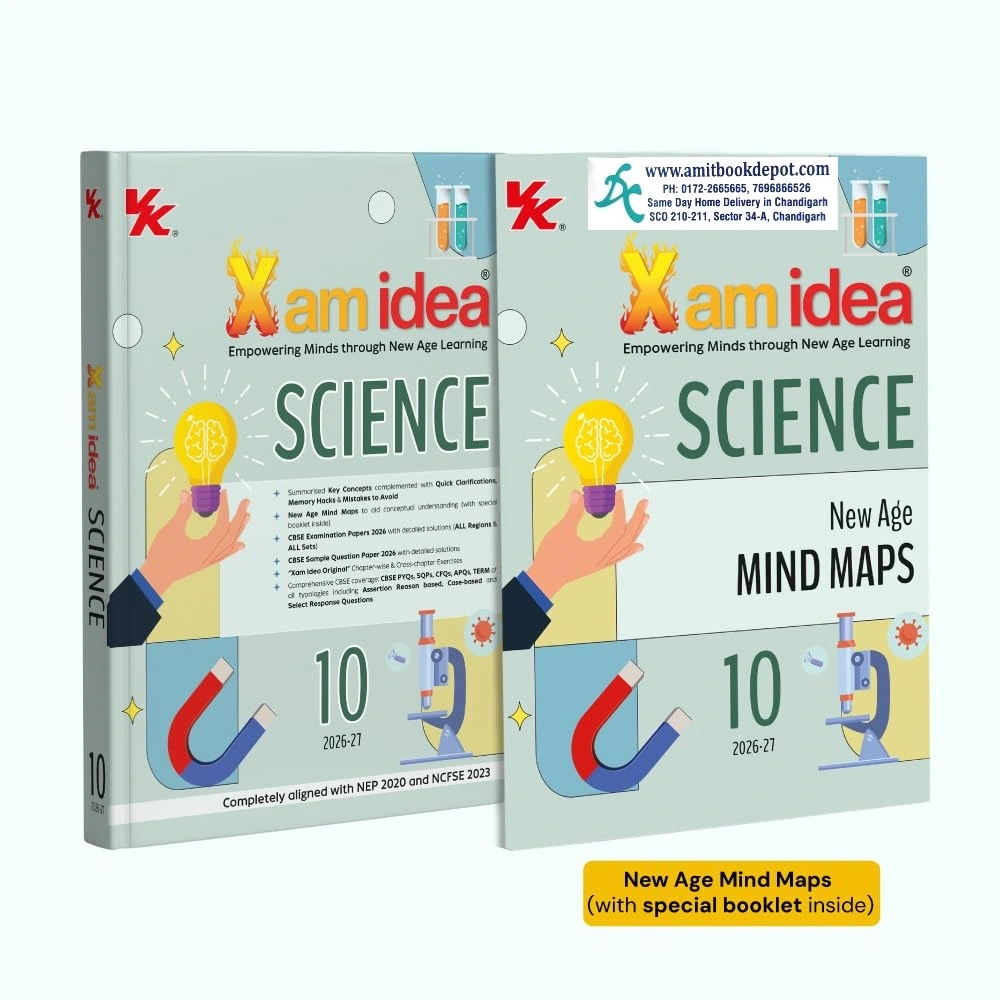
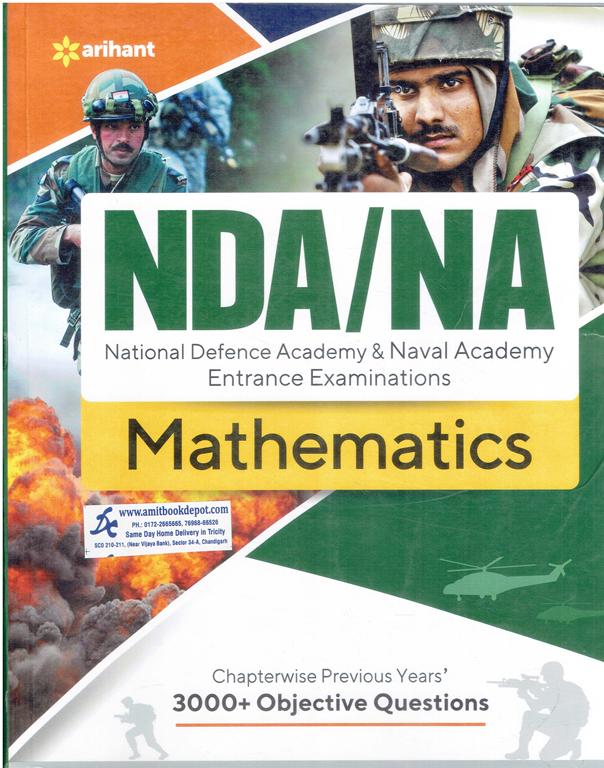
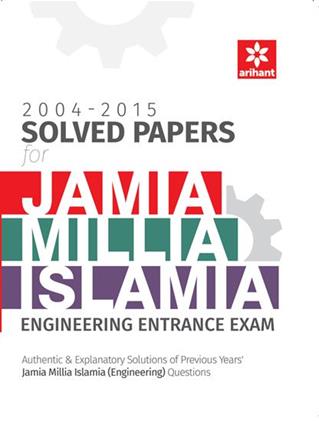
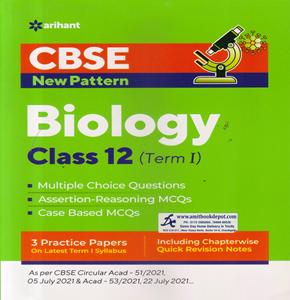
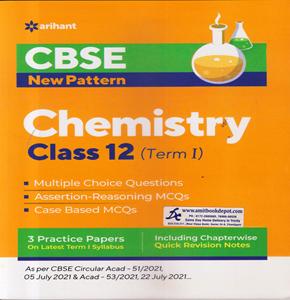
Xamidea Science for Class 10th (2026 Edition) by VK Global Publications Pvt Ltd is a complete exam-ready guide featuring chapter-wise basic concepts, NCERT exercises, and a comprehensive examination corner. Covering Physics, Chemistry, and Biology—from Chemical Reactions to Magnetic Effects and Our Environment—it includes solved CBSE Examination Papers 2026 (all regions), a solved CBSE Sample Paper, practice papers, HOTS questions, case-based MCQs, and new age mind maps. This exam-oriented book ensures rapid revision, step-by-step numerical solutions, and competency-based assessment. Perfect for scoring high in the CBSE Board Exams 2026. Upgrade your preparation with Xamidea’s error-free, syllabus-complete content.
All 13 chapters including Chemical Reactions, Acids-Bases, Metals-Nonmetals, Carbon compounds, Life Processes, Control Coordination, Heredity, Light, Human Eye, Electricity, Magnetic Effects, and Environment.
Yes. It contains CBSE Examination Papers 2026 (Region 1 Solved) plus DLRs to solved papers from all regions.
Visual flowcharts that link key concepts across Physics, Chemistry, and Biology for rapid revision before exams.
Yes. Each chapter includes competency-based MCQs, assertion-reason, case study questions, and HOTS problems as per latest CBSE pattern.
Part B includes multiple practice papers along with solved CBSE Sample Paper 2026 for self-assessment.
Yes. Electricity and Light chapters include complete stepwise solutions to all numerical problems with formulas and units.
Yes. Each chapter has practical-based MCQs and viva-voce type questions aligned with CBSE internal assessment.
Yes. Integrated coverage: Physics (Light, Electricity, Magnetic Effects), Chemistry (Reactions, Acids, Metals, Carbon), Biology (Life, Control, Reproduction, Heredity, Environment).
Yes. Fully updated with rationalized NCERT content and new competency-focused question typologies.
Yes. Labeled diagrams for Life Processes, Reproduction, and Human Eye with flowchart explanations.
Theme: Materials
Unit I: Chemical Substances—Nature and Behavior
Chemical Reactions and Equations: Chemical reactions, chemical equations, balanced chemical equations, types of chemical reactions: combination, decomposition, displacement, double displacement, precipitation, endothermic and exothermic reactions, oxidation, and reduction.
Acids, Bases, and Salts: Acids and Bases—definitions in terms of furnishing of H⁺ and OH⁻ ions, identification using indicators, chemical properties, examples and uses, neutralization, concept of pH scale (definition relating to logarithm not required), importance of pH in everyday life; preparation and uses of sodium hydroxide, bleaching powder, baking soda, washing soda, and plaster of Paris.
Metals and Non-metals: Properties of metals and non-metals; reactivity series; formation and properties of ionic compounds; Basic metallurgical processes; Corrosion and its prevention.
Carbon and Its Compounds: Covalent bonds—formation and properties of covalent compounds, Versatile nature of carbon, Hydrocarbons—saturated and unsaturated homologous series. Nomenclature of alkanes, alkenes, alkynes, and carbon compounds containing functional groups (halogens, alcohol, ketones, and aldehydes). Chemical properties of carbon compounds (combustion, oxidation, addition, and substitution reactions). Ethanol and ethanoic acid (only properties and uses), soaps, and detergents.
Theme: The World of the Living
Unit II: World of Living
Life processes: ‘Living Being.’ Basic concepts of nutrition, respiration, transport, and excretion in plants and animals.
Control and coordination in animals and plants: Tropic movements in plants; Introduction of plant hormones; Control and coordination in animals: Nervous system; Voluntary, involuntary, and reflex action; Chemical co-ordination: animal hormones.
Reproduction: Reproduction in animals and plants (asexual and sexual) reproductive health—need and methods of family planning. Safe sex vs HIV/AIDS. Childbearing and women’s health.
Heredity and Evolution: Heredity; Mendel’s contribution - Laws for inheritance of traits: Sex determination; brief introduction.
Theme: Natural Phenomena
Unit III: Natural Phenomena
Reflection of light by curved surfaces; images formed by spherical mirrors, center of curvature, principal axis, principal focus, focal length, mirror formula (derivation not required), magnification.
Refraction: Laws of refraction, refractive index.
Refraction of light by spherical lenses; images formed by spherical lenses; Lens formula (derivation not required); Magnification. Power of a lens.
Functioning of a lens in the human eye, defects of vision and their corrections, and applications of spherical mirrors and lenses.
Refraction of light through a prism, dispersion of light, scattering of light, applications in daily life (excluding color of the sun at sunrise and sunset).
Theme: How Things Work
Unit IV: Effects of Current
Electric current, potential difference, and electric current. Ohm’s law; resistance, resistivity, Factors on which the resistance of a conductor depends. Series combination of resistors, parallel combination of resistors, and their applications in daily life. Heating effect of electric current and its applications in daily life. Electric power, Interrelation between P, V, I, and R.
Magnetic effects of current: magnetic field, field lines, field due to a current-carrying conductor, field due to a current-carrying coil or solenoid, force on a current-carrying conductor, Fleming’s Left Hand Rule, and direct current. Alternating current: frequency of AC. Advantage of AC over DC. Domestic electric circuits.
Theme: Natural Resources
Unit V: Natural Resources
Our environment: Ecosystem, environmental problems, ozone depletion, waste production, and their solutions. Biodegradable and non-biodegradable substances.
Note for the Teachers: The NCERT textbooks present information in boxes across the book. These help students to get conceptual clarity. However, the information in these boxes would not be assessed in the year-end examination.

All 13 chapters including Chemical Reactions, Acids-Bases, Metals-Nonmetals, Carbon compounds, Life Processes, Control Coordination, Heredity, Light, Human Eye, Electricity, Magnetic Effects, and Environment.
Yes. It contains CBSE Examination Papers 2026 (Region 1 Solved) plus DLRs to solved papers from all regions.
Visual flowcharts that link key concepts across Physics, Chemistry, and Biology for rapid revision before exams.
Yes. Each chapter includes competency-based MCQs, assertion-reason, case study questions, and HOTS problems as per latest CBSE pattern.
Part B includes multiple practice papers along with solved CBSE Sample Paper 2026 for self-assessment.
Yes. Electricity and Light chapters include complete stepwise solutions to all numerical problems with formulas and units.
Yes. Each chapter has practical-based MCQs and viva-voce type questions aligned with CBSE internal assessment.
Yes. Integrated coverage: Physics (Light, Electricity, Magnetic Effects), Chemistry (Reactions, Acids, Metals, Carbon), Biology (Life, Control, Reproduction, Heredity, Environment).
Yes. Fully updated with rationalized NCERT content and new competency-focused question typologies.
Yes. Labeled diagrams for Life Processes, Reproduction, and Human Eye with flowchart explanations.
Theme: Materials
Unit I: Chemical Substances—Nature and Behavior
Chemical Reactions and Equations: Chemical reactions, chemical equations, balanced chemical equations, types of chemical reactions: combination, decomposition, displacement, double displacement, precipitation, endothermic and exothermic reactions, oxidation, and reduction.
Acids, Bases, and Salts: Acids and Bases—definitions in terms of furnishing of H⁺ and OH⁻ ions, identification using indicators, chemical properties, examples and uses, neutralization, concept of pH scale (definition relating to logarithm not required), importance of pH in everyday life; preparation and uses of sodium hydroxide, bleaching powder, baking soda, washing soda, and plaster of Paris.
Metals and Non-metals: Properties of metals and non-metals; reactivity series; formation and properties of ionic compounds; Basic metallurgical processes; Corrosion and its prevention.
Carbon and Its Compounds: Covalent bonds—formation and properties of covalent compounds, Versatile nature of carbon, Hydrocarbons—saturated and unsaturated homologous series. Nomenclature of alkanes, alkenes, alkynes, and carbon compounds containing functional groups (halogens, alcohol, ketones, and aldehydes). Chemical properties of carbon compounds (combustion, oxidation, addition, and substitution reactions). Ethanol and ethanoic acid (only properties and uses), soaps, and detergents.
Theme: The World of the Living
Unit II: World of Living
Life processes: ‘Living Being.’ Basic concepts of nutrition, respiration, transport, and excretion in plants and animals.
Control and coordination in animals and plants: Tropic movements in plants; Introduction of plant hormones; Control and coordination in animals: Nervous system; Voluntary, involuntary, and reflex action; Chemical co-ordination: animal hormones.
Reproduction: Reproduction in animals and plants (asexual and sexual) reproductive health—need and methods of family planning. Safe sex vs HIV/AIDS. Childbearing and women’s health.
Heredity and Evolution: Heredity; Mendel’s contribution - Laws for inheritance of traits: Sex determination; brief introduction.
Theme: Natural Phenomena
Unit III: Natural Phenomena
Reflection of light by curved surfaces; images formed by spherical mirrors, center of curvature, principal axis, principal focus, focal length, mirror formula (derivation not required), magnification.
Refraction: Laws of refraction, refractive index.
Refraction of light by spherical lenses; images formed by spherical lenses; Lens formula (derivation not required); Magnification. Power of a lens.
Functioning of a lens in the human eye, defects of vision and their corrections, and applications of spherical mirrors and lenses.
Refraction of light through a prism, dispersion of light, scattering of light, applications in daily life (excluding color of the sun at sunrise and sunset).
Theme: How Things Work
Unit IV: Effects of Current
Electric current, potential difference, and electric current. Ohm’s law; resistance, resistivity, Factors on which the resistance of a conductor depends. Series combination of resistors, parallel combination of resistors, and their applications in daily life. Heating effect of electric current and its applications in daily life. Electric power, Interrelation between P, V, I, and R.
Magnetic effects of current: magnetic field, field lines, field due to a current-carrying conductor, field due to a current-carrying coil or solenoid, force on a current-carrying conductor, Fleming’s Left Hand Rule, and direct current. Alternating current: frequency of AC. Advantage of AC over DC. Domestic electric circuits.
Theme: Natural Resources
Unit V: Natural Resources
Our environment: Ecosystem, environmental problems, ozone depletion, waste production, and their solutions. Biodegradable and non-biodegradable substances.
Note for the Teachers: The NCERT textbooks present information in boxes across the book. These help students to get conceptual clarity. However, the information in these boxes would not be assessed in the year-end examination.