Tax Planning and Management for MCOM 3rd Semester Panjab University Chandigarh
Tax Planning and Management for MCOM 3rd Semester Panjab University Chandigarh
by Madhurima
₹750₹750.00(-/
off)
Rating & Reviews
23 Customer Review
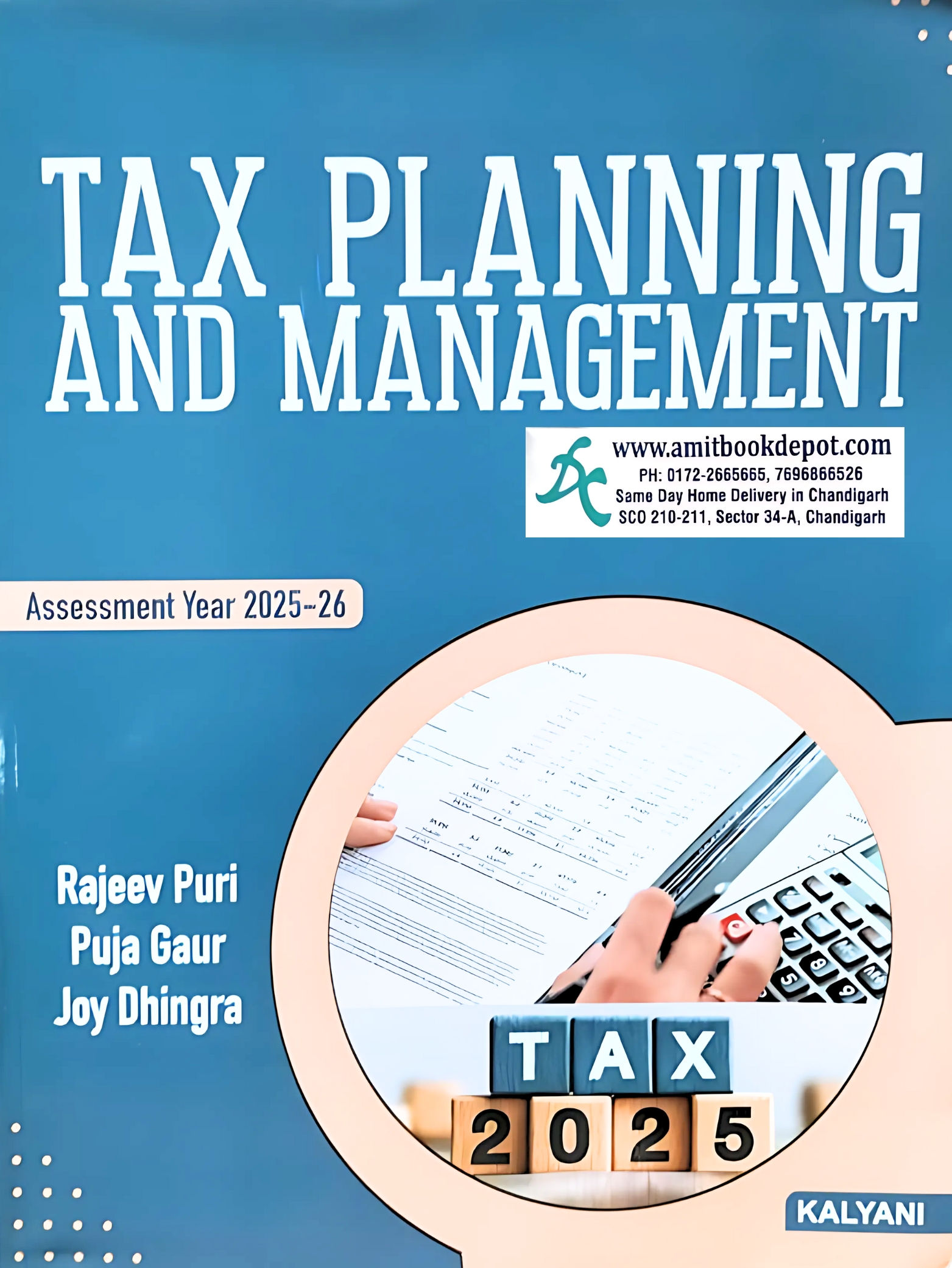
Tax Planning and Management for MCom 3rd Semester (Panjab University, Chandigarh) by Joy Dhingra, Puja Gaur, and Rajeev Puri is a meticulously crafted book from Kalyani Publishers. Fully aligned with the latest syllabus (MC. 302), it provides an in-depth analysis of Indian tax laws, including income tax and GST. The book covers essential concepts like tax planning, tax avoidance, assessment of companies, and strategic managerial decisions. With clear explanations and a structured approach, it is the perfect resource for students to master corporate tax planning, leverage legal benefits, and excel in their academics.
Tax Planning and Management for MCom 3rd Semester (Panjab University, Chandigarh) by Joy Dhingra, Puja Gaur, and Rajeev Puri | Kalyani Publishers
This comprehensive book, "Tax Planning and Management," is meticulously crafted as a definitive academic resource for Master of Commerce (MCom) students in their third semester at Panjab University, Chandigarh. Authored by the esteemed Joy Dhingra, Puja Gaur, and Rajeev Puri, and published by Kalyani Publishers, this book is an indispensable guide that aligns perfectly with the latest prescribed syllabus (MC. 302). It is designed to provide an in-depth understanding of the intricate framework of Indian taxation, with a specialized focus on its application in corporate decision-making.
The primary objective of this book is to equip students with a robust knowledge of the latest provisions of Indian tax laws, including significant judicial pronouncements that impact corporate enterprises. It delves into the strategic aspects of tax planning and management, empowering future commerce professionals to identify and leverage legitimate avenues for maximizing tax benefits within the legal framework. The content is structured to bridge the gap between theoretical concepts and their practical implications in the business world.
The book is systematically divided into four units, each addressing a core component of the syllabus. Unit I lays a solid foundation by exploring the Indian taxation structure, clearly distinguishing between critical concepts like tax planning, tax avoidance, and tax evasion. It provides a thorough grounding in the basic concepts of income tax, including an analysis of exempted incomes and the computation of income from various heads such as house property, business & profession (including depreciation), capital gains, and other sources. This unit is crucial for mastering the fundamentals, with detailed chapters on Set-Off and Carry Forward of Losses and essential Deductions under the Income Tax Act.
Unit II shifts the focus to corporate entities, offering a detailed examination of the assessment of companies. It clarifies the definition and residential status of companies and their profound implications for effective tax planning. This section is vital for understanding how corporate structures are evaluated under the Indian Income Tax Act.
Unit III is the strategic core of the book, dedicated to practical tax planning and managerial decisions. It analyzes the tax implications of choosing different business formations like proprietorships, partnerships, and private/public limited companies. It guides students on tax planning for new business setups, covering location, nature of business, and leveraging tax holiday benefits. Furthermore, it provides a framework for making informed managerial decisions on critical issues such as make or buy, own or lease, repair or replace, export vs. local sale, and shut down or continue.
Unit IV provides a contemporary and comprehensive overview of the Goods and Services Tax (GST) regime in India. It covers the structure, implementation of GST, the registration process, and the mechanisms for levy and collection of CGST, SGST, and IGST. Key operational areas like the Composition Levy Scheme, Input Tax Credit (ITC), and the distinction between Interstate and Intrastate Supplies are explained with clarity, making the complex GST system accessible to students.
Key features of this book include:
1. Strict adherence to the latest MCom 3rd Semester Syllabus for Panjab University, Chandigarh.
2. Clear, lucid language and a structured presentation for easy comprehension.
3. Illustrations and examples to elucidate complex tax provisions.
4. Exam-oriented content that highlights important topics and concepts.
5. Thorough coverage of both direct taxes (income tax) and indirect taxes (GST).
This book is an essential purchase for any MCom student at Panjab University aiming to excel in their Tax Planning and Management paper. It serves not only as an academic book but also as a foundational reference for aspiring chartered accountants, company secretaries, and business professionals who need to navigate the complexities of Indian tax law for strategic corporate planning and compliance.
Is this book strictly based on the latest syllabus for MCom 3rd Semester at Panjab University, Chandigarh?
A1
Yes, this book is meticulously crafted to align 100% with the latest prescribed syllabus for paper MC. 302 (Tax Planning and Management) for MCom 3rd Semester at Panjab University, Chandigarh.
Q2
Does this book cover the Goods and Services Tax (GST) in detail?
A2
Absolutely. Unit IV of the book is entirely dedicated to GST, covering its overview, implementation, registration, levy of CGST/SGST/IGST, the composition scheme, and Input Tax Credit (ITC), as required by the syllabus.
Q3
Are there practical examples included for complex topics like Depreciation or Capital Gains?
A3
Yes, the book includes illustrations and clear explanations to simplify complex topics such as Depreciation, Capital Gains, and the computation of income from various sources, aiding in better understanding.
Q4
How does this book help in understanding the tax implications of different business structures?
A4
Unit III provides a dedicated analysis of the tax implications of setting up business units as Proprietorships, Partnerships, and Private/Public Limited companies, which is crucial for strategic planning.
Q5
Is the concept of "Set-Off and Carry Forward of Losses" for companies explained in this book?
A5
Yes, this is a key topic covered in both Unit I (for general assessees) and Unit II (specifically for companies), explaining the rules and conditions for carrying forward and setting off losses.
Q6
Are managerial decisions like "make or buy" or "own or lease" covered from a tax perspective?
A6
Yes, Unit III has a specific chapter on "Tax Planning and Managerial Decisions" that analyzes the tax implications of such critical business choices.
Q7
Is this book useful for professional courses like CA or CS alongside my MCom studies?
A7
While it is specifically designed for the MCom syllabus, the fundamental concepts of Income Tax and GST covered in the book can serve as a helpful supplementary resource for students pursuing CA or CS.
Q8
Does the book explain the difference between tax planning, tax avoidance, and tax evasion?
A8
Yes, a clear distinction between these three critical concepts is provided in a dedicated chapter in Unit I, which is a fundamental part of the syllabus.
Q9
Is the Composition Levy Scheme under GST explained with its conditions?
A9
Yes, Chapter 21 provides a detailed explanation of the Composition Levy Scheme under GST, including its features and eligibility criteria.
Q10
Is input tax credit (ITC) under GST covered in a separate chapter?
A10
Yes, Chapter 24 is exclusively dedicated to explaining the mechanism, eligibility, and procedures for claiming Input Tax Credit (ITC) under the GST regime.
0.00
0 Overall Rating
5
0
4
0
3
0
2
0
1
0
Try this product & share your review &
thoughts
UNIT - I
1. Indian Taxation Structure
2. Tax Planning, Avoidance, Evasion, and Management
3. Basic Concepts of Income Tax
4. Exempted Incomes
5. Income From House Property
6. Profits and Gains of Business or Profession
7. Profits and Gains—II—Depreciation
8. Capital Gains
9. Income From Other Sources
10. Set-Off and Carry Forward of Losses
11. Deductions to Be Made in Computing Total Income
UNIT - II
12. Assessment of Companies
13. Tax on Shipping Tonnage Income of Companies
UNIT - III
14. Tax Planning Regarding New Business
15. Tax Planning and Managerial Decisions
UNIT - IV
16. Tax Structure in India: An Overview
17. Understanding GST With Illustrations
18. Implementation of GST
19. Registration
20. Levy and Collection of CGST and SGST [Including Reverse Charge]
21. Composition Levy Scheme
22. IGST [Levy and Collection]
23. Supplies in the Course of Interstate and Intrastate Trade
24. Input Tax Credit [ITC]
Latest Syllabus Of Tax Planning and Management for MCom 3rd Semester Panjab University Chandigarh
MC. 302 - Tax Planning and Management
OBJECTIVE
The aim of this course is to familiarize the student with the major latest provisions of the Indian tax laws and related judicial pronouncements pertaining to corporate enterprises having implications for various aspects of corporate planning with a view to derive maximum possible tax benefits admissible under the law.
UNIT - I
Structure of Direct and Indirect Taxes in India. Concepts, Significance, and Problems of Tax Planning, Tax Avoidance, and Tax Evasion - Recognized methods of tax planning: depreciation allowance, expenses of scientific research, amortization of preliminary expenses, and amounts not claimed otherwise. Taking advantage of available reliefs, rebates, and tax-free sources of income.
UNIT - II
Definition of various kinds of companies—meaning of "company" under the IT Act, residential status of companies, and implications for tax planning. Assessment of companies, including carry forward and set off of losses.
UNIT - III
Tax implications in planning of business units as proprietorships, partnerships, Pvt. Ltd., and public Ltd. Tax planning in the context of exemptions, incentives, export promotions, and various deductions under Chapter VI of the Income Tax Act Setting up of a new industrial establishment: Location aspects, nature of business, and planning for tax holiday benefits. Specific management decisions such as (1) make or buy; (2) own or lease; (3) repair or replace; (4) export vs. local sale; (5) shut down or continue; (6) expand or contract.
UNIT - IV
An overview of goods and services tax: Introduction to GST, reasons for introducing GST, and pros and cons of GST. Registration procedure of trader/service provider under GST. Levy and collection of CGST/SGST under GST. Composite levy scheme of GST. Levy and collection of IGST. Input tax credit and relief to consumers and traders under GST. Applicable rates of tax on various goods and services under GST.
Tax Planning and Management for MCom 3rd Semester (Panjab University, Chandigarh) by Joy Dhingra, Puja Gaur, and Rajeev Puri | Kalyani Publishers
This comprehensive book, "Tax Planning and Management," is meticulously crafted as a definitive academic resource for Master of Commerce (MCom) students in their third semester at Panjab University, Chandigarh. Authored by the esteemed Joy Dhingra, Puja Gaur, and Rajeev Puri, and published by Kalyani Publishers, this book is an indispensable guide that aligns perfectly with the latest prescribed syllabus (MC. 302). It is designed to provide an in-depth understanding of the intricate framework of Indian taxation, with a specialized focus on its application in corporate decision-making.
The primary objective of this book is to equip students with a robust knowledge of the latest provisions of Indian tax laws, including significant judicial pronouncements that impact corporate enterprises. It delves into the strategic aspects of tax planning and management, empowering future commerce professionals to identify and leverage legitimate avenues for maximizing tax benefits within the legal framework. The content is structured to bridge the gap between theoretical concepts and their practical implications in the business world.
The book is systematically divided into four units, each addressing a core component of the syllabus. Unit I lays a solid foundation by exploring the Indian taxation structure, clearly distinguishing between critical concepts like tax planning, tax avoidance, and tax evasion. It provides a thorough grounding in the basic concepts of income tax, including an analysis of exempted incomes and the computation of income from various heads such as house property, business & profession (including depreciation), capital gains, and other sources. This unit is crucial for mastering the fundamentals, with detailed chapters on Set-Off and Carry Forward of Losses and essential Deductions under the Income Tax Act.
Unit II shifts the focus to corporate entities, offering a detailed examination of the assessment of companies. It clarifies the definition and residential status of companies and their profound implications for effective tax planning. This section is vital for understanding how corporate structures are evaluated under the Indian Income Tax Act.
Unit III is the strategic core of the book, dedicated to practical tax planning and managerial decisions. It analyzes the tax implications of choosing different business formations like proprietorships, partnerships, and private/public limited companies. It guides students on tax planning for new business setups, covering location, nature of business, and leveraging tax holiday benefits. Furthermore, it provides a framework for making informed managerial decisions on critical issues such as make or buy, own or lease, repair or replace, export vs. local sale, and shut down or continue.
Unit IV provides a contemporary and comprehensive overview of the Goods and Services Tax (GST) regime in India. It covers the structure, implementation of GST, the registration process, and the mechanisms for levy and collection of CGST, SGST, and IGST. Key operational areas like the Composition Levy Scheme, Input Tax Credit (ITC), and the distinction between Interstate and Intrastate Supplies are explained with clarity, making the complex GST system accessible to students.
Key features of this book include:
1. Strict adherence to the latest MCom 3rd Semester Syllabus for Panjab University, Chandigarh.
2. Clear, lucid language and a structured presentation for easy comprehension.
3. Illustrations and examples to elucidate complex tax provisions.
4. Exam-oriented content that highlights important topics and concepts.
5. Thorough coverage of both direct taxes (income tax) and indirect taxes (GST).
This book is an essential purchase for any MCom student at Panjab University aiming to excel in their Tax Planning and Management paper. It serves not only as an academic book but also as a foundational reference for aspiring chartered accountants, company secretaries, and business professionals who need to navigate the complexities of Indian tax law for strategic corporate planning and compliance.
UNIT - I
1. Indian Taxation Structure
2. Tax Planning, Avoidance, Evasion, and Management
3. Basic Concepts of Income Tax
4. Exempted Incomes
5. Income From House Property
6. Profits and Gains of Business or Profession
7. Profits and Gains—II—Depreciation
8. Capital Gains
9. Income From Other Sources
10. Set-Off and Carry Forward of Losses
11. Deductions to Be Made in Computing Total Income
UNIT - II
12. Assessment of Companies
13. Tax on Shipping Tonnage Income of Companies
UNIT - III
14. Tax Planning Regarding New Business
15. Tax Planning and Managerial Decisions
UNIT - IV
16. Tax Structure in India: An Overview
17. Understanding GST With Illustrations
18. Implementation of GST
19. Registration
20. Levy and Collection of CGST and SGST [Including Reverse Charge]
21. Composition Levy Scheme
22. IGST [Levy and Collection]
23. Supplies in the Course of Interstate and Intrastate Trade
Is this book strictly based on the latest syllabus for MCom 3rd Semester at Panjab University, Chandigarh?
A1
Yes, this book is meticulously crafted to align 100% with the latest prescribed syllabus for paper MC. 302 (Tax Planning and Management) for MCom 3rd Semester at Panjab University, Chandigarh.
Q2
Does this book cover the Goods and Services Tax (GST) in detail?
A2
Absolutely. Unit IV of the book is entirely dedicated to GST, covering its overview, implementation, registration, levy of CGST/SGST/IGST, the composition scheme, and Input Tax Credit (ITC), as required by the syllabus.
Q3
Are there practical examples included for complex topics like Depreciation or Capital Gains?
A3
Yes, the book includes illustrations and clear explanations to simplify complex topics such as Depreciation, Capital Gains, and the computation of income from various sources, aiding in better understanding.
Q4
How does this book help in understanding the tax implications of different business structures?
A4
Unit III provides a dedicated analysis of the tax implications of setting up business units as Proprietorships, Partnerships, and Private/Public Limited companies, which is crucial for strategic planning.
Q5
Is the concept of "Set-Off and Carry Forward of Losses" for companies explained in this book?
A5
Yes, this is a key topic covered in both Unit I (for general assessees) and Unit II (specifically for companies), explaining the rules and conditions for carrying forward and setting off losses.
Q6
Are managerial decisions like "make or buy" or "own or lease" covered from a tax perspective?
A6
Yes, Unit III has a specific chapter on "Tax Planning and Managerial Decisions" that analyzes the tax implications of such critical business choices.
Q7
Is this book useful for professional courses like CA or CS alongside my MCom studies?
A7
While it is specifically designed for the MCom syllabus, the fundamental concepts of Income Tax and GST covered in the book can serve as a helpful supplementary resource for students pursuing CA or CS.
Q8
Does the book explain the difference between tax planning, tax avoidance, and tax evasion?
A8
Yes, a clear distinction between these three critical concepts is provided in a dedicated chapter in Unit I, which is a fundamental part of the syllabus.
Q9
Is the Composition Levy Scheme under GST explained with its conditions?
A9
Yes, Chapter 21 provides a detailed explanation of the Composition Levy Scheme under GST, including its features and eligibility criteria.
Q10
Is input tax credit (ITC) under GST covered in a separate chapter?
A10
Yes, Chapter 24 is exclusively dedicated to explaining the mechanism, eligibility, and procedures for claiming Input Tax Credit (ITC) under the GST regime.
Latest Syllabus Of Tax Planning and Management for MCom 3rd Semester Panjab University Chandigarh
MC. 302 - Tax Planning and Management
OBJECTIVE
The aim of this course is to familiarize the student with the major latest provisions of the Indian tax laws and related judicial pronouncements pertaining to corporate enterprises having implications for various aspects of corporate planning with a view to derive maximum possible tax benefits admissible under the law.
UNIT - I
Structure of Direct and Indirect Taxes in India. Concepts, Significance, and Problems of Tax Planning, Tax Avoidance, and Tax Evasion - Recognized methods of tax planning: depreciation allowance, expenses of scientific research, amortization of preliminary expenses, and amounts not claimed otherwise. Taking advantage of available reliefs, rebates, and tax-free sources of income.
UNIT - II
Definition of various kinds of companies—meaning of "company" under the IT Act, residential status of companies, and implications for tax planning. Assessment of companies, including carry forward and set off of losses.
UNIT - III
Tax implications in planning of business units as proprietorships, partnerships, Pvt. Ltd., and public Ltd. Tax planning in the context of exemptions, incentives, export promotions, and various deductions under Chapter VI of the Income Tax Act Setting up of a new industrial establishment: Location aspects, nature of business, and planning for tax holiday benefits. Specific management decisions such as (1) make or buy; (2) own or lease; (3) repair or replace; (4) export vs. local sale; (5) shut down or continue; (6) expand or contract.
UNIT - IV
An overview of goods and services tax: Introduction to GST, reasons for introducing GST, and pros and cons of GST. Registration procedure of trader/service provider under GST. Levy and collection of CGST/SGST under GST. Composite levy scheme of GST. Levy and collection of IGST. Input tax credit and relief to consumers and traders under GST. Applicable rates of tax on various goods and services under GST.
0.00
0 Overall Rating
5
0
4
0
3
0
2
0
1
0
Try this product & share your review &
thoughts
Top Trending Product
Related
Product
Related Product
Related Blog Posts
Latest Blogs
Latest Blogs
Classic Literature Reimagined: Discuss modern twists on classic novels.
Lorem ipsum dolor sit amet, consectetur adipiscing elit, sed
do
eiusmod tempor incididunt ut labore et dolore magna aliqua. Ut enim ad minim
veniam, quis nostrud exercitation ullamco Lorem ipsum dolor sit amet,
consectetur adipiscing elit, sed do eiusmod tempor incididunt ut labore et
dolore magna aliqua. Utenim ad minim veniam, quis nostrud exercitation
ullamco
Lorem ipsum dolor sit amet, consecte...
Classic Literature Reimagined: Discuss modern twists on classic novels.
Lorem ipsum dolor sit amet, consectetur adipiscing elit, sed
do
eiusmod tempor incididunt ut labore et dolore magna aliqua. Ut enim ad minim
veniam, quis nostrud exercitation ullamco Lorem ipsum dolor sit amet,
consectetur adipiscing elit, sed do eiusmod tempor incididunt ut labore et
dolore magna aliqua. Utenim ad minim veniam, quis nostrud exercitation
ullamco
Lorem ipsum dolor sit amet, consecte...
Classic Literature Reimagined: Discuss modern twists on classic novels.
Lorem ipsum dolor sit amet, consectetur adipiscing elit, sed
do
eiusmod tempor incididunt ut labore et dolore magna aliqua. Ut enim ad minim
veniam, quis nostrud exercitation ullamco Lorem ipsum dolor sit amet,
consectetur adipiscing elit, sed do eiusmod tempor incididunt ut labore et
dolore magna aliqua. Utenim ad minim veniam, quis nostrud exercitation
ullamco
Lorem ipsum dolor sit amet, consecte...