Categories
College Bookssss >
BA PU Chandigarh
BSC PU Chandigarh
MSC PU Chandigarh
BBA PU Chandigarh
MA PU Chandigarh
Medical Books
Engineering Books
Management Books
PGDCA Books
BCOM PU Chandigarh
MCOM PU Chandigarh
BCA PU Chandigarh
MCA PU Chandigarh
animate-books

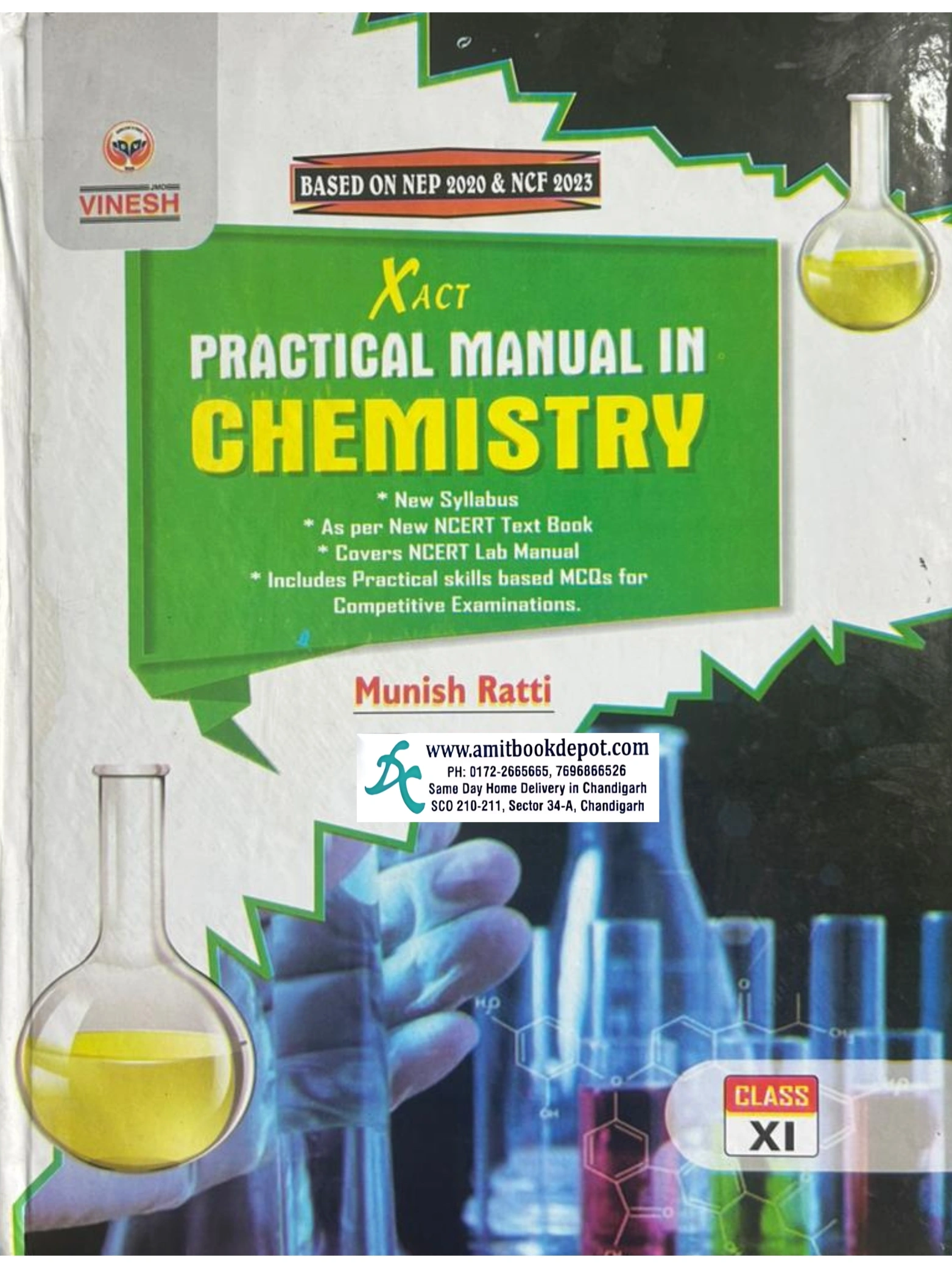
Vinesh Xact Practical Manual Chemistry Class 11th

by Madhurima
₹390 ₹390.00(-/ off)

Rating & Reviews

23 Customer Review

The Vinesh Xact Practical Manual Chemistry Class 11th by Munish Ratti & V.K. Sharma (S. Dinesh & Co.) is the complete guide for the CBSE Class 11 Chemistry Practical syllabus. It provides detailed procedures for all experiments—from basic laboratory techniques and salt analysis to volumetric estimations and investigatory projects. Enhanced with competitive exam MCQs, answers, and explanations, this manual ensures mastery of practical skills and theoretical concepts. Essential for scoring high in board practical exams and building a strong foundation for NEET/JEE, it is the definitive lab manual for every Class 11 science student.

Have Doubts Regarding This Product ? Ask Your Question

  • Q1
    Does this manual cover all the experiments listed in the latest CBSE Class 11 Chemistry Practical syllabus?
    A1

    Yes, it comprehensively covers every topic and experiment outlined in the official CBSE syllabus, including sections on Basic Laboratory Techniques, Characterization, pH, Equilibrium, Quantitative Estimation, and Qualitative Analysis.

  • Q2
    Are the investigatory projects provided detailed enough to be executed independently?
    A2

    Absolutely. The manual provides structured guidance for numerous suggested projects, including objectives, methodologies, and expected analysis, enabling students to undertake them with minimal supervision.

  • Q3
    How does this manual help in competitive exam preparation like NEET or JEE?
    A3

    It includes a dedicated section with Multiple Choice Questions (MCQs) compiled from various competitive exams, complete with hints and explanations, linking practical concepts to objective-type question patterns.

  • Q4
    Is the section on salt analysis up-to-date with the current CBSE list of cations and anions?
    A4

    Yes, it includes the latest prescribed list of cations (like Pb²⁺, Al³⁺, Zn²⁺, NH₄⁺) and anions (like CO₃²⁻, SO₄²⁻, Cl⁻, NO₃⁻), along with systematic analytical charts.

  • Q5
    Does it include instructions for microchemical methods as suggested in the syllabus?
    A5

    While the manual focuses on standard laboratory procedures, it emphasizes principles that are applicable and encourages efficient use of chemicals, aligning with the syllabus's suggestion for micro-methods where possible.

  • Q6
    Is there guidance on how to maintain a practical record book or observation journal?
    A6

    The manual provides a clear format for recording aims, apparatus, procedures, observations, and results, which students can directly emulate to maintain a neat and accurate lab record.

  • Q7
    Does it cover safety protocols for handling chemicals and equipment?
    A7

    Yes, the book begins with important chapters on 'Laboratory Discipline' and 'Important Safety Precautions' to ensure students understand and follow safe laboratory practices.

  • Q8
    Are the diagrams of apparatus clear and accurately labelled?
    A8

    The manual includes well-illustrated and labelled diagrams of laboratory equipment and setup to help students visualize and assemble apparatus correctly.

  • Q9
    Is the detection of Nitrogen, Sulphur, and Halogens in organic compounds (Lassaigne's test) explained as per the CBSE scope?
    A9

    Yes, it is covered in detail. The manual also clearly notes that the detection of Bromine and Iodine, while explained, is not part of the current CBSE syllabus, as per the latest guidelines.

  • Q10
    How is the project section organized? Does it suggest how to write a project report?
    A10

    The projects are listed with clear aims and approaches. While it guides the experimental work, students are encouraged to structure their formal report with an introduction, method, result, and conclusion as per their teacher's instructions.


0.00

0 Overall Rating
  • 5
    0
  • 4
    0
  • 3
    0
  • 2
    0
  • 1
    0

Try this product & share your review & thoughts

- Some Laboratory Equipment
- Laboratory Discipline
- Important Safety Precautions

A. Basic Laboratory Techniques
B. Characterization and Purification of Chemical Substances
C. Experiments related to pH change
D. Chemical Equilibrium
E. Quantitative Estimations (Volumetric Analysis)
F. Qualitative Analysis
1. Salt Analysis
2. Detection of Nitrogen, Sulphur, and Halogens (Cl, Br*, and I*) in Organic Compounds (*Not in C.B.S.E. Syllabus)

INVESTIGATORY PROJECTS

Project No. 1
Project No. 2
Project No. 3
Project No. 4 (a)
Project No. 4 (b)
Project No. 5
Project No. 6 (a)
Project No. 6 (b)
Project No. 6 (c)
Project No. 6 (d) 
Project No. 7(a)
Project No. 7(a)
Project No. 8

Multiple Choice Questions

- MCQs from Competitive Exams
- Answers
- Hints and Explanations

Some Common Acids and Bases in the Chemistry Laboratory
PRACTICAL SYLLABUS

Microchemical methods are available for several of the practical experiments; wherever possible, such techniques should be used:

A. Basic Laboratory Techniques

1. Cutting glass tube and glass rod
2. Bending a glass tube
3. Drawing out a glass jet
4. Boring a cork

B. Characterization and Purification of Chemical Substances

1. Determination of the melting point of an organic compound.
2. Determination of boiling point of an organic compound.
3. Crystallization of an impure sample of any one of the following: alum, copper sulfate, or benzoic acid.

C. Experiments based on pH

1. Any one of the following experiments:
- Determination of pH of some solutions obtained from fruit juices and solutions of known and varied concentrations of acids, bases, and salts using pH paper or universal indicator.
- Comparing the pH of solutions of strong and weak acids of the same concentration.
- Study the pH change in the titration of a strong base using a universal indicator.
2. Study the pH change by common ion in the case of weak acids and weak bases.

D. Chemical Equilibrium

- One of the following experiments:
(a) Study the shift in equilibrium between ferric ions by increasing/decreasing the concentration of either of the ions.
(b) Study the shift in equilibrium between [Co(H₂O)₆]²⁺ and chloride ions by changing the concentration of the ions.

E. Quantitative Estimation

(i) Using a mechanical balance/electronic balance.
(ii) Preparation of standard solution of oxalic acid.
(iii) Determination of the strength of a given solution of sodium hydroxide by titrating it against a standard solution of oxalic acid.
(iv) Preparation of standard solution of sodium carbonate.
(v) Determination of strength of a given solution of hydrochloric acid by titrating it against standard 

F. Qualitative Analysis

(a) Determination of one anion and one cation in a given salt
Cations—Pb²⁺, Cu²⁺, As³⁺, Al³⁺, Fe³⁺, Mn²⁺, Ni²⁺, Zn²⁺, Co²⁺, Ca²⁺, Sr²⁺, Ba²⁺, Mg²⁺, NH₄⁺
Anions - CO3 2-, S2-, NO2-, SO3 2-, NO3- ,Cl-, Br-, l-, PO4 3-, CH3 COO-
(Note: Insoluble salts excluded)
(b) Detection of nitrogen, sulfur, and chlorine in organic compounds.
(c) Projects
Scientific investigations involving laboratory testing and collecting information from other sources.

A Few Suggested Projects.

- Checking the bacterial contamination in drinking water by testing sulphide ion.
- Study of the methods of purification of water.
- Testing the hardness, presence of iron, fluoride, chloride, etc., depending upon the regional variation in drinking water and study of causes of presence of these ions above the permissible limit (if any).
- Investigation of the foaming capacity of different washing soaps and the effect of the addition of sodium carbonate on it.
- Study the acidity of different samples of tea leaves.
- Determination of the rate of evaporation of different liquids.
- Study the effect of acids and bases on the tensile strength of fibers.
- Study of acidity of fruit and vegetable juices.
Note: Any other investigatory project, which involves about 10 periods of work, can be chosen with the approval of the teacher.

The Vinesh Xact Practical Manual Chemistry Class 11th is an indispensable and comprehensive laboratory companion meticulously crafted for students embarking on their senior secondary chemistry journey. Authored by Munish Ratti and V. K. Sharma and published by S. Dinesh & Co., this manual is engineered to bridge the gap between theoretical knowledge and practical application, ensuring mastery of the CBSE Class 11 Chemistry Practical syllabus. It serves as a definitive guide for school laboratory experiments, investigatory projects, and competitive exam preparation, fostering a deep, hands-on understanding of fundamental chemical principles.

This manual is strategically structured to align perfectly with the latest CBSE syllabus, providing a step-by-step, systematic approach to all prescribed experiments. It begins by instilling essential laboratory discipline and safety precautions, foundational for any successful scientific inquiry. The core content is divided into logical sections mirroring the syllabus: Basic Laboratory Techniques (like cutting glass tubes and boring corks), Characterization and Purification of Chemical Substances (determining melting/boiling points, crystallization), experiments on pH change and Chemical Equilibrium, Quantitative Estimations (volumetric analysis), and detailed Qualitative Analysis, including systematic salt analysis and detection of elements like nitrogen, sulfur, and halogens in organic compounds.

A standout feature of this Class 11 Chemistry lab manual is its extensive section on Investigatory Projects. It provides detailed guidance on numerous suggested projects, such as checking bacterial contamination in water, studying water purification methods, testing water hardness, investigating soap foaming capacity, and analyzing the acidity of tea leaves or fruit juices. This section empowers students to undertake scientific investigations confidently, developing critical research skills vital for academic excellence.

Beyond routine practicals, the Vinesh Xact Practical Manual includes a substantial collection of Multiple Choice Questions (MCQs) from competitive exams like NEET and JEE, complete with answers, hints, and explanations. This integration makes it a dual-purpose tool, reinforcing practical concepts while preparing students for the objective-type questions prevalent in entrance examinations. It effectively links practical chemistry with competitive exam preparation.

The manual emphasizes accuracy and clarity, with detailed procedures, precise chemical equations, expected observations, and precautions for each experiment. It covers crucial techniques like using a mechanical balance, preparing standard solutions, and performing titrations. The section on qualitative inorganic analysis provides clear charts and flow diagrams for the identification of a wide range of cations (Pb²⁺, Cu²⁺, Fe³⁺, NH₄⁺, etc.) and anions (CO₃²⁻, SO₄²⁻, Cl⁻, NO₃⁻, etc.), following established protocols.

Designed for easy learning and scoring high practical marks, this book is an essential resource for every Class 11 science student. Its practical focus aids in visualizing chemical reactions and principles, thereby strengthening conceptual understanding. Teachers also find it a reliable reference for guiding students through the chemistry practical syllabus. For any student aiming to excel in their board practical exams, build a robust foundation for Class 12, and gain an edge in competitive tests, the Vinesh Xact Practical Manual Chemistry Class 11th is the most trusted and exhaustive guide available, ensuring learning is both exact and experiential.

- Some Laboratory Equipment
- Laboratory Discipline
- Important Safety Precautions

A. Basic Laboratory Techniques
B. Characterization and Purification of Chemical Substances
C. Experiments related to pH change
D. Chemical Equilibrium
E. Quantitative Estimations (Volumetric Analysis)
F. Qualitative Analysis
1. Salt Analysis
2. Detection of Nitrogen, Sulphur, and Halogens (Cl, Br*, and I*) in Organic Compounds (*Not in C.B.S.E. Syllabus)

INVESTIGATORY PROJECTS

Project No. 1
Project No. 2
Project No. 3
Project No. 4 (a)
Project No. 4 (b)
Project No. 5
Project No. 6 (a)
Project No. 6 (b)
Project No. 6 (c)
Project No. 6 (d) 
Project No. 7(a)
Project No. 7(a)
Project No. 8

Multiple Choice Questions

- MCQs from Competitive Exams
- Answers
- Hints and Explanations

Some Common Acids and Bases in the Chemistry Laboratory

Have Doubts Regarding This Product ? Ask Your Question

  • Q1
    Does this manual cover all the experiments listed in the latest CBSE Class 11 Chemistry Practical syllabus?
    A1

    Yes, it comprehensively covers every topic and experiment outlined in the official CBSE syllabus, including sections on Basic Laboratory Techniques, Characterization, pH, Equilibrium, Quantitative Estimation, and Qualitative Analysis.

  • Q2
    Are the investigatory projects provided detailed enough to be executed independently?
    A2

    Absolutely. The manual provides structured guidance for numerous suggested projects, including objectives, methodologies, and expected analysis, enabling students to undertake them with minimal supervision.

  • Q3
    How does this manual help in competitive exam preparation like NEET or JEE?
    A3

    It includes a dedicated section with Multiple Choice Questions (MCQs) compiled from various competitive exams, complete with hints and explanations, linking practical concepts to objective-type question patterns.

  • Q4
    Is the section on salt analysis up-to-date with the current CBSE list of cations and anions?
    A4

    Yes, it includes the latest prescribed list of cations (like Pb²⁺, Al³⁺, Zn²⁺, NH₄⁺) and anions (like CO₃²⁻, SO₄²⁻, Cl⁻, NO₃⁻), along with systematic analytical charts.

  • Q5
    Does it include instructions for microchemical methods as suggested in the syllabus?
    A5

    While the manual focuses on standard laboratory procedures, it emphasizes principles that are applicable and encourages efficient use of chemicals, aligning with the syllabus's suggestion for micro-methods where possible.

  • Q6
    Is there guidance on how to maintain a practical record book or observation journal?
    A6

    The manual provides a clear format for recording aims, apparatus, procedures, observations, and results, which students can directly emulate to maintain a neat and accurate lab record.

  • Q7
    Does it cover safety protocols for handling chemicals and equipment?
    A7

    Yes, the book begins with important chapters on 'Laboratory Discipline' and 'Important Safety Precautions' to ensure students understand and follow safe laboratory practices.

  • Q8
    Are the diagrams of apparatus clear and accurately labelled?
    A8

    The manual includes well-illustrated and labelled diagrams of laboratory equipment and setup to help students visualize and assemble apparatus correctly.

  • Q9
    Is the detection of Nitrogen, Sulphur, and Halogens in organic compounds (Lassaigne's test) explained as per the CBSE scope?
    A9

    Yes, it is covered in detail. The manual also clearly notes that the detection of Bromine and Iodine, while explained, is not part of the current CBSE syllabus, as per the latest guidelines.

  • Q10
    How is the project section organized? Does it suggest how to write a project report?
    A10

    The projects are listed with clear aims and approaches. While it guides the experimental work, students are encouraged to structure their formal report with an introduction, method, result, and conclusion as per their teacher's instructions.

PRACTICAL SYLLABUS

Microchemical methods are available for several of the practical experiments; wherever possible, such techniques should be used:

A. Basic Laboratory Techniques

1. Cutting glass tube and glass rod
2. Bending a glass tube
3. Drawing out a glass jet
4. Boring a cork

B. Characterization and Purification of Chemical Substances

1. Determination of the melting point of an organic compound.
2. Determination of boiling point of an organic compound.
3. Crystallization of an impure sample of any one of the following: alum, copper sulfate, or benzoic acid.

C. Experiments based on pH

1. Any one of the following experiments:
- Determination of pH of some solutions obtained from fruit juices and solutions of known and varied concentrations of acids, bases, and salts using pH paper or universal indicator.
- Comparing the pH of solutions of strong and weak acids of the same concentration.
- Study the pH change in the titration of a strong base using a universal indicator.
2. Study the pH change by common ion in the case of weak acids and weak bases.

D. Chemical Equilibrium

- One of the following experiments:
(a) Study the shift in equilibrium between ferric ions by increasing/decreasing the concentration of either of the ions.
(b) Study the shift in equilibrium between [Co(H₂O)₆]²⁺ and chloride ions by changing the concentration of the ions.

E. Quantitative Estimation

(i) Using a mechanical balance/electronic balance.
(ii) Preparation of standard solution of oxalic acid.
(iii) Determination of the strength of a given solution of sodium hydroxide by titrating it against a standard solution of oxalic acid.
(iv) Preparation of standard solution of sodium carbonate.
(v) Determination of strength of a given solution of hydrochloric acid by titrating it against standard 

F. Qualitative Analysis

(a) Determination of one anion and one cation in a given salt
Cations—Pb²⁺, Cu²⁺, As³⁺, Al³⁺, Fe³⁺, Mn²⁺, Ni²⁺, Zn²⁺, Co²⁺, Ca²⁺, Sr²⁺, Ba²⁺, Mg²⁺, NH₄⁺
Anions - CO3 2-, S2-, NO2-, SO3 2-, NO3- ,Cl-, Br-, l-, PO4 3-, CH3 COO-
(Note: Insoluble salts excluded)
(b) Detection of nitrogen, sulfur, and chlorine in organic compounds.
(c) Projects
Scientific investigations involving laboratory testing and collecting information from other sources.

A Few Suggested Projects.

- Checking the bacterial contamination in drinking water by testing sulphide ion.
- Study of the methods of purification of water.
- Testing the hardness, presence of iron, fluoride, chloride, etc., depending upon the regional variation in drinking water and study of causes of presence of these ions above the permissible limit (if any).
- Investigation of the foaming capacity of different washing soaps and the effect of the addition of sodium carbonate on it.
- Study the acidity of different samples of tea leaves.
- Determination of the rate of evaporation of different liquids.
- Study the effect of acids and bases on the tensile strength of fibers.
- Study of acidity of fruit and vegetable juices.
Note: Any other investigatory project, which involves about 10 periods of work, can be chosen with the approval of the teacher.

0.00

0 Overall Rating
  • 5
    0
  • 4
    0
  • 3
    0
  • 2
    0
  • 1
    0

Try this product & share your review & thoughts

Top Trending Product

Related Product

Related Product

Related Blog Posts

Latest Blogs

Latest Blogs

blog-img
Classic Literature Reimagined: Discuss modern twists on classic novels.
Lorem ipsum dolor sit amet, consectetur adipiscing elit, sed do eiusmod tempor incididunt ut labore et dolore magna aliqua. Ut enim ad minim veniam, quis nostrud exercitation ullamco Lorem ipsum dolor sit amet, consectetur adipiscing elit, sed do eiusmod tempor incididunt ut labore et dolore magna aliqua. Utenim ad minim veniam, quis nostrud exercitation ullamco Lorem ipsum dolor sit amet, consecte...
Read more
Author name | 10 jan, 2025
blog-img
Classic Literature Reimagined: Discuss modern twists on classic novels.
Lorem ipsum dolor sit amet, consectetur adipiscing elit, sed do eiusmod tempor incididunt ut labore et dolore magna aliqua. Ut enim ad minim veniam, quis nostrud exercitation ullamco Lorem ipsum dolor sit amet, consectetur adipiscing elit, sed do eiusmod tempor incididunt ut labore et dolore magna aliqua. Utenim ad minim veniam, quis nostrud exercitation ullamco Lorem ipsum dolor sit amet, consecte...
Read more
Author name | 10 jan, 2025
blog-img
Classic Literature Reimagined: Discuss modern twists on classic novels.
Lorem ipsum dolor sit amet, consectetur adipiscing elit, sed do eiusmod tempor incididunt ut labore et dolore magna aliqua. Ut enim ad minim veniam, quis nostrud exercitation ullamco Lorem ipsum dolor sit amet, consectetur adipiscing elit, sed do eiusmod tempor incididunt ut labore et dolore magna aliqua. Utenim ad minim veniam, quis nostrud exercitation ullamco Lorem ipsum dolor sit amet, consecte...
Read more
Author name | 10 jan, 2025
blog-img
Classic Literature Reimagined: Discuss modern twists on classic novels.
Lorem ipsum dolor sit amet, consectetur adipiscing elit...
Read more
Author Name | 10 Jan, 2025
blog-img
Classic Literature Reimagined: Discuss modern twists on classic novels.
Lorem ipsum dolor sit amet, consectetur adipiscing elit...
Read more
Author Name | 10 Jan, 2025
blog-img
Classic Literature Reimagined: Discuss modern twists on classic novels.
Lorem ipsum dolor sit amet, consectetur adipiscing elit...
Read more
Author Name | 10 Jan, 2025
blog-img
Classic Literature Reimagined: Discuss modern twists on classic novels.
Lorem ipsum dolor sit amet, consectetur adipiscing elit...
Read more
Author Name | 10 Jan, 2025
blog-img
Classic Literature Reimagined: Discuss modern twists on classic novels.
Lorem ipsum dolor sit amet, consectetur adipiscing elit...
Read more
Author Name | 10 Jan, 2025
blog-img
Classic Literature Reimagined: Discuss modern twists on classic novels.
Lorem ipsum dolor sit amet, consectetur adipiscing elit...
Read more
Author Name | 10 Jan, 2025
blog-img
Classic Literature Reimagined: Discuss modern twists on classic novels.
Lorem ipsum dolor sit amet, consectetur adipiscing elit...
Read more
Author Name | 10 Jan, 2025
blog-img
Classic Literature Reimagined: Discuss modern twists on classic novels.
Lorem ipsum dolor sit amet, consectetur adipiscing elit...
Read more
Author Name | 10 Jan, 2025
blog-img
Classic Literature Reimagined: Discuss modern twists on classic novels.
Lorem ipsum dolor sit amet, consectetur adipiscing elit...
Read more
Author Name | 10 Jan, 2025