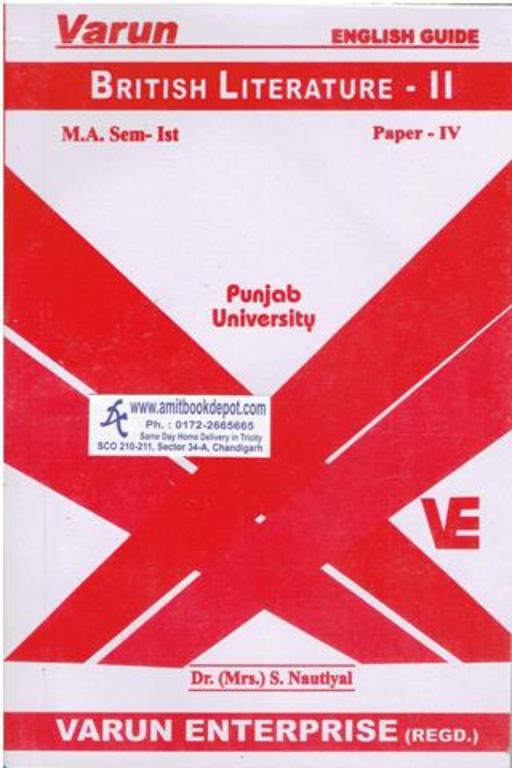
Varun English Guide British Literature 2 For MA 1st Sem Paper 4 Panjab University Chandigarh
Varun English Guide British Literature 2 For MA 1st Sem Paper 4 Panjab University Chandigarh
by Madhurima
₹350₹350.00(-/
off)
Rating & Reviews
23 Customer Review
Master Panjab University's M.A. English Paper IV syllabus with this essential guide by Dr. S. Nautiyal. Specifically designed for British Literature II (Romantic Age), this book provides complete coverage of prescribed texts including Mary Shelley's Frankenstein, poetry by Wordsworth, Coleridge, Keats, Blake, and essays by Lamb and Hazlitt. Features detailed critical analysis, chapter summaries, thematic explanations, reference-to-context notes, and a solved question bank. This exam-oriented guide is the perfect companion for in-depth understanding and high scores in Panjab University M.A. English examinations.
Varun English Guide: British Literature II for M.A. 1st Semester (Paper IV)—Panjab University, Chandigarh
Master the profound literary landscape of Romanticism with the definitive academic companion: Varun English Guide for British Literature II, meticulously crafted for M.A. 1st Semester, Paper IV of Panjab University, Chandigarh. Authored by the esteemed Dr. S. Nautiyal and published by Varun Enterprises, this guide is an indispensable resource designed to provide comprehensive syllabus coverage, critical analysis, and exam-oriented insights into one of the most pivotal periods in English literary history.
This guide is strategically structured to align perfectly with the Panjab University M.A. English syllabus, offering a thorough exploration of the Romantic Age in Britain. The book begins by contextualizing the movement, detailing its revolutionary shift from 18th-century neoclassicism and rationalism towards a celebration of imagination, individualism, nature, and emotional subjectivity. It equips students to understand Romanticism not just as a literary trend but as a complex philosophical, aesthetic, and cultural reaction that championed liberty and creative freedom.
Unit-wise Detailed Analysis and Critical Commentary:
The core of this guide provides an in-depth, line-by-line examination of prescribed texts. It demystifies complex poetic language and prose, breaking down themes, stylistic devices, and historical context for each author and work.
1. Unit I delve into Mary Shelley's Frankenstein, analyzing it as a seminal Gothic novel that interrogates the limits of scientific ambition, the nature of monstrosity, and Romantic anxieties about creation and isolation.
2. Unit II offers a detailed exposition of William Wordsworth's Preface to Lyrical Ballads, the manifesto of English Romanticism. It clarifies key concepts like the "real language of men," poetic diction, and the role of the poet.
3. Unit III & IV focus on the major Romantic poets. For William Blake, it contrasts the themes of innocence and experience in The Chimney Sweeper and The Tyger. For Wordsworth's poetry, it explores the healing power of nature in Lines Written in Early Spring and the philosophical depths of the Immortality Ode. The guide provides exhaustive commentary on John Keats's Odes (Grecian Urn, Nightingale, Autumn), elucidating his concepts of Negative Capability and Beauty, and on Coleridge's Rime of the Ancient Mariner, a masterpiece of the supernatural and penance.
4. Unit V transitions to the familiar essayists of the period. It explores the poignant nostalgia in Charles Lamb's Dream Children and the witty observations in The Praise of Chimney Sweepers, alongside the critical vigor of William Hazlitt's essays On Reading Old Books and On Gusto.
Key Features for Academic Success:
1. Strict Syllabus Adherence: Fully covers the latest Panjab University M.A. Paper 4 syllabus.
2. Chapter-wise Summaries and Paraphrases: Simplifies complex texts for clear understanding.
3. Critical Interpretations and Thematic Analysis: Provides multiple perspectives on characters, symbols, and motifs essential for long-answer questions.
4. Important Explanations with Reference to Context: A vital section for scoring well in short-answer and annotation questions.
5. Previous Years' Question Bank: Includes solved and potential questions to familiarize students with the exam pattern and trends.
6. Glossary of Literary Terms: Defines key Romantic and critical terminology used in the course.
Ideal for both regular study and last-minute revision, Varun English Guide British Literature II by Dr. S. Nautiyal is more than a book—it's a structured pathway to achieving academic excellence. It transforms the challenging works of Wordsworth, Coleridge, Keats, Shelley, Blake, Lamb, and Hazlitt into accessible, engaging, and exam-ready material. Ensure your mastery over English Romantic poetry and prose with this authoritative guide tailored specifically for Panjab University postgraduate students.
Is this Varun Guide updated for the latest Panjab University M.A. 1st Semester (Paper IV) syllabus?
A1
Yes, this guide by Dr. S. Nautiyal is meticulously compiled to adhere strictly to the current syllabus prescribed by Panjab University, Chandigarh, for British Literature II.
Q2
Does the guide include the complete text of "Frankenstein" and the poems, or is it only commentary?
A2
This is a critical guide and study companion. It contains detailed summaries, paraphrases, analysis, and explanations but not the full, unabridged original texts of the novels or poems. Students should use it alongside the prescribed editions.
Q3
How does this guide help in understanding complex poems like Keats's Odes or Coleridge's "Rime of the Ancient Mariner"?
A3
The guide provides line-by-line paraphrases, explanations of archaic language, and in-depth analysis of themes, symbols (like the Urn, Nightingale, Albatross), and poetic devices, making these complex works accessible and clear.
Q4
Is there coverage of William Hazlitt's essays "On Gusto" and "On Reading Old Books," which are often considered challenging?
A4
Yes, Unit V provides dedicated sections for Hazlitt's essays. It breaks down his critical concepts, defines key terms like "gusto," and explains the context and arguments of each essay in a student-friendly manner.
Q5
Does the book provide a critical overview of the Romantic Age as a whole?
A5
Absolutely. The introduction and unit introductions provide a comprehensive background on the Romantic Movement, its historical context, philosophical tenets, and its reaction against Neoclassicism, which is crucial for answering broad, essay-type questions.
Q6
Is the "Preface to Lyrical Ballads" explained in simple terms?
A6
Yes, Unit II is dedicated to demystifying Wordsworth's "Preface." It explains key propositions like the choice of rustic life, the definition of poetry, poetic diction, and the role of the poet, translating his ideas into easily understandable points.
Q7
How does the guide handle the comparison between Blake's two "Chimney Sweeper" poems?
A7
The analysis explicitly contrasts the poems from Songs of Innocence and Songs of Experience, highlighting differences in tone, perspective, and social criticism, a common question in exams.
Q8
Are there notes on the "Gothic" elements in Frankenstein as required by the syllabus?
A8
Yes, the analysis of Frankenstein in Unit I specifically addresses its classification as a Gothic novel, detailing elements like the sublime settings, the monstrous creation, and themes of terror and the supernatural.
Q9
Is the book written in a language that is easy for M.A. level students to comprehend?
A9
While dealing with advanced literary concepts, the language of the guide is clear, academic, and aimed at facilitating understanding rather than showcasing complexity, making it highly student-centric.
Q10
Does it include explanations for "Reference to Context" (RTC) type questions?
A10
Yes, a significant feature of this and most Varun guides is a dedicated section with important passages from poems and prose for explanation, which is vital for preparing for RTC questions in the exam.
0.00
0 Overall Rating
5
0
4
0
3
0
2
0
1
0
Try this product & share your review &
thoughts
UNIT - I
1. Mary Shelley: Frankenstein
UNIT - II
1. William Wordsworth: Preface to Lyrical Ballads
UNIT - III
1. William Blake: The Chimney Sweeper The Tyger
2. William Wordsworth: Lines Written in Early Spring, ‘Ode: Intimation of Immortality
UNIT - IV
1. John Keats: Ode to a Grecian Urn, Ode to a Nightingale, Ode to Autumn
2. Samuel Taylor Coleridge: Rime of the Ancient Mariner
UNIT - V
1. Charles Lamb: Dream Children: A Reverie, The Praise of Chimney Sweepers
2. William Hazlitt: On Reading Old Books On Gusto
Latest Syllabus of English Guide British Literature 2 for MA 1st Semester Paper 4 Panjab University (PU) Chandigarh
British Literature – II
Time: 3 Hrs.
M.M.: 80
The end of the eighteenth century and early nineteenth century saw a momentous shift in philosophical, artistic, and literary movements in Europe—Romanticism. It
flourished until the mid-nineteenth century. Romanticism celebrated imagination and intuition in the enduring search for individual rights and liberty. It marks a shift from objectivism to subjectivism, from reason to the power of imagination and emotive response. The objective of the paper is to introduce students to these tenets of Romanticism in general and English Romanticism in particular. During the course they will be introduced to major English poets and prose writers of the period.
Through the reading, the students will be familiarized with the English Romantic imagination, its stress on nature, poetic inspiration, freedom, individualism, and
spontaneity; and the role language plays in it. Gothic fiction is also explored in the paper. At the end of the course the students will be familiar with major themes, ideas, and concepts of Romanticism and English literature. They will be cognizant of the historical, cultural, political, and aesthetic milieu of the time. Students will study Romanticism as a reaction against the philosophical rationalism and neoclassicism of the Enlightenment. At the end of the course, they would have in-depth knowledge of a movement that not only captured the imagination of people with their ideas of liberty and freedom but also fuelled the avant-garde movements well into the twentieth century.
Unit I
1. Mary Shelley, Frankenstein. Foreword by Ruskin Bond (Collins Classics, 2018).
Unit II
1. William Wordsworth, Preface to Lyrical Ballads (Create Space Pub, 2016).
Unit III
1. William Blake, “The Chimney Sweeper” & “The Tyger,” Songs of Innocence and of Experience (Oxford UP, 1967).
2. William Wordsworth, “Lines Written in Early Spring,” “Ode: Intimations of Immortality,” & “London 1802,” Selected Poems (Penguin Classics, 2004).
Unit IV
1. John Keats, “Ode on a Grecian Urn,” “Ode to a Nightingale,” & “Ode to Autumn,” Selected Poems (Penguin Classics, 2007).
2. Samuel Taylor Coleridge, “Rime of the Ancient Mariner,” Rime of the Ancient Mariner and the Other Poems (Collin Classics, 2016).
Unit V
1. Charles Lamb, “Dream Children: A Reverie” & “The Praise of Chimney Sweepers,” The Essays of Elia and Eliana (G. Bell & Sons, Ltd.).
2. William Hazlitt:
• ‘On Reading Old Books,’ from The Spirit of the Age (Vintage, 2009).
• ‘On Gusto,’ The Fight and Other Writings (Penguin Classics, 2000).
Varun English Guide: British Literature II for M.A. 1st Semester (Paper IV)—Panjab University, Chandigarh
Master the profound literary landscape of Romanticism with the definitive academic companion: Varun English Guide for British Literature II, meticulously crafted for M.A. 1st Semester, Paper IV of Panjab University, Chandigarh. Authored by the esteemed Dr. S. Nautiyal and published by Varun Enterprises, this guide is an indispensable resource designed to provide comprehensive syllabus coverage, critical analysis, and exam-oriented insights into one of the most pivotal periods in English literary history.
This guide is strategically structured to align perfectly with the Panjab University M.A. English syllabus, offering a thorough exploration of the Romantic Age in Britain. The book begins by contextualizing the movement, detailing its revolutionary shift from 18th-century neoclassicism and rationalism towards a celebration of imagination, individualism, nature, and emotional subjectivity. It equips students to understand Romanticism not just as a literary trend but as a complex philosophical, aesthetic, and cultural reaction that championed liberty and creative freedom.
Unit-wise Detailed Analysis and Critical Commentary:
The core of this guide provides an in-depth, line-by-line examination of prescribed texts. It demystifies complex poetic language and prose, breaking down themes, stylistic devices, and historical context for each author and work.
1. Unit I delve into Mary Shelley's Frankenstein, analyzing it as a seminal Gothic novel that interrogates the limits of scientific ambition, the nature of monstrosity, and Romantic anxieties about creation and isolation.
2. Unit II offers a detailed exposition of William Wordsworth's Preface to Lyrical Ballads, the manifesto of English Romanticism. It clarifies key concepts like the "real language of men," poetic diction, and the role of the poet.
3. Unit III & IV focus on the major Romantic poets. For William Blake, it contrasts the themes of innocence and experience in The Chimney Sweeper and The Tyger. For Wordsworth's poetry, it explores the healing power of nature in Lines Written in Early Spring and the philosophical depths of the Immortality Ode. The guide provides exhaustive commentary on John Keats's Odes (Grecian Urn, Nightingale, Autumn), elucidating his concepts of Negative Capability and Beauty, and on Coleridge's Rime of the Ancient Mariner, a masterpiece of the supernatural and penance.
4. Unit V transitions to the familiar essayists of the period. It explores the poignant nostalgia in Charles Lamb's Dream Children and the witty observations in The Praise of Chimney Sweepers, alongside the critical vigor of William Hazlitt's essays On Reading Old Books and On Gusto.
Key Features for Academic Success:
1. Strict Syllabus Adherence: Fully covers the latest Panjab University M.A. Paper 4 syllabus.
2. Chapter-wise Summaries and Paraphrases: Simplifies complex texts for clear understanding.
3. Critical Interpretations and Thematic Analysis: Provides multiple perspectives on characters, symbols, and motifs essential for long-answer questions.
4. Important Explanations with Reference to Context: A vital section for scoring well in short-answer and annotation questions.
5. Previous Years' Question Bank: Includes solved and potential questions to familiarize students with the exam pattern and trends.
6. Glossary of Literary Terms: Defines key Romantic and critical terminology used in the course.
Ideal for both regular study and last-minute revision, Varun English Guide British Literature II by Dr. S. Nautiyal is more than a book—it's a structured pathway to achieving academic excellence. It transforms the challenging works of Wordsworth, Coleridge, Keats, Shelley, Blake, Lamb, and Hazlitt into accessible, engaging, and exam-ready material. Ensure your mastery over English Romantic poetry and prose with this authoritative guide tailored specifically for Panjab University postgraduate students.
UNIT - I
1. Mary Shelley: Frankenstein
UNIT - II
1. William Wordsworth: Preface to Lyrical Ballads
UNIT - III
1. William Blake: The Chimney Sweeper The Tyger
2. William Wordsworth: Lines Written in Early Spring, ‘Ode: Intimation of Immortality
UNIT - IV
1. John Keats: Ode to a Grecian Urn, Ode to a Nightingale, Ode to Autumn
2. Samuel Taylor Coleridge: Rime of the Ancient Mariner
UNIT - V
1. Charles Lamb: Dream Children: A Reverie, The Praise of Chimney Sweepers
Is this Varun Guide updated for the latest Panjab University M.A. 1st Semester (Paper IV) syllabus?
A1
Yes, this guide by Dr. S. Nautiyal is meticulously compiled to adhere strictly to the current syllabus prescribed by Panjab University, Chandigarh, for British Literature II.
Q2
Does the guide include the complete text of "Frankenstein" and the poems, or is it only commentary?
A2
This is a critical guide and study companion. It contains detailed summaries, paraphrases, analysis, and explanations but not the full, unabridged original texts of the novels or poems. Students should use it alongside the prescribed editions.
Q3
How does this guide help in understanding complex poems like Keats's Odes or Coleridge's "Rime of the Ancient Mariner"?
A3
The guide provides line-by-line paraphrases, explanations of archaic language, and in-depth analysis of themes, symbols (like the Urn, Nightingale, Albatross), and poetic devices, making these complex works accessible and clear.
Q4
Is there coverage of William Hazlitt's essays "On Gusto" and "On Reading Old Books," which are often considered challenging?
A4
Yes, Unit V provides dedicated sections for Hazlitt's essays. It breaks down his critical concepts, defines key terms like "gusto," and explains the context and arguments of each essay in a student-friendly manner.
Q5
Does the book provide a critical overview of the Romantic Age as a whole?
A5
Absolutely. The introduction and unit introductions provide a comprehensive background on the Romantic Movement, its historical context, philosophical tenets, and its reaction against Neoclassicism, which is crucial for answering broad, essay-type questions.
Q6
Is the "Preface to Lyrical Ballads" explained in simple terms?
A6
Yes, Unit II is dedicated to demystifying Wordsworth's "Preface." It explains key propositions like the choice of rustic life, the definition of poetry, poetic diction, and the role of the poet, translating his ideas into easily understandable points.
Q7
How does the guide handle the comparison between Blake's two "Chimney Sweeper" poems?
A7
The analysis explicitly contrasts the poems from Songs of Innocence and Songs of Experience, highlighting differences in tone, perspective, and social criticism, a common question in exams.
Q8
Are there notes on the "Gothic" elements in Frankenstein as required by the syllabus?
A8
Yes, the analysis of Frankenstein in Unit I specifically addresses its classification as a Gothic novel, detailing elements like the sublime settings, the monstrous creation, and themes of terror and the supernatural.
Q9
Is the book written in a language that is easy for M.A. level students to comprehend?
A9
While dealing with advanced literary concepts, the language of the guide is clear, academic, and aimed at facilitating understanding rather than showcasing complexity, making it highly student-centric.
Q10
Does it include explanations for "Reference to Context" (RTC) type questions?
A10
Yes, a significant feature of this and most Varun guides is a dedicated section with important passages from poems and prose for explanation, which is vital for preparing for RTC questions in the exam.
Latest Syllabus of English Guide British Literature 2 for MA 1st Semester Paper 4 Panjab University (PU) Chandigarh
British Literature – II
Time: 3 Hrs.
M.M.: 80
The end of the eighteenth century and early nineteenth century saw a momentous shift in philosophical, artistic, and literary movements in Europe—Romanticism. It
flourished until the mid-nineteenth century. Romanticism celebrated imagination and intuition in the enduring search for individual rights and liberty. It marks a shift from objectivism to subjectivism, from reason to the power of imagination and emotive response. The objective of the paper is to introduce students to these tenets of Romanticism in general and English Romanticism in particular. During the course they will be introduced to major English poets and prose writers of the period.
Through the reading, the students will be familiarized with the English Romantic imagination, its stress on nature, poetic inspiration, freedom, individualism, and
spontaneity; and the role language plays in it. Gothic fiction is also explored in the paper. At the end of the course the students will be familiar with major themes, ideas, and concepts of Romanticism and English literature. They will be cognizant of the historical, cultural, political, and aesthetic milieu of the time. Students will study Romanticism as a reaction against the philosophical rationalism and neoclassicism of the Enlightenment. At the end of the course, they would have in-depth knowledge of a movement that not only captured the imagination of people with their ideas of liberty and freedom but also fuelled the avant-garde movements well into the twentieth century.
Unit I
1. Mary Shelley, Frankenstein. Foreword by Ruskin Bond (Collins Classics, 2018).
Unit II
1. William Wordsworth, Preface to Lyrical Ballads (Create Space Pub, 2016).
Unit III
1. William Blake, “The Chimney Sweeper” & “The Tyger,” Songs of Innocence and of Experience (Oxford UP, 1967).
2. William Wordsworth, “Lines Written in Early Spring,” “Ode: Intimations of Immortality,” & “London 1802,” Selected Poems (Penguin Classics, 2004).
Unit IV
1. John Keats, “Ode on a Grecian Urn,” “Ode to a Nightingale,” & “Ode to Autumn,” Selected Poems (Penguin Classics, 2007).
2. Samuel Taylor Coleridge, “Rime of the Ancient Mariner,” Rime of the Ancient Mariner and the Other Poems (Collin Classics, 2016).
Unit V
1. Charles Lamb, “Dream Children: A Reverie” & “The Praise of Chimney Sweepers,” The Essays of Elia and Eliana (G. Bell & Sons, Ltd.).
2. William Hazlitt:
• ‘On Reading Old Books,’ from The Spirit of the Age (Vintage, 2009).
• ‘On Gusto,’ The Fight and Other Writings (Penguin Classics, 2000).
0.00
0 Overall Rating
5
0
4
0
3
0
2
0
1
0
Try this product & share your review &
thoughts
Top Trending Product
Related
Product
Related Product
Related Blog Posts
Latest Blogs
Latest Blogs
Classic Literature Reimagined: Discuss modern twists on classic novels.
Lorem ipsum dolor sit amet, consectetur adipiscing elit, sed
do
eiusmod tempor incididunt ut labore et dolore magna aliqua. Ut enim ad minim
veniam, quis nostrud exercitation ullamco Lorem ipsum dolor sit amet,
consectetur adipiscing elit, sed do eiusmod tempor incididunt ut labore et
dolore magna aliqua. Utenim ad minim veniam, quis nostrud exercitation
ullamco
Lorem ipsum dolor sit amet, consecte...
Classic Literature Reimagined: Discuss modern twists on classic novels.
Lorem ipsum dolor sit amet, consectetur adipiscing elit, sed
do
eiusmod tempor incididunt ut labore et dolore magna aliqua. Ut enim ad minim
veniam, quis nostrud exercitation ullamco Lorem ipsum dolor sit amet,
consectetur adipiscing elit, sed do eiusmod tempor incididunt ut labore et
dolore magna aliqua. Utenim ad minim veniam, quis nostrud exercitation
ullamco
Lorem ipsum dolor sit amet, consecte...
Classic Literature Reimagined: Discuss modern twists on classic novels.
Lorem ipsum dolor sit amet, consectetur adipiscing elit, sed
do
eiusmod tempor incididunt ut labore et dolore magna aliqua. Ut enim ad minim
veniam, quis nostrud exercitation ullamco Lorem ipsum dolor sit amet,
consectetur adipiscing elit, sed do eiusmod tempor incididunt ut labore et
dolore magna aliqua. Utenim ad minim veniam, quis nostrud exercitation
ullamco
Lorem ipsum dolor sit amet, consecte...