Categories
College Bookssss >
BA PU Chandigarh
BSC PU Chandigarh
MSC PU Chandigarh
BBA PU Chandigarh
MA PU Chandigarh
Medical Books
Engineering Books
Management Books
PGDCA Books
BCOM PU Chandigarh
MCOM PU Chandigarh
BCA PU Chandigarh
MCA PU Chandigarh
animate-books

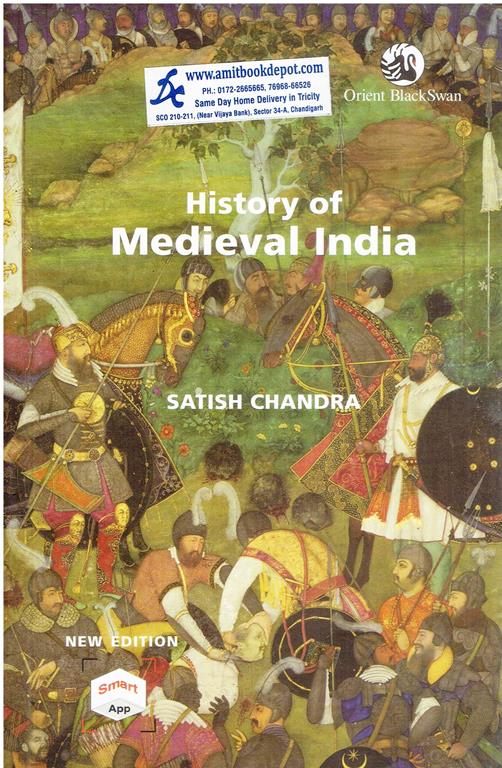
History of Medieval India

by Madhurima
₹0 ₹0.00(-/ off)
Rating & Reviews

23 Customer Review

Purchase Type

Have Doubts Regarding This Product ? Ask Your Question

  • Q1
    Is this book by Satish Chandra a single comprehensive volume, or is it split into parts?
    A1

    This is a single, comprehensive volume titled "History of Medieval India" that covers the entire period from 800 AD to the 18th century. It is not to be confused with the author's other work, "Medieval India: From Sultanat to the Mughals," which is published as a two-part set.

  • Q2
    Does this book contain source-based questions or primary source excerpts?
    A2

    No, this is primarily a secondary source textbook written by a renowned historian. It is an analytical narrative based on primary sources and historical research. It does not include exercises, sample questions, or lengthy excerpts from primary sources like chronicles or inscriptions.

  • Q3
    Is the content aligned with the NCERT curriculum for school students?
    A3

    While it covers the same period, Satish Chandra's book is significantly more detailed, analytical, and advanced than NCERT textbooks. It is an excellent resource for deepening understanding after studying NCERTs, but it is not a direct substitute for the simpler language and scope of school-level books.

  • Q4
    How does this book handle the different regional histories of India, like those of the Northeast or the Deccan?
    A4

    The book integrates regional history within its chronological framework. It has dedicated chapters on South India (Cholas, Vijayanagara) and the Deccan (Bahmanids), and regional dynamics are woven into chapters on the Delhi Sultanate and Mughal Empire. However, it does not have separate, in-depth chapters on every geographical region like the Northeast or Gujarat; its focus is on the major pan-Indian and regional empires.

  • Q5
    Does this edition include recent archaeological findings or modern historiographical perspectives?
    A5

    This edition by Orient Black Swan is a well-established and updated version that incorporates significant scholarly consensus. However, for the very latest, niche research debates or very recent archaeological discoveries, one would need to consult specialized journal articles or newer monographs. This book provides the essential, robust foundation.

  • Q6
    Can this book be used for understanding art, architecture, and literature of the medieval period?
    A6

    Yes, Chapter 11 ("Cultural Development in India (1200-1500)") and Chapter 17 ("Cultural and Religious Developments") specifically address these themes, covering Indo-Islamic architecture, painting, music, and literary traditions in Sanskrit, Persian, and regional languages.

  • Q7
    Does the book cover the history of European trading companies (like the Dutch or French) in detail?
    A7

    The book's primary focus ends with the disintegration of the Mughal Empire in the early 18th century. It covers the coming of the Portuguese in detail (Chapter 9) as they arrived earlier. The rise of the British, French, and Dutch East India Companies as political powers falls more into the "Modern India" period and is only touched upon as a factor in the late Mughal context.

  • Q8
    Is the index at the back detailed enough to quickly locate specific events, persons, or terms?
    A8

    Yes, the book includes a comprehensive index that lists key personalities, battles, treaties, administrative terms, and places. This makes it an excellent reference tool for quickly finding information for revision or research purposes.

  • Q9
    How does it compare to R.S. Sharma's books on early medieval India?
    A9

    R.S. Sharma's works (like "India's Ancient Past") famously end around 1200 AD with a focus on early medieval feudal structures. Satish Chandra's book begins where Sharma's narrative often ends, providing a seamless continuation into the Sultanate and Mughal periods. They are complementary, not competing, texts.

  • Q10
    Is the language accessible for a non-History student who is just curious about the period?
    A10

    While it is an academic text, Satish Chandra's writing is known for its clarity and lack of unnecessary jargon. A motivated general reader with a serious interest in history will find it accessible and engaging, though it is denser than popular history books.

0.00

0 Overall Rating
  • 5
    0
  • 4
    0
  • 3
    0
  • 2
    0
  • 1
    0

Try this product & share your review & thoughts

No Description Added

No Table Content Added

Have Doubts Regarding This Product ? Ask Your Question

  • Q1
    Is this book by Satish Chandra a single comprehensive volume, or is it split into parts?
    A1

    This is a single, comprehensive volume titled "History of Medieval India" that covers the entire period from 800 AD to the 18th century. It is not to be confused with the author's other work, "Medieval India: From Sultanat to the Mughals," which is published as a two-part set.

  • Q2
    Does this book contain source-based questions or primary source excerpts?
    A2

    No, this is primarily a secondary source textbook written by a renowned historian. It is an analytical narrative based on primary sources and historical research. It does not include exercises, sample questions, or lengthy excerpts from primary sources like chronicles or inscriptions.

  • Q3
    Is the content aligned with the NCERT curriculum for school students?
    A3

    While it covers the same period, Satish Chandra's book is significantly more detailed, analytical, and advanced than NCERT textbooks. It is an excellent resource for deepening understanding after studying NCERTs, but it is not a direct substitute for the simpler language and scope of school-level books.

  • Q4
    How does this book handle the different regional histories of India, like those of the Northeast or the Deccan?
    A4

    The book integrates regional history within its chronological framework. It has dedicated chapters on South India (Cholas, Vijayanagara) and the Deccan (Bahmanids), and regional dynamics are woven into chapters on the Delhi Sultanate and Mughal Empire. However, it does not have separate, in-depth chapters on every geographical region like the Northeast or Gujarat; its focus is on the major pan-Indian and regional empires.

  • Q5
    Does this edition include recent archaeological findings or modern historiographical perspectives?
    A5

    This edition by Orient Black Swan is a well-established and updated version that incorporates significant scholarly consensus. However, for the very latest, niche research debates or very recent archaeological discoveries, one would need to consult specialized journal articles or newer monographs. This book provides the essential, robust foundation.

  • Q6
    Can this book be used for understanding art, architecture, and literature of the medieval period?
    A6

    Yes, Chapter 11 ("Cultural Development in India (1200-1500)") and Chapter 17 ("Cultural and Religious Developments") specifically address these themes, covering Indo-Islamic architecture, painting, music, and literary traditions in Sanskrit, Persian, and regional languages.

  • Q7
    Does the book cover the history of European trading companies (like the Dutch or French) in detail?
    A7

    The book's primary focus ends with the disintegration of the Mughal Empire in the early 18th century. It covers the coming of the Portuguese in detail (Chapter 9) as they arrived earlier. The rise of the British, French, and Dutch East India Companies as political powers falls more into the "Modern India" period and is only touched upon as a factor in the late Mughal context.

  • Q8
    Is the index at the back detailed enough to quickly locate specific events, persons, or terms?
    A8

    Yes, the book includes a comprehensive index that lists key personalities, battles, treaties, administrative terms, and places. This makes it an excellent reference tool for quickly finding information for revision or research purposes.

  • Q9
    How does it compare to R.S. Sharma's books on early medieval India?
    A9

    R.S. Sharma's works (like "India's Ancient Past") famously end around 1200 AD with a focus on early medieval feudal structures. Satish Chandra's book begins where Sharma's narrative often ends, providing a seamless continuation into the Sultanate and Mughal periods. They are complementary, not competing, texts.

  • Q10
    Is the language accessible for a non-History student who is just curious about the period?
    A10

    While it is an academic text, Satish Chandra's writing is known for its clarity and lack of unnecessary jargon. A motivated general reader with a serious interest in history will find it accessible and engaging, though it is denser than popular history books.

No Syllabus Added

0.00

0 Overall Rating
  • 5
    0
  • 4
    0
  • 3
    0
  • 2
    0
  • 1
    0

Try this product & share your review & thoughts

Top Trending Product

Related Product

Related Product

Related Blog Posts

Latest Blogs

Latest Blogs

blog-img
Classic Literature Reimagined: Discuss modern twists on classic novels.
Lorem ipsum dolor sit amet, consectetur adipiscing elit, sed do eiusmod tempor incididunt ut labore et dolore magna aliqua. Ut enim ad minim veniam, quis nostrud exercitation ullamco Lorem ipsum dolor sit amet, consectetur adipiscing elit, sed do eiusmod tempor incididunt ut labore et dolore magna aliqua. Utenim ad minim veniam, quis nostrud exercitation ullamco Lorem ipsum dolor sit amet, consecte...
Read more
Author name | 10 jan, 2025
blog-img
Classic Literature Reimagined: Discuss modern twists on classic novels.
Lorem ipsum dolor sit amet, consectetur adipiscing elit, sed do eiusmod tempor incididunt ut labore et dolore magna aliqua. Ut enim ad minim veniam, quis nostrud exercitation ullamco Lorem ipsum dolor sit amet, consectetur adipiscing elit, sed do eiusmod tempor incididunt ut labore et dolore magna aliqua. Utenim ad minim veniam, quis nostrud exercitation ullamco Lorem ipsum dolor sit amet, consecte...
Read more
Author name | 10 jan, 2025
blog-img
Classic Literature Reimagined: Discuss modern twists on classic novels.
Lorem ipsum dolor sit amet, consectetur adipiscing elit, sed do eiusmod tempor incididunt ut labore et dolore magna aliqua. Ut enim ad minim veniam, quis nostrud exercitation ullamco Lorem ipsum dolor sit amet, consectetur adipiscing elit, sed do eiusmod tempor incididunt ut labore et dolore magna aliqua. Utenim ad minim veniam, quis nostrud exercitation ullamco Lorem ipsum dolor sit amet, consecte...
Read more
Author name | 10 jan, 2025
blog-img
Classic Literature Reimagined: Discuss modern twists on classic novels.
Lorem ipsum dolor sit amet, consectetur adipiscing elit...
Read more
Author Name | 10 Jan, 2025
blog-img
Classic Literature Reimagined: Discuss modern twists on classic novels.
Lorem ipsum dolor sit amet, consectetur adipiscing elit...
Read more
Author Name | 10 Jan, 2025
blog-img
Classic Literature Reimagined: Discuss modern twists on classic novels.
Lorem ipsum dolor sit amet, consectetur adipiscing elit...
Read more
Author Name | 10 Jan, 2025
blog-img
Classic Literature Reimagined: Discuss modern twists on classic novels.
Lorem ipsum dolor sit amet, consectetur adipiscing elit...
Read more
Author Name | 10 Jan, 2025
blog-img
Classic Literature Reimagined: Discuss modern twists on classic novels.
Lorem ipsum dolor sit amet, consectetur adipiscing elit...
Read more
Author Name | 10 Jan, 2025
blog-img
Classic Literature Reimagined: Discuss modern twists on classic novels.
Lorem ipsum dolor sit amet, consectetur adipiscing elit...
Read more
Author Name | 10 Jan, 2025
blog-img
Classic Literature Reimagined: Discuss modern twists on classic novels.
Lorem ipsum dolor sit amet, consectetur adipiscing elit...
Read more
Author Name | 10 Jan, 2025
blog-img
Classic Literature Reimagined: Discuss modern twists on classic novels.
Lorem ipsum dolor sit amet, consectetur adipiscing elit...
Read more
Author Name | 10 Jan, 2025
blog-img
Classic Literature Reimagined: Discuss modern twists on classic novels.
Lorem ipsum dolor sit amet, consectetur adipiscing elit...
Read more
Author Name | 10 Jan, 2025