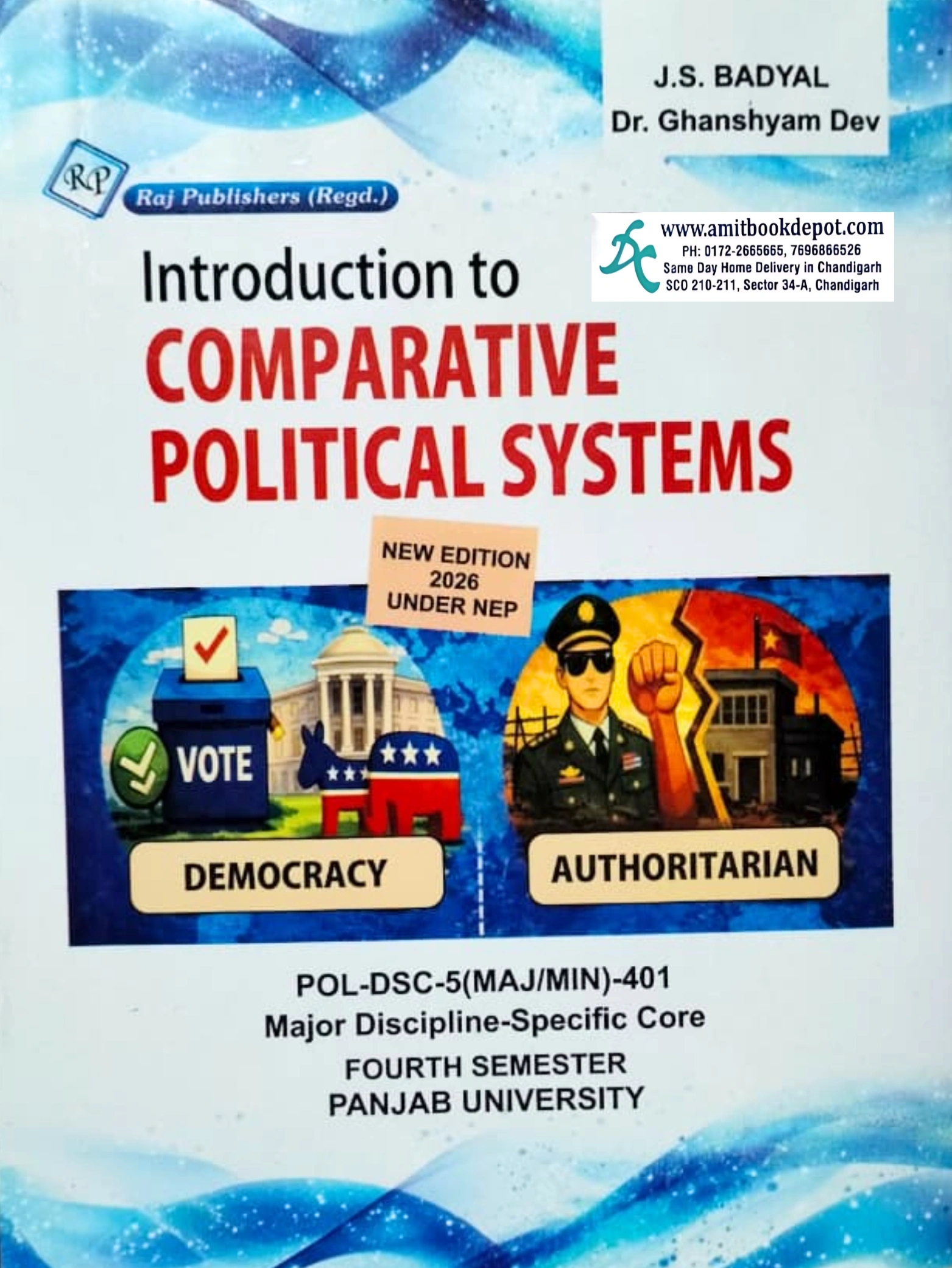
Yes, this book is meticulously crafted to align with the latest syllabus for "Introduction to Comparative Political Systems" (HSS-POL-DSC5) as per the New Education Policy (NEP) for B.A. 4th Semester.
Absolutely. The course code HSS-POL-DSC5(MAJ/MIN)-401 indicates it is designed for both Major and Minor discipline students of Political Science.
Yes, the book contains detailed comparative case studies on the Parliamentary System of the UK and the Presidential System of the USA, as well as their respective political parties and pressure groups.
Yes, Unit II provides a clear comparison of Federal and Unitary systems using the specific examples of Canada and the United Kingdom.
While the book covers all theoretical concepts for the 80-mark terminal exam, the in-depth explanations aid in completing internal assessments like assignments, term papers, and presentations.
Yes, Unit III is dedicated to comparing political regimes, detailing the types and features of both Authoritarian and Democratic systems.
Yes, it provides complete syllabus coverage, which is crucial for reappear/improvement candidates whose final marks are based solely on the theory paper performance.
Yes, one of the key learning outcomes of the book is to equip students with the comparative method to critically analyze and contrast different political systems.
Yes, Unit IV explains the meaning and functions of Interest/Pressure Groups and includes specific studies of these groups in the U.K. and the USA.
Yes, the first unit comprehensively covers the understanding of Comparative Politics as a discipline, including its meaning, changing nature, and scope.
No Description Added
Yes, this book is meticulously crafted to align with the latest syllabus for "Introduction to Comparative Political Systems" (HSS-POL-DSC5) as per the New Education Policy (NEP) for B.A. 4th Semester.
Absolutely. The course code HSS-POL-DSC5(MAJ/MIN)-401 indicates it is designed for both Major and Minor discipline students of Political Science.
Yes, the book contains detailed comparative case studies on the Parliamentary System of the UK and the Presidential System of the USA, as well as their respective political parties and pressure groups.
Yes, Unit II provides a clear comparison of Federal and Unitary systems using the specific examples of Canada and the United Kingdom.
While the book covers all theoretical concepts for the 80-mark terminal exam, the in-depth explanations aid in completing internal assessments like assignments, term papers, and presentations.
Yes, Unit III is dedicated to comparing political regimes, detailing the types and features of both Authoritarian and Democratic systems.
Yes, it provides complete syllabus coverage, which is crucial for reappear/improvement candidates whose final marks are based solely on the theory paper performance.
Yes, one of the key learning outcomes of the book is to equip students with the comparative method to critically analyze and contrast different political systems.
Yes, Unit IV explains the meaning and functions of Interest/Pressure Groups and includes specific studies of these groups in the U.K. and the USA.
Yes, the first unit comprehensively covers the understanding of Comparative Politics as a discipline, including its meaning, changing nature, and scope.