-
Mon-Fri: 10AM to 8PM 01722665665
-
My Account
-
-
0
Total :
₹ 0.00

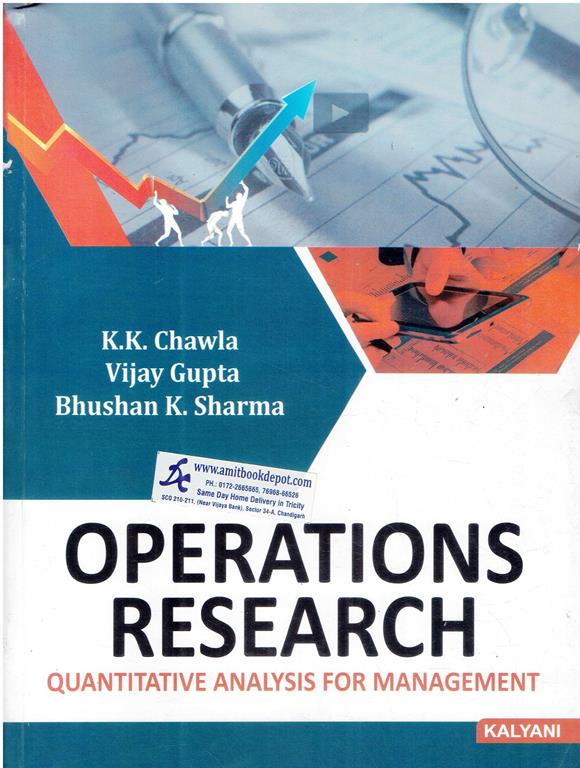




Yes, it is designed to be student-friendly. It starts with an introduction to OR and builds concepts from the ground up, making it accessible for beginners with a basic understanding of mathematics.
Absolutely. This book is a highly recommended text for various IGNOU management courses and covers the core topics of their Operations Research syllabus comprehensively.
While the book is renowned for its solved examples and step-by-step problem-solving approach, it primarily focuses on methodology. For a dedicated book of solved problems, you may need to check for a companion "Solved Problems" book by the same authors/publisher.
This book focuses on establishing a strong theoretical foundation in core OR techniques. It covers classic and essential algorithms but may not include specific software tutorials. The principles taught are fundamental to using any OR software effectively.
Yes, Chapters 5 and 6 are dedicated to the Big M Method and the Two-Phase Simplex Method respectively, providing detailed explanations and examples for solving linear programming problems with artificial variables and mixed constraints.
Chapter 17 on Network Analysis—PERT and CPM is comprehensive. It covers network construction, calculation of EST, EFT, LST, LFT, floats, probability in PERT, and time-cost trade-off concepts.
Yes, the book's content is structured to cover all four units of a typical PTU Operations Research syllabus, including Linear Programming, Transportation/Assignment, PERT/CPM/Decision Theory, and Game Theory/Queuing Theory.
Yes, Chapter 19 on Decision Theory includes decision-making under uncertainty and risk, Bayesian analysis, and the use of decision trees for multi-stage decision problems.
The authors have taken care to present complex quantitative concepts in a clear and manageable manner, making it suitable for students from commerce and management backgrounds, not just engineering.
Yes, it includes dedicated chapters on Goal Programming (Chapter 10) and Dynamic Programming Problems (Chapter 21), addressing these advanced optimization techniques.
No Description Added
Yes, it is designed to be student-friendly. It starts with an introduction to OR and builds concepts from the ground up, making it accessible for beginners with a basic understanding of mathematics.
Absolutely. This book is a highly recommended text for various IGNOU management courses and covers the core topics of their Operations Research syllabus comprehensively.
While the book is renowned for its solved examples and step-by-step problem-solving approach, it primarily focuses on methodology. For a dedicated book of solved problems, you may need to check for a companion "Solved Problems" book by the same authors/publisher.
This book focuses on establishing a strong theoretical foundation in core OR techniques. It covers classic and essential algorithms but may not include specific software tutorials. The principles taught are fundamental to using any OR software effectively.
Yes, Chapters 5 and 6 are dedicated to the Big M Method and the Two-Phase Simplex Method respectively, providing detailed explanations and examples for solving linear programming problems with artificial variables and mixed constraints.
Chapter 17 on Network Analysis—PERT and CPM is comprehensive. It covers network construction, calculation of EST, EFT, LST, LFT, floats, probability in PERT, and time-cost trade-off concepts.
Yes, the book's content is structured to cover all four units of a typical PTU Operations Research syllabus, including Linear Programming, Transportation/Assignment, PERT/CPM/Decision Theory, and Game Theory/Queuing Theory.
Yes, Chapter 19 on Decision Theory includes decision-making under uncertainty and risk, Bayesian analysis, and the use of decision trees for multi-stage decision problems.
The authors have taken care to present complex quantitative concepts in a clear and manageable manner, making it suitable for students from commerce and management backgrounds, not just engineering.
Yes, it includes dedicated chapters on Goal Programming (Chapter 10) and Dynamic Programming Problems (Chapter 21), addressing these advanced optimization techniques.