Categories
College Bookssss >
BA PU Chandigarh
BSC PU Chandigarh
MSC PU Chandigarh
BBA PU Chandigarh
MA PU Chandigarh
Medical Books
Engineering Books
Management Books
PGDCA Books
BCOM PU Chandigarh
MCOM PU Chandigarh
BCA PU Chandigarh
MCA PU Chandigarh
animate-books

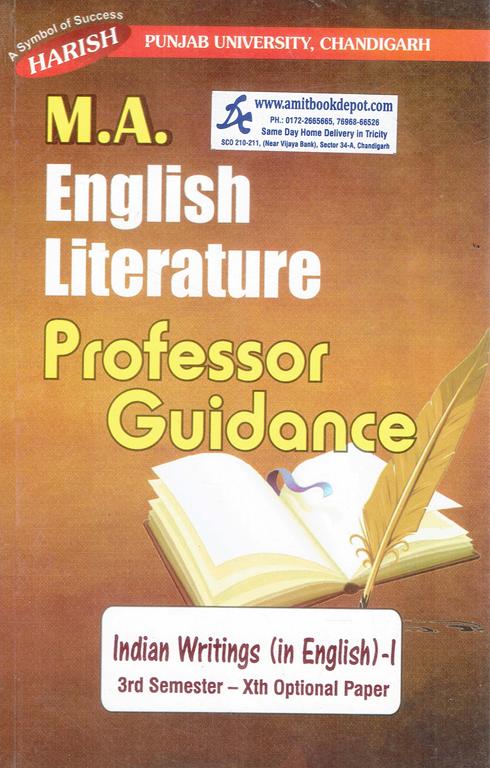
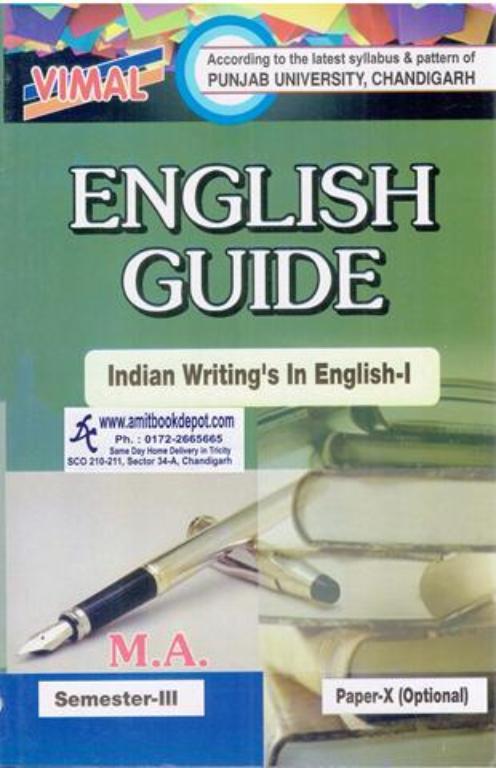
Harish Professor Guidance Indian Writings in English 1 For MA 3rd Semester 10th Optional Paper Panjab University Chandigarh

by Madhurima
โ‚น360 โ‚น360.00(-/ off)

Rating & Reviews

23 Customer Review

Master your MA 3rd Semester (Paper X) with this essential Professor Guidance for Indian Writings in English - I, tailored for Panjab University, Chandigarh. Authored by Dr. Chakreshwari Dixit and Dr. Mohd Mazhar, this guide provides comprehensive, unit-wise analysis of the prescribed syllabus. It covers key texts, including prose by Tagore and Chaudhuri, novels by Raja Rao and Githa Hariharan, poetry by Ramanujan, Kolatkar, and Agha Shahid Ali, and Dattani's drama Final Solutions. With critical insights, thematic explanations, and exam-focused content, it is the definitive study aid for achieving academic excellence in this optional paper.

Have Doubts Regarding This Product ? Ask Your Question

  • Q1
    Is this book a compilation of the original literary texts or a guide/analysis of them?
    A1

    This is a comprehensive academic guide and analysis book. It provides detailed explanations, critical commentary, thematic discussions, and exam-oriented content for the original texts prescribed in the Panjab University syllabus. The original literary works themselves are not reproduced in full.

  • Q2
    Does this guide cover all five units exactly as per the latest Panjab University MA 3rd Semester syllabus for Optional Paper X?
    A2

    Yes, the book is meticulously structured to align with the latest syllabus. It covers all five units: Non-Fictional Prose (Tagore, Mehrotra, Chaudhuri), Fiction I (Raja Rao), Fiction II (Githa Hariharan), Poetry (Ramanujan, Kolatkar, Agha Shahid Ali), and Drama (Mahesh Dattani) in precise detail.

  • Q3
    How does this book help in understanding complex theoretical essays like those in Unit I on Non-Fictional Prose?
    A3

    The guide breaks down complex essays by Tagore, Mehrotra, and Chaudhuri into clear summaries and analyses. It explains key arguments, historical context, and critical terminology, making these foundational texts more accessible.

  • Q4
    Is there a detailed analysis of the narrative technique and "panchayat style" in Raja Rao's Kanthapura?
    A4

    Yes, a significant portion of the Unit on Kanthapura is dedicated to analyzing its unique narrative voice, the use of the oral storytelling tradition (panchayat style), and its significance in Indianizing the English novel.

  • Q5
    How does the guide approach the feminist themes and use of myth in Githa Hariharan's The Thousand Faces of Night?
    A5

    The book provides a dedicated feminist reading of the novel, explaining its intertextuality with Indian epics and folklore, and analyzing how these myths are subverted to explore modern women's struggles and identities.

  • Q6
    What specific aspects of Mahesh Dattani's Final Solutions does the book highlight?
    A6

    It focuses on the play's dramatic structure, character motivations, symbolism, and its powerful treatment of sensitive themes like communalism, religious prejudice, and the search for personal and national identity in contemporary India.

  • Q7
    Is the historical and cultural context of Indian Writing in English, as mentioned in the syllabus introduction, covered in this guide?
    A7

    Yes, the guide incorporates the broader context of the genre's evolutionโ€”from colonial origins to post-modern expressionsโ€”within the analysis of individual texts, helping students answer questions on authenticity, language, and national identity.

  • Q8
    If I am a distance learning or part-time student of Panjab University, is this guide sufficient for self-study?
    A8

    Yes, it is particularly valuable for distance and self-study students. Its structured format, clear explanations, and self-contained analysis are designed to compensate for limited classroom instruction.

  • Q9
    Does the product description list the exact page numbers or editions referenced for the literary texts (e.g., from Kala Ghoda Poems)?
    A9

    The guide follows the editions and specific selections (like poems "Meera" and "Knucklebones" from Kala Ghoda Poems) as prescribed in the official Panjab University syllabus provided in the product details.

  • Q10
    Is this book useful only for exam preparation, or can it also aid in developing critical thinking for seminars and assignments?
    A10

    While exam-oriented, the guide's in-depth critical analysis, thematic explorations, and discussion points provide a strong foundation for developing original arguments, making it highly useful for seminars, term papers, and assignments as well.

0.00

0 Overall Rating
  • 5
    0
  • 4
    0
  • 3
    0
  • 2
    0
  • 1
    0

Try this product & share your review & thoughts

Unit Iโ€”NON-FICTIONAL PROSE

1. Nationalism in Indiaโ€”Ravindranath Tagore

- Rabindranath Tagore
Life and Works
Ravindranath Tagore as a Poet
Tagore as a Poet of Love
1. Tagore Rejected Nationalism
2. Tagore as an Intellectualist

- Nationalism in India
Text
Summary
1. Tagore's Brand of Nationalism
2. Nationalism. Nation and Indian Nationalism
3. Ravindranath Tagore's Perception of Indian Nationalism

2. THE EMPEROR HAS NO CLOTHESโ€”Arvind Krishna Mehrotra

- Arvind Krishna Mehrotra
Introduction to the Author
1. Arvind Krishna Mehrotra as a Critic
2. Mehrotra as a Surrealist Poet

- The Emperor Has No Clothes
What does 'The emperor has no clothes' mean?
1. A.K. Mehrotra and Other Indian Writers
2. Mehrotra's Views on Criticism
3. Discussion between Mehrotra and Daruwalla
4. A. K. Mehrotra and Indian English Poets

3. THE CONSTRUCTION OF THE INDIAN NOVEL IN ENGLISHโ€”Amit Chaudhuri

- Amit Chaudhuri
Introduction to the Author
1. Social Crisis in the Novels of Amit Chaudhuri
2. Amit Chaudhuriโ€”His Relationship with Calcutta and Current Literary Trends
3. Amit Chaudhuri: A Creative Writer of the Highest Intellectual Quality

- The Construction of the Indian Novel in English
Introduction of the Essay
Summary of the Essay
1. Indian Novel in English Versus Indian Languages 17-18
2. About Translated Words in Indian Languages
3. Indian Writers in English Open New Chapter in Europe
4. Amit Chaudhuri's views on modern Indian literature
5. Indian Writing in English and Regional Literature in the Light of Indian-English
6. Amit Chaudhuri on Indian Vernacular Literature
7. Amit Chaudhuri on Rushdie's Remark

Unit-II-FICTION-I

4. Kanthapuraโ€”Raja Rao

- Raja Rao
Introduction to Raja Rao's Life
1. His Early Life and Education
2. Raja Rao as a Novelist
3. The Novels of Raja Rao
4. The Short Stories of Raja Rao

- Kanthapura
English Summary of the Novel

MAJOR CHARACTERS

1. Moorthy
2. Ranga Gowda
3. Ratna
4. Bade Khan
1: Discuss, in your own words, the significance of the title, 'Kanthapura,' a great novel by Raja Rao.
or
'Kanthapura' itself shows and presents the life in a South Indian village as an appropriate title.
2. Discuss, in your own words, that 'Kanthapura' is a social novel by Raja Rao.
or
'Kanthapura' depicts well the social evils of untouchability, the caste system, widowhood, etc. in a realistic style. Discuss.
3. Moorthy is the central character of 'Kanthapura,' working and fighting under the invisible inspiration of Gandhiji. Discuss.
4. Write a brief note on Raja Rao's art of characterization as given in 'Kanthapura.'
5. Describe, in your own words, the Skeffington Coffee Estate.
or
"The Skeffington Coffee Estate" plays an important part in the novel "Kanthapura" by Raja Rao. Discuss.
or
The Skeffington Coffee Estate is closely related with the life and activities of the people of Kanthapura village. Discuss.
6. Raja Rao presents Gandhiji's Freedom Movement in 'Kanthapura.' Discuss.
or
Describe, in your own words, how 'Kanthapura' shows the transformation of Indian life under Moorthy's leadership and Gandhiji's inspiration.
7. 'Kanthapura' by Raja Rao is a perfect novel about Indian life. Discuss.
or
The theme and the background of the novel 'Kanthapura' by Raja Rao are perfectly Indian. Describe it in your own words.
8. 'Kanthapura' by Raja Rao presents the historical background of the freedom movement in India. Discuss.
or
Describe, in your own words, Gandhiji's invisible role in the present novel.
9. Describe, in your own words, the aim of Raja Rao in writing 'Kanthapura.'
or
Gandhiji's aim of socio-economic programs is glorified in 'Kanthapura,' written by Raja Rao. Discuss.
10. The village, 'Kanthapura,' itself is the hero in the novel, 'Kanthapura.' Discuss.
or
The people, the rituals, the festivals, and the Gandhian movement find an effective expression in the novel 'Kanthapura' by Raja Rao. Discuss it in your own words.
11. 'Kanthapura' shows a harmonious mixture of religion and politics. Discuss.
or
Describe, in your own words, the blending of the Freedom Movement in Kanthapura with the people's religious feelings.
12. 'Kanthapura' by Raja Rao is Gandhiji's philosophy in practice. Discuss.
or
Describe, in your own words, Gandhiji's main principles referred to in 'Kanthapura.'

Unit IIIโ€”FICTIONโ€”II
5. THE THOUSAND FACES OF NIGHTโ€”Githa Hariharam

- Githa Hariharan
Introduction to Githa Hariharan

- The Thousand Faces of Night
Summary of the Novel
Introduction to the Novel
1. Portrayal of Women Characters in the Novel of Githa Hariharan
2. Female Consciousness in the Novel
3. A Critical Appraisal of Women in the Novel
4. Myth and Reality in the Novel
5. Fusion of Myth and Reality
6. Survival Strategies of Women

Unit IVโ€”POETRY
6. SELECTED POEMSโ€”A. K. Ramanujan

- A.K. Ramanujan
Life and Career
1. Ramanujan's Contribution
2. Ramanujan's Poetic Craft
3. Influence of Hindu Heritage
4. The Importance of Family
5. Personal Elements in Ramanujan's Poetry
6. Use of Irony
7. Tradition and Modernity

- Small-Scale Reflection on Great House
Text of Poem
Introduction to the Poem
Summary of the Poem
Critical Appreciation of the Poem

- Extended Family
Text of Poem
Introduction to the Poem
Summary of the Poem
The Theme of the Poem
Critical Appreciation of the Poem

7. 'KALA GHODA' POEMSโ€”Arun Kolatkar

- Arun Kolatkar
Introduction to Arun Kolatkar
1. Arun Kolatkar and Literary Modernism in India
2. The Cartography of the Local in Arun Kolatkar's Poetry
3. Arun Kolatkar: The Reclusive and Audacious Poet
4. Intercultural Transfer in the Poetry of Arun Kolatkar

- Kala Ghoda
1. Main Features of Kala Ghoda's Poems
2. Bombay (Mumbai), as Kolatkar has depicted in Kala Ghoda of Bombay of Kolatkar's Poems

- Knucklebones
Text of Poem
Introduction to the Poem
Summary of the Poem
Critical Appreciation of the Poem

- Mecra
Text of Poem
Introduction to the Poem
Summary of the Poem
Critical Appreciation of the Poem

8. SELECTED POEMSโ€”Agha Shahid Ali

- Agha Shahid Ali
Introduction to Agha Shahid Ali
1. Agha Shahid Ali: The Poet of Loss and Longing
2. Agha Shahid Ali as a Poet
3. Imagery in Agha Shahid Ali's Poetry
4. Depiction of Women in Agha Shahid Ali's
5. Style, Themes, and Imagery

- The Dacca Gauzes
Text
Introduction to the Poem
Summary of the Poem
Critical Appreciation of the Poem

- Beyond English
Text
Introduction to the Poem
Summary of the Poem
Critical Appreciation of the Poem

Unit Vโ€”DRAMA
9. FINAL SOLUTIONSโ€”Mahesh Dattani

- Mahesh Dattani
Introduction to the Author
A Brief Summary of Dattani's Plays
1. Mahesh Dattani as a Playwright
2. The Art of Characterization in Mahesh Dattani's Play
3. Role of Mahesh Dattani in Reviving Indian-English Drama

- Final Solutions
Summary of 'Final Solutions'
1. A Drama of Social Melodies
2. An Analytical Study
3. Mother-Daughter Conflicts
4. A Study of Harsh Social Reality
5. Revisited in the Light of Communal Divide
6. Communal Tension and Gender Bias
7. Role of Memory in Shaping Character's Identity in Mahesh Dattani's Final Solutions
8. Stage Direction
9. Exposure of Communal Disharmony
10. Transferred Resentment in 'Final Solution'

- Characters in Final Solutions
Ramanik
Hardika
Javed
Aruna
Samita
Babban (Bobby)

Latest Syllabus of Professor Guidance Indian Writings in English 1 For MA 3rd Semester 10th Optional Paper Panjab University (PU) Chandigarh


Paper X
(Choose any one option.)
(1) Indian Writings (in English) โ€“ I

Indian Literature in English has captured the attention of readers both at home and abroad as it transforms the art of oral Indian narrative and indigenous experience in an adopted language, giving it a new dimension. The present course aims at presenting a sweep of Indian writing in English, representative of multiple genres and voices. Indian writers took to English as a consequence of the introduction of English as the medium of instruction by the British. From raising questions against the colonial enterprise to encapsulating the disillusionment of post-Independence India and receiving a definitive fillip in the 1980s, it has negotiated a convoluted terrain. And from being โ€˜twice bornโ€™ to flowering into a playful, self-conscious writing, it indeed has been a long journey. The course aims at acquainting students with the diverse range of Indian writing in English. Further, the list of texts will call for a thorough contextual discussion, as the genre has grappled with contentious issues of authenticity, language, nation, identity, and idiom. The paper has 5 units. The testing pattern will include one question with internal choice from each unit. All questions will be compulsory.

Unit 1: Non-Fictional Prose

1. Rabindranath Tagore, โ€œNationalism in India,โ€ Nationalism (BoD, 2018), 41-55.
2. Arvind Krishna Mehrotra, โ€œFrom โ€œThe Emperor Has No Clothes,โ€ ed. Amit Chaudhuri, The Picador Book of Modern Indian Literature (New Delhi: Picador, 2001) 456-477.
3. Amit Chaudhuri, โ€œThe Construction of the Indian Novel in English,โ€ ed. Amit Chaudhuri, The Picador Book of Modern Indian Literature (New Delhi: Picador, 2001) xxiiiโ€“xxxi.

Unit 2 Fiction I

1. Raja Rao. Kanthapura, New Delhi: Orient, 1971

Unit 3: Fiction II

2. Githa Hariharan. The Thousand Faces of Night. New Delhi: Penguin, 2008.

Unit 4 Poetry

1. A.K. Ramanujan: โ€œExtended Familyโ€ and โ€œSmall Scale Reflections on a Great House,โ€ The Collected Poems of A.K. Ramanujan (Delhi: OUP, 1995)
2. Arun Kolatkar: โ€œMeeraโ€ (26-33) and โ€œKnucklebonesโ€ (66-69), Kala Ghoda Poems (Mumbai, Pras Prakashan, 2004)
3. Agha Shahid Ali: โ€œThe Dacca Gauzesโ€ and โ€œBeyond Englishโ€ from The Veiled Suiteโ€”The Collected Poems. WW Norton & Company, 2009.

Unit 5 Drama

1. Mahesh Dattani. Final Solutions. Oxford University Press, 2005.

Harish Prakashan Mandir presents "Professor Guidance: Indian Writings in Englishโ€”I," an essential and meticulously crafted academic guide designed explicitly for the MA 3rd Semester, 10th Optional Paper (Paper X) of Panjab University, Chandigarh. Authored by the esteemed academics Dr. Chakreshwari Dixit and Dr. Mohd Mazhar, this book serves as a definitive companion for students navigating the rich and complex terrain of Indian Writing in English. It aligns perfectly with the prescribed syllabus, offering a structured, unit-wise, and in-depth exploration of the texts and themes mandated by the university. This guide is engineered to facilitate a profound understanding, critical analysis, and examination success.

The book is systematically organized into five units, mirroring the university syllabus to provide seamless study and revision. Unit I delves into Non-Fictional Prose, featuring critical essays that form the theoretical backbone of the genre. It includes Rabindranath Tagore's seminal thoughts on "Nationalism in India," Arvind Krishna Mehrotra's incisive literary critique in "The Emperor Has No Clothes," and Amit Chaudhuri's pivotal exploration of "The Construction of the Indian Novel in English." This unit equips students with the necessary critical frameworks to appreciate the historical and aesthetic debates surrounding Indian English literature, including issues of authenticity, colonialism, and literary identity.

Units II and III are dedicated to fiction, offering comprehensive guidance on two landmark novels. Detailed analysis of Raja Rao's Kanthapura covers its narrative technique, use of the panchayat style, and its portrayal of the Gandhian freedom struggle. The guide then explores Githa Hariharan's The Thousand Faces of Night, focusing on its feminist perspectives, intertextuality with Indian myths, and the portrayal of contemporary womanhood. These sections provide character sketches, thematic discussions, critical commentaries, and potential question-answer formats crucial for exam preparation.

Unit IV provides an exhaustive treatment of poetry, a core component of the paper. It decodes the selected poems of three iconic poets: A.K. Ramanujan ("Extended Family," "Small-Scale Reflections on a Great House"), Arun Kolatkar ("Meera," "Knucklebones" from Kala Ghoda Poems), and Agha Shahid Ali ("The Dacca Gauzes," "Beyond English"). The guide illuminates the poets' distinctive styles, imagery, and central themesโ€”such as memory, tradition, cultural hybridity, and linguistic identityโ€”enabling students to analyze and interpret poetic texts with confidence.

The final unit encompasses drama, with a focused study of Mahesh Dattani's powerful play Final Solutions. The guide breaks down the plot, characters, and dramatic techniques while providing a critical examination of its handling of communal tensions, prejudice, and identity politics in modern India. This analysis helps students engage with the play's contemporary relevance and moral complexities.

Beyond textual analysis, this Professor Guidance book encapsulates the entire spirit of the syllabus, which traces the journey of Indian Writing in English from its colonial origins to its postmodern expressions. It addresses the genre's negotiation with nation, language, and idiom. Compiled by experts familiar with Panjab University's examination patterns, the book includes probable questions, model answers, and discussion points that emphasize a contextual understanding of the literature. It is an indispensable resource for securing high marks, offering clarity, depth, and academic rigor in one consolidated volume. For any MA English student at Panjab University, this guide is not just a book but a strategic academic tool for mastering Paper X.

Unit Iโ€”NON-FICTIONAL PROSE

1. Nationalism in Indiaโ€”Ravindranath Tagore

- Rabindranath Tagore
Life and Works
Ravindranath Tagore as a Poet
Tagore as a Poet of Love
1. Tagore Rejected Nationalism
2. Tagore as an Intellectualist

- Nationalism in India
Text
Summary
1. Tagore's Brand of Nationalism
2. Nationalism. Nation and Indian Nationalism
3. Ravindranath Tagore's Perception of Indian Nationalism

2. THE EMPEROR HAS NO CLOTHESโ€”Arvind Krishna Mehrotra

- Arvind Krishna Mehrotra
Introduction to the Author
1. Arvind Krishna Mehrotra as a Critic
2. Mehrotra as a Surrealist Poet

- The Emperor Has No Clothes
What does 'The emperor has no clothes' mean?
1. A.K. Mehrotra and Other Indian Writers
2. Mehrotra's Views on Criticism
3. Discussion between Mehrotra and Daruwalla
4. A. K. Mehrotra and Indian English Poets

3. THE CONSTRUCTION OF THE INDIAN NOVEL IN ENGLISHโ€”Amit Chaudhuri

- Amit Chaudhuri
Introduction to the Author
1. Social Crisis in the Novels of Amit Chaudhuri
2. Amit Chaudhuriโ€”His Relationship with Calcutta and Current Literary Trends
3. Amit Chaudhuri: A Creative Writer of the Highest Intellectual Quality

- The Construction of the Indian Novel in English
Introduction of the Essay
Summary of the Essay
1. Indian Novel in English Versus Indian Languages 17-18
2. About Translated Words in Indian Languages
3. Indian Writers in English Open New Chapter in Europe
4. Amit Chaudhuri's views on modern Indian literature
5. Indian Writing in English and Regional Literature in the Light of Indian-English
6. Amit Chaudhuri on Indian Vernacular Literature
7. Amit Chaudhuri on Rushdie's Remark

Unit-II-FICTION-I

4. Kanthapuraโ€”Raja Rao

- Raja Rao
Introduction to Raja Rao's Life
1. His Early Life and Education
2. Raja Rao as a Novelist
3. The Novels of Raja Rao
4. The Short Stories of Raja Rao

- Kanthapura
English Summary of the Novel

MAJOR CHARACTERS

1. Moorthy
2. Ranga Gowda
3. Ratna
4. Bade Khan
1: Discuss, in your own words, the significance of the title, 'Kanthapura,' a great novel by Raja Rao.
or
'Kanthapura' itself shows and presents the life in a South Indian village as an appropriate title.
2. Discuss, in your own words, that 'Kanthapura' is a social novel by Raja Rao.
or
'Kanthapura' depicts well the social evils of untouchability, the caste system, widowhood, etc. in a realistic style. Discuss.
3. Moorthy is the central character of 'Kanthapura,' working and fighting under the invisible inspiration of Gandhiji. Discuss.
4. Write a brief note on Raja Rao's art of characterization as given in 'Kanthapura.'
5. Describe, in your own words, the Skeffington Coffee Estate.
or
"The Skeffington Coffee Estate" plays an important part in the novel "Kanthapura" by Raja Rao. Discuss.
or
The Skeffington Coffee Estate is closely related with the life and activities of the people of Kanthapura village. Discuss.
6. Raja Rao presents Gandhiji's Freedom Movement in 'Kanthapura.' Discuss.
or
Describe, in your own words, how 'Kanthapura' shows the transformation of Indian life under Moorthy's leadership and Gandhiji's inspiration.
7. 'Kanthapura' by Raja Rao is a perfect novel about Indian life. Discuss.
or
The theme and the background of the novel 'Kanthapura' by Raja Rao are perfectly Indian. Describe it in your own words.
8. 'Kanthapura' by Raja Rao presents the historical background of the freedom movement in India. Discuss.
or
Describe, in your own words, Gandhiji's invisible role in the present novel.
9. Describe, in your own words, the aim of Raja Rao in writing 'Kanthapura.'
or
Gandhiji's aim of socio-economic programs is glorified in 'Kanthapura,' written by Raja Rao. Discuss.
10. The village, 'Kanthapura,' itself is the hero in the novel, 'Kanthapura.' Discuss.
or
The people, the rituals, the festivals, and the Gandhian movement find an effective expression in the novel 'Kanthapura' by Raja Rao. Discuss it in your own words.
11. 'Kanthapura' shows a harmonious mixture of religion and politics. Discuss.
or
Describe, in your own words, the blending of the Freedom Movement in Kanthapura with the people's religious feelings.
12. 'Kanthapura' by Raja Rao is Gandhiji's philosophy in practice. Discuss.
or
Describe, in your own words, Gandhiji's main principles referred to in 'Kanthapura.'

Unit IIIโ€”FICTIONโ€”II
5. THE THOUSAND FACES OF NIGHTโ€”Githa Hariharam

- Githa Hariharan
Introduction to Githa Hariharan

- The Thousand Faces of Night
Summary of the Novel
Introduction to the Novel
1. Portrayal of Women Characters in the Novel of Githa Hariharan
2. Female Consciousness in the Novel
3. A Critical Appraisal of Women in the Novel
4. Myth and Reality in the Novel
5. Fusion of Myth and Reality
6. Survival Strategies of Women

Unit IVโ€”POETRY
6. SELECTED POEMSโ€”A. K. Ramanujan

- A.K. Ramanujan
Life and Career
1. Ramanujan's Contribution
2. Ramanujan's Poetic Craft
3. Influence of Hindu Heritage
4. The Importance of Family
5. Personal Elements in Ramanujan's Poetry
6. Use of Irony
7. Tradition and Modernity

- Small-Scale Reflection on Great House
Text of Poem
Introduction to the Poem
Summary of the Poem
Critical Appreciation of the Poem

- Extended Family
Text of Poem
Introduction to the Poem
Summary of the Poem
The Theme of the Poem
Critical Appreciation of the Poem

7. 'KALA GHODA' POEMSโ€”Arun Kolatkar

- Arun Kolatkar
Introduction to Arun Kolatkar
1. Arun Kolatkar and Literary Modernism in India
2. The Cartography of the Local in Arun Kolatkar's Poetry
3. Arun Kolatkar: The Reclusive and Audacious Poet
4. Intercultural Transfer in the Poetry of Arun Kolatkar

- Kala Ghoda
1. Main Features of Kala Ghoda's Poems
2. Bombay (Mumbai), as Kolatkar has depicted in Kala Ghoda of Bombay of Kolatkar's Poems

- Knucklebones
Text of Poem
Introduction to the Poem
Summary of the Poem
Critical Appreciation of the Poem

- Mecra
Text of Poem
Introduction to the Poem
Summary of the Poem
Critical Appreciation of the Poem

8. SELECTED POEMSโ€”Agha Shahid Ali

- Agha Shahid Ali
Introduction to Agha Shahid Ali
1. Agha Shahid Ali: The Poet of Loss and Longing
2. Agha Shahid Ali as a Poet
3. Imagery in Agha Shahid Ali's Poetry
4. Depiction of Women in Agha Shahid Ali's
5. Style, Themes, and Imagery

- The Dacca Gauzes
Text
Introduction to the Poem
Summary of the Poem
Critical Appreciation of the Poem

- Beyond English
Text
Introduction to the Poem
Summary of the Poem
Critical Appreciation of the Poem

Unit Vโ€”DRAMA
9. FINAL SOLUTIONSโ€”Mahesh Dattani

- Mahesh Dattani
Introduction to the Author
A Brief Summary of Dattani's Plays
1. Mahesh Dattani as a Playwright
2. The Art of Characterization in Mahesh Dattani's Play
3. Role of Mahesh Dattani in Reviving Indian-English Drama

- Final Solutions
Summary of 'Final Solutions'
1. A Drama of Social Melodies
2. An Analytical Study
3. Mother-Daughter Conflicts
4. A Study of Harsh Social Reality
5. Revisited in the Light of Communal Divide
6. Communal Tension and Gender Bias
7. Role of Memory in Shaping Character's Identity in Mahesh Dattani's Final Solutions
8. Stage Direction
9. Exposure of Communal Disharmony
10. Transferred Resentment in 'Final Solution'

- Characters in Final Solutions
Ramanik
Hardika
Javed
Aruna
Samita
Babban (Bobby)

Have Doubts Regarding This Product ? Ask Your Question

  • Q1
    Is this book a compilation of the original literary texts or a guide/analysis of them?
    A1

    This is a comprehensive academic guide and analysis book. It provides detailed explanations, critical commentary, thematic discussions, and exam-oriented content for the original texts prescribed in the Panjab University syllabus. The original literary works themselves are not reproduced in full.

  • Q2
    Does this guide cover all five units exactly as per the latest Panjab University MA 3rd Semester syllabus for Optional Paper X?
    A2

    Yes, the book is meticulously structured to align with the latest syllabus. It covers all five units: Non-Fictional Prose (Tagore, Mehrotra, Chaudhuri), Fiction I (Raja Rao), Fiction II (Githa Hariharan), Poetry (Ramanujan, Kolatkar, Agha Shahid Ali), and Drama (Mahesh Dattani) in precise detail.
  • Q3
    How does this book help in understanding complex theoretical essays like those in Unit I on Non-Fictional Prose?
    A3

    The guide breaks down complex essays by Tagore, Mehrotra, and Chaudhuri into clear summaries and analyses. It explains key arguments, historical context, and critical terminology, making these foundational texts more accessible.

  • Q4
    Is there a detailed analysis of the narrative technique and "panchayat style" in Raja Rao's Kanthapura?
    A4

    Yes, a significant portion of the Unit on Kanthapura is dedicated to analyzing its unique narrative voice, the use of the oral storytelling tradition (panchayat style), and its significance in Indianizing the English novel.

  • Q5
    How does the guide approach the feminist themes and use of myth in Githa Hariharan's The Thousand Faces of Night?
    A5

    The book provides a dedicated feminist reading of the novel, explaining its intertextuality with Indian epics and folklore, and analyzing how these myths are subverted to explore modern women's struggles and identities.

  • Q6
    What specific aspects of Mahesh Dattani's Final Solutions does the book highlight?
    A6

    It focuses on the play's dramatic structure, character motivations, symbolism, and its powerful treatment of sensitive themes like communalism, religious prejudice, and the search for personal and national identity in contemporary India.

  • Q7
    Is the historical and cultural context of Indian Writing in English, as mentioned in the syllabus introduction, covered in this guide?
    A7

    Yes, the guide incorporates the broader context of the genre's evolutionโ€”from colonial origins to post-modern expressionsโ€”within the analysis of individual texts, helping students answer questions on authenticity, language, and national identity.

  • Q8
    If I am a distance learning or part-time student of Panjab University, is this guide sufficient for self-study?
    A8

    Yes, it is particularly valuable for distance and self-study students. Its structured format, clear explanations, and self-contained analysis are designed to compensate for limited classroom instruction.

  • Q9
    Does the product description list the exact page numbers or editions referenced for the literary texts (e.g., from Kala Ghoda Poems)?
    A9

    The guide follows the editions and specific selections (like poems "Meera" and "Knucklebones" from Kala Ghoda Poems) as prescribed in the official Panjab University syllabus provided in the product details.

  • Q10
    Is this book useful only for exam preparation, or can it also aid in developing critical thinking for seminars and assignments?
    A10

    While exam-oriented, the guide's in-depth critical analysis, thematic explorations, and discussion points provide a strong foundation for developing original arguments, making it highly useful for seminars, term papers, and assignments as well.

Latest Syllabus of Professor Guidance Indian Writings in English 1 For MA 3rd Semester 10th Optional Paper Panjab University (PU) Chandigarh


Paper X
(Choose any one option.)
(1) Indian Writings (in English) โ€“ I

Indian Literature in English has captured the attention of readers both at home and abroad as it transforms the art of oral Indian narrative and indigenous experience in an adopted language, giving it a new dimension. The present course aims at presenting a sweep of Indian writing in English, representative of multiple genres and voices. Indian writers took to English as a consequence of the introduction of English as the medium of instruction by the British. From raising questions against the colonial enterprise to encapsulating the disillusionment of post-Independence India and receiving a definitive fillip in the 1980s, it has negotiated a convoluted terrain. And from being โ€˜twice bornโ€™ to flowering into a playful, self-conscious writing, it indeed has been a long journey. The course aims at acquainting students with the diverse range of Indian writing in English. Further, the list of texts will call for a thorough contextual discussion, as the genre has grappled with contentious issues of authenticity, language, nation, identity, and idiom. The paper has 5 units. The testing pattern will include one question with internal choice from each unit. All questions will be compulsory.

Unit 1: Non-Fictional Prose

1. Rabindranath Tagore, โ€œNationalism in India,โ€ Nationalism (BoD, 2018), 41-55.
2. Arvind Krishna Mehrotra, โ€œFrom โ€œThe Emperor Has No Clothes,โ€ ed. Amit Chaudhuri, The Picador Book of Modern Indian Literature (New Delhi: Picador, 2001) 456-477.
3. Amit Chaudhuri, โ€œThe Construction of the Indian Novel in English,โ€ ed. Amit Chaudhuri, The Picador Book of Modern Indian Literature (New Delhi: Picador, 2001) xxiiiโ€“xxxi.

Unit 2 Fiction I

1. Raja Rao. Kanthapura, New Delhi: Orient, 1971

Unit 3: Fiction II

2. Githa Hariharan. The Thousand Faces of Night. New Delhi: Penguin, 2008.

Unit 4 Poetry

1. A.K. Ramanujan: โ€œExtended Familyโ€ and โ€œSmall Scale Reflections on a Great House,โ€ The Collected Poems of A.K. Ramanujan (Delhi: OUP, 1995)
2. Arun Kolatkar: โ€œMeeraโ€ (26-33) and โ€œKnucklebonesโ€ (66-69), Kala Ghoda Poems (Mumbai, Pras Prakashan, 2004)
3. Agha Shahid Ali: โ€œThe Dacca Gauzesโ€ and โ€œBeyond Englishโ€ from The Veiled Suiteโ€”The Collected Poems. WW Norton & Company, 2009.

Unit 5 Drama

1. Mahesh Dattani. Final Solutions. Oxford University Press, 2005.

0.00

0 Overall Rating
  • 5
    0
  • 4
    0
  • 3
    0
  • 2
    0
  • 1
    0

Try this product & share your review & thoughts

Top Trending Product

Related Product

Related Product

Related Blog Posts

Latest Blogs

Latest Blogs

blog-img
Classic Literature Reimagined: Discuss modern twists on classic novels.
Lorem ipsum dolor sit amet, consectetur adipiscing elit, sed do eiusmod tempor incididunt ut labore et dolore magna aliqua. Ut enim ad minim veniam, quis nostrud exercitation ullamco Lorem ipsum dolor sit amet, consectetur adipiscing elit, sed do eiusmod tempor incididunt ut labore et dolore magna aliqua. Utenim ad minim veniam, quis nostrud exercitation ullamco Lorem ipsum dolor sit amet, consecte...
Read more
Author name | 10 jan, 2025
blog-img
Classic Literature Reimagined: Discuss modern twists on classic novels.
Lorem ipsum dolor sit amet, consectetur adipiscing elit, sed do eiusmod tempor incididunt ut labore et dolore magna aliqua. Ut enim ad minim veniam, quis nostrud exercitation ullamco Lorem ipsum dolor sit amet, consectetur adipiscing elit, sed do eiusmod tempor incididunt ut labore et dolore magna aliqua. Utenim ad minim veniam, quis nostrud exercitation ullamco Lorem ipsum dolor sit amet, consecte...
Read more
Author name | 10 jan, 2025
blog-img
Classic Literature Reimagined: Discuss modern twists on classic novels.
Lorem ipsum dolor sit amet, consectetur adipiscing elit, sed do eiusmod tempor incididunt ut labore et dolore magna aliqua. Ut enim ad minim veniam, quis nostrud exercitation ullamco Lorem ipsum dolor sit amet, consectetur adipiscing elit, sed do eiusmod tempor incididunt ut labore et dolore magna aliqua. Utenim ad minim veniam, quis nostrud exercitation ullamco Lorem ipsum dolor sit amet, consecte...
Read more
Author name | 10 jan, 2025
blog-img
Classic Literature Reimagined: Discuss modern twists on classic novels.
Lorem ipsum dolor sit amet, consectetur adipiscing elit...
Read more
Author Name | 10 Jan, 2025
blog-img
Classic Literature Reimagined: Discuss modern twists on classic novels.
Lorem ipsum dolor sit amet, consectetur adipiscing elit...
Read more
Author Name | 10 Jan, 2025
blog-img
Classic Literature Reimagined: Discuss modern twists on classic novels.
Lorem ipsum dolor sit amet, consectetur adipiscing elit...
Read more
Author Name | 10 Jan, 2025
blog-img
Classic Literature Reimagined: Discuss modern twists on classic novels.
Lorem ipsum dolor sit amet, consectetur adipiscing elit...
Read more
Author Name | 10 Jan, 2025
blog-img
Classic Literature Reimagined: Discuss modern twists on classic novels.
Lorem ipsum dolor sit amet, consectetur adipiscing elit...
Read more
Author Name | 10 Jan, 2025
blog-img
Classic Literature Reimagined: Discuss modern twists on classic novels.
Lorem ipsum dolor sit amet, consectetur adipiscing elit...
Read more
Author Name | 10 Jan, 2025
blog-img
Classic Literature Reimagined: Discuss modern twists on classic novels.
Lorem ipsum dolor sit amet, consectetur adipiscing elit...
Read more
Author Name | 10 Jan, 2025
blog-img
Classic Literature Reimagined: Discuss modern twists on classic novels.
Lorem ipsum dolor sit amet, consectetur adipiscing elit...
Read more
Author Name | 10 Jan, 2025
blog-img
Classic Literature Reimagined: Discuss modern twists on classic novels.
Lorem ipsum dolor sit amet, consectetur adipiscing elit...
Read more
Author Name | 10 Jan, 2025