Categories
College Bookssss >
BA PU Chandigarh
BSC PU Chandigarh
MSC PU Chandigarh
BBA PU Chandigarh
MA PU Chandigarh
Medical Books
Engineering Books
Management Books
PGDCA Books
BCOM PU Chandigarh
MCOM PU Chandigarh
BCA PU Chandigarh
MCA PU Chandigarh
animate-books

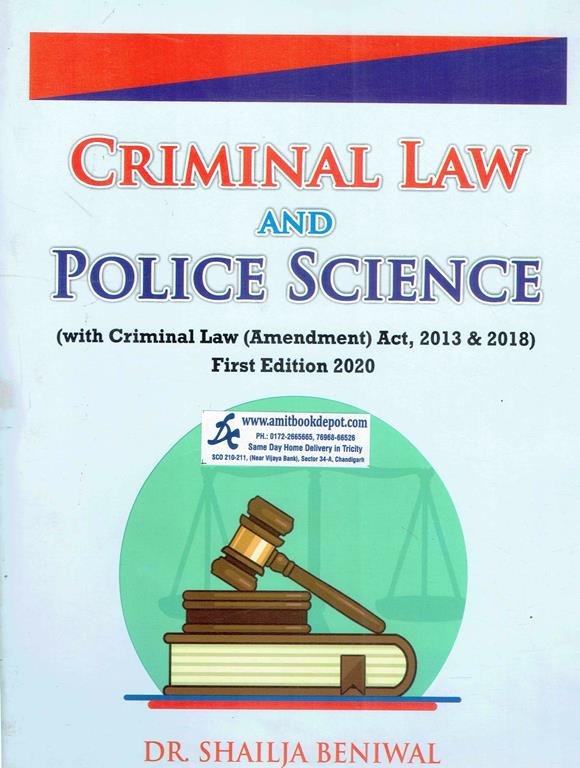
Criminal Law and Police Science for UG and PG Police Administration and Law Student

by Madhurima
₹195 ₹195.00(-/ off)

Rating & Reviews

23 Customer Review

Criminal Law and Police Science by Dr. Shailja Beniwal is a comprehensive book for UG and PG students of Police Administration and Law. This authoritative guide provides an in-depth analysis of the Indian Penal Code (IPC) and the Code of Criminal Procedure (CrPC), including vital amendments like the 2013 and 2018 Acts. Covering essential topics from criminal liability and offenses to arrest procedures, investigation powers, and bail, it bridges legal theory with practical policing. An indispensable resource for academic study, competitive exams, and professional reference in criminal justice and police science.

Have Doubts Regarding This Product ? Ask Your Question

  • Q1
    Is this book suitable for someone preparing for state-level police service exams (like DSP, SI)?
    A1

    Absolutely. It covers the IPC and CrPC in detail, which form the core syllabus for law-based papers in most state and national police service examinations.

  • Q2
    Does the book cover the latest amendments, such as those related to sexual offenses?
    A2

    Yes, it includes a dedicated section analyzing the Criminal Law (Amendment) Acts of 2013 and 2018, which introduced strict laws against rape, stalking, voyeurism, and rape of minors.

  • Q3
    Is the Code of Criminal Procedure (CrPC) explained with a focus on police duties?
    A3

    Yes, Part II meticulously details police procedures, including arrest (Sections 41-60A), search, investigation powers, and the classification of offenses, making it highly practical for police administration students.

  • Q4
    Are definitions like 'public servant' and 'dishonestly' from the IPC explained clearly?
    A4

    Yes, the book begins with a comprehensive chapter on "General Explanations" (Sections 1-52A) of the IPC, providing clear definitions essential for understanding subsequent offenses.

  • Q5
    Is the topic of criminal conspiracy covered?
    A5

    Yes, Sections 120A and 120B of the IPC dealing with criminal conspiracy are covered in detail under Part I of the book.

  • Q6
    Is kidnapping and abduction under the IPC covered?
    A6

    Yes, it covers all relevant sections (359-369) on kidnapping, abduction, and related offenses like kidnapping for ransom (364A).

  • Q7
    Is the concept of 'abetment' explained with relevant sections?
    A7

    Yes, Chapter V on 'Abetment' (Sections 107-120) is covered comprehensively, explaining the liability of an abettor.

  • Q8
    Is the offense of sedition (124A IPC) discussed in the book?
    A8

    Yes, offenses against the state, including sedition under Section 124A, are covered in the relevant chapter.

  • Q9
    Is this book useful for LL.B. students studying Criminal Law papers?
    A9

    Certainly. It covers the substantive and procedural criminal law syllabus prescribed for LL.B. programs in a structured and detailed manner.

  • Q10
    Are investigation procedures, like filing an FIR, explained from a police science perspective?
    A10

    Yes, the chapter on "Information to the Police and Their Powers to Investigate" (Sections 154-157, 165-166) explains the procedure for FIR, investigation of cognizable/non-cognizable cases, and search during investigation.

0.00

0 Overall Rating
  • 5
    0
  • 4
    0
  • 3
    0
  • 2
    0
  • 1
    0

Try this product & share your review & thoughts

Part 1

THE INDIAN PENAL CODE, 1860
INTRODUCTION

Preamble
1. Title and extent of operation of the Code
2. Punishment of offenses committed within India
3. Punishment of offenses committed beyond but that by law may be tried within India
4. Extension of Code to extraterritorial offenses
5. Certain laws not to be affected by this act

GENERAL EXPLANATIONS

6. Definitions in the Code are to be understood subject to exceptions. 
7. Sense of expression once explained
8. Gender
9. Number
10. Man, Woman
11. Person
12. Public
13. Queen
14. Servant of Government
15. British India
16. Government of India
17. Government
18. India
19. Judge
20. Court of Justice
21. Public Servant
22. Movable property
23. Wrongful gain
24. Dishonestly
25. Fraudulently
26. Reason to believe
27. Property in possession of wife, clerk, or servant
28. Counterfeit
29. Document
29A. Electronic record
30. Valuable security
31. A Will
32. Words referring to acts include illegal omissions.
33. Act, Omission
34. Acts done by several persons in furtherance of common intention
35. When such an act is criminal by reason of its being done with criminal knowledge or intention
36. Effect caused partly by act and partly by omission
37. Co-operation by doing one of several acts constituting an offense
38. Persons concerned in a criminal act may be guilty of different offenses.
39. Voluntarily
40. Offense
41. Special law
42. Local law
43. Illegal, legally bound to do
44. Injury
45. Life
46. Death
47. Animal
48. Vessel
49. Year, Month
50. Section
51. Oath
52. Good faith
52A. Harbor

PUNISHMENTS

53. Punishment
53A. Construction of reference to transportation
54. Commutation of sentence of death
55. Commutation of sentence of imprisonment for life
55A. Definition of Appropriate Government
56. [Omitted]
57. Fractions of terms of punishment
58. [Omitted]
59. [Omitted]
60. A sentence may be (in certain cases of imprisonment) wholly or partly rigorous or simple.
61. Sentence of forfeiture of property
62. Forfeiture of property in respect of offenders punishable with death, transportation, or imprisonment
63. Amount of fine
64. Sentence of imprisonment for non-payment of fine
65. Sentence of imprisonment for non-payment of fine
66. Description of imprisonment for non-payment of fine
67. Imprisonment for non-payment of fine, when the offense is punishable with a fine only
68. Imprisonment to terminate on payment of fine
69. Termination of imprisonment on payment of proportional part of fine
70. Fine leviable within six years, or during imprisonment; death not to discharge property from liability
71. Limit of punishment of an offense made up of several offenses
72. Punishment of a person guilty of one of several offenses, the judgment stating that it is doubtful of which
73. Solitary confinement
74. Limit of solitary confinement
82. Act of a child under seven years of age

OF ABETMENT

107. Abetment of a thing
108. Abettor
108A. Abetment in India of offenses outside India
109. Punishment of abetment if the act abetted is committed in consequence, and where no express provision is made for its punishment
110. Punishment of abetment if the person abetted does the act with a different intention from that of the abettor
111. Liability of abettor when one act is abetted and a different act is done
112. Abettor when liable to cumulative punishment for act abetted and for act done
113. Liability of abettor for an effect caused by the act abetted different from that intended by the abettor
114. Abettor present when offense is committed
115. Abetment of offense punishable with death or imprisonment for life, if offense not committed
116. Abetment of offense punishable with imprisonment, if offense is not committed
117. Abetting commission of offense by the public or by more than ten persons
118. Concealing a design to commit an offense punishable with death or imprisonment for life
119. Public servant concealing design to commit offense that it is his duty to prevent
120. Concealing design to commit an offense punishable with Imprisonment

CRIMINAL CONSPIRACY

120 A. Definition of criminal conspiracy
120 B. Punishment of criminal conspiracy

OFFENSES AGAINST THE STATE

121. Waging, or attempting to wage war, or abetting the waging of war against the Government of India
121A. Conspiracy to commit offenses punishable by section 121
122. Collecting arms, etc., with the intention of waging war against the Government of India
123. Concealing with intent to facilitate design to wage war
124. Assaulting President, Governor, etc., with intent to compel or restrain the exercise of any lawful power
124A. Sedition

OFFENSES AGAINST THE PUBLIC TRANQUILLITY

141. Unlawful assembly
142. Being a member of an unlawful assembly
143. Punishment
144. Joining unlawful assembly armed with deadly weapon
145. Joining or continuing in unlawful assembly, knowing it has been commanded to disperse
146. Rioting
147. Punishment for rioting
148. Rioting, armed with a deadly weapon
149. Every member of an unlawful assembly is guilty of an offense committed in the prosecution of a common object.
150. Hiring, or conniving at hiring, of persons to join unlawful assembly
151. Knowingly joining or continuing in an assembly of five or more persons after it has been commanded to disperse

OF OFFENSES AFFECTING THE HUMAN BODY OF OFFENSES AFFECTING LIFE

299. Culpable homicide
300. Murder
304A. Causing death by negligence
304B. Dowry death

OF HURT

319. Hurt
320. Grievous hurt

OF WRONGFUL RESTRAINT AND WRONGFUL CONFINEMENT

339. Wrongful restraint
340. Wrongful Confinement

OF CRIMINAL FORCE AND ASSAULT

351. Assault
352. Punishment for assault or criminal force otherwise than on grave provocation
354. Assault or criminal force to a woman with intent to outrage her modesty
354A. Sexual harassment and punishment for sexual harassment
354B. Assault or use of criminal force on a woman with intent to disrobe
354C. Voyeurism
354D. Stalking

OF KIDNAPPING, ABDUCTION

359. Kidnapping
360. Kidnapping from India
361. Kidnapping from lawful guardianship
362. Abduction
363. Punishment for kidnapping
363A. Kidnapping or maiming a minor for purposes of begging
364. Kidnapping or abducting in order to murder
364A. Kidnapping for ransom, etc.
365. Kidnapping or abducting with intent secretly and wrongfully to confine a person
366. Kidnapping, abducting, or inducing a woman to compel her marriage, etc.
366-A. Procuration of minor girl
366-B. Importation of girl from foreign country
367. Kidnapping or abducting in order to subject a person to grievous hurt, slavery, etc.
368. Wrongfully concealing or keeping in confinement a kidnapped or abducted person

OF SEXUAL OFFENSES

375. Rape
376. Punishment for rape
376 A. Punishment for causing death or resulting in persistent vegetative state of victim
376AB. Punishment for rape of a woman under twelve years of age
376 B. Sexual intercourse by husband upon his wife during separation
376 C. Sexual intercourse by a person in authority
376 D. Gang rape
376DA. Punishment for gang rape of a woman under sixteen years of age
376DB. Punishment for gang rape of a woman under twelve years of age
376-E. Punishment for repeat offenders
376-F. Liability of person in charge of workplace and others to give information about offense


Part II
CODE OF CRIMINAL PROCEDURE, 1973

PRELIMINARY

1. Short title, extent, and commencement
2. Definitions

ARREST OF PERSONS

41. When police may arrest without a warrant
41A. Notice of appearance before police officer
41 B. Procedure of arrest and duties of officer making arrest
41C. Control room at districts
41D. Right of arrested person to meet an advocate of his choice during interrogation
42. Arrest on refusal to give name and residence
43. Arrest by private person and procedure on such arrest
44. Arrest by Magistrate
45. Protection of members of the Armed Forces from arrest
46. How Arrests Are Made
47. Search of place entered by person sought to be arrested
48. Pursuit of offenders into other jurisdictions
49. No unnecessary restraint
50. Person arrested to be informed of grounds of arrest and of right to bail
50A. Obligation of person making arrest to inform about the arrest, etc., to a nominated person
51. Search of arrested person
52. Power to seize offensive weapons
53. Examination of accused by medical practitioner at the request of police officer
53A. Examination of person accused of rape by medical practitioner
54. Examination of arrested person by medical practitioner at the request of the arrested person
54A. Identification of person arrested
55. Procedure when a police officer deputes a subordinate to arrest without a warrant
55A. Health and safety of arrested person
56. Person arrested to be taken before magistrate or officer in charge of police station.
57. Person arrested not to be detained more than twenty-four hours
58. Police to report apprehensions
59. Discharge of person apprehended
60. Power, on escape, to pursue and retake
60A. Arrests are to be made strictly according to the Code.

SUMMON AND WARRANT

61. Form of Summons
62. Summons: How served
63. Service of summons on corporate bodies and societies
64. Service when persons summoned cannot be found
65. Procedure when service cannot be affected as before provided
66. Service on Government Servant
67. Service of summons outside local limits
68. Proof of service in such cases and when the serving officer is not present
69. Service of summons on witness by post
70. Form of warrant of arrest and duration
71. Power to direct security to be taken
72. Warrants to whom directed
73. Warrant may be directed to any person
74. Warrant directed to police officer
75. Notification of substance of warrant
76. Person arrested to be brought before court without delay
77. Where warrant may be executed
78. Warrant forwarded for execution outside jurisdiction
79. Warrant directed to police officer for execution outside jurisdiction
80. Procedure on arrest of person against whom warrant was issued
81. Procedure by magistrate before whom such arrested person is brought
82. Proclamation for person absconding
83. Attachment of property of person absconding
90. Provisions of this chapter generally applicable to summonses and warrants of arrest
91. Summons to produce document or other thing
92. Procedure as to letters and telegrams
93. When a search warrant may be issued
94. Search of place suspected to contain stolen property, forged documents, etc.

INFORMATION TO THE POLICE AND THEIR POWERS TO INVESTIGATE

154. Information in Cognizable Cases
155. Information as to non-cognizable cases and investigation of such cases
156. Police officer's power to investigate cognizable cases
157. Procedure for investigation
165. Search by Police Officer
166. When the officer in charge of the police station may require another to issue a search warrant
- Classification of Offences
- Cognizable and Non-Cognizable Offences
- Compoundable and Non-Compoundable offenses
320. Compounding of offences
- Bailable and non-bailable offenses
437. When bail may be taken in case of a non-bailable offense
437A. Bail to require the accused to appear before the next appellate court
438. Direction for grant of bail to person apprehending arrest
439. Special powers of the High Court or Court of Session regarding bail.

AMENDMENTS IN CRIMINAL LAW ACTS

- Criminal Law (Amendment) Act, 2013
- Criminal Law (Amendment) Act, 2018
- Generally Asked Questions

"Criminal Law and Police Science" by Dr. Shailja Beniwal is an authoritative and comprehensive academic treatise meticulously designed for undergraduate and postgraduate students of police administration, law, criminology, and forensic science. Published by Mohindra Publishing House, this essential book provides an integrated and in-depth analysis of the core legal frameworks governing criminal justice and policing in India. It serves as an indispensable resource for aspiring police officers, legal practitioners, judicial service aspirants, and academicians, bridging the critical gap between theoretical legal principles and their practical application in police science and field investigations.

The book is systematically structured into two exhaustive parts, ensuring a logical progression from substantive criminal law to procedural criminal law. Part One delivers a rigorous examination of the Indian Penal Code (IPC), 1860. It commences with a detailed exploration of the preamble, extent, and fundamental General Explanations (Sections 1-52A), establishing a solid foundation for interpreting legal definitions such as ‘public servant,’ ‘dishonestly,’ ‘fraudulently,’ and ‘electronic record.’ The analysis extends to nuanced doctrines of criminal liability, including common intention, abetment, and criminal conspiracy. A significant focus is placed on critical offenses against the state, public tranquility, and the human body. The text provides contemporary and detailed commentary on pivotal sections dealing with culpable homicide, murder, dowry death, sexual offenses (including rape, sexual harassment, voyeurism, and stalking as amended), kidnapping, abduction, and hurt. This section is vital for understanding the elements of specific crimes, which is fundamental for both legal adjudication and police investigation.

Part Two is dedicated to the Code of Criminal Procedure (CrPC), 1973, the backbone of procedural criminal law in India. It meticulously guides the reader through the machinery of criminal justice, beginning with preliminary definitions and moving to the practical aspects of policing. The chapters on the arrest of persons (Sections 41-60A) are exceptionally detailed, covering protocols for arrest with and without a warrant, the rights of arrested persons, procedures for medical examination, and the duties of police officers—a must-know for ethical and lawful policing. Subsequent sections elucidate processes related to summons and warrants, information to the police, and the powers of investigation, including the recording of FIRs, investigation of cognizable and non-cognizable offenses, and search procedures. The book also clarifies crucial classifications such as bailable and non-bailable and compoundable and non-compoundable offenses, supported by a clear explanation of bail provisions under Sections 437, 438, and 439.

A distinguishing and highly valuable feature of this book is its dedicated section on key amendments to criminal law acts. It incorporates insightful analysis of the transformative Criminal Law (Amendment) Act, 2013 (enacted after the Nirbhaya case), and the subsequent Criminal Law (Amendment) Act, 2018, which introduced stringent provisions against rape of minors. This ensures the content is completely up-to-date with the latest statutory changes affecting IPC, CrPC, and the Indian Evidence Act. The inclusion of a chapter on "Generally Asked Questions" further enhances its utility for exam preparation and quick revision.

Dr. Beniwal’s work stands out for its pedagogical clarity, precise language, and structured presentation of complex legal statutes. It is more than a commentary; it is a guided syllabus that aligns perfectly with university curricula for police administration and law degrees. Keywords such as Indian Penal Code, CrPC, Criminal Procedure, Police Science, Investigation, Arrest Procedures, Bailable Offense, Non-Bailable Offense, Cognizable Offense, Sexual Offences, Criminal Law Amendment Act 2013, Bail Provisions, Legal Studies for Police, and UG PG Law Book are seamlessly integrated, reflecting the book’s core coverage. This volume is an unmatched reference for building a robust foundation in criminal jurisprudence and police procedures, making it a mandatory addition to the library of every serious student and professional in the field of criminal justice.

Part 1

THE INDIAN PENAL CODE, 1860
INTRODUCTION

Preamble
1. Title and extent of operation of the Code
2. Punishment of offenses committed within India
3. Punishment of offenses committed beyond but that by law may be tried within India
4. Extension of Code to extraterritorial offenses
5. Certain laws not to be affected by this act

GENERAL EXPLANATIONS

6. Definitions in the Code are to be understood subject to exceptions. 
7. Sense of expression once explained
8. Gender
9. Number
10. Man, Woman
11. Person
12. Public
13. Queen
14. Servant of Government
15. British India
16. Government of India
17. Government
18. India
19. Judge
20. Court of Justice
21. Public Servant
22. Movable property
23. Wrongful gain
24. Dishonestly
25. Fraudulently
26. Reason to believe
27. Property in possession of wife, clerk, or servant
28. Counterfeit
29. Document
29A. Electronic record
30. Valuable security
31. A Will
32. Words referring to acts include illegal omissions.
33. Act, Omission
34. Acts done by several persons in furtherance of common intention
35. When such an act is criminal by reason of its being done with criminal knowledge or intention
36. Effect caused partly by act and partly by omission
37. Co-operation by doing one of several acts constituting an offense
38. Persons concerned in a criminal act may be guilty of different offenses.
39. Voluntarily
40. Offense
41. Special law
42. Local law
43. Illegal, legally bound to do
44. Injury
45. Life
46. Death
47. Animal
48. Vessel
49. Year, Month
50. Section
51. Oath
52. Good faith
52A. Harbor

PUNISHMENTS

53. Punishment
53A. Construction of reference to transportation
54. Commutation of sentence of death
55. Commutation of sentence of imprisonment for life
55A. Definition of Appropriate Government
56. [Omitted]
57. Fractions of terms of punishment
58. [Omitted]
59. [Omitted]
60. A sentence may be (in certain cases of imprisonment) wholly or partly rigorous or simple.
61. Sentence of forfeiture of property
62. Forfeiture of property in respect of offenders punishable with death, transportation, or imprisonment
63. Amount of fine
64. Sentence of imprisonment for non-payment of fine
65. Sentence of imprisonment for non-payment of fine
66. Description of imprisonment for non-payment of fine
67. Imprisonment for non-payment of fine, when the offense is punishable with a fine only
68. Imprisonment to terminate on payment of fine
69. Termination of imprisonment on payment of proportional part of fine
70. Fine leviable within six years, or during imprisonment; death not to discharge property from liability
71. Limit of punishment of an offense made up of several offenses
72. Punishment of a person guilty of one of several offenses, the judgment stating that it is doubtful of which
73. Solitary confinement
74. Limit of solitary confinement
82. Act of a child under seven years of age

OF ABETMENT

107. Abetment of a thing
108. Abettor
108A. Abetment in India of offenses outside India
109. Punishment of abetment if the act abetted is committed in consequence, and where no express provision is made for its punishment
110. Punishment of abetment if the person abetted does the act with a different intention from that of the abettor
111. Liability of abettor when one act is abetted and a different act is done
112. Abettor when liable to cumulative punishment for act abetted and for act done
113. Liability of abettor for an effect caused by the act abetted different from that intended by the abettor
114. Abettor present when offense is committed
115. Abetment of offense punishable with death or imprisonment for life, if offense not committed
116. Abetment of offense punishable with imprisonment, if offense is not committed
117. Abetting commission of offense by the public or by more than ten persons
118. Concealing a design to commit an offense punishable with death or imprisonment for life
119. Public servant concealing design to commit offense that it is his duty to prevent
120. Concealing design to commit an offense punishable with Imprisonment

CRIMINAL CONSPIRACY

120 A. Definition of criminal conspiracy
120 B. Punishment of criminal conspiracy

OFFENSES AGAINST THE STATE

121. Waging, or attempting to wage war, or abetting the waging of war against the Government of India
121A. Conspiracy to commit offenses punishable by section 121
122. Collecting arms, etc., with the intention of waging war against the Government of India
123. Concealing with intent to facilitate design to wage war
124. Assaulting President, Governor, etc., with intent to compel or restrain the exercise of any lawful power
124A. Sedition

OFFENSES AGAINST THE PUBLIC TRANQUILLITY

141. Unlawful assembly
142. Being a member of an unlawful assembly
143. Punishment
144. Joining unlawful assembly armed with deadly weapon
145. Joining or continuing in unlawful assembly, knowing it has been commanded to disperse
146. Rioting
147. Punishment for rioting
148. Rioting, armed with a deadly weapon
149. Every member of an unlawful assembly is guilty of an offense committed in the prosecution of a common object.
150. Hiring, or conniving at hiring, of persons to join unlawful assembly
151. Knowingly joining or continuing in an assembly of five or more persons after it has been commanded to disperse

OF OFFENSES AFFECTING THE HUMAN BODY OF OFFENSES AFFECTING LIFE

299. Culpable homicide
300. Murder
304A. Causing death by negligence
304B. Dowry death

OF HURT

319. Hurt
320. Grievous hurt

OF WRONGFUL RESTRAINT AND WRONGFUL CONFINEMENT

339. Wrongful restraint
340. Wrongful Confinement

OF CRIMINAL FORCE AND ASSAULT

351. Assault
352. Punishment for assault or criminal force otherwise than on grave provocation
354. Assault or criminal force to a woman with intent to outrage her modesty
354A. Sexual harassment and punishment for sexual harassment
354B. Assault or use of criminal force on a woman with intent to disrobe
354C. Voyeurism
354D. Stalking

OF KIDNAPPING, ABDUCTION

359. Kidnapping
360. Kidnapping from India
361. Kidnapping from lawful guardianship
362. Abduction
363. Punishment for kidnapping
363A. Kidnapping or maiming a minor for purposes of begging
364. Kidnapping or abducting in order to murder
364A. Kidnapping for ransom, etc.
365. Kidnapping or abducting with intent secretly and wrongfully to confine a person
366. Kidnapping, abducting, or inducing a woman to compel her marriage, etc.
366-A. Procuration of minor girl
366-B. Importation of girl from foreign country
367. Kidnapping or abducting in order to subject a person to grievous hurt, slavery, etc.
368. Wrongfully concealing or keeping in confinement a kidnapped or abducted person

OF SEXUAL OFFENSES

375. Rape
376. Punishment for rape
376 A. Punishment for causing death or resulting in persistent vegetative state of victim
376AB. Punishment for rape of a woman under twelve years of age
376 B. Sexual intercourse by husband upon his wife during separation
376 C. Sexual intercourse by a person in authority
376 D. Gang rape
376DA. Punishment for gang rape of a woman under sixteen years of age
376DB. Punishment for gang rape of a woman under twelve years of age
376-E. Punishment for repeat offenders
376-F. Liability of person in charge of workplace and others to give information about offense


Part II
CODE OF CRIMINAL PROCEDURE, 1973

PRELIMINARY

1. Short title, extent, and commencement
2. Definitions

ARREST OF PERSONS

41. When police may arrest without a warrant
41A. Notice of appearance before police officer
41 B. Procedure of arrest and duties of officer making arrest
41C. Control room at districts
41D. Right of arrested person to meet an advocate of his choice during interrogation
42. Arrest on refusal to give name and residence
43. Arrest by private person and procedure on such arrest
44. Arrest by Magistrate
45. Protection of members of the Armed Forces from arrest
46. How Arrests Are Made
47. Search of place entered by person sought to be arrested
48. Pursuit of offenders into other jurisdictions
49. No unnecessary restraint
50. Person arrested to be informed of grounds of arrest and of right to bail
50A. Obligation of person making arrest to inform about the arrest, etc., to a nominated person
51. Search of arrested person
52. Power to seize offensive weapons
53. Examination of accused by medical practitioner at the request of police officer
53A. Examination of person accused of rape by medical practitioner
54. Examination of arrested person by medical practitioner at the request of the arrested person
54A. Identification of person arrested
55. Procedure when a police officer deputes a subordinate to arrest without a warrant
55A. Health and safety of arrested person
56. Person arrested to be taken before magistrate or officer in charge of police station.
57. Person arrested not to be detained more than twenty-four hours
58. Police to report apprehensions
59. Discharge of person apprehended
60. Power, on escape, to pursue and retake
60A. Arrests are to be made strictly according to the Code.

SUMMON AND WARRANT

61. Form of Summons
62. Summons: How served
63. Service of summons on corporate bodies and societies
64. Service when persons summoned cannot be found
65. Procedure when service cannot be affected as before provided
66. Service on Government Servant
67. Service of summons outside local limits
68. Proof of service in such cases and when the serving officer is not present
69. Service of summons on witness by post
70. Form of warrant of arrest and duration
71. Power to direct security to be taken
72. Warrants to whom directed
73. Warrant may be directed to any person
74. Warrant directed to police officer
75. Notification of substance of warrant
76. Person arrested to be brought before court without delay
77. Where warrant may be executed
78. Warrant forwarded for execution outside jurisdiction
79. Warrant directed to police officer for execution outside jurisdiction
80. Procedure on arrest of person against whom warrant was issued
81. Procedure by magistrate before whom such arrested person is brought
82. Proclamation for person absconding
83. Attachment of property of person absconding
90. Provisions of this chapter generally applicable to summonses and warrants of arrest
91. Summons to produce document or other thing
92. Procedure as to letters and telegrams
93. When a search warrant may be issued
94. Search of place suspected to contain stolen property, forged documents, etc.

INFORMATION TO THE POLICE AND THEIR POWERS TO INVESTIGATE

154. Information in Cognizable Cases
155. Information as to non-cognizable cases and investigation of such cases
156. Police officer's power to investigate cognizable cases
157. Procedure for investigation
165. Search by Police Officer
166. When the officer in charge of the police station may require another to issue a search warrant
- Classification of Offences
- Cognizable and Non-Cognizable Offences
- Compoundable and Non-Compoundable offenses
320. Compounding of offences
- Bailable and non-bailable offenses
437. When bail may be taken in case of a non-bailable offense
437A. Bail to require the accused to appear before the next appellate court
438. Direction for grant of bail to person apprehending arrest
439. Special powers of the High Court or Court of Session regarding bail.

AMENDMENTS IN CRIMINAL LAW ACTS

- Criminal Law (Amendment) Act, 2013
- Criminal Law (Amendment) Act, 2018
- Generally Asked Questions
Have Doubts Regarding This Product ? Ask Your Question

  • Q1
    Is this book suitable for someone preparing for state-level police service exams (like DSP, SI)?
    A1

    Absolutely. It covers the IPC and CrPC in detail, which form the core syllabus for law-based papers in most state and national police service examinations.

  • Q2
    Does the book cover the latest amendments, such as those related to sexual offenses?
    A2

    Yes, it includes a dedicated section analyzing the Criminal Law (Amendment) Acts of 2013 and 2018, which introduced strict laws against rape, stalking, voyeurism, and rape of minors.
  • Q3
    Is the Code of Criminal Procedure (CrPC) explained with a focus on police duties?
    A3

    Yes, Part II meticulously details police procedures, including arrest (Sections 41-60A), search, investigation powers, and the classification of offenses, making it highly practical for police administration students.

  • Q4
    Are definitions like 'public servant' and 'dishonestly' from the IPC explained clearly?
    A4

    Yes, the book begins with a comprehensive chapter on "General Explanations" (Sections 1-52A) of the IPC, providing clear definitions essential for understanding subsequent offenses.

  • Q5
    Is the topic of criminal conspiracy covered?
    A5

    Yes, Sections 120A and 120B of the IPC dealing with criminal conspiracy are covered in detail under Part I of the book.

  • Q6
    Is kidnapping and abduction under the IPC covered?
    A6

    Yes, it covers all relevant sections (359-369) on kidnapping, abduction, and related offenses like kidnapping for ransom (364A).

  • Q7
    Is the concept of 'abetment' explained with relevant sections?
    A7

    Yes, Chapter V on 'Abetment' (Sections 107-120) is covered comprehensively, explaining the liability of an abettor.

  • Q8
    Is the offense of sedition (124A IPC) discussed in the book?
    A8

    Yes, offenses against the state, including sedition under Section 124A, are covered in the relevant chapter.

  • Q9
    Is this book useful for LL.B. students studying Criminal Law papers?
    A9

    Certainly. It covers the substantive and procedural criminal law syllabus prescribed for LL.B. programs in a structured and detailed manner.

  • Q10
    Are investigation procedures, like filing an FIR, explained from a police science perspective?
    A10

    Yes, the chapter on "Information to the Police and Their Powers to Investigate" (Sections 154-157, 165-166) explains the procedure for FIR, investigation of cognizable/non-cognizable cases, and search during investigation.

No Syllabus Added

0.00

0 Overall Rating
  • 5
    0
  • 4
    0
  • 3
    0
  • 2
    0
  • 1
    0

Try this product & share your review & thoughts

Top Trending Product

Related Product

Related Product

Related Blog Posts

Latest Blogs

Latest Blogs

blog-img
Classic Literature Reimagined: Discuss modern twists on classic novels.
Lorem ipsum dolor sit amet, consectetur adipiscing elit, sed do eiusmod tempor incididunt ut labore et dolore magna aliqua. Ut enim ad minim veniam, quis nostrud exercitation ullamco Lorem ipsum dolor sit amet, consectetur adipiscing elit, sed do eiusmod tempor incididunt ut labore et dolore magna aliqua. Utenim ad minim veniam, quis nostrud exercitation ullamco Lorem ipsum dolor sit amet, consecte...
Read more
Author name | 10 jan, 2025
blog-img
Classic Literature Reimagined: Discuss modern twists on classic novels.
Lorem ipsum dolor sit amet, consectetur adipiscing elit, sed do eiusmod tempor incididunt ut labore et dolore magna aliqua. Ut enim ad minim veniam, quis nostrud exercitation ullamco Lorem ipsum dolor sit amet, consectetur adipiscing elit, sed do eiusmod tempor incididunt ut labore et dolore magna aliqua. Utenim ad minim veniam, quis nostrud exercitation ullamco Lorem ipsum dolor sit amet, consecte...
Read more
Author name | 10 jan, 2025
blog-img
Classic Literature Reimagined: Discuss modern twists on classic novels.
Lorem ipsum dolor sit amet, consectetur adipiscing elit, sed do eiusmod tempor incididunt ut labore et dolore magna aliqua. Ut enim ad minim veniam, quis nostrud exercitation ullamco Lorem ipsum dolor sit amet, consectetur adipiscing elit, sed do eiusmod tempor incididunt ut labore et dolore magna aliqua. Utenim ad minim veniam, quis nostrud exercitation ullamco Lorem ipsum dolor sit amet, consecte...
Read more
Author name | 10 jan, 2025
blog-img
Classic Literature Reimagined: Discuss modern twists on classic novels.
Lorem ipsum dolor sit amet, consectetur adipiscing elit...
Read more
Author Name | 10 Jan, 2025
blog-img
Classic Literature Reimagined: Discuss modern twists on classic novels.
Lorem ipsum dolor sit amet, consectetur adipiscing elit...
Read more
Author Name | 10 Jan, 2025
blog-img
Classic Literature Reimagined: Discuss modern twists on classic novels.
Lorem ipsum dolor sit amet, consectetur adipiscing elit...
Read more
Author Name | 10 Jan, 2025
blog-img
Classic Literature Reimagined: Discuss modern twists on classic novels.
Lorem ipsum dolor sit amet, consectetur adipiscing elit...
Read more
Author Name | 10 Jan, 2025
blog-img
Classic Literature Reimagined: Discuss modern twists on classic novels.
Lorem ipsum dolor sit amet, consectetur adipiscing elit...
Read more
Author Name | 10 Jan, 2025
blog-img
Classic Literature Reimagined: Discuss modern twists on classic novels.
Lorem ipsum dolor sit amet, consectetur adipiscing elit...
Read more
Author Name | 10 Jan, 2025
blog-img
Classic Literature Reimagined: Discuss modern twists on classic novels.
Lorem ipsum dolor sit amet, consectetur adipiscing elit...
Read more
Author Name | 10 Jan, 2025
blog-img
Classic Literature Reimagined: Discuss modern twists on classic novels.
Lorem ipsum dolor sit amet, consectetur adipiscing elit...
Read more
Author Name | 10 Jan, 2025
blog-img
Classic Literature Reimagined: Discuss modern twists on classic novels.
Lorem ipsum dolor sit amet, consectetur adipiscing elit...
Read more
Author Name | 10 Jan, 2025