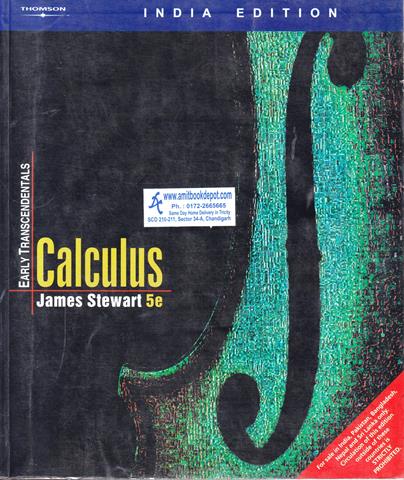
James Stewart’s Calculus: Early Transcendentals with CD provides a rigors yet accessible introduction to the fundamental concepts of calculus, specifically designed for science, engineering, and mathematics majors. This comprehensive book integrates the “Early Transcendentals” approach—introducing exponential, logarithmic, and trigonometric functions prior to integration techniques—to facilitate a deeper, more intuitive understanding of limits, derivatives, and integrals. Published by Thomson Brooks/Cole, this edition includes a supplementary CD-ROM packed with interactive learning tools, making it an ideal solution for both classroom instruction and independent study.
Complete Syllabus Coverage
The text systematically progresses from foundational principles to advanced multivariable calculus, ensuring students build confidence at every stage. The content is structured to align with a standard three-semester calculus sequence.
Part One: Single-Variable Calculus
- Functions and Models (Ch. 1): Begins with essential precalculus concepts, mathematical modelling, and transformations of functions.
- Limits and Derivatives (Ch. 2): Introduces the limit definition of the derivative, continuity, and tangent line problems.
- Differentiation Rules (Ch. 3): Covers product, quotient, chain rules, implicit differentiation, and derivatives of exponential/logarithmic functions (Early Transcendentals focus).
- Applications of Differentiation (Ch. 4): Explores optimisation, related rates, curve sketching, and L'Hôpital's Rule.
- Integrals (Ch. 5): Defines the definite and indefinite integral, the Fundamental Theorem of Calculus, and Riemann sums.
- Applications of Integration (Ch. 6): Includes area between curves, volume of solids of revolution, and average value of a function.
- Techniques of Integration (Ch. 7): Mastery of integration by parts, trigonometric integrals, partial fractions, and improper integrals.
- Further Applications (Ch. 8): Arc length, surface area of revolution, and physical applications (work, hydrostatic pressure).
- Differential Equations (Ch. 9): Introduces separable and first-order linear differential equations, plus logistic growth models.
- Parametric Equations & Polar Coordinates (Ch. 10): Parametric curves, polar graphing, and area in polar coordinates.
- Infinite Sequences & Series (Ch. 11): Convergence/divergence tests, power series, Taylor and Maclaurin series.
Part Two: Multivariable Calculus
- Vectors and Geometry of Space (Ch. 12): Dot/cross products, equations of lines and planes, quadric surfaces.
- Vector Functions (Ch. 13): Space curves, velocity/acceleration vectors, and curvature.
- Partial Derivatives (Ch. 14): Limits of multivariable functions, tangent planes, directional derivatives, and Lagrange multipliers.
- Multiple Integrals (Ch. 15): Double and triple integrals in rectangular, polar, cylindrical, and spherical coordinates.
- Vector Calculus (Ch. 16): Line integrals, Green’s Theorem, the Divergence Theorem, and Stokes’ Theorem.
- Second-Order Differential Equations (Ch. 17): Homogeneous and nonhomogeneous linear ODEs with constant coefficients.
Key Features & CD-ROM Content
- Included CD-ROM: Features interactive visualisations, additional problem sets, lecture videos, and step-by-step solutions to selected exercises. This digital supplement reinforces graphical, numerical, and algebraic understanding.
- Problem Sets: Thousands of graded exercises ranging from computational drills to real-world applied problems.
- Conceptual Focus: “Concept Check” and “True-False Quiz” sections at each chapter’s end prepare students for exams.
- Appendices: Includes algebra/trigonometry reviews, proofs, and additional tables.
This book by James Stewart, through Thomson Brooks/Cole, remains a gold standard for calculus education, balancing theoretical rigour with practical application.








.jpg)