Varun English Guide World Literature -II For MA 4 rd Paper 16 (3) Panjab University Chandigarh
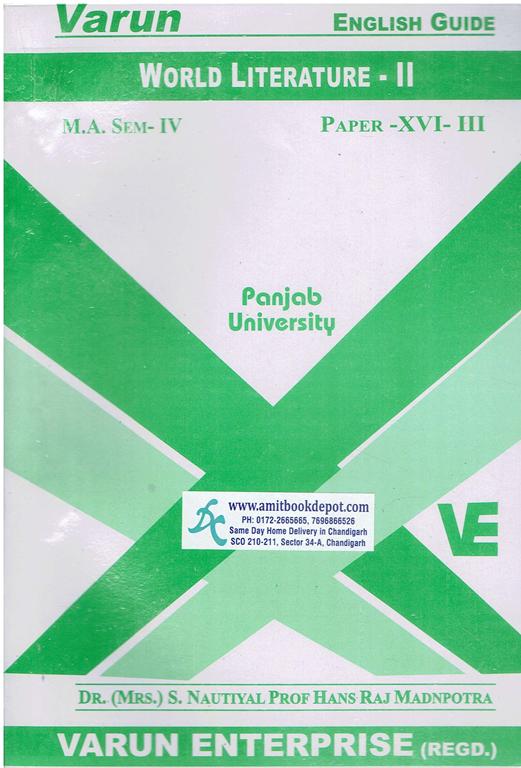
Varun English Guide World Literature -II For MA 4 rd Paper 16 (3) Panjab University Chandigarh
by Madhurima
₹350₹350.00(-/
off)
Rating & Reviews
23 Customer Review
The Varun English Guide World Literature-II for MA 4th Paper 16 (3) is the definitive study companion for Panjab University, Chandigarh students. Authored by Dr. S. Nautiyal, this guide meticulously covers the entire syllabus, from David Damrosch and Franco Moretti’s literary theories to masterpieces by Gandhi, Brecht, Marquez, and renowned poets like Neruda and Akhmatova. It provides detailed critical analysis, summaries, and exam-focused insights for each text. This essential MA English guide simplifies complex concepts, making it an invaluable resource for mastering World Literature in Translation and excelling in your MA 4th Semester exams.
The Varun English Guide World Literature -II for MA 4th Paper 16 (3) is an essential and comprehensive academic companion meticulously crafted for students pursuing their Master of Arts from Panjab University, Chandigarh. Authored by the esteemed Dr. S. Nautiyal and published by Varun Enterprises, this guide is specifically designed to align with the university's prescribed syllabus, providing a structured and in-depth analysis of seminal texts and critical theories in the domain of World Literature in Translation. This volume serves as an indispensable resource for mastering the curriculum, offering clarity, critical insights, and scholarly commentary to facilitate both exam preparation and a deeper appreciation of global literary canons.
This MA English guide systematically covers all five units of the syllabus. The first unit delves into the foundational literary theory of world literature, featuring key excerpts from influential scholars. Students will engage with David Damrosch’s pivotal concepts from World Literature in Theory, including chapters on "World Literature in Theory and Practice," "Conversations with Eckermann on Weltliteratur," and the seminal "What is World Literature?" This is complemented by Franco Moretti’s provocative "Conjectures on World Literature," encouraging critical thinking about the systems and networks through which literature circulates globally. This theoretical grounding is crucial for approaching the subsequent literary texts with an informed, comparative perspective.
Unit II presents a landmark work of non-fiction: M.K. Gandhi’s The Story of My Experiments with Truth. The guide provides critical commentary on this autobiographical masterpiece, exploring its philosophical depth, historical context, and its status as a transformative text in world literature. Unit III focuses on dramatic literature with an analysis of Bertolt Brecht’s epic theatre masterpiece, Mother Courage and Her Children. The guide unpacks Brecht’s techniques, themes of war and capitalism, and the play's enduring relevance, aiding students in navigating its complex theatricality and political commentary.
The heart of the guide for many students will be Unit IV, dedicated to the iconic novel One Hundred Years of Solitude by Gabriel Garcia Marquez. This section offers a detailed exploration of magical realism, the multi-generational saga of the Buendía family, and the novel's major themes, symbols, and historical underpinnings, making this challenging text accessible and comprehensible. Unit V is an extensive study of modern poetry in translation, featuring a diverse array of poets. The guide provides analytical notes on selected poems by Pablo Neruda, Octavio Paz, Joseph Brodsky, C.P. Cavafy, and Anna Akhmatova. It illuminates their stylistic nuances, thematic concerns—from love and despair to exile and identity—and their significant places within the global literary landscape.
Key features of this Panjab University MA English book include a clear, chapter-wise breakdown mirroring the official syllabus, ensuring no topic is overlooked. It offers summary and critical analysis for each text and poem, elucidating complex ideas. The content emphasizes exam-oriented preparation, highlighting probable themes, important questions, and key quotations. Furthermore, it fosters a comparative perspective across different genres and cultures, a core objective of the World Literature in Translation–II paper.
For any MA English student at Panjab University Chandigarh, this guide by Dr. S. Nautiyal is more than just a book; it is a critical pathway to success. It synthesizes dense theoretical material and complex literary works into a coherent, student-friendly format. By investing in the Varun English Guide World Literature-II, you are equipping yourself with a reliable, authoritative, and comprehensive study aid that will enhance your understanding, boost your confidence, and help you achieve academic excellence in your MA 4th Semester examinations.
Does this guide include the complete original texts of "One Hundred Years of Solitude" or "Mother Courage and Her Children"?
A1
No, this is a critical guide and study companion. It provides detailed summaries, analysis, and commentary on the prescribed texts but does not contain the full primary texts. Students must obtain the novels, play, and poetry collections separately as per the syllabus.
Q2
How does this guide help in understanding the complex theoretical works of David Damrosch and Franco Moretti?
A2
The guide breaks down the key arguments, concepts, and terminology from the selected chapters, providing clear explanations and context to make these foundational theories of World Literature accessible for students.
Q3
Is this guide useful for students from universities other than Panjab University?
A3
While it is specifically tailored for Panjab University's MA Paper 16 (3) syllabus, students of World Literature from other universities covering similar authors and texts may find the critical analyses and theoretical explanations highly beneficial.
Q4
How current is the literary criticism and analysis presented in this guide?
A4
The analysis is based on established scholarly perspectives relevant to university-level study and is framed to align with the Panjab University syllabus. It incorporates timeless critical views on these canonical texts.
Q5
Is Gandhi's "The Story of My Experiments with Truth" analyzed from a literary perspective or just a historical one?
A5
The guide treats it as a literary non-fiction text, analyzing its narrative style, autobiographical form, rhetorical strategies, and thematic depth, placing it firmly within the context of world literature studies.
Q6
Does the section on Brecht explain dramatic techniques like the "Verfremdungseffekt" (Alienation Effect)?
A6
Yes, a crucial part of analyzing Mother Courage involves explaining Brecht's epic theatre techniques, including the Alienation Effect, and how they function within the play to convey its political message.
Q7
Is the book language student-friendly or highly academic?
A7
It is written in clear, comprehensible English designed to elucidate complex ideas for MA students. It balances academic rigor with accessibility.
Q8
Are comparisons drawn between the different poets in Unit V?
A8
The guide analyzes each poet individually. However, its structured approach allows students to easily identify and compare overarching themes like exile, memory, love, and resistance that run across the works of Brodsky, Akhmatova, Paz, etc.
Q9
How does the guide handle the "magical realism" in One Hundred Years of Solitude?
A9
It dedicates significant analysis to defining magical realism, providing specific examples from the novel, and explaining how Marquez uses this technique to explore history, politics, and family saga.
Q10
Does it cover the historical and biographical context for each author?
A10
Yes, the guide provides concise and relevant biographical background and historical context for each author—from Neruda's politics to Akhmatova's life in Soviet Russia—to enrich the understanding of their works.
0.00
0 Overall Rating
5
0
4
0
3
0
2
0
1
0
Try this product & share your review &
thoughts
UNIT - I THEORY
1. David Damrosch: “World Literature in Theory and Practice,” “Conversations with Eckermann on Weltliterature 1827,” and “What is World Literature?”).
2. Franco Moretti: “Conjectures on World Literature,” Debating World Literature, Christopher Pendergast,
UNIT II: NON-FICTION
1. M.K. Gandhi: The Story of My Experiments with Truth
UNIT - III PLAY
1. Bertolt Brecht: Mother Courage and Her Children
UNIT - IV NOVEL
1. Gabriel Garcia Marquez: One Hundred Years of Solitude
UNIT V - POETRY
1. Pablo Neruda: ‘A Song of Despair,’ ‘Enigmas,’ ‘Brown & Agile Child
2. Octavio Paz: ‘A Tree Within,’ ‘No More Cliches,’ Tomb of Amir Khusru
3. Joseph Brodsky: ‘Elegy,’ ‘Odysseus to Telemachus,’ ‘Folk Tune’
4. CP Cavafy: “Waiting for the Barbarians,” “Ithaka,” “The City”
5. Anna Akhmatova: “He Did Love,” “You will hear Thunder.” “Lot’s Wife,”
Latest Syllabus of English Guide World Literature -II For MA 4 rd Paper 16 (3) Panjab University (PU) Chandigarh
World Literature in Translation – II
Time: 3 Hrs.
M.M.: 80
This course would help the students understand the concept of world literature. It is designed around modern canonical texts and offers an opportunity to widen one’s literary horizons, encourage a comparative perspective, and inculcate an awareness of the best in world literature.
Unit I Theory
1. Selected chapters from World Literature in Theory by David Damrosch, 2014 (“World Literature in Theory and Practice,” “Conversations with Eckermann on Weltliteratur 1827,” and “What is World Literature”).
2. Franco Moretti, “Conjectures on World Literature,” Debating World Literature, Christopher Pendergast, ed. (Verso, 2004, pp. 148-163).
Unit II Non-Fiction
1. M.K. Gandhi, The Story of My Experiments with Truth (Maple Press, 2011).
Unit III Play
1. Bertolt Brecht, Mother Courage and Her Children (Bloomsbury Academic, 2009).
Unit IV Novel
1. Gabriel Garcia Marquez, One Hundred Years of Solitude (Harper, 2003).
Unit V Poetry
1. Pablo Neruda: ‘A Song of Despair,’ ‘Enigmas’ and ‘Brown & Agile Child’ [The Poetry of Pablo Neruda (Farrar, Straus and Giroux, 2005)]. Also available online.
2. Octavio Paz: ‘A Tree Within,’ ‘No More Cliches,’ ‘Tomb of Amir Khusru’ [Collected Poems of Octavia Paz, (New Directions; Bilingual ed. edition, 1991)]. Also available online.
3. Joseph Brodsky: ‘Elegy,’ ‘Odysseus to Telemachus,’ ‘Folk Tune’ [Collected Poems in English (Farrar, Straus and Giroux, 2002)]. Also available online.
4. CP Cavafy: “Waiting for the Barbarians,” “Ithaka,” “The City,” [C.P. Cavafy: The Collected Poems (Oxford World's Classics, 2007)].
5. Anna Akhmatova: “He Did Love,” “You will hear Thunder,” “Lot’s Wife,” [Available online at <https://www.poemhunter.com/poem/he-did-love>,
The Varun English Guide World Literature -II for MA 4th Paper 16 (3) is an essential and comprehensive academic companion meticulously crafted for students pursuing their Master of Arts from Panjab University, Chandigarh. Authored by the esteemed Dr. S. Nautiyal and published by Varun Enterprises, this guide is specifically designed to align with the university's prescribed syllabus, providing a structured and in-depth analysis of seminal texts and critical theories in the domain of World Literature in Translation. This volume serves as an indispensable resource for mastering the curriculum, offering clarity, critical insights, and scholarly commentary to facilitate both exam preparation and a deeper appreciation of global literary canons.
This MA English guide systematically covers all five units of the syllabus. The first unit delves into the foundational literary theory of world literature, featuring key excerpts from influential scholars. Students will engage with David Damrosch’s pivotal concepts from World Literature in Theory, including chapters on "World Literature in Theory and Practice," "Conversations with Eckermann on Weltliteratur," and the seminal "What is World Literature?" This is complemented by Franco Moretti’s provocative "Conjectures on World Literature," encouraging critical thinking about the systems and networks through which literature circulates globally. This theoretical grounding is crucial for approaching the subsequent literary texts with an informed, comparative perspective.
Unit II presents a landmark work of non-fiction: M.K. Gandhi’s The Story of My Experiments with Truth. The guide provides critical commentary on this autobiographical masterpiece, exploring its philosophical depth, historical context, and its status as a transformative text in world literature. Unit III focuses on dramatic literature with an analysis of Bertolt Brecht’s epic theatre masterpiece, Mother Courage and Her Children. The guide unpacks Brecht’s techniques, themes of war and capitalism, and the play's enduring relevance, aiding students in navigating its complex theatricality and political commentary.
The heart of the guide for many students will be Unit IV, dedicated to the iconic novel One Hundred Years of Solitude by Gabriel Garcia Marquez. This section offers a detailed exploration of magical realism, the multi-generational saga of the Buendía family, and the novel's major themes, symbols, and historical underpinnings, making this challenging text accessible and comprehensible. Unit V is an extensive study of modern poetry in translation, featuring a diverse array of poets. The guide provides analytical notes on selected poems by Pablo Neruda, Octavio Paz, Joseph Brodsky, C.P. Cavafy, and Anna Akhmatova. It illuminates their stylistic nuances, thematic concerns—from love and despair to exile and identity—and their significant places within the global literary landscape.
Key features of this Panjab University MA English book include a clear, chapter-wise breakdown mirroring the official syllabus, ensuring no topic is overlooked. It offers summary and critical analysis for each text and poem, elucidating complex ideas. The content emphasizes exam-oriented preparation, highlighting probable themes, important questions, and key quotations. Furthermore, it fosters a comparative perspective across different genres and cultures, a core objective of the World Literature in Translation–II paper.
For any MA English student at Panjab University Chandigarh, this guide by Dr. S. Nautiyal is more than just a book; it is a critical pathway to success. It synthesizes dense theoretical material and complex literary works into a coherent, student-friendly format. By investing in the Varun English Guide World Literature-II, you are equipping yourself with a reliable, authoritative, and comprehensive study aid that will enhance your understanding, boost your confidence, and help you achieve academic excellence in your MA 4th Semester examinations.
UNIT - I THEORY
1. David Damrosch: “World Literature in Theory and Practice,” “Conversations with Eckermann on Weltliterature 1827,” and “What is World Literature?”).
2. Franco Moretti: “Conjectures on World Literature,” Debating World Literature, Christopher Pendergast,
UNIT II: NON-FICTION
1. M.K. Gandhi: The Story of My Experiments with Truth
UNIT - III PLAY
1. Bertolt Brecht: Mother Courage and Her Children
UNIT - IV NOVEL
1. Gabriel Garcia Marquez: One Hundred Years of Solitude
UNIT V - POETRY
1. Pablo Neruda: ‘A Song of Despair,’ ‘Enigmas,’ ‘Brown & Agile Child
2. Octavio Paz: ‘A Tree Within,’ ‘No More Cliches,’ Tomb of Amir Khusru
3. Joseph Brodsky: ‘Elegy,’ ‘Odysseus to Telemachus,’ ‘Folk Tune’
4. CP Cavafy: “Waiting for the Barbarians,” “Ithaka,” “The City”
5. Anna Akhmatova: “He Did Love,” “You will hear Thunder.” “Lot’s Wife,”
Does this guide include the complete original texts of "One Hundred Years of Solitude" or "Mother Courage and Her Children"?
A1
No, this is a critical guide and study companion. It provides detailed summaries, analysis, and commentary on the prescribed texts but does not contain the full primary texts. Students must obtain the novels, play, and poetry collections separately as per the syllabus.
Q2
How does this guide help in understanding the complex theoretical works of David Damrosch and Franco Moretti?
A2
The guide breaks down the key arguments, concepts, and terminology from the selected chapters, providing clear explanations and context to make these foundational theories of World Literature accessible for students.
Q3
Is this guide useful for students from universities other than Panjab University?
A3
While it is specifically tailored for Panjab University's MA Paper 16 (3) syllabus, students of World Literature from other universities covering similar authors and texts may find the critical analyses and theoretical explanations highly beneficial.
Q4
How current is the literary criticism and analysis presented in this guide?
A4
The analysis is based on established scholarly perspectives relevant to university-level study and is framed to align with the Panjab University syllabus. It incorporates timeless critical views on these canonical texts.
Q5
Is Gandhi's "The Story of My Experiments with Truth" analyzed from a literary perspective or just a historical one?
A5
The guide treats it as a literary non-fiction text, analyzing its narrative style, autobiographical form, rhetorical strategies, and thematic depth, placing it firmly within the context of world literature studies.
Q6
Does the section on Brecht explain dramatic techniques like the "Verfremdungseffekt" (Alienation Effect)?
A6
Yes, a crucial part of analyzing Mother Courage involves explaining Brecht's epic theatre techniques, including the Alienation Effect, and how they function within the play to convey its political message.
Q7
Is the book language student-friendly or highly academic?
A7
It is written in clear, comprehensible English designed to elucidate complex ideas for MA students. It balances academic rigor with accessibility.
Q8
Are comparisons drawn between the different poets in Unit V?
A8
The guide analyzes each poet individually. However, its structured approach allows students to easily identify and compare overarching themes like exile, memory, love, and resistance that run across the works of Brodsky, Akhmatova, Paz, etc.
Q9
How does the guide handle the "magical realism" in One Hundred Years of Solitude?
A9
It dedicates significant analysis to defining magical realism, providing specific examples from the novel, and explaining how Marquez uses this technique to explore history, politics, and family saga.
Q10
Does it cover the historical and biographical context for each author?
A10
Yes, the guide provides concise and relevant biographical background and historical context for each author—from Neruda's politics to Akhmatova's life in Soviet Russia—to enrich the understanding of their works.
Latest Syllabus of English Guide World Literature -II For MA 4 rd Paper 16 (3) Panjab University (PU) Chandigarh
World Literature in Translation – II
Time: 3 Hrs.
M.M.: 80
This course would help the students understand the concept of world literature. It is designed around modern canonical texts and offers an opportunity to widen one’s literary horizons, encourage a comparative perspective, and inculcate an awareness of the best in world literature.
Unit I Theory
1. Selected chapters from World Literature in Theory by David Damrosch, 2014 (“World Literature in Theory and Practice,” “Conversations with Eckermann on Weltliteratur 1827,” and “What is World Literature”).
2. Franco Moretti, “Conjectures on World Literature,” Debating World Literature, Christopher Pendergast, ed. (Verso, 2004, pp. 148-163).
Unit II Non-Fiction
1. M.K. Gandhi, The Story of My Experiments with Truth (Maple Press, 2011).
Unit III Play
1. Bertolt Brecht, Mother Courage and Her Children (Bloomsbury Academic, 2009).
Unit IV Novel
1. Gabriel Garcia Marquez, One Hundred Years of Solitude (Harper, 2003).
Unit V Poetry
1. Pablo Neruda: ‘A Song of Despair,’ ‘Enigmas’ and ‘Brown & Agile Child’ [The Poetry of Pablo Neruda (Farrar, Straus and Giroux, 2005)]. Also available online.
2. Octavio Paz: ‘A Tree Within,’ ‘No More Cliches,’ ‘Tomb of Amir Khusru’ [Collected Poems of Octavia Paz, (New Directions; Bilingual ed. edition, 1991)]. Also available online.
3. Joseph Brodsky: ‘Elegy,’ ‘Odysseus to Telemachus,’ ‘Folk Tune’ [Collected Poems in English (Farrar, Straus and Giroux, 2002)]. Also available online.
4. CP Cavafy: “Waiting for the Barbarians,” “Ithaka,” “The City,” [C.P. Cavafy: The Collected Poems (Oxford World's Classics, 2007)].
5. Anna Akhmatova: “He Did Love,” “You will hear Thunder,” “Lot’s Wife,” [Available online at <https://www.poemhunter.com/poem/he-did-love>,
Classic Literature Reimagined: Discuss modern twists on classic novels.
Lorem ipsum dolor sit amet, consectetur adipiscing elit, sed
do
eiusmod tempor incididunt ut labore et dolore magna aliqua. Ut enim ad minim
veniam, quis nostrud exercitation ullamco Lorem ipsum dolor sit amet,
consectetur adipiscing elit, sed do eiusmod tempor incididunt ut labore et
dolore magna aliqua. Utenim ad minim veniam, quis nostrud exercitation
ullamco
Lorem ipsum dolor sit amet, consecte...
Classic Literature Reimagined: Discuss modern twists on classic novels.
Lorem ipsum dolor sit amet, consectetur adipiscing elit, sed
do
eiusmod tempor incididunt ut labore et dolore magna aliqua. Ut enim ad minim
veniam, quis nostrud exercitation ullamco Lorem ipsum dolor sit amet,
consectetur adipiscing elit, sed do eiusmod tempor incididunt ut labore et
dolore magna aliqua. Utenim ad minim veniam, quis nostrud exercitation
ullamco
Lorem ipsum dolor sit amet, consecte...
Classic Literature Reimagined: Discuss modern twists on classic novels.
Lorem ipsum dolor sit amet, consectetur adipiscing elit, sed
do
eiusmod tempor incididunt ut labore et dolore magna aliqua. Ut enim ad minim
veniam, quis nostrud exercitation ullamco Lorem ipsum dolor sit amet,
consectetur adipiscing elit, sed do eiusmod tempor incididunt ut labore et
dolore magna aliqua. Utenim ad minim veniam, quis nostrud exercitation
ullamco
Lorem ipsum dolor sit amet, consecte...



.jpg)