Categories
College Bookssss >
BA PU Chandigarh
BSC PU Chandigarh
MSC PU Chandigarh
BBA PU Chandigarh
MA PU Chandigarh
Medical Books
Engineering Books
Management Books
PGDCA Books
BCOM PU Chandigarh
MCOM PU Chandigarh
BCA PU Chandigarh
MCA PU Chandigarh
animate-books

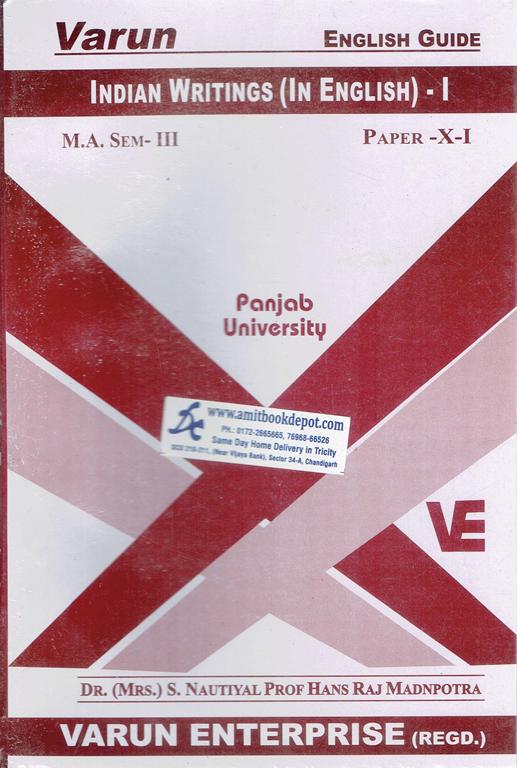
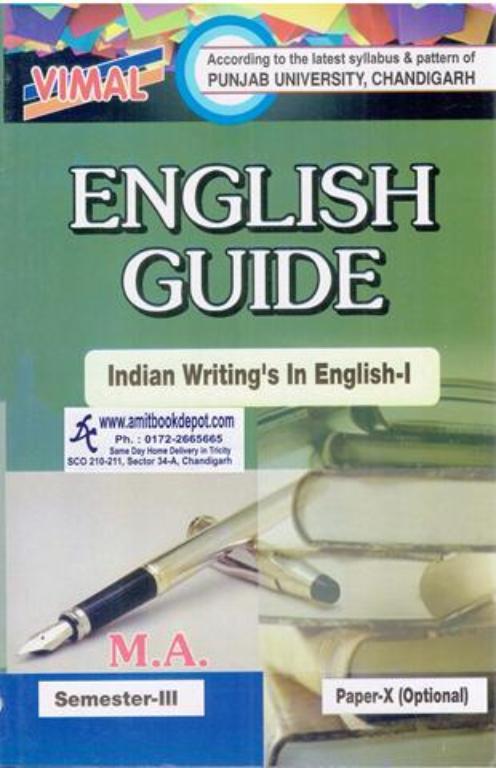
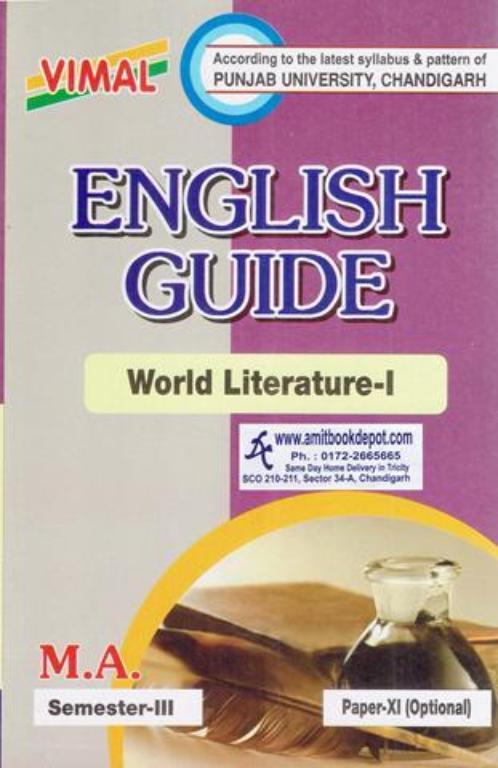
Varun English Guide Indian Writings in English 1 For MA 3rd Semester Paper 10 (1) Panjab University Chandigarh

by Madhurima
β‚Ή350 β‚Ή350.00(-/ off)

Rating & Reviews

23 Customer Review

The Varun English Guide for MA 3rd Semester, Paper 10 (1) is the essential study resource for Panjab University students. Authored by Dr. S. Nautiyal, this guide provides comprehensive coverage of the Indian Writings in English syllabus. It includes detailed critical analyses of works by Raja Rao (Kanthapura), Githa Hariharan, Mahesh Dattani (Final Solutions), and poets like A.K. Ramanujan and Agha Shahid Ali. With focused explanations, thematic discussions, and exam-oriented content, this guide is meticulously designed to help students decode complex texts and excel in their examinations. Keywords: MA English Guide, Panjab University, Indian Writings in English, Raja Rao, Kanthapura, Final Solutions, Syllabus-specific.

Have Doubts Regarding This Product ? Ask Your Question

  • Q1
    Does this guide include solved previous years' question papers from Panjab University?
    A1

    While the guide is structured to help answer exam-style questions, it may not contain full, compiled previous years' papers. Its primary focus is on providing critical analysis and content that enables students to formulate their own answers.

  • Q2
    How does the guide help in understanding the complex narrative style of Raja Rao's Kanthapura?
    A2

    It dedicates a significant section to explaining Raja Rao's use of the 'sthalapurana' (legend-of-a-place) technique, the grandmother narrator, and how the English language is Indianized to suit the storytelling, making the novel's structure more accessible.

  • Q3
    Is the critical theory behind the non-fictional prose pieces (Tagore, Mehrotra, Chaudhuri) explained?
    A3

    Yes, Unit 1 provides context and critical frameworks for understanding the essays, explaining their arguments about nationalism, literary criticism, and the evolution of the Indian novel in English.

  • Q4
    Does this guide cover the specific page numbers of the essays as mentioned in the Panjab University syllabus?
    A4

    The guide is designed based on the syllabus-prescribed texts and excerpts. However, for the precise pagination of essays within anthologies, students should cross-reference with their primary texts.

  • Q5
    How is Githa Hariharan's feminist perspective in The Thousand Faces of Night addressed?
    A5

    The guide offers a dedicated feminist critique, analyzing how the novel deconstructs traditional myths (like Sita, Gandhari) to explore the constraints and aspirations of its female protagonists in a patriarchal society.

  • Q6
    Is this book useful for students from universities other than Panjab University?
    A6

    While it is specifically tailored for the Panjab University syllabus, students from other universities studying the same texts (e.g., Kanthapura, Final Solutions, poetry of Ramanujan) will find the critical analyses immensely beneficial.

  • Q7
    Does the section on Mahesh Dattani's Final Solutions explain the symbolism of the set and characters?
    A7

    Absolutely. The guide analyzes the symbolism of the divided set, the characters of the Mob, and the choral interludes, which are central to understanding the play's themes of communalism and duality.

  • Q8
    Is the language used in the guide academic and complex, or is it simplified for better understanding?
    A8

    The language is academic yet clear and student-friendly, designed to simplify complex literary concepts without diluting their critical depth.

  • Q9
    Are the works of all three poets (Ramanujan, Kolatkar, Ali) given equal weightage in the analysis?
    A9

    Yes, the guide provides comprehensive and balanced critical analysis for all the prescribed poems of each poet, as per the university's syllabus requirements.

  • Q10
    How does the guide handle the cultural and historical context of the texts, such as the Gandhian era in Kanthapura?
    A10

    Each unit provides essential historical and cultural background to situate the text, such as the Gandhian National Movement for Kanthapura and the post-Babri Masjid context for Final Solutions.

0.00

0 Overall Rating
  • 5
    0
  • 4
    0
  • 3
    0
  • 2
    0
  • 1
    0

Try this product & share your review & thoughts

UNIT 1 - Non-Fictional Prose
1. Rabindranath Tagore: β€œNationalism in India,” Nationalism
2. Arvind Krishna Mehrotra: The Emperor Has No Clothes
3. Amit Chaudhuri: The Construction of the Indian Novel in English

UNIT 2 - Fiction I
1. Raja Rao: Kanthapura

UNIT 3 - Fiction II
1. Githa Hariharan: The Thousand Faces of Night

UNIT 4 - Poetry
1. A.K. Ramanujan: β€œExtended Family” and β€œSmall-Scale Reflections on a Great House”
2. Arun Kolatkar: β€œMeera” and β€œKnucklebones,” β€œKala Ghoda”
3. Agha Shahid Ali: β€œThe Dacca Gauzes,” β€œBeyond English from The Veiled Suite

UNIT 5 - Drama
1. Mahesh Dattani: Final Solutions

Latest Syllabus of English Guide Indian Writings in English 1 For MA 3rd Semester Paper 10 (1) Panjab University (PU) Chandigarh


Paper X
(Choose any one option.)
(1) Indian Writings (in English) – I

Indian Literature in English has captured the attention of readers both at home and abroad as it transforms the art of oral Indian narrative and indigenous experience in an adopted language, giving it a new dimension. The present course aims at presenting a sweep of Indian writing in English, representative of multiple genres and voices. Indian writers took to English as a consequence of the introduction of English as the medium of instruction by the British. From raising questions against the colonial enterprise to encapsulating the disillusionment of post-Independence India and receiving a definitive fillip in the 1980s, it has negotiated a convoluted terrain. And from being β€˜twice born’ to flowering into a playful, self-conscious writing, it indeed has been a long journey. The course aims at acquainting students with the diverse range of Indian writing in English. Further, the list of texts will call for a thorough contextual discussion, as the genre has grappled with contentious issues of authenticity, language, nation, identity, and idiom. The paper has 5 units. The testing pattern will include one question with internal choice from each unit. All questions will be compulsory.

Unit 1: Non-Fictional Prose
1. Rabindranath Tagore, β€œNationalism in India,” Nationalism (BoD, 2018), 41-55.
2. Arvind Krishna Mehrotra, β€œFrom β€œThe Emperor Has No Clothes,” ed. Amit Chaudhuri, The Picador Book of Modern Indian Literature (New Delhi: Picador, 2001) 456-477.
3. Amit Chaudhuri, β€œThe Construction of the Indian Novel in English,” ed. Amit Chaudhuri, The Picador Book of Modern Indian Literature (New Delhi: Picador, 2001) xxiii–xxxi.

Unit 2 Fiction I
β€’ Raja Rao. Kanthapura, New Delhi: Orient, 1971

Unit 3: Fiction II
β€’ Githa Hariharan. The Thousand Faces of Night. New Delhi: Penguin, 2008.

Unit 4 Poetry
1. A.K. Ramanujan: β€œExtended Family” and β€œSmall Scale Reflections on a Great House,” The Collected Poems of A.K. Ramanujan (Delhi: OUP, 1995)
2. Arun Kolatkar: β€œMeera” (26-33) and β€œKnucklebones” (66-69), Kala Ghoda Poems (Mumbai, Pras Prakashan, 2004)
3. Agha Shahid Ali: β€œThe Dacca Gauzes” and β€œBeyond English” from The Veiled Suiteβ€”The Collected Poems. WW Norton & Company, 2009.

Unit 5 Drama
β€’ Mahesh Dattani. Final Solutions. Oxford University Press, 2005

Varun English Guide: Indian Writings in English 1 for MA 3rd Semester, Paper 10 (1)β€”Panjab University, Chandigarh

Master the nuanced landscape of Indian Writings in English with the definitive academic companion for Panjab University's MA 3rd Semester, Paper 10 (1). This Varun English Guide, meticulously authored by Dr. S. Nautiyal and published by Varun Enterprises, is an indispensable resource designed to provide students with a comprehensive and in-depth understanding of the prescribed syllabus. It is strategically structured to align perfectly with the university's curriculum, ensuring complete syllabus coverage and focused exam preparation.

The guide begins by contextualizing the journey of Indian literature in English, tracing its evolution from a colonial byproduct to a powerful, self-conscious medium of expression that grapples with complex themes of identity, nationhood, and authenticity. This foundational understanding is crucial for appreciating the texts covered across the five units of the paper.

Unit 1: Non-Fictional Prose offers critical insights into the ideological underpinnings of Indian thought. The guide provides detailed analyses of Rabindranath Tagore's seminal essay "Nationalism in India," Arvind Krishna Mehrotra's critical work "The Emperor Has No Clues," and Amit Chaudhuri's meta-literary exploration in "The Construction of the Indian Novel in English." This unit equips students to engage with debates on nationalism, literary criticism, and the very fabric of the Indian literary canon.

Unit 2: Fiction I am dedicated entirely to Raja Rao's iconic novel, Kanthapura. The guide delves deep into its narrative structure, exploring how Rao masterfully employs the 'sthalapurana' technique to tell a local story with epic dimensions. Key themes such as the Gandhian freedom struggle, the role of the village, and the innovative use of the English language are thoroughly examined to help students appreciate this cornerstone of Indian fiction.

Unit 3: Fiction II focuses on Githa Hariharan's celebrated novel, The Thousand Faces of Night. The guide offers a penetrating analysis of the novel's feminist perspective, deconstructing the myths and realities of womanhood in post-colonial India. It provides detailed character sketches and explores the central conflict between tradition and individual desire, a vital area for critical examination.

Unit 4: Poetry navigates the diverse poetic voices of A.K. Ramanujan, Arun Kolatkar, and Agha Shahid Ali. The guide includes comprehensive line-by-line explanations, thematic discussions, and critical commentaries on poems such as Ramanujan's "Small-Scale Reflections on a Great House," Kolatkar's "Meera" and "Knucklebones," and Agha Shahid Ali's "The Dacca Gauzes." This section helps students unravel the complex imagery, cultural motifs, and emotional depth of these significant poetic works.

Unit 5: Drama concludes with a thorough exploration of Mahesh Dattani's powerful play, Final Solutions. The guide breaks down the plot, characters, and dramatic techniques used by Dattani to address the incendiary themes of communal prejudice, religious intolerance, and the search for personal and political resolution in modern India.

This Varun English Guide is more than just a summary book. It is a critical companion that fosters analytical thinking and provides:

1. Detailed chapter summaries and critical analyses for each text.
2. In-depth exploration of key themes such as nationalism, gender, identity, and tradition.
3. Character Sketches and Plot Overviews for prose and drama.
4. Line-by-line Explanations and Poetic Device Analysis for poetry.
5. Examination-Oriented Content structured to help students answer questions effectively, including potential short and long answer questions.

For any student pursuing a master's in English from Panjab University, this guide is an essential investment for academic success, offering a clear, coherent, and critical pathway to mastering Paper 10 (1): Indian Writings in English 1.

UNIT 1 - Non-Fictional Prose
1. Rabindranath Tagore: β€œNationalism in India,” Nationalism
2. Arvind Krishna Mehrotra: The Emperor Has No Clothes
3. Amit Chaudhuri: The Construction of the Indian Novel in English

UNIT 2 - Fiction I
1. Raja Rao: Kanthapura

UNIT 3 - Fiction II
1. Githa Hariharan: The Thousand Faces of Night

UNIT 4 - Poetry
1. A.K. Ramanujan: β€œExtended Family” and β€œSmall-Scale Reflections on a Great House”
2. Arun Kolatkar: β€œMeera” and β€œKnucklebones,” β€œKala Ghoda”
3. Agha Shahid Ali: β€œThe Dacca Gauzes,” β€œBeyond English from The Veiled Suite

UNIT 5 - Drama
1. Mahesh Dattani: Final Solutions

Have Doubts Regarding This Product ? Ask Your Question

  • Q1
    Does this guide include solved previous years' question papers from Panjab University?
    A1

    While the guide is structured to help answer exam-style questions, it may not contain full, compiled previous years' papers. Its primary focus is on providing critical analysis and content that enables students to formulate their own answers.

  • Q2
    How does the guide help in understanding the complex narrative style of Raja Rao's Kanthapura?
    A2

    It dedicates a significant section to explaining Raja Rao's use of the 'sthalapurana' (legend-of-a-place) technique, the grandmother narrator, and how the English language is Indianized to suit the storytelling, making the novel's structure more accessible.
  • Q3
    Is the critical theory behind the non-fictional prose pieces (Tagore, Mehrotra, Chaudhuri) explained?
    A3

    Yes, Unit 1 provides context and critical frameworks for understanding the essays, explaining their arguments about nationalism, literary criticism, and the evolution of the Indian novel in English.

  • Q4
    Does this guide cover the specific page numbers of the essays as mentioned in the Panjab University syllabus?
    A4

    The guide is designed based on the syllabus-prescribed texts and excerpts. However, for the precise pagination of essays within anthologies, students should cross-reference with their primary texts.

  • Q5
    How is Githa Hariharan's feminist perspective in The Thousand Faces of Night addressed?
    A5

    The guide offers a dedicated feminist critique, analyzing how the novel deconstructs traditional myths (like Sita, Gandhari) to explore the constraints and aspirations of its female protagonists in a patriarchal society.

  • Q6
    Is this book useful for students from universities other than Panjab University?
    A6

    While it is specifically tailored for the Panjab University syllabus, students from other universities studying the same texts (e.g., Kanthapura, Final Solutions, poetry of Ramanujan) will find the critical analyses immensely beneficial.

  • Q7
    Does the section on Mahesh Dattani's Final Solutions explain the symbolism of the set and characters?
    A7

    Absolutely. The guide analyzes the symbolism of the divided set, the characters of the Mob, and the choral interludes, which are central to understanding the play's themes of communalism and duality.

  • Q8
    Is the language used in the guide academic and complex, or is it simplified for better understanding?
    A8

    The language is academic yet clear and student-friendly, designed to simplify complex literary concepts without diluting their critical depth.

  • Q9
    Are the works of all three poets (Ramanujan, Kolatkar, Ali) given equal weightage in the analysis?
    A9

    Yes, the guide provides comprehensive and balanced critical analysis for all the prescribed poems of each poet, as per the university's syllabus requirements.

  • Q10
    How does the guide handle the cultural and historical context of the texts, such as the Gandhian era in Kanthapura?
    A10

    Each unit provides essential historical and cultural background to situate the text, such as the Gandhian National Movement for Kanthapura and the post-Babri Masjid context for Final Solutions.

Latest Syllabus of English Guide Indian Writings in English 1 For MA 3rd Semester Paper 10 (1) Panjab University (PU) Chandigarh


Paper X
(Choose any one option.)
(1) Indian Writings (in English) – I

Indian Literature in English has captured the attention of readers both at home and abroad as it transforms the art of oral Indian narrative and indigenous experience in an adopted language, giving it a new dimension. The present course aims at presenting a sweep of Indian writing in English, representative of multiple genres and voices. Indian writers took to English as a consequence of the introduction of English as the medium of instruction by the British. From raising questions against the colonial enterprise to encapsulating the disillusionment of post-Independence India and receiving a definitive fillip in the 1980s, it has negotiated a convoluted terrain. And from being β€˜twice born’ to flowering into a playful, self-conscious writing, it indeed has been a long journey. The course aims at acquainting students with the diverse range of Indian writing in English. Further, the list of texts will call for a thorough contextual discussion, as the genre has grappled with contentious issues of authenticity, language, nation, identity, and idiom. The paper has 5 units. The testing pattern will include one question with internal choice from each unit. All questions will be compulsory.

Unit 1: Non-Fictional Prose
1. Rabindranath Tagore, β€œNationalism in India,” Nationalism (BoD, 2018), 41-55.
2. Arvind Krishna Mehrotra, β€œFrom β€œThe Emperor Has No Clothes,” ed. Amit Chaudhuri, The Picador Book of Modern Indian Literature (New Delhi: Picador, 2001) 456-477.
3. Amit Chaudhuri, β€œThe Construction of the Indian Novel in English,” ed. Amit Chaudhuri, The Picador Book of Modern Indian Literature (New Delhi: Picador, 2001) xxiii–xxxi.

Unit 2 Fiction I
β€’ Raja Rao. Kanthapura, New Delhi: Orient, 1971

Unit 3: Fiction II
β€’ Githa Hariharan. The Thousand Faces of Night. New Delhi: Penguin, 2008.

Unit 4 Poetry
1. A.K. Ramanujan: β€œExtended Family” and β€œSmall Scale Reflections on a Great House,” The Collected Poems of A.K. Ramanujan (Delhi: OUP, 1995)
2. Arun Kolatkar: β€œMeera” (26-33) and β€œKnucklebones” (66-69), Kala Ghoda Poems (Mumbai, Pras Prakashan, 2004)
3. Agha Shahid Ali: β€œThe Dacca Gauzes” and β€œBeyond English” from The Veiled Suiteβ€”The Collected Poems. WW Norton & Company, 2009.

Unit 5 Drama
β€’ Mahesh Dattani. Final Solutions. Oxford University Press, 2005

0.00

0 Overall Rating
  • 5
    0
  • 4
    0
  • 3
    0
  • 2
    0
  • 1
    0

Try this product & share your review & thoughts

Top Trending Product

Related Product

Related Product

Related Blog Posts

Latest Blogs

Latest Blogs

blog-img
Classic Literature Reimagined: Discuss modern twists on classic novels.
Lorem ipsum dolor sit amet, consectetur adipiscing elit, sed do eiusmod tempor incididunt ut labore et dolore magna aliqua. Ut enim ad minim veniam, quis nostrud exercitation ullamco Lorem ipsum dolor sit amet, consectetur adipiscing elit, sed do eiusmod tempor incididunt ut labore et dolore magna aliqua. Utenim ad minim veniam, quis nostrud exercitation ullamco Lorem ipsum dolor sit amet, consecte...
Read more
Author name | 10 jan, 2025
blog-img
Classic Literature Reimagined: Discuss modern twists on classic novels.
Lorem ipsum dolor sit amet, consectetur adipiscing elit, sed do eiusmod tempor incididunt ut labore et dolore magna aliqua. Ut enim ad minim veniam, quis nostrud exercitation ullamco Lorem ipsum dolor sit amet, consectetur adipiscing elit, sed do eiusmod tempor incididunt ut labore et dolore magna aliqua. Utenim ad minim veniam, quis nostrud exercitation ullamco Lorem ipsum dolor sit amet, consecte...
Read more
Author name | 10 jan, 2025
blog-img
Classic Literature Reimagined: Discuss modern twists on classic novels.
Lorem ipsum dolor sit amet, consectetur adipiscing elit, sed do eiusmod tempor incididunt ut labore et dolore magna aliqua. Ut enim ad minim veniam, quis nostrud exercitation ullamco Lorem ipsum dolor sit amet, consectetur adipiscing elit, sed do eiusmod tempor incididunt ut labore et dolore magna aliqua. Utenim ad minim veniam, quis nostrud exercitation ullamco Lorem ipsum dolor sit amet, consecte...
Read more
Author name | 10 jan, 2025
blog-img
Classic Literature Reimagined: Discuss modern twists on classic novels.
Lorem ipsum dolor sit amet, consectetur adipiscing elit...
Read more
Author Name | 10 Jan, 2025
blog-img
Classic Literature Reimagined: Discuss modern twists on classic novels.
Lorem ipsum dolor sit amet, consectetur adipiscing elit...
Read more
Author Name | 10 Jan, 2025
blog-img
Classic Literature Reimagined: Discuss modern twists on classic novels.
Lorem ipsum dolor sit amet, consectetur adipiscing elit...
Read more
Author Name | 10 Jan, 2025
blog-img
Classic Literature Reimagined: Discuss modern twists on classic novels.
Lorem ipsum dolor sit amet, consectetur adipiscing elit...
Read more
Author Name | 10 Jan, 2025
blog-img
Classic Literature Reimagined: Discuss modern twists on classic novels.
Lorem ipsum dolor sit amet, consectetur adipiscing elit...
Read more
Author Name | 10 Jan, 2025
blog-img
Classic Literature Reimagined: Discuss modern twists on classic novels.
Lorem ipsum dolor sit amet, consectetur adipiscing elit...
Read more
Author Name | 10 Jan, 2025
blog-img
Classic Literature Reimagined: Discuss modern twists on classic novels.
Lorem ipsum dolor sit amet, consectetur adipiscing elit...
Read more
Author Name | 10 Jan, 2025
blog-img
Classic Literature Reimagined: Discuss modern twists on classic novels.
Lorem ipsum dolor sit amet, consectetur adipiscing elit...
Read more
Author Name | 10 Jan, 2025
blog-img
Classic Literature Reimagined: Discuss modern twists on classic novels.
Lorem ipsum dolor sit amet, consectetur adipiscing elit...
Read more
Author Name | 10 Jan, 2025