Categories
College Bookssss >
BA PU Chandigarh
BSC PU Chandigarh
MSC PU Chandigarh
BBA PU Chandigarh
MA PU Chandigarh
Medical Books
Engineering Books
Management Books
PGDCA Books
BCOM PU Chandigarh
MCOM PU Chandigarh
BCA PU Chandigarh
MCA PU Chandigarh
animate-books

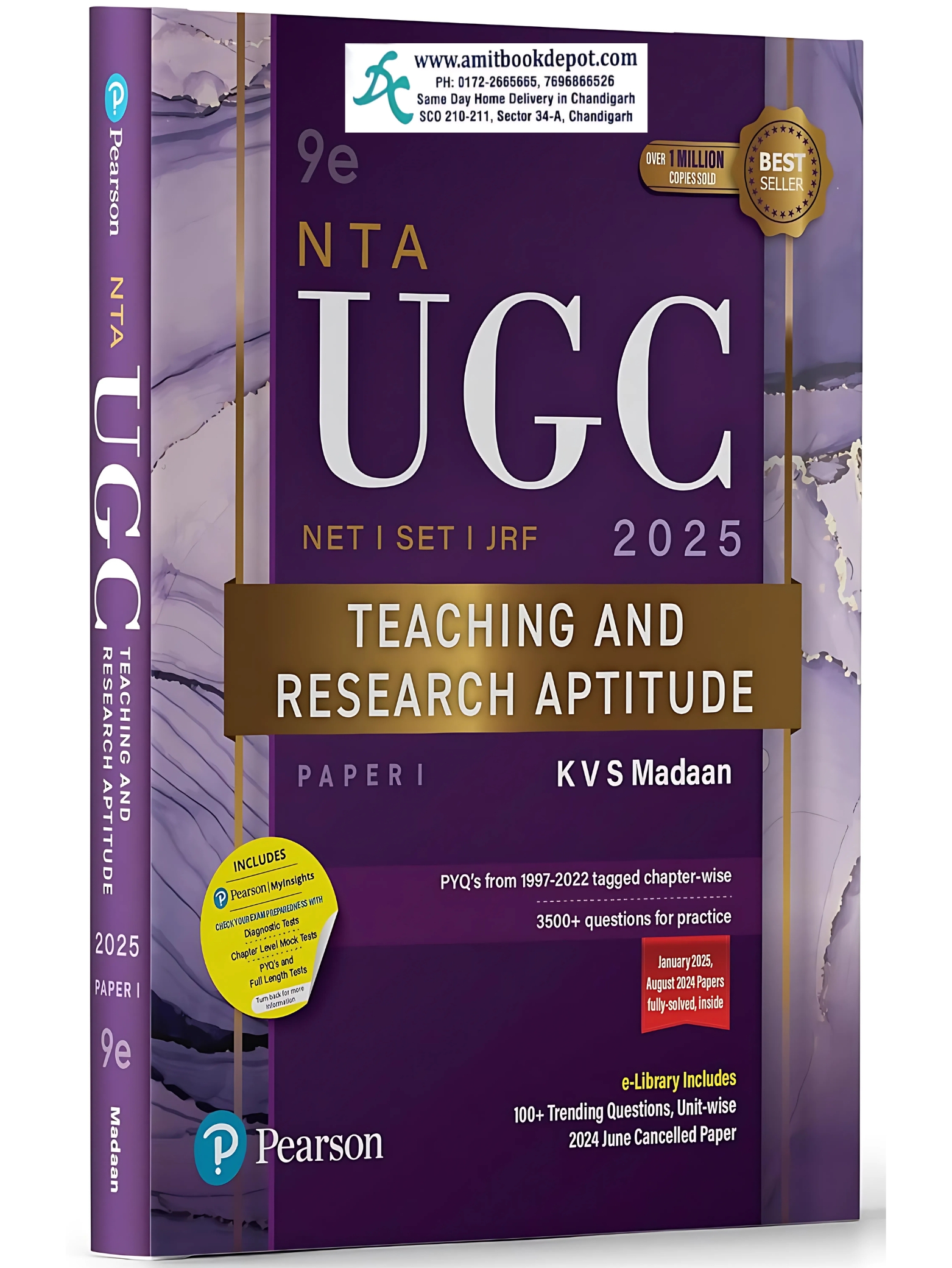
Pearson NTA UGC NET, SET JRF Teaching and Research Aptitude Paper 1 2025 (English Medium)

by Madhurima
₹440 ₹599.00(-/ off)

Rating & Reviews

23 Customer Review

Pearson NTA UGC NET/SET/JRF Teaching & Research Aptitude Paper 1 2025 (English Medium) by K. V. S. Madaan is the latest edition for UGC NET, SET, and JRF aspirants. It covers all 10 units of Paper 1, including teaching aptitude, research aptitude, logical reasoning, ICT, and more. The book features previous years’ papers (2022-2023), mock tests, and practice questions for complete exam readiness. Written in a student-friendly manner, it ensures conceptual clarity and high scores. Ideal for teaching and research career aspirants, this book is a trusted guide for NTA-UGC NET, SET, and JRF exams.

Have Doubts Regarding This Product ? Ask Your Question

  • Q1
    Is this book updated for the 2025 UGC NET exam?
    A1

    Yes, this is the latest 2025 edition as per the NTA syllabus.

  • Q2
    Does it include previous years’ question papers?
    A2

    Yes, it includes UGC NET 2022 & 2023 papers with solutions.

  • Q3
    Is this book useful for SET exams?
    A3

    Absolutely, it covers the common syllabus for UGC NET & SET.

  • Q4
    Does it cover all 10 units of Paper 1?
    A4

    Yes, all 10 units are explained with practice questions.

  • Q5
    Is the book suitable for JRF preparation?
    A5

    Yes, it is designed for both Assistant Professor & JRF exams.

  • Q6
    Does it include ICT and Higher Education System topics?
    A6

    Yes, Unit 8 (ICT) and Unit 10 (Higher Education System) are covered.

  • Q7
    How is this book different from other UGC NET guides?
    A7

    It is written by K.V.S. Madaan, a renowned expert, and includes latest NTA pattern questions.

  • Q8
    Does it contain environmental and development topics?
    A8

    Yes, Unit 9 (People, Development & Environment) is included.

  • Q9
    Are there any online resources with this book?
    A9

    This is a standalone book, but it includes ample offline practice material.

  • Q10
    Can this book help with Ph.D. entrance exams?
    A10

    Yes, the Research Aptitude section is beneficial for Ph.D. entrance tests.

0.00

0 Overall Rating
  • 5
    0
  • 4
    0
  • 3
    0
  • 2
    0
  • 1
    0

Try this product & share your review & thoughts

1. Teaching Aptitude
2. Research Aptitude
3. Comprehension
4. Communication
5. Mathematical Reasoning and Aptitude
6. Logical Reasoning
7. Data Interpretation
8. Information and Communication Technology (ICT)
9. People, Development, and Environment
10. Higher Education System

MOCK TEST
Previous Years’ Papers
UGC NET Question Paper December 2023
UGC NET Question Paper June 2023 - Set 1
UGC NET Question Paper June 2023 - Set 2
UGC NET Question Paper 2022 - Set 1
UGC NET Question Paper 2022 - Set 2

Latest Syllabus Of Pearson NTA UGC NET/SET/JRF Teaching & Research Aptitude Paper 1 2025


UNIVERSITY GRANTS COMMISSION
NET BUREAU

SYLLABUS
Subject: GENERAL PAPER ON TEACHING & RESEARCH APTITUDE Code No.: 00
 

PAPER-I 

The main objective is to assess the teaching and research capabilities of the candidates. The test aims at assessing the teaching and research aptitude as well.
Candidates are expected to possess and exhibit cognitive abilities, which include comprehension, analysis, evaluation, understanding the structure of arguments, 
deductive and inductive reasoning. The candidates are also expected to have a general awareness about teaching and learning processes in the higher education system. Further, they should be aware of the interaction between people, the environment, natural resources, and their impact on the quality of life. The details of the syllabi are as follows:

Unit I: Teaching Aptitude 

- Teaching: Concept, objectives, levels of teaching (memory, understanding, and reflective), characteristics, and basic requirements.
- Learner’s characteristics: Characteristics of adolescent and adult learners (academic, social, emotional, and cognitive) and individual differences.
- Factors affecting teaching related to: Teacher, Learner, Support material, Instructional facilities, Learning environment, and Institution.
- Methods of teaching in institutions of higher learning: teacher-centered vs. learner-centered methods; offline vs. online methods (Swayam, Swayamprabha, MOOCs, etc.).
- Teaching Support System: Traditional, Modern, and ICT-Based.
- Evaluation Systems: Elements and types of evaluation, evaluation in the choice-based credit system in higher education, computer-based testing, and innovations in evaluation systems.

Unit II: Research Aptitude 

- Research: Meaning, Types, and Characteristics, Positivism and Post-positivistic Approach to Research.
- Methods of Research: Experimental, Descriptive, Historical, Qualitative, and Quantitative methods.
- Steps of Research.
- Thesis and article writing: Format and styles of referencing.
- Application of ICT in research.
- Research ethics.

Unit III Comprehension 
- A passage of text be given. Questions are asked from the passage to be answered.

Unit IV: Communication 

- Communication: Meaning, types, and characteristics of communication.
- Effective communication: verbal and nonverbal, intercultural and group communications, and classroom communication.
- Barriers to effective communication.
- Mass Media and Society.

Unit V: Mathematical Reasoning and Aptitude 

- Types of reasoning.
- Number series, letter series, codes, and relationships.
- Mathematical Aptitude (Fraction, Time & Distance, Ratio, Proportion and Percentage, Profit and Loss, Interest and Discounting, Averages, etc.).

Unit VI: Logical Reasoning 

- Understanding the structure of arguments: argument forms, structure of categorical propositions, mood and figure, formal and informal fallacies, uses of language, connotations and denotations of terms, and the classical square of opposition.
- Evaluating and distinguishing deductive and inductive reasoning.
- Analogies. 
- Venn diagram: Simple and multiple use for establishing validity of arguments.
- Indian Logic: Means of knowledge.
- Pramanas: Pratyaksha (Perception), Anumana (Inference), Upamana (Comparison), Shabda (Verbal testimony), Arthapatti (Implication), and Anupalabddhi (Non-apprehension). 
- Structure and kinds of Anumana (inference), Vyapti (invariable relation), and Hetvabhasas (fallacies of inference).

Unit VII: Data Interpretation 

- Sources, acquisition, and classification of data.
- Quantitative and Qualitative Data.
- Graphical representation (bar chart, histogram, pie chart, table chart, and line chart) and mapping of data.
- Data Interpretation.
- Data and Governance.

Unit VIII: Information and Communication Technology (ICT) 

- ICT: General abbreviations and terminology.
- Basics of Internet, Intranet, E-mail, Audio, and Video Conferencing.
- Digital initiatives in higher education.
- ICT and Governance.

Unit IX: People, Development, and Environment 

- Development and environment: Millennium development and sustainable development goals.
- Human and environment interaction: Anthropogenic activities and their impacts on the environment.
- Environmental issues: Local, regional, and global; air pollution, water pollution, soil pollution, noise pollution, waste (solid, liquid, biomedical, hazardous, and electronic), climate change, and its socio-economic and political dimensions.
- Impacts of pollutants on human health.
- Natural and energy resources: Solar, wind, soil, hydro, geothermal, biomass, nuclear, and forests.
- Natural hazards and disasters: Mitigation strategies.
- Environmental Protection Act (1986), National Action Plan on Climate Change, International agreements/efforts—Montreal Protocol, Rio Summit, Convention on Biodiversity, Kyoto Protocol, Paris Agreement, International Solar Alliance.

Unit-X Higher Education System 

- Institutions of higher learning and education in ancient India.
- Evolution of higher learning and research in post-independence India.
- Oriental, conventional, and non-conventional learning programs in India.
- Professional, technical, and skill-based education.
- Value education and environmental education.
- Policies, Governance, and Administration.

NOTE: (i) Five questions, each carrying 2 marks, are to be set from each module. 
(ii) Whenever graphical/pictorial question(s) are set for sighted candidates, a passage followed by an equal number of questions and weightage should be set for visually impaired candidates.

Pearson NTA UGC NET, SET JRF Teaching and Research Aptitude Paper 1 2025 (English Medium) by K. V. S. Madaan is a comprehensive guide designed to help aspirants crack the UGC NET, SET, and JRF examinations with confidence. This latest edition aligns with the updated syllabus and exam pattern prescribed by the National Testing Agency (NTA). The book covers all 10 units of Paper 1 (General Paper on Teaching and Research Aptitude), ensuring complete conceptual clarity, practice questions, and previous years’ papers for thorough preparation.

Key Features of the Book

1. Structured Syllabus Coverage—The book systematically covers all 10 units of UGC NET Paper 1, including
2. Latest Exam Pattern & Previous Years’ Papers—Includes UGC NET December 2023, June 2023 (Set 1 & 2), and 2022 (Set 1 & 2) question papers with detailed solutions to familiarize students with the exam trends and difficulty level.
3. Conceptual Clarity & Practice Questions—Each chapter provides clear explanations, examples, and practice questions to strengthen understanding and improve problem-solving speed.
4. Mock Tests for Self-Assessment—The book contains full-length mock tests designed as per the latest NTA pattern, helping students evaluate their preparation and identify weak areas.
5. Expert Author Guidance—K. V. S. Madaan, a renowned name in UGC NET exam preparation, ensures the content is accurate, exam-oriented, and student-friendly.
6. Useful for All Teaching & Research Exams—Besides UGC NET, this book is beneficial for State Eligibility Test (SET), Junior Research Fellowship (JRF), and other teaching recruitment exams.

Why Choose This Book?

1. Latest 2025 Edition with updated content as per NTA guidelines.
2. Comprehensive coverage of all Paper 1 topics in a single book.
3. Previous years’ solved papers for real exam practice.
4. High-quality practice questions with explanations.
5. Designed for quick revision with well-structured content.
6. Trusted by thousands of NET aspirants for its reliability.

Who Should Buy This Book?

1. UGC NET (Assistant Professor & JRF) aspirants
2. SET (State Eligibility Test) candidates
3. Ph.D. entrance exam takers
4. College/university teachers preparing for promotions
5. Anyone aiming for a career in teaching and research

Conclusion
The Pearson NTA UGC NET/SET/JRF Teaching & Research Aptitude Paper 1 2025 is a must-have resource for serious aspirants. With its structured approach, previous years’ papers, and mock tests, it ensures effective preparation and high scores in the exam.

1. Teaching Aptitude
2. Research Aptitude
3. Comprehension
4. Communication
5. Mathematical Reasoning and Aptitude
6. Logical Reasoning
7. Data Interpretation
8. Information and Communication Technology (ICT)
9. People, Development, and Environment
10. Higher Education System

MOCK TEST
Previous Years’ Papers
UGC NET Question Paper December 2023
UGC NET Question Paper June 2023 - Set 1
UGC NET Question Paper June 2023 - Set 2
UGC NET Question Paper 2022 - Set 1
UGC NET Question Paper 2022 - Set 2

Have Doubts Regarding This Product ? Ask Your Question

  • Q1
    Is this book updated for the 2025 UGC NET exam?
    A1

    Yes, this is the latest 2025 edition as per the NTA syllabus.

  • Q2
    Does it include previous years’ question papers?
    A2

    Yes, it includes UGC NET 2022 & 2023 papers with solutions.

  • Q3
    Is this book useful for SET exams?
    A3

    Absolutely, it covers the common syllabus for UGC NET & SET.

  • Q4
    Does it cover all 10 units of Paper 1?
    A4

    Yes, all 10 units are explained with practice questions.

  • Q5
    Is the book suitable for JRF preparation?
    A5

    Yes, it is designed for both Assistant Professor & JRF exams.

  • Q6
    Does it include ICT and Higher Education System topics?
    A6

    Yes, Unit 8 (ICT) and Unit 10 (Higher Education System) are covered.

  • Q7
    How is this book different from other UGC NET guides?
    A7

    It is written by K.V.S. Madaan, a renowned expert, and includes latest NTA pattern questions.

  • Q8
    Does it contain environmental and development topics?
    A8

    Yes, Unit 9 (People, Development & Environment) is included.

  • Q9
    Are there any online resources with this book?
    A9

    This is a standalone book, but it includes ample offline practice material.

  • Q10
    Can this book help with Ph.D. entrance exams?
    A10

    Yes, the Research Aptitude section is beneficial for Ph.D. entrance tests.

Latest Syllabus Of Pearson NTA UGC NET/SET/JRF Teaching & Research Aptitude Paper 1 2025


UNIVERSITY GRANTS COMMISSION
NET BUREAU

SYLLABUS
Subject: GENERAL PAPER ON TEACHING & RESEARCH APTITUDE Code No.: 00
 

PAPER-I 

The main objective is to assess the teaching and research capabilities of the candidates. The test aims at assessing the teaching and research aptitude as well.
Candidates are expected to possess and exhibit cognitive abilities, which include comprehension, analysis, evaluation, understanding the structure of arguments, 
deductive and inductive reasoning. The candidates are also expected to have a general awareness about teaching and learning processes in the higher education system. Further, they should be aware of the interaction between people, the environment, natural resources, and their impact on the quality of life. The details of the syllabi are as follows:

Unit I: Teaching Aptitude 

- Teaching: Concept, objectives, levels of teaching (memory, understanding, and reflective), characteristics, and basic requirements.
- Learner’s characteristics: Characteristics of adolescent and adult learners (academic, social, emotional, and cognitive) and individual differences.
- Factors affecting teaching related to: Teacher, Learner, Support material, Instructional facilities, Learning environment, and Institution.
- Methods of teaching in institutions of higher learning: teacher-centered vs. learner-centered methods; offline vs. online methods (Swayam, Swayamprabha, MOOCs, etc.).
- Teaching Support System: Traditional, Modern, and ICT-Based.
- Evaluation Systems: Elements and types of evaluation, evaluation in the choice-based credit system in higher education, computer-based testing, and innovations in evaluation systems.

Unit II: Research Aptitude 

- Research: Meaning, Types, and Characteristics, Positivism and Post-positivistic Approach to Research.
- Methods of Research: Experimental, Descriptive, Historical, Qualitative, and Quantitative methods.
- Steps of Research.
- Thesis and article writing: Format and styles of referencing.
- Application of ICT in research.
- Research ethics.

Unit III Comprehension 
- A passage of text be given. Questions are asked from the passage to be answered.

Unit IV: Communication 

- Communication: Meaning, types, and characteristics of communication.
- Effective communication: verbal and nonverbal, intercultural and group communications, and classroom communication.
- Barriers to effective communication.
- Mass Media and Society.

Unit V: Mathematical Reasoning and Aptitude 

- Types of reasoning.
- Number series, letter series, codes, and relationships.
- Mathematical Aptitude (Fraction, Time & Distance, Ratio, Proportion and Percentage, Profit and Loss, Interest and Discounting, Averages, etc.).

Unit VI: Logical Reasoning 

- Understanding the structure of arguments: argument forms, structure of categorical propositions, mood and figure, formal and informal fallacies, uses of language, connotations and denotations of terms, and the classical square of opposition.
- Evaluating and distinguishing deductive and inductive reasoning.
- Analogies. 
- Venn diagram: Simple and multiple use for establishing validity of arguments.
- Indian Logic: Means of knowledge.
- Pramanas: Pratyaksha (Perception), Anumana (Inference), Upamana (Comparison), Shabda (Verbal testimony), Arthapatti (Implication), and Anupalabddhi (Non-apprehension). 
- Structure and kinds of Anumana (inference), Vyapti (invariable relation), and Hetvabhasas (fallacies of inference).

Unit VII: Data Interpretation 

- Sources, acquisition, and classification of data.
- Quantitative and Qualitative Data.
- Graphical representation (bar chart, histogram, pie chart, table chart, and line chart) and mapping of data.
- Data Interpretation.
- Data and Governance.

Unit VIII: Information and Communication Technology (ICT) 

- ICT: General abbreviations and terminology.
- Basics of Internet, Intranet, E-mail, Audio, and Video Conferencing.
- Digital initiatives in higher education.
- ICT and Governance.

Unit IX: People, Development, and Environment 

- Development and environment: Millennium development and sustainable development goals.
- Human and environment interaction: Anthropogenic activities and their impacts on the environment.
- Environmental issues: Local, regional, and global; air pollution, water pollution, soil pollution, noise pollution, waste (solid, liquid, biomedical, hazardous, and electronic), climate change, and its socio-economic and political dimensions.
- Impacts of pollutants on human health.
- Natural and energy resources: Solar, wind, soil, hydro, geothermal, biomass, nuclear, and forests.
- Natural hazards and disasters: Mitigation strategies.
- Environmental Protection Act (1986), National Action Plan on Climate Change, International agreements/efforts—Montreal Protocol, Rio Summit, Convention on Biodiversity, Kyoto Protocol, Paris Agreement, International Solar Alliance.

Unit-X Higher Education System 

- Institutions of higher learning and education in ancient India.
- Evolution of higher learning and research in post-independence India.
- Oriental, conventional, and non-conventional learning programs in India.
- Professional, technical, and skill-based education.
- Value education and environmental education.
- Policies, Governance, and Administration.

NOTE: (i) Five questions, each carrying 2 marks, are to be set from each module. 
(ii) Whenever graphical/pictorial question(s) are set for sighted candidates, a passage followed by an equal number of questions and weightage should be set for visually impaired candidates.
0.00

0 Overall Rating
  • 5
    0
  • 4
    0
  • 3
    0
  • 2
    0
  • 1
    0

Try this product & share your review & thoughts

Top Trending Product

Related Product

Related Product

Related Blog Posts

Latest Blogs

Latest Blogs

blog-img
Classic Literature Reimagined: Discuss modern twists on classic novels.
Lorem ipsum dolor sit amet, consectetur adipiscing elit, sed do eiusmod tempor incididunt ut labore et dolore magna aliqua. Ut enim ad minim veniam, quis nostrud exercitation ullamco Lorem ipsum dolor sit amet, consectetur adipiscing elit, sed do eiusmod tempor incididunt ut labore et dolore magna aliqua. Utenim ad minim veniam, quis nostrud exercitation ullamco Lorem ipsum dolor sit amet, consecte...
Read more
Author name | 10 jan, 2025
blog-img
Classic Literature Reimagined: Discuss modern twists on classic novels.
Lorem ipsum dolor sit amet, consectetur adipiscing elit, sed do eiusmod tempor incididunt ut labore et dolore magna aliqua. Ut enim ad minim veniam, quis nostrud exercitation ullamco Lorem ipsum dolor sit amet, consectetur adipiscing elit, sed do eiusmod tempor incididunt ut labore et dolore magna aliqua. Utenim ad minim veniam, quis nostrud exercitation ullamco Lorem ipsum dolor sit amet, consecte...
Read more
Author name | 10 jan, 2025
blog-img
Classic Literature Reimagined: Discuss modern twists on classic novels.
Lorem ipsum dolor sit amet, consectetur adipiscing elit, sed do eiusmod tempor incididunt ut labore et dolore magna aliqua. Ut enim ad minim veniam, quis nostrud exercitation ullamco Lorem ipsum dolor sit amet, consectetur adipiscing elit, sed do eiusmod tempor incididunt ut labore et dolore magna aliqua. Utenim ad minim veniam, quis nostrud exercitation ullamco Lorem ipsum dolor sit amet, consecte...
Read more
Author name | 10 jan, 2025
blog-img
Classic Literature Reimagined: Discuss modern twists on classic novels.
Lorem ipsum dolor sit amet, consectetur adipiscing elit...
Read more
Author Name | 10 Jan, 2025
blog-img
Classic Literature Reimagined: Discuss modern twists on classic novels.
Lorem ipsum dolor sit amet, consectetur adipiscing elit...
Read more
Author Name | 10 Jan, 2025
blog-img
Classic Literature Reimagined: Discuss modern twists on classic novels.
Lorem ipsum dolor sit amet, consectetur adipiscing elit...
Read more
Author Name | 10 Jan, 2025
blog-img
Classic Literature Reimagined: Discuss modern twists on classic novels.
Lorem ipsum dolor sit amet, consectetur adipiscing elit...
Read more
Author Name | 10 Jan, 2025
blog-img
Classic Literature Reimagined: Discuss modern twists on classic novels.
Lorem ipsum dolor sit amet, consectetur adipiscing elit...
Read more
Author Name | 10 Jan, 2025
blog-img
Classic Literature Reimagined: Discuss modern twists on classic novels.
Lorem ipsum dolor sit amet, consectetur adipiscing elit...
Read more
Author Name | 10 Jan, 2025
blog-img
Classic Literature Reimagined: Discuss modern twists on classic novels.
Lorem ipsum dolor sit amet, consectetur adipiscing elit...
Read more
Author Name | 10 Jan, 2025
blog-img
Classic Literature Reimagined: Discuss modern twists on classic novels.
Lorem ipsum dolor sit amet, consectetur adipiscing elit...
Read more
Author Name | 10 Jan, 2025
blog-img
Classic Literature Reimagined: Discuss modern twists on classic novels.
Lorem ipsum dolor sit amet, consectetur adipiscing elit...
Read more
Author Name | 10 Jan, 2025