-
Mon-Fri: 10AM to 8PM 01722665665
-
My Account
-
-
0
Total :
₹ 0.00

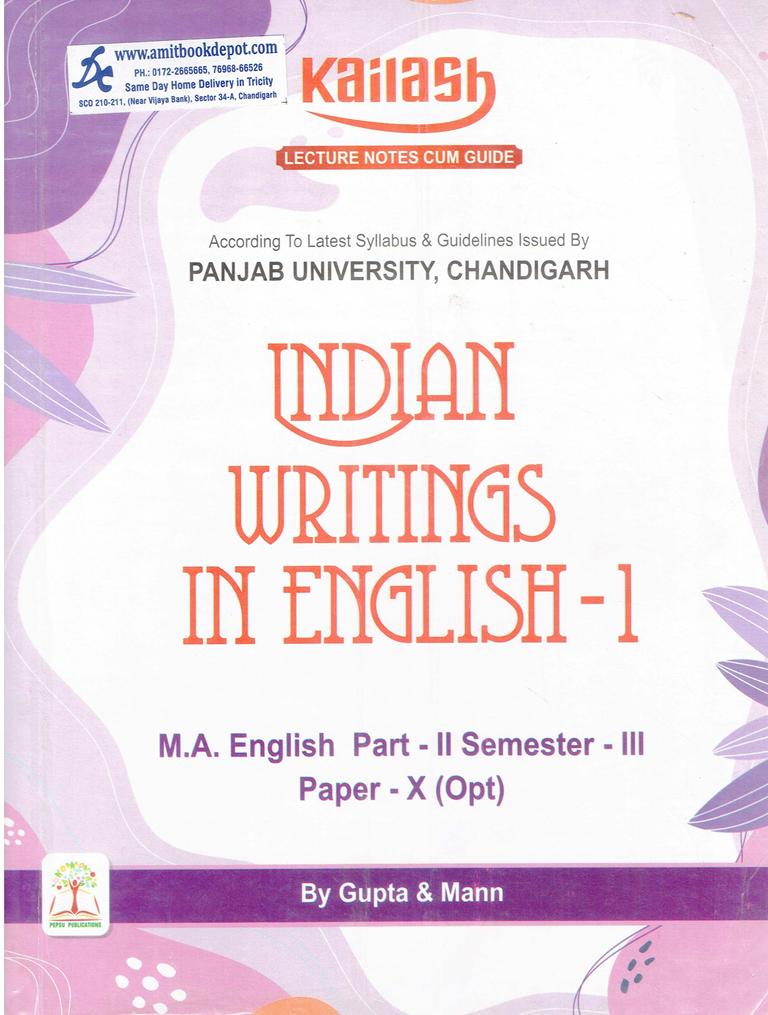
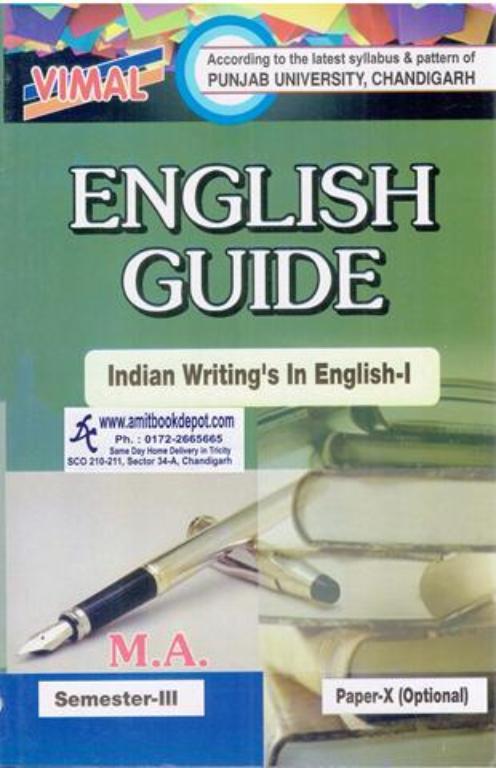
Kailash Indian Writings in English 1 is the prescribed academic guide for MA English Part 2, Semester 3, Paper 10 at Panjab University, Chandigarh. Authored by Gupta and Mann and published by Pepsu Book Depot, this comprehensive book provides detailed analysis of the complete syllabus. It covers Non-Fictional Prose by Tagore, Mehrotra, and Chaudhuri; Fiction by Raja Rao (Kanthapura) and Githa Hariharan (The Thousand Faces of Night); and Poetry by Ramanujan, Kolatkar, and Agha Shahid Ali. Designed for exam success, it includes summaries, critical insights, character sketches, and important questions for thorough preparation.

Yes, this volume by Gupta and Mann is specifically tailored to cover the current syllabus for Panjab University's MA English Part 2, Semester 3, Paper 10 (Indian Writings in English – I).
This is a critical guide and study companion. It does not contain the full original texts but provides exhaustive summaries, detailed analysis, character sketches, thematic explorations, and exam-oriented notes for all prescribed texts, including the novels.
The Poetry unit comprehensively covers A.K. Ramanujan ("Small-Scale Reflections on a Great House"), Arun Kolatkar ("Meera" and "Knucklebones" from Kala Ghoda Poems), and Agha Shahid Ali ("The Dacca Gauzes" and "Beyond English" from The Veiled Suite).
The book provides detailed explanations, critical perspectives, and analysis of these essays. For the complete original essays, students should refer to the source anthologies mentioned in the university syllabus, but this guide offers all necessary critical content for exam preparation.
Yes, in depth. The guide dedicates sections to the "Mythical Technique," its form as a Sthala-Purana (regional legend), and a detailed examination of "The Impact of Gandhi in 'Kanthapura'."
It offers a strong feminist and mythological interpretation, with dedicated sections on "Female Consciousness," "Remapping Mythology," "Journey of Women Characters," and "Feminist Interpretation."
Yes. For Kanthapura, sketches for Moorthy, Ratna, Patel Range Gowda, Bhatta, and others are included. For The Thousand Faces of Night, a detailed sketch of Devi and analysis of other women characters are provided.
It covers his life and works, the core arguments of his essay, and its significance in debates about Indian literature, including connections to translation (Prakrit, Bhakti verse) and his critical stance.
The guide provides a balanced approach. It includes detailed explanations and summaries of selected poems (like "Small-Scale Reflections on a Great House" and "Dacca Gauzes") and also broader analyses of thematic concerns, imagery, and poetic style for each poet.
Yes, the overall approach and unit introductions help students understand the journey of Indian Writing in English from its origins to its contemporary status, addressing issues of language, authenticity, and nationhood.
Yes, this volume by Gupta and Mann is specifically tailored to cover the current syllabus for Panjab University's MA English Part 2, Semester 3, Paper 10 (Indian Writings in English – I).
This is a critical guide and study companion. It does not contain the full original texts but provides exhaustive summaries, detailed analysis, character sketches, thematic explorations, and exam-oriented notes for all prescribed texts, including the novels.
The Poetry unit comprehensively covers A.K. Ramanujan ("Small-Scale Reflections on a Great House"), Arun Kolatkar ("Meera" and "Knucklebones" from Kala Ghoda Poems), and Agha Shahid Ali ("The Dacca Gauzes" and "Beyond English" from The Veiled Suite).
The book provides detailed explanations, critical perspectives, and analysis of these essays. For the complete original essays, students should refer to the source anthologies mentioned in the university syllabus, but this guide offers all necessary critical content for exam preparation.
Yes, in depth. The guide dedicates sections to the "Mythical Technique," its form as a Sthala-Purana (regional legend), and a detailed examination of "The Impact of Gandhi in 'Kanthapura'."
It offers a strong feminist and mythological interpretation, with dedicated sections on "Female Consciousness," "Remapping Mythology," "Journey of Women Characters," and "Feminist Interpretation."
Yes. For Kanthapura, sketches for Moorthy, Ratna, Patel Range Gowda, Bhatta, and others are included. For The Thousand Faces of Night, a detailed sketch of Devi and analysis of other women characters are provided.
It covers his life and works, the core arguments of his essay, and its significance in debates about Indian literature, including connections to translation (Prakrit, Bhakti verse) and his critical stance.
The guide provides a balanced approach. It includes detailed explanations and summaries of selected poems (like "Small-Scale Reflections on a Great House" and "Dacca Gauzes") and also broader analyses of thematic concerns, imagery, and poetic style for each poet.
Yes, the overall approach and unit introductions help students understand the journey of Indian Writing in English from its origins to its contemporary status, addressing issues of language, authenticity, and nationhood.