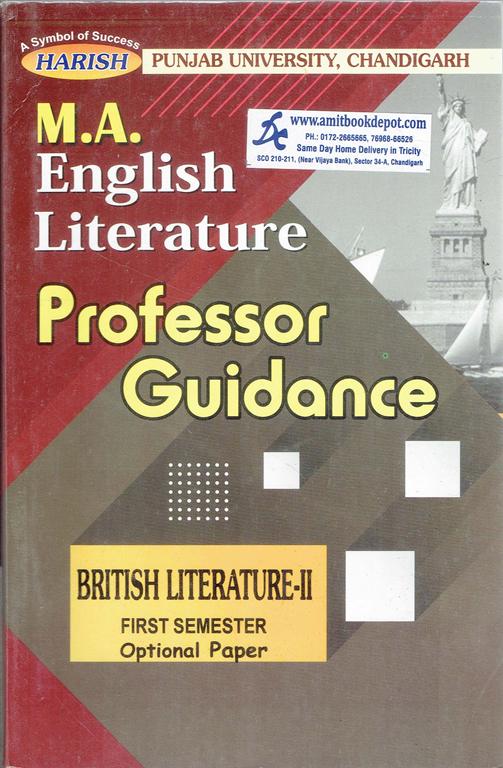
BRITISH LITERATURE-II
First Semester - IVth (Optional) Paper
Unit-I Frankenstein—Mary Shelley
Mary Shelley—His Life and Works
Frankenstein
1. An Introduction
2. A Note on the Text
3. A Short Summary of Frankenstein
4. Detailed Summary with Critical Comments
Letter-1 to Letter-4
Volume I: Chapters I to VII
Volume II: Chapters I to IX
Volume III: Chapters I to VII
5. Some Major Themes and the Narrative
Technique in Frankenstein
- Long Question with Their Answers
1. Meetings of Victor and the Monster
2. Narrative Technique in the Novel
3. Female Characters in the Novel
4. Allusions in the Novel
5. Parallels in the Novel
6. Gothic Tradition in the Novel
Unit-II
- Preface to Lyrical Ballads—William Wordsworth
William Wordsworth—His Life and Works
A Summary of 'Preface to Lyrical Ballads'
Hindi summary of 'Preface to Lyrical Ballads'
- Descriptive Questions and Answers
1. The Preface is a Landmark in the History of Criticism.
2. Wordsworth's definition of poetry as the spontaneous overflow of powerful feelings
3. Wordsworth's concept of poetic language
4. Wordsworth's views on themes proper to poetry 2
5. Wordsworth's View on Meter and Its Function 2
6. Wordsworth's view on (a) the nature of poetic truth and (b) poetic pleasure
7. Poetry is the breath and finer spirit of all knowledge.
8. Wordsworth as a Critic
9. Wordsworth's theory of poetic diction reflects the Romantic Revolt.
10. Relationship between poetry and science
11. Wordsworth's theory of poetic language
12. Wordsworth's theory of poetry as enunciated in the Preface to Lyrical Ballads
13. Wordsworth's theory of poetic diction
14. Wordsworth's View on Meter
15. The Themes of Poetry
16. Wordsworth's view on imagination as represented in the Preface to Lyrical Ballads
17. Wordsworth's greatness as a critic and its achievement
Unit III
- Selected Poems—William Blake
Introduction of William Blake
1. Songs of Innocence—A Brief Survey
2. Note on Blake's vision of childhood as depicted in the "Songs of Innocence" and "Songs of Experience"
3. Trace the growth of Blake's thought from the "Songs of Innocence" to the "Songs of Experience""
4. Lamb versus Tyger: Two Contrary States
5. William Blake: Songs of Innocence
- 1. The Chimney Sweeper (Songs of Experience)
1. Text
2. Introduction to the Poem
3. Substance of the Poem
- Questions and Answers
Critical Appreciation of the Poem
- 2. The Chimney Sweeper (Songs of Innocence)
1. Text
2. Introduction to the Poem
3. Substance of the Poem
- Questions and Answers
1. Critical Appreciation of the Poem
2. Parents' indifference towards children
- 3. The Tiger
1. Text
2. Introduction to the Poem
3. Substance of the Poem
- Questions and Answers
Critical Appreciation of the Poem
- Selected Poems—William Wordsworth
1. A Brief Biographical Sketch
2. His Poetical Works
3. Wordsworth as a Romantic Poet
4. Wordsworth as a Poet of Nature
5. Wordsworth as a Poet of Man
6. Wordsworth as a Mystic Poet
7. Wordsworth's Theory of Poetic Diction
- Questions and Answers
1. Wordsworth as a Teacher
2. Process of Wordsworth's Poetic Composition
- 1. Ode on Intimations of Immortality from Recollections of Early Childhood
1. Text
2. Introduction to the Poem
3. Summary of the Poem
- Questions and Answers
Critical Appreciation of the Poem
Metaphysical Implications of Platonism
Wordsworth's Concept of Childhood
- 2. Lines Written in Early Spring
1. Text
2. Introduction to the Poem
3. Summary of the Poem
- Questions and Answers
Estimate of Poem
Relationship between Man and Nature
- 3. London, 1802 (The Milton)
1. Text
2. Introduction to the Poem
3. Substance of the Poem
- Questions and Answers
Critical Estimate of the Poem
Unit IV
- Selected Poems—John Keats
1. Life and Works of Keats
2. Keats as a Poet
3. Keats's Hellenism
4. Keats as a Poet of Beauty
5. Romantic Qualities of Keats' Poetry
- Critical Opinions on Keats' Poetry
1. As a Poet of Beauty
2. Keats's Sensuousness
3. His Odes
4. Keats as a Poet of Nature
- Questions and Answers
The Ode in English Literature
- 1. Ode to the Nightingale
1. Introduction to the Ode
2. Substance of the Ode
3. Text, Paraphrase in English
- Questions and Answers
Critical Appreciation of the Ode
- 2. Ode to Autumn
1. Introduction to the Ode
2. Substance of the Ode
3. Text, Paraphrase in English
- Questions and Answers
Critical Appreciation of the Ode
- 3. Ode on a Grecian Urn
1. Introduction to the Ode
2. Substance of the Ode
3. Text, Paraphrase in English
- Questions and Answers
Critical Appreciation of the Ode
Main Idea of the Ode
- The Rime of the Ancient Mariner—S. T. Coleridge
Medievalism in Coleridge's Poetry
Date and Sources of the Ancient Mariner
The Form of the Ancient Mariner
Meter and Versification of the Ancient Mariner
Style and Atmosphere in the Ancient Mariner
Mediaeval Element in the Ancient Mariner: The Moral of the Ancient Mariner
Supernaturalism in the Ancient Mariner
The Significance of the Wedding Guest
The Synopsis of the Ancient Mariner
Outline of the Story of the Ancient Mariner
Detailed Summary of the Ancient Mariner
Part I to Part VII
Critical Commentary on the Ancient Mariner
Part I to Part VII
Hindi translation (critical discussion on ancient mariners)
Paraphrase of Text in English & Hindi
Part I to Part VII
- Questions and Answers
1. Source of the Poem "The Ancient Mariner'
2. Form of the Poem "The Ancient Mariner'
3. Coleridge as a Lover of Nature
4. Importance of the Supernatural Element in the Poem
5. Coleridge's Poetic Diction
6. The Ancient Mariner is a story of sin and punishment.
Unit-V
- Selected Essays—Charles Lamb
Introduction of Charles Lamb
Important Dates and Events in the Life of
Charles Lamb
Personality of Charles Lamb
Works of Charles Lamb
The Essays of Elia
- 1. The Praise of Chimney Sweepers
1. Text
2. Introduction to the Essay
3. Summary of the Essay
- Questions and Answers
Critical Appreciation of the Essay
Silent Features of the Essay
- 2. Dream Children: A Reverie
1. Text
2. Introduction to the Essay
3. Summary of the Essay
- Questions and Answers
Critical Appreciation of the Essay
Humor and Pathos in the Essay:
Dream Children: A Reverie
- Selected Essays—William Hazlitt
1. His Life and Personality
2. Hazlitt's Works
3. William Hazlitt—The Man
4. The Essay: Its Definition and Characteristics
5. Hazlitt's Philosophy of Life
6. Hazlitt as a (Literary) Critic
7. Hazlitt as an Essayist: A General Estimate
8. Autobiographical Element in Hazlitt's Essays
9. Wit, Humor, Irony, and Satire in the Essays of Hazlitt
10. Hazlitt's Observations on Style
11. Hazlitt's Style
- 1. On Reading Old Books
1. Text
2. Introduction to the Essay
3. Summary of the Essay
- Questions and Answers
Comment on the essay, On Reading Old Books.
The Main Qualities of Hazlitt's Prose Style
- 2. On Gusto
1. Text
2. Introduction to the Essay
3. Summary of the Essay
- Questions and Answers
Hazlitt's Concept of Gusto






.jpg)