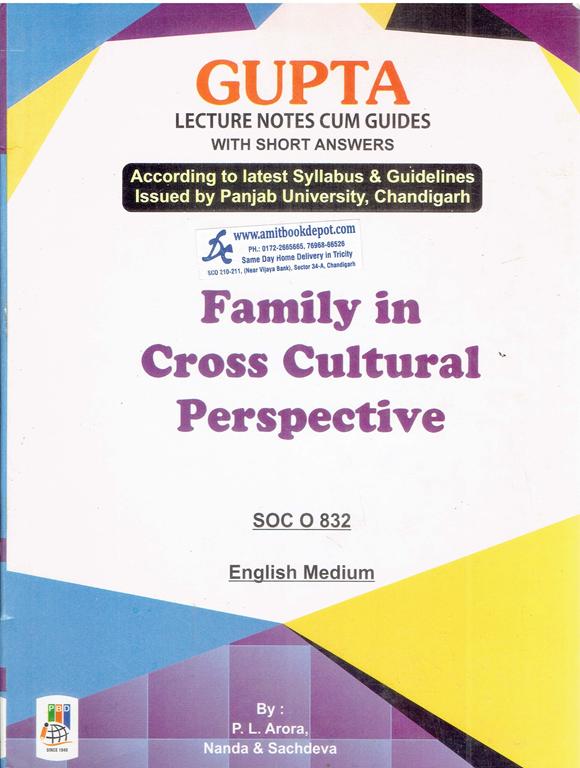
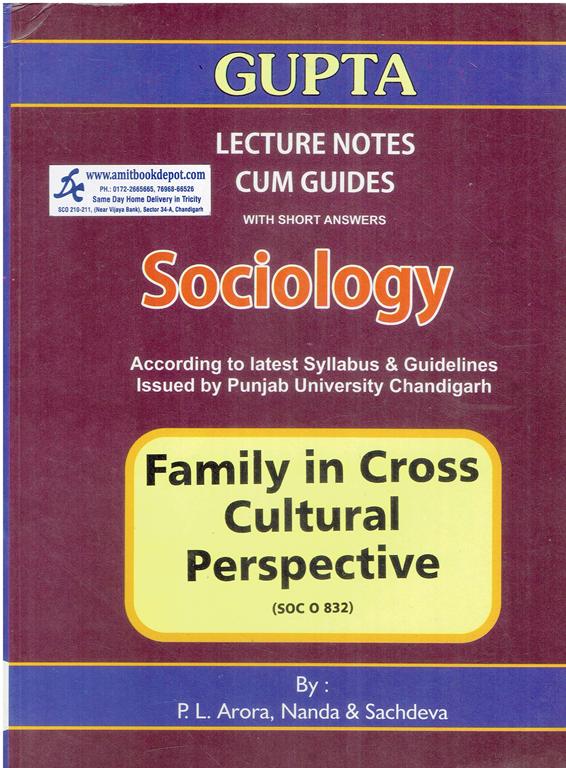
Gupta Family in Cross Cultural Perspective SOC O 832 For MA Sociology 3rd Semester Panjab University Chandigarh (English Medium)
Gupta Family in Cross Cultural Perspective SOC O 832 For MA Sociology 3rd Semester Panjab University Chandigarh (English Medium)
by Madhurima
₹500₹500.00(-/
off)
Rating & Reviews
23 Customer Review
Gupta Family in Cross Cultural Perspective (SOC O 832) is the prescribed book for MA Sociology, 3rd Semester, at Panjab University, Chandigarh. Authored by P.L. Arora, Nanda, and Sachdeva and published by Pepsu Book Depot, it provides a comprehensive analysis of family structures and gender relations from a cross-cultural perspective. The book covers the universality of the family, theoretical views from Malinowski to Parsons, alternative lifestyles like cohabitation and single parenthood, and the future of the family in light of migration and aging. It is an essential resource for complete syllabus coverage and exam preparation.
Gupta Family in Cross Cultural Perspective (SOC O 832) is an indispensable and comprehensive book meticulously designed for Master of Arts (MA) in Sociology, Third Semester students of Panjab University, Chandigarh, following the prescribed English Medium syllabus. Authored by the esteemed academics P. L. Arora, Nanda, and Sachdeva, and published by the trusted academic publisher Pepsu Book Depot, this volume serves as the definitive guide for mastering the paper "Family in Cross-Cultural Perspective."
The book's primary objective is to furnish students with a rigorous, comparative framework for analyzing family structures and gender relations across diverse global societies. It systematically addresses the core questions posed by the syllabus: Is the family a universal social institution? Is it facing extinction, or is it undergoing significant restructuring? What alternative lifestyles are emerging in contemporary times? The content is expertly structured into four coherent units, each aligning perfectly with the university's course outline, ensuring complete syllabus coverage and exam preparedness.
Unit I: Family and Gender Relations provides a sweeping cross-cultural analysis, moving beyond theoretical abstraction to ground students in specific national contexts. It offers detailed examinations of family and gender dynamics in a carefully selected spectrum of countries, including highly developed nations like Japan and Belgium, developing economies such as India, Iran, and Brazil, and underdeveloped regions like Afghanistan and Ethiopia. This comparative approach allows students to discern the intricate interplay between a society's level of development, its cultural norms, and the resulting family systems and gender roles.
Unit II: Universality of Family delves into the foundational sociological debate on whether the family is a universal social institution. It presents the seminal perspectives of renowned theorists including Bronislaw Malinowski, George Murdock, Talcott Parsons, Norman W. Bell, and Ezra F. Vogel. This theoretical foundation is then critically tested against ethnographic and sociological case studies, exploring the fate of family among Black populations in the West Indies and Central America, in the USA, and through the classic example of the Nayars of Central Kerala in India. This unit equips students to critically evaluate claims of universality against empirical evidence.
Unit III: Emerging Alternative Lifestyles shifts focus to the changing contours of intimate and domestic life in the modern world. It provides insightful, sociological explorations of key alternative family structures and living arrangements. Chapters thoroughly dissect phenomena such as singlehood (never married), cohabitation (living together without marriage), single-parent households (both male- and female-headed), and group living models, with a focused study on the kibbutz of Israel. This section is vital for understanding the diversification of family forms beyond the traditional nuclear model.
Unit IV: Future of the Family looks forward, analyzing the forces shaping the evolution of family institutions. It investigates the impact of critical contemporary issues like the pursuit of gender equity, the demographic challenge of aging populations, and the pervasive effects of migration on family stability, roles, and intergenerational relationships. This forward-looking perspective encourages students to think critically about the trajectory of familial change.
To aid in examination success, the book includes a dedicated section of short answer type questions, enabling effective revision and self-assessment. The content precisely mirrors the Panjab University examination pattern, with clear demarcation of units and topics as per the official syllabus. For any MA Sociology student at Panjab University aiming for a deep, comparative, and syllabus-specific understanding of the family as a dynamic social institution across cultures and time, Gupta Family in Cross-Cultural Perspective is the authoritative, essential, and prescribed academic resource.
Is this book the latest and officially prescribed textbook for the MA Sociology 3rd Semester paper "Family in Cross-Cultural Perspective" (SOC O 832) at Panjab University?
A1
Yes, this book by Arora, Nanda, and Sachdeva is specifically written and prescribed for the SOC O 832 paper at Panjab University, Chandigarh.
Q2
Does the book's content strictly follow the unit-wise breakdown provided in the Panjab University syllabus?
A2
Absolutely. The book is divided into four precise units that exactly match the university's course outline, ensuring no topic is missed.
Q3
Which specific countries' family and gender relations are analyzed in Unit I for comparative study?
A3
Unit I provides case studies on Japan, Belgium, India, Iran, Brazil, Afghanistan, and Ethiopia, covering highly developed, developing, and underdeveloped contexts.
Q4
Which sociological theorists' perspectives on the family as a universal institution are covered in Unit II?
A4
The book covers the views of Bronislaw Malinowski, George Murdock, Talcott Parsons, Norman W. Bell, and Ezra F. Vogel.
Q5
Are the Nayars of Kerala discussed in this book, as mentioned in the syllabus?
A5
Yes, the classic case study of the Nayars of Central Kerala is included in Unit II as part of the discussion on the universality of the family.
Q6
Does the book discuss the future of the family in relation to contemporary issues like migration and aging?
A6
Yes, Unit IV is dedicated to the future of the family, with specific chapters on the impact of Gender Equity, Aging, and Migration.
Q7
I am a student from a different university studying comparative family sociology. Is this book useful for me?
A7
While specifically tailored for Panjab University, the book's structured cross-cultural analysis, theoretical chapters, and coverage of global family patterns make it a valuable academic resource for any student of the subject.
Q8
Does the book only provide descriptive accounts, or does it also engage with sociological theories?
A8
It robustly combines both. It applies theoretical frameworks (e.g., from Parsons, Murdock) to empirical case studies, fostering critical analytical skills.
Q9
Is the language of the book accessible for students whose first language is not English?
A9
Yes, it is written in clear, academic English suitable for postgraduate students, with complex sociological concepts explained in context.
Q10
Are concepts like 'gender equity' and 'female-headed households' discussed from a sociological perspective
A10
Yes, these are core themes. The book examines gender relations analytically across cultures and dedicates chapters to gender equity and single-parent households as part of family change.
0.00
0 Overall Rating
5
0
4
0
3
0
2
0
1
0
Try this product & share your review &
thoughts
UNIT - I
1. Family and Gender Relations
2. Japa: Family & Gender Relation
3. Family and Gender Relations in Belgium
4. India: Family and Gender Relations
5. Gender Relations and Family in Iran
6. Family and Gender Relations in Brazil
7. Family and Gender Relations in Afghanistan
8. Ethiopia: Family and Gender Relations
UNIT - II
9. Bronislaw Malinowski: Family As a Social Institution
10. George Murdock: Family as a Social Institution
11. Talcott Parsons: Family as a Social Institution
12. Norman W. Bell & Ezra F. Vogel
13. Fate of Family among the Blacks in the Island of the West Indies
14. Fate of Family in Parts of Central America
15. Fate of Family in U.S.A.
16. The Nayars of Central Kerala in India
UNIT - III
17. Singlehood/Never Married
18. Cohabitation: Living together without marriage
19. Single Parent: Male/Female-Headed Households
20. Group Living: Communes (The Kibbutz of Israel)
UNIT - IV
21. Future of the Family
22. Gender Equity: Future of the Family
23. Aging and the Future of the Family
24. Migration & Future of the Family
Short Answer Type Questions
Latest Syllabus of Family in Cross Cultural Perspective SOC O 832 for MA Sociology 3rd Semester Panjab University (PU) Chandigarh (English Medium)
SOC O 832: FAMILY IN CROSS-CULTURAL PERSPECTIVE
Objective
Students’ exposure to this course is intended to facilitate their comparative understanding of family and gender relations in different societies. Another aim is to make the students aware of whether the family is the basic institution in all societies and whether the family as an institution is near the point of extinction or restructuring itself, and as a consequence, many alternative lifestyles to traditional marriage and family living are emerging.
INSTRUCTIONS FOR THE PAPER-SETTER AND THE CANDIDATES
(i) The theory question paper will be of 80 marks, and 20 marks will be for internal assessment. The duration of the paper will be 3 hours.
(ii) For private candidates, who have not been assessed earlier for internal assessment, the marks secured by them in the theory paper will proportionately be increased to the maximum marks of the paper in lieu of internal assessment.
The paper setter must put note (ii) in the question paper.
The syllabus has been divided into four units.
There shall be 9 questions in all. The first question is compulsory and shall be a short answer type containing 10 short questions spread over the whole syllabus to be answered in about 30 to 35 words each, carrying 20 marks, i.e., 2 marks each. The rest of the paper shall contain 4 units. Each unit shall have two long questions, and the candidates shall be given an internal choice of attempting one question from each unit—4 in all. Each question will carry 15 marks.
Course Outline
Unit-I
Family and Gender Relations
In Highly Developed, Developing, and Underdeveloped Countries
- Japan, Belgium
- India, Iran, Brazil
- Afghanistan and Ethiopia
Unit II
Universality of Family
- Family as a Universal Social Institution—Views of Bronislaw Malinowski, George Murdock, Talcott Parsons, Norman W. Bell, and Ezra F. Vogel
- Fate of Family among the Blacks in the Islands of the West Indies, Parts of Central America and the U.S.A.; the Nayars of Central Kerala in India.
Gupta Family in Cross Cultural Perspective (SOC O 832) is an indispensable and comprehensive book meticulously designed for Master of Arts (MA) in Sociology, Third Semester students of Panjab University, Chandigarh, following the prescribed English Medium syllabus. Authored by the esteemed academics P. L. Arora, Nanda, and Sachdeva, and published by the trusted academic publisher Pepsu Book Depot, this volume serves as the definitive guide for mastering the paper "Family in Cross-Cultural Perspective."
The book's primary objective is to furnish students with a rigorous, comparative framework for analyzing family structures and gender relations across diverse global societies. It systematically addresses the core questions posed by the syllabus: Is the family a universal social institution? Is it facing extinction, or is it undergoing significant restructuring? What alternative lifestyles are emerging in contemporary times? The content is expertly structured into four coherent units, each aligning perfectly with the university's course outline, ensuring complete syllabus coverage and exam preparedness.
Unit I: Family and Gender Relations provides a sweeping cross-cultural analysis, moving beyond theoretical abstraction to ground students in specific national contexts. It offers detailed examinations of family and gender dynamics in a carefully selected spectrum of countries, including highly developed nations like Japan and Belgium, developing economies such as India, Iran, and Brazil, and underdeveloped regions like Afghanistan and Ethiopia. This comparative approach allows students to discern the intricate interplay between a society's level of development, its cultural norms, and the resulting family systems and gender roles.
Unit II: Universality of Family delves into the foundational sociological debate on whether the family is a universal social institution. It presents the seminal perspectives of renowned theorists including Bronislaw Malinowski, George Murdock, Talcott Parsons, Norman W. Bell, and Ezra F. Vogel. This theoretical foundation is then critically tested against ethnographic and sociological case studies, exploring the fate of family among Black populations in the West Indies and Central America, in the USA, and through the classic example of the Nayars of Central Kerala in India. This unit equips students to critically evaluate claims of universality against empirical evidence.
Unit III: Emerging Alternative Lifestyles shifts focus to the changing contours of intimate and domestic life in the modern world. It provides insightful, sociological explorations of key alternative family structures and living arrangements. Chapters thoroughly dissect phenomena such as singlehood (never married), cohabitation (living together without marriage), single-parent households (both male- and female-headed), and group living models, with a focused study on the kibbutz of Israel. This section is vital for understanding the diversification of family forms beyond the traditional nuclear model.
Unit IV: Future of the Family looks forward, analyzing the forces shaping the evolution of family institutions. It investigates the impact of critical contemporary issues like the pursuit of gender equity, the demographic challenge of aging populations, and the pervasive effects of migration on family stability, roles, and intergenerational relationships. This forward-looking perspective encourages students to think critically about the trajectory of familial change.
To aid in examination success, the book includes a dedicated section of short answer type questions, enabling effective revision and self-assessment. The content precisely mirrors the Panjab University examination pattern, with clear demarcation of units and topics as per the official syllabus. For any MA Sociology student at Panjab University aiming for a deep, comparative, and syllabus-specific understanding of the family as a dynamic social institution across cultures and time, Gupta Family in Cross-Cultural Perspective is the authoritative, essential, and prescribed academic resource.
UNIT - I
1. Family and Gender Relations
2. Japa: Family & Gender Relation
3. Family and Gender Relations in Belgium
4. India: Family and Gender Relations
5. Gender Relations and Family in Iran
6. Family and Gender Relations in Brazil
7. Family and Gender Relations in Afghanistan
8. Ethiopia: Family and Gender Relations
UNIT - II
9. Bronislaw Malinowski: Family As a Social Institution
10. George Murdock: Family as a Social Institution
11. Talcott Parsons: Family as a Social Institution
12. Norman W. Bell & Ezra F. Vogel
13. Fate of Family among the Blacks in the Island of the West Indies
14. Fate of Family in Parts of Central America
15. Fate of Family in U.S.A.
16. The Nayars of Central Kerala in India
UNIT - III
17. Singlehood/Never Married
18. Cohabitation: Living together without marriage
19. Single Parent: Male/Female-Headed Households
20. Group Living: Communes (The Kibbutz of Israel)
Is this book the latest and officially prescribed textbook for the MA Sociology 3rd Semester paper "Family in Cross-Cultural Perspective" (SOC O 832) at Panjab University?
A1
Yes, this book by Arora, Nanda, and Sachdeva is specifically written and prescribed for the SOC O 832 paper at Panjab University, Chandigarh.
Q2
Does the book's content strictly follow the unit-wise breakdown provided in the Panjab University syllabus?
A2
Absolutely. The book is divided into four precise units that exactly match the university's course outline, ensuring no topic is missed.
Q3
Which specific countries' family and gender relations are analyzed in Unit I for comparative study?
A3
Unit I provides case studies on Japan, Belgium, India, Iran, Brazil, Afghanistan, and Ethiopia, covering highly developed, developing, and underdeveloped contexts.
Q4
Which sociological theorists' perspectives on the family as a universal institution are covered in Unit II?
A4
The book covers the views of Bronislaw Malinowski, George Murdock, Talcott Parsons, Norman W. Bell, and Ezra F. Vogel.
Q5
Are the Nayars of Kerala discussed in this book, as mentioned in the syllabus?
A5
Yes, the classic case study of the Nayars of Central Kerala is included in Unit II as part of the discussion on the universality of the family.
Q6
Does the book discuss the future of the family in relation to contemporary issues like migration and aging?
A6
Yes, Unit IV is dedicated to the future of the family, with specific chapters on the impact of Gender Equity, Aging, and Migration.
Q7
I am a student from a different university studying comparative family sociology. Is this book useful for me?
A7
While specifically tailored for Panjab University, the book's structured cross-cultural analysis, theoretical chapters, and coverage of global family patterns make it a valuable academic resource for any student of the subject.
Q8
Does the book only provide descriptive accounts, or does it also engage with sociological theories?
A8
It robustly combines both. It applies theoretical frameworks (e.g., from Parsons, Murdock) to empirical case studies, fostering critical analytical skills.
Q9
Is the language of the book accessible for students whose first language is not English?
A9
Yes, it is written in clear, academic English suitable for postgraduate students, with complex sociological concepts explained in context.
Q10
Are concepts like 'gender equity' and 'female-headed households' discussed from a sociological perspective
A10
Yes, these are core themes. The book examines gender relations analytically across cultures and dedicates chapters to gender equity and single-parent households as part of family change.
Latest Syllabus of Family in Cross Cultural Perspective SOC O 832 for MA Sociology 3rd Semester Panjab University (PU) Chandigarh (English Medium)
SOC O 832: FAMILY IN CROSS-CULTURAL PERSPECTIVE
Objective
Students’ exposure to this course is intended to facilitate their comparative understanding of family and gender relations in different societies. Another aim is to make the students aware of whether the family is the basic institution in all societies and whether the family as an institution is near the point of extinction or restructuring itself, and as a consequence, many alternative lifestyles to traditional marriage and family living are emerging.
INSTRUCTIONS FOR THE PAPER-SETTER AND THE CANDIDATES
(i) The theory question paper will be of 80 marks, and 20 marks will be for internal assessment. The duration of the paper will be 3 hours.
(ii) For private candidates, who have not been assessed earlier for internal assessment, the marks secured by them in the theory paper will proportionately be increased to the maximum marks of the paper in lieu of internal assessment.
The paper setter must put note (ii) in the question paper.
The syllabus has been divided into four units.
There shall be 9 questions in all. The first question is compulsory and shall be a short answer type containing 10 short questions spread over the whole syllabus to be answered in about 30 to 35 words each, carrying 20 marks, i.e., 2 marks each. The rest of the paper shall contain 4 units. Each unit shall have two long questions, and the candidates shall be given an internal choice of attempting one question from each unit—4 in all. Each question will carry 15 marks.
Course Outline
Unit-I
Family and Gender Relations
In Highly Developed, Developing, and Underdeveloped Countries
- Japan, Belgium
- India, Iran, Brazil
- Afghanistan and Ethiopia
Unit II
Universality of Family
- Family as a Universal Social Institution—Views of Bronislaw Malinowski, George Murdock, Talcott Parsons, Norman W. Bell, and Ezra F. Vogel
- Fate of Family among the Blacks in the Islands of the West Indies, Parts of Central America and the U.S.A.; the Nayars of Central Kerala in India.
Unit III
Emerging Alternative Lifestyles
- Singlehood – Never Married
- Cohabitation – Living Together Without Marriage
- Single parent – Male/Female Headed Households
- Group Living – Communes (The Kibbutz of Israel)
Unit IV
Future of Family in the Light of
- Gender Equity
- Aging
- Migration
0.00
0 Overall Rating
5
0
4
0
3
0
2
0
1
0
Try this product & share your review &
thoughts
Top Trending Product
Related
Product
Related Product
Related Blog Posts
Latest Blogs
Latest Blogs
Classic Literature Reimagined: Discuss modern twists on classic novels.
Lorem ipsum dolor sit amet, consectetur adipiscing elit, sed
do
eiusmod tempor incididunt ut labore et dolore magna aliqua. Ut enim ad minim
veniam, quis nostrud exercitation ullamco Lorem ipsum dolor sit amet,
consectetur adipiscing elit, sed do eiusmod tempor incididunt ut labore et
dolore magna aliqua. Utenim ad minim veniam, quis nostrud exercitation
ullamco
Lorem ipsum dolor sit amet, consecte...
Classic Literature Reimagined: Discuss modern twists on classic novels.
Lorem ipsum dolor sit amet, consectetur adipiscing elit, sed
do
eiusmod tempor incididunt ut labore et dolore magna aliqua. Ut enim ad minim
veniam, quis nostrud exercitation ullamco Lorem ipsum dolor sit amet,
consectetur adipiscing elit, sed do eiusmod tempor incididunt ut labore et
dolore magna aliqua. Utenim ad minim veniam, quis nostrud exercitation
ullamco
Lorem ipsum dolor sit amet, consecte...
Classic Literature Reimagined: Discuss modern twists on classic novels.
Lorem ipsum dolor sit amet, consectetur adipiscing elit, sed
do
eiusmod tempor incididunt ut labore et dolore magna aliqua. Ut enim ad minim
veniam, quis nostrud exercitation ullamco Lorem ipsum dolor sit amet,
consectetur adipiscing elit, sed do eiusmod tempor incididunt ut labore et
dolore magna aliqua. Utenim ad minim veniam, quis nostrud exercitation
ullamco
Lorem ipsum dolor sit amet, consecte...