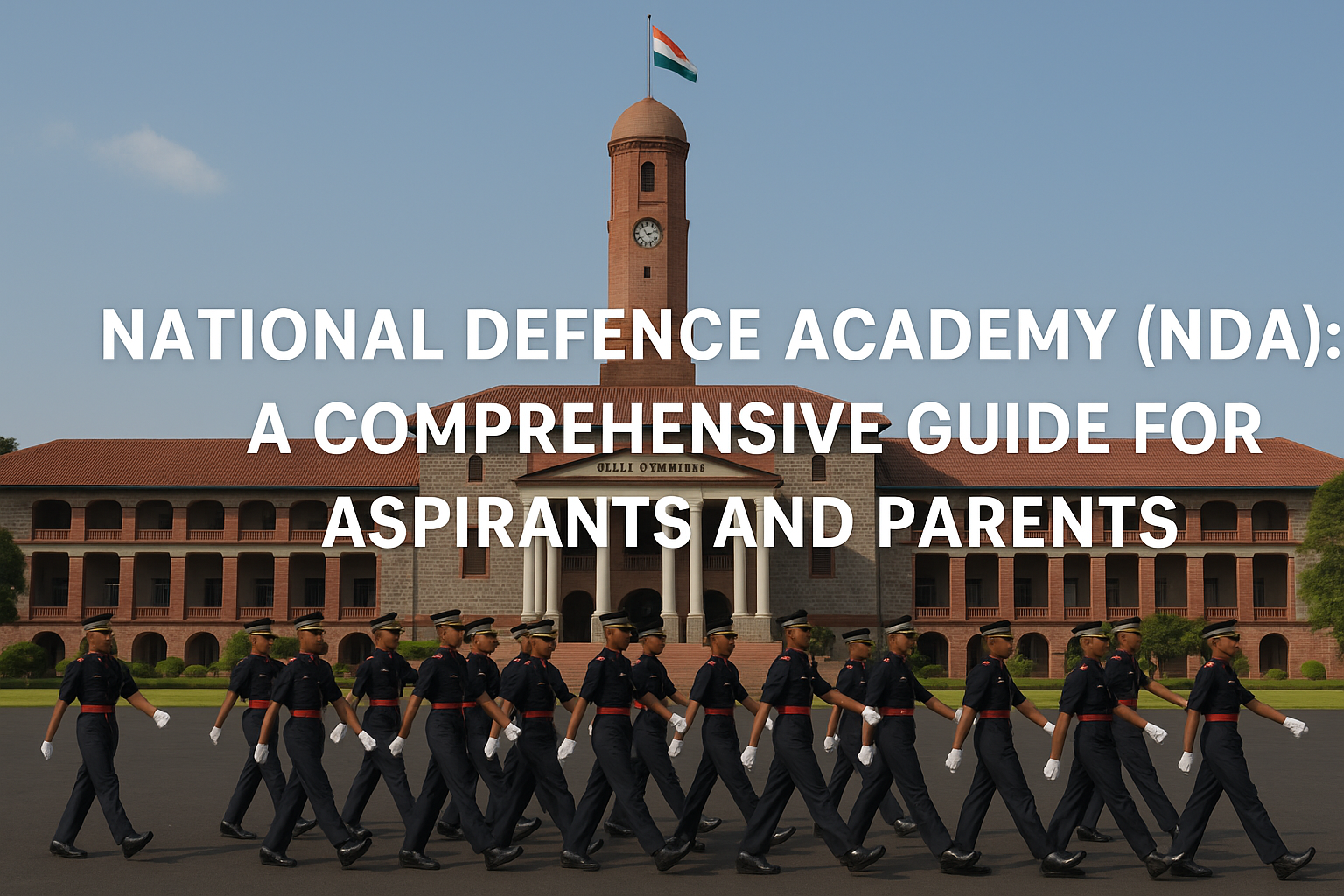
The Sudan Block building at the National Defence Academy (NDA) campus in Khadakwasla, Pune. The National Defence Academy (NDA) is the premier joint services training institute of the Indian Armed Forces, where cadets of the Army, Navy, and Air Force train together before moving on to their respective service academies for further training. Located in Khadakwasla near Pune, Maharashtra, NDA holds the distinction of being the first tri-service military academy in the world. Since its establishment in 1954, NDA has built a proud legacy of excellence – its alumni include decorated war heroes (with 3 Param Vir Chakra and 11 Ashoka Chakra recipients) and dozens of top military leaders, including multiple Chiefs of Staff of the Army, Navy, and Air Force. This makes NDA one of the most prestigious institutions for young Indians aspiring to serve as officers in the armed forces.
Eligibility Criteria for NDA
Entering the NDA is highly competitive, and candidates must meet strict eligibility criteria set by the Union Public Service Commission (UPSC) and the Indian Armed Forces:
-
Age Limit: Applicants must be 16½ to 19½ years old at the time of entry into NDA. In practical terms, this usually means candidates can apply while in 11th or 12th grade or just after 12th, as long as they fall within the age range. There is no relaxation on the age limit – candidates older or younger than this window are not eligible.
-
Gender and Marital Status: NDA was historically open only to male candidates, but since 2021 female candidates are also allowed to apply following a landmark Supreme Court ruling. Only unmarried male and female aspirants can join NDA, and they must remain unmarried throughout the training period. Candidates who marry during the training are disqualified and discharged from the academy, given the importance of full commitment during the formative training years.
-
Educational Qualification: Candidates must have completed 10+2 (Higher Secondary) education or be appearing in the final year of 10+2. For admission to the Army Wing of NDA, students from any stream (Science, Commerce, Arts) who have passed Class 12 are eligible. However, for admission to the Air Force and Naval wings of NDA (and the associated Naval Academy program), a science background with Physics and Mathematics in Class 12 is mandatory. There is no specific percentage cut-off – one simply needs to have passed the exams. Candidates in their final year of school can take the NDA exam provisionally, but they must produce proof of passing 12th standard by the time of joining.
-
Nationality: Applicants must be citizens of India, or subjects of Nepal/Bhutan, or Tibetan refugees or persons of Indian origin who meet the conditions specified by the Government of India (with necessary certificates). In essence, Indian citizenship is required (some exceptions allow candidates from neighboring countries or Indian-origin migrants with a certificate of eligibility).
-
Physical and Medical Standards: All candidates must meet strict physical fitness and medical standards to ensure they can endure the rigorous training. This includes criteria for height, weight, vision, and general health as prescribed by the Armed Forces. For example, the minimum height for male candidates is 157 cm (162.5 cm for Air Force) and for female candidates is 157 cm, with correlated weight standards. Candidates should be free of serious medical conditions; there are specific requirements for vision acuity, hearing, and no chronic ailments. Physical fitness (through regular exercise) before joining is highly recommended, as the training is physically demanding. A thorough medical examination is conducted for those who clear the interview stage, and only those deemed medically fit are selected.
Note: Meeting the eligibility criteria is just the first step. Every cycle, hundreds of thousands of aspirants apply, so being eligible does not guarantee selection – one must also clear the competitive exams and tests that follow (described below).
NDA Entrance Exam and Selection Process
Getting into NDA involves a multi-stage selection process that tests a candidate's academic ability, physical fitness, and leadership potential. The entire process consists of a written entrance exam followed by the Services Selection Board (SSB) interviews, along with medical exams:
-
Written Examination (NDA/NA Exam): The NDA entrance exam is conducted by UPSC twice a year – typically termed NDA (I) and NDA (II), for the two sessions (usually held around April and September each year). This is an offline, pen-and-paper exam consisting of two papers held on the same day:
-
Mathematics: A 2½ hour paper that tests mathematical aptitude (topics up to Class 11–12 level, such as algebra, geometry, trigonometry, calculus, etc.).
-
General Ability Test (GAT): A 2½ hour paper that covers English language, general knowledge, and general science. The GAT includes sections on English grammar and vocabulary, physics, chemistry, biology, history, geography, economics, current affairs, and general mental ability.
All questions are objective multiple-choice type. The written exam has a maximum score of 900 (300 for Math and 600 for GAT). Candidates must score above the cut-off (which varies year to year) to be shortlisted for the next stage. It’s worth noting that the NDA written exam is highly competitive – about 400,000 candidates take the test in each cycle, out of which only roughly 4-5% qualify the written stage on average.
-
Services Selection Board (SSB) Interview: Candidates who clear the written exam are invited for the SSB interview, a comprehensive assessment that typically spans 5 days at an SSB center. About 6,000-7,000 candidates reach the SSB stage in each cycle. The SSB process evaluates officer-like qualities (OLQs) through various tasks and tests:
-
Stage I (Screening): This includes an Officer Intelligence Rating (OIR) test (verbal and non-verbal reasoning) and a Picture Perception & Description Test (PPDT). Candidates are shortlisted based on these to proceed to the next stages.
-
Stage II: This comprises a series of tests over four days, including:
-
Psychological Tests: Written tests like Thematic Apperception Test (story writing on pictures), Word Association Test, Situation Reaction Test, and Self-Description, conducted by a psychologist to gauge the candidate's personality traits.
-
Group Testing Officer (GTO) Tasks: Group exercises such as group discussions, group planning exercises, outdoor group tasks/obstacle courses, command tasks, etc., which assess teamwork, leadership, and problem-solving in a group setting.
-
Personal Interview: One-on-one interview with a senior officer to evaluate the candidate’s motivation, background, and overall personality.
-
Conference: A board of assessors (including the psychologists, GTOs, and interviewing officers) collectively evaluate and decide on the candidate’s suitability.
The SSB aims to test a candidate's leadership qualities, communication skills, decision-making, physical courage, and mental stamina under various conditions. Throughout, qualities like confidence, teamwork, integrity, and adaptability are scrutinized. Only a fraction of those who attend SSB are recommended for the next step – typically around 300-350 candidates are finally selected per course to join NDA.
-
Medical Examination: Candidates who are recommended by the SSB must undergo a thorough medical examination at designated military hospitals. This ensures the candidate is in good health and meets all medical standards (vision, hearing, blood tests, etc.). The medical exam can take 4-5 days. Common reasons for medical rejection include vision issues (high myopia or color blindness), orthopedic issues (like past fractures not healed properly), chronic diseases (asthma, heart conditions), etc. Candidates are given a chance to appeal or re-appear for a medical review in certain cases.
-
Final Merit List: UPSC prepares a final merit list of candidates based on their combined performance in the written exam and SSB interview. The medical fitness is a qualifying factor. High scorers get their first choice of service (Army/Navy/Air Force) depending on vacancies. Approximately 350 or fewer candidates make it to the final merit list for each course, which corresponds to the number of seats available at NDA for that term. For instance, if 370 vacancies are announced (around 208 for Army, 42 for Navy, 120 for Air Force as an example), the top 370 or so in the merit (who are medically fit) will get the call to join NDA.
The selection ratio is extremely stringent – out of the hundreds of thousands of aspirants, only the very best make it through all stages. This high selectivity is what makes NDA cadets a cut above the rest. In summary, roughly 0.1% of initial applicants succeed in joining NDA, highlighting the exam’s difficulty and the caliber expected.
(Note: Air Force candidates who clear SSB for the flying branch have to also pass the Computerized Pilot Selection System (CPSS) test – a specialized pilot aptitude test that has replaced the old PABT. This test is conducted during SSB to determine suitability for Air Force flying roles, and one gets only a single chance in their lifetime to clear CPSS.)
Training and Academics at NDA
Once selected, the real journey begins at the National Defence Academy. NDA training transforms a fresh higher-secondary graduate into a disciplined, knowledgeable, and fit officer cadet ready for a military career. Here are the key features of the training and academic program at NDA:
-
Duration and Structure: The NDA program is a residential course spanning three years, divided into six terms (semesters) of about 5 months each. New batches join twice a year (July and January semesters) and train together through these terms. After completing the three-year curriculum at NDA, cadets graduate from the academy and then move to the specific service academies for their branch (Army, Navy, or Air Force) for the final phase of training.
-
Military Training: All cadets, regardless of service, go through basic military training at NDA. This includes physical training (PT), drills and parades, weapon handling and marksmanship, field craft and tactics, map reading and navigation, obstacle courses, and the development of leadership and command skills. Cadets are taught the essentials of soldiering – discipline, ceremony, and the basics of combat. Training camps are held to expose cadets to simulated field conditions. For example, Camp Green Horn (for second-term cadets), Camp Rover (fourth term), and Camp Torna (sixth term) are training camps to test and reinforce fieldcraft and leadership under rugged conditions. These camps, often named after historic military events or figures, push cadets to their physical and mental limits in simulated battle scenarios.
-
Academic Education: Alongside military training, NDA provides a full-time academic program leading to a bachelor’s degree. The academy is affiliated to Jawaharlal Nehru University (JNU), and cadets receive degrees upon completion. Army cadets typically graduate with B.A. (Bachelor of Arts) or B.Sc. (Bachelor of Science) degrees, whereas Air Force and Naval cadets earn a B.Tech (Bachelor of Technology) degree (NDA started the B.Tech program for Navy and Air Force cadets in recent years to strengthen technical education). In practice, Naval and Air Force cadets complete three years of academic study at NDA and then finish the final year of their engineering degree at their respective academies (Indian Naval Academy or Air Force Academy).
-
Streams and Subjects: Cadets choose between two main academic streams – Science or Humanities (Liberal Arts). The Science stream includes subjects like mathematics, physics, chemistry, computer science, etc., while the Humanities stream offers history, political science, economics, geography, languages, etc.. Regardless of stream, certain core subjects are mandatory for all cadets: English, general science, social studies, and a foreign language (options typically include Arabic, Chinese, French, or Russian). This broad-based curriculum ensures cadets have well-rounded knowledge. In addition, military studies (covering military history, geopolitics, weapon systems, etc.) and general studies are part of the foundation course for everyone. By the 5th and 6th terms, cadets also take specialized subjects related to their chosen service (Army, Navy, or Air Force) – for example, an Army cadet might learn about infantry tactics, while a Naval cadet studies navigation and seamanship.
-
Examinations and Discipline: Cadets must pass regular exams in both academics and military subjects. The routine is rigorous, balancing morning drills with daytime classes and evening study. The academy follows a strict honor code (discussed later), and cadets are expected to uphold academic integrity alongside military discipline. The first few terms focus more on academics and basic joint training, while later terms introduce advanced service-specific training modules.
-
Service-Specific Training: While much of NDA training is common for all (to build a spirit of jointmanship), there are components specific to each service, especially in the later terms:
-
Army cadets spend extra time on tactics, weapons training, field engineering, and leadership exercises tailored for Army officers.
-
Air Force cadets are trained in the basics of aviation – they learn principles of flight, get exposure to aircraft and simulators, and even undergo a short flight training on a basic trainer aircraft (e.g., Super Dimona glider flights) during their stint at NDA. This prepares them for more intensive flying training at the Air Force Academy later.
-
Naval cadets focus on naval subjects like navigation, seamanship, and communication. NDA has a navigation and seamanship training facility at Peacock Bay on the Kadakwasla Lake, where Naval cadets practice boating, yachting, sailing, and naval warfare basics. They also familiarize themselves with naval ship models and go on orientation visits to naval bases and ships during their training.
By the end of three years, cadets have undergone transformational training – academically earning a degree, and physically and mentally molded into junior leaders. The NDA training methodology aims to develop officer-like qualities, camaraderie, and a tri-service perspective that stays with cadets throughout their careers. Cadets learn to live by the academy’s motto “Seva Parmo Dharma” (Service Before Self), embracing a life of service, honor, and nation-before-self attitude.
-
Infrastructure and Facilities: NDA’s campus is sprawling (over 7,000 acres), with world-class facilities to support all-round training. The iconic Sudan Block (the administrative headquarters named in honor of Indian soldiers’ sacrifices in Sudan in WWII) is a prominent landmark. The campus houses well-equipped lecture halls, science labs, libraries, and even an Air Force Training Team with simulators and a micro air strip. For physical development, NDA boasts multiple Olympic-size swimming pools, gymnasiums, dozens of sports fields (football, hockey, etc.), tennis/squash courts, a golf course, a firing range, and equitation (horse riding) grounds. There are also facilities for adventure activities like rock climbing, trekking, and para-sailing. Such infrastructure ensures that cadets get opportunities to excel in academics, sports, and other skills during their training.
-
Evaluations and Passing Out: Each term, cadets are evaluated in both academics and physical/military training. There’s a continuous assessment, and term-end exams. At the end of three years, those who meet the rigorous standards graduate from NDA at the Passing Out Parade (POP), a grand ceremony where cadets march out in ceremonial uniform in front of proud families and top military brass. They are then designated as cadets of their respective service and sent to the next academy: Indian Military Academy (IMA) Dehradun for Army cadets, Air Force Academy (AFA Dundigal, Hyderabad) for Air Force cadets, and Indian Naval Academy (INA Ezhimala) for Naval cadets. At these academies, they undergo one more year (or more, in case of naval B.Tech) of pre-commissioning training before finally being commissioned as officers.
Life at NDA: Discipline, Routine and Camaraderie
Life at the National Defence Academy is often described as tough but transformative. Cadets follow a strict daily schedule that pushes them to achieve their full potential in all spheres – physical, mental, and moral. “Life at the NDA is a blend of rigorous physical training, academic excellence, and character-building activities, with each day meticulously scheduled to instill discipline, resilience, and leadership,” as one account puts it. Over the three years, cadets forge lifelong friendships and learn to live by values of honor, courage, and unity. Here’s a glimpse of a typical day in a cadet’s life and the ethos of NDA:
Daily Routine: The routine at NDA starts before sunrise and goes on until 10 PM, packing a wide variety of activities. A typical weekday schedule is as follows:
-
🔸 04:30 – 05:30 AM: Wake-Up and Morning Physical Training – A bugle call at the crack of dawn signals the start of the day. Cadets quickly get ready and fall in for Physical Training (PT). The morning PT session includes endurance runs, push-ups, sit-ups, and other intensive exercises to build stamina and strength. Regular PT and difficult obstacles first thing in the morning instill mental toughness and physical fitness essential for military life.
-
🔸 06:00 – 07:30 AM: Drill and Parade Practice – After PT, cadets change into uniform for drill. Drill is a fundamental part of military training that teaches obedience, sharpness, and cohesion. Under the watch of Drill Instructors, cadets practice marching in formation, rifle drill, and parade movements. This session on the parade ground builds bearing, discipline, and pride in military customs. Synchronized marching and repeated practice also nurture unity and team spirit among the cadets.
-
🔸 07:30 AM – 01:30 PM: Academic Classes (with Breakfast in between) – Following drill, cadets have breakfast in the mess, a much-needed refuel with a nutritious diet. Then comes academic time: from roughly 8 AM to 1:30 PM, cadets attend classes according to their academic stream and term. The curriculum (as described earlier) includes a mix of science, humanities, and military subjects taught by qualified civilian and service instructors. Classes often incorporate modern teaching aids, group projects, and practical lab work. Despite the military setting, education at NDA is on par with any good university, and cadets must balance their combat training with maintaining academic performance. By early afternoon, the classes break for lunch.
-
🔸 01:30 – 03:30 PM: Lunch and Rest – Cadets assemble for lunch at the mess where a wholesome meal is served. Meal times are also an opportunity for camaraderie, as cadets eat together and relax briefly. After lunch, there is a short rest period (often called “off parades” or downtime). Cadets can use this time to take a quick nap, unwind, or catch up on personal tasks like washing clothes or writing letters home. This break helps them recharge for the intense activities ahead in the latter half of the day.
-
🔸 03:30 – 06:30 PM: Afternoon Sports and Military Training – Post-rest, the focus shifts back to physical and outdoor activities. The academy schedules various sports in the afternoons – football, basketball, hockey, swimming, athletics, or whichever sport is in season. Every cadet is encouraged to excel in at least one sport, and inter-squadron sports competitions are fierce. Sports not only improve fitness but also foster team spirit and competitiveness. Alongside sports, specific military training sessions continue in the afternoons: cadets might go for weapon training at the firing range, attend a lecture on tactics, or do map-reading exercises in the field. There are also club activities (like debate club, astronomy club, etc.) or hobby periods occasionally, to encourage well-rounded development. By sundown, cadets have expended their energy in productive pursuits all day.
-
🔸 06:30 – 08:30 PM: Evening Study Period – After evening roll-call or a quick refresh, cadets have a scheduled study period. This time is meant for personal study, homework, or revision. Cadets often study in their squadrons or designated study halls. Senior cadets might mentor juniors in subjects or help them prepare for tests, reflecting a culture of mutual support. Maintaining academic grades is important, so this quiet time allows cadets to focus on academics after a physically tiring day.
-
🔸 08:30 – 10:00 PM: Dinner and Leisure – Around 8:30, cadets head for dinner. After a long day, dinner is welcome and is again a community experience in the mess. Post-dinner, there is usually a short leisure period. Cadets can relax, perhaps watch news or sports on the common room TV, socialize casually, or do any light activities. Some may use this time to polish uniforms and shoes for the next day, iron clothes, or write in their diary. By 9:45 or so, preparations for lights-out begin.
-
🔸 10:00 PM: Lights Out – At 2200 hours, lights-out is observed. Cadets must be in their assigned rooms in the dormitory (also called cabin or squadron quarters) and go to bed to rest. Adequate sleep is essential given the early start and physical demands of each day. Thus ends a typical day, only to be repeated at 4:30 AM next morning!
This disciplined routine, followed day in and day out, ingrains in cadets time management, endurance, and a strong work ethic. There is little idle time – every hour has a purpose. Over time, cadets adapt to this lifestyle, and what initially seems tough becomes second nature.
Squadron Life and Camaraderie: At NDA, each cadet is assigned to a squadron – a sort of dormitory unit and team – which becomes their family on campus. NDA has 18 squadrons (each named alphabetically such as Alpha, Bravo, Charlie, ... up to Romeo) grouped into 5 battalions. A squadron houses cadets from all terms (juniors and seniors together), fostering a mentor-mentee environment. There is intense inter-squadron rivalry in sports, academics, and drills; squadrons compete for the prestigious Inter-Squadron Championship Trophy each term. This healthy competition motivates cadets to do well for their squadron honor. Meanwhile, living and training together for three years forges very strong bonds. Cadets learn the true meaning of brotherhood/sisterhood – they celebrate each other’s achievements and pull each other through difficulties. Seniors pass down traditions and help the juniors adjust to the NDA way of life, while juniors bring energy and respect. Lifelong friendships and the famed NDA camaraderie are born in these squadrons, whether it’s cheering for your team on the sports field or helping each other shine boots at 2 AM before an early inspection.
Discipline and Code of Conduct: NDA prides itself on producing officers and gentlemen/ladies. A strict Honor Code governs cadet conduct – emphasizing honesty, integrity, and accountability. Lying, cheating, or stealing are taboo, and violations can lead to serious punishment or even dismissal. Cadets are trained to uphold the highest standards of ethics. Discipline is enforced in every aspect of life – from wearing the correct uniform with pride, maintaining short and proper haircuts, to keeping time and following orders. Punishments for infractions can range from extra drills to restriction of privileges, ensuring that cadets learn from mistakes. Over time, cadets internalize discipline not out of fear but as a way of life, essential for military effectiveness. They learn self-discipline – managing their own time and responsibilities without constant supervision. The Academy’s motto “Service Before Self” is constantly emphasized; cadets learn to put duty, country, and their team before personal comfort. This value system shapes them into selfless leaders.
Extracurricular Activities: While the schedule is tight, NDA does encourage extracurriculars for holistic development. There are various clubs and hobby activities – from photography, music and dramatics, to debate, quizzing, and science clubs. Cadets often get opportunities on weekends or certain evenings to pursue these interests. NDA also celebrates cultural events and festivals with enthusiasm (with due military decorum). Cadets participate in events like debates, variety entertainment programs, athletic meets, etc. Adventure training is another highlight – cadets may get to do mountaineering expeditions, parasailing, or visits to military units. These activities relieve stress and also develop individuality and leadership in different settings.
Weekends and Leave: Saturdays often have a half-day routine, and Sundays are mostly rest days or lighter activity days. Cadets can catch up on studies, cleaning, or just get a bit of extra rest. However, ragda (tough training) can happen any day if scheduled. Cadets generally get term breaks after end of semester, when they can visit home on leave for a few weeks. During term, mid-term breaks or short leave may be limited. The routine thus continues relentlessly, shaping the cadet’s mind and body.
In summary, life at NDA is challenging yet immensely rewarding. The academy transforms adolescents into confident, capable leaders with strong character. As one passes out from NDA, they carry with them not just a degree and a commission, but the shared memories of hardships and victories with their course-mates, a pan-India perspective (since cadets come from all states and cultures), and a profound sense of honor and responsibility.
Career After NDA – Opportunities and Progression
Graduating from NDA is a proud achievement and only the beginning of an exciting military career. After the three-year NDA course, the cadets (now called gentlemen cadets or lady cadets at the next academies) proceed to their respective pre-commissioning training academies for roughly 1 more year of specialized training before they become commissioned officers:
-
Indian Military Academy (IMA), Dehradun: Army cadets from NDA join IMA to undergo one year of intensive military training focused on Army-specific skills, tactics, leadership in combat, and polishing of fieldcraft. On successful completion, they are commissioned as Lieutenants in the Indian Army.
-
Air Force Academy (AFA), Dundigal (Hyderabad): Air Force cadets go to AFA, where they begin flight training (if in flying branch) or other specialized training for ground-duty branches. They also complete any remaining part of their B.Tech program here. After roughly a year (which includes basic flying training for pilots), they are commissioned as Flying Officers in the Indian Air Force.
-
Indian Naval Academy (INA), Ezhimala: Naval cadets proceed to INA, where they often join with other direct entry cadets to complete their Bachelor of Technology final year (for those pursuing B.Tech) and undergo naval training – including living on training ships, learning advanced navigation, naval warfare, etc. After completing the course, they are commissioned as Sub-Lieutenants in the Indian Navy.
Thus, by around age 20-21, an NDA graduate becomes a commissioned officer in their service, ready to take on the responsibilities of leading men and women under them. The advantages of the NDA route are significant: one enters the service at a young age with a robust 4-year training (3 at NDA + 1 at academy) and a well-rounded education. NDA alumni are known for their joint forces mindset – having trained alongside other services, they carry an appreciation for inter-service cooperation, which is valuable as modern military operations are often joint.
In the long term, an NDA officer has excellent career growth opportunities. They can rise through the ranks in their respective service through dedication and performance. Many NDA officers go on to attend prestigious higher military education courses (like Defence Services Staff College, Wellington) and assume important commands. In fact, NDA has produced a remarkable number of top-ranking officers. As of recent records, 32 officers who trained at NDA have reached the coveted position of Service Chief (Chief of Army Staff, Navy, or Air Force). Countless others have led important formations, received gallantry awards, and even served as Governors, Ambassadors and in other significant positions post-retirement – reflecting the leadership training of NDA.
Life as an Officer: After commissioning, an officer’s life is filled with new challenges and duties. Young officers might be leading a platoon of soldiers on the border, training recruits, flying aircraft, or navigating ships on the high seas, depending on their service and branch. The training at NDA and the respective academies prepares them for these real-world responsibilities. The initial years are usually in junior leadership roles (platoon commanders, pilot on probation, deputy ship officers, etc.), with a lot of on-ground learning. With experience, they get promoted to higher ranks (Captain, Major, Colonel and equivalent in other services, and beyond). The armed forces offer a structured career progression, with promotions based on performance and time in service, as well as opportunities for specialization and further education (many officers do courses like M.Tech, MBA, or defence studies degrees during service).
Officers commissioned via NDA often form a close-knit network (NDA alumni association is strong). They celebrate NDA ties throughout their service. Importantly, being an officer also comes with social prestige, job security, and attractive benefits – including decent pay, furnished accommodation, medical facilities, and a lifetime pension after retirement. For parents, seeing their child become a Class-1 Gazetted Officer of the nation at a young age is a matter of immense pride. The discipline and values imbibed at NDA stay with the officer through life, often leading them to success even after their military career (in corporate roles, government, etc., if they choose second careers after premature retirement or superannuation).
It’s also worth noting that with the introduction of women into NDA, female officers are now emerging via this academy route. In a historic first, 17 women cadets graduated from NDA in 2025, marching alongside their male counterparts at the passing out parade. These pioneer women officers have since been commissioned and will pave the way for many more, indicating the armed forces’ move towards greater inclusivity. Thus, a young woman aspirant today can equally dream of rising to senior ranks in the military through NDA, just as men have done for decades.
Career Paths: NDA officers serve in various roles:
-
In the Army, one could join Infantry, Armored Corps, Artillery, Engineers, Signals, etc. and later even try for elite forces like Para Special Forces if inclined.
-
In the Navy, one could become a warship commander, submarine or naval aviator, etc., with opportunities to specialize in navigation, gunnery, engineering, etc.
-
In the Air Force, one could be a fighter pilot, transport or helicopter pilot, or serve in air traffic control, technical engineering branches, etc.
The possibilities are vast. The skills learned at NDA – leadership, strategic thinking, adaptability – serve as a strong foundation for all these paths.
Finally, an officer’s career is not just about personal advancement; it's fundamentally about service to the nation. NDA instills in its graduates a deep sense of duty and patriotism. Whether in times of conflict or peace, NDA-trained officers have led from the front – be it in wars, humanitarian relief operations, UN peacekeeping, or training the next generation of soldiers. The camaraderie of NDA also means that officers across Army, Navy, Air Force have an easy rapport (having been course-mates), which greatly enhances joint operations and understanding among services.
Conclusion
The National Defence Academy is more than just a military training school – it is an institution of national pride that grooms young boys and girls into the future leaders of India’s Armed Forces. For aspirants with the dream of wearing the uniform, NDA offers an unparalleled start: world-class training, a recognized academic degree, and the honor of being called an “NDA cadet”, which itself commands respect. The journey through NDA is challenging physically and mentally, demanding unwavering commitment – but those who endure emerge as confident, capable officers ready to serve “Nation First”.
For students and parents considering NDA, it represents a pathway to a rewarding career filled with honor, adventure, and purpose. Cadets enter as teenagers and leave as matured leaders of character. The Academy’s alumni have proven their mettle time and again, from the battlefield to the highest military offices, which attests to the quality of grooming at NDA. With the doors now open to all genders and a continued emphasis on excellence, NDA stands as a shining beacon for India’s youth.
In essence, the National Defence Academy instills in its cadets the core values of duty, honor, and courage. Whether one is leading troops on the frontline, flying a fighter jet, or commanding a naval vessel, the foundational lessons from NDA guide them throughout their life. If you have the passion to serve your country and the determination to push your limits, NDA is a noble avenue to achieve those aspirations. The motto “Service Before Self” is not just a slogan but a way of life for NDA officers – a legacy that continues to inspire generations of Indians.
Sources:
-
National Defence Academy (India) – Wikipedia
-
National Defence Academy Entrance Exam – Wikipedia
-
NDA Eligibility Criteria – Prince NDA Academy
-
“Daily Routine of NDA Cadets – Life at NDA” – SSBCrack Blog
-
NDTV News – First Female Cadets Graduate from NDA (2025)


















Your email address will not be published.