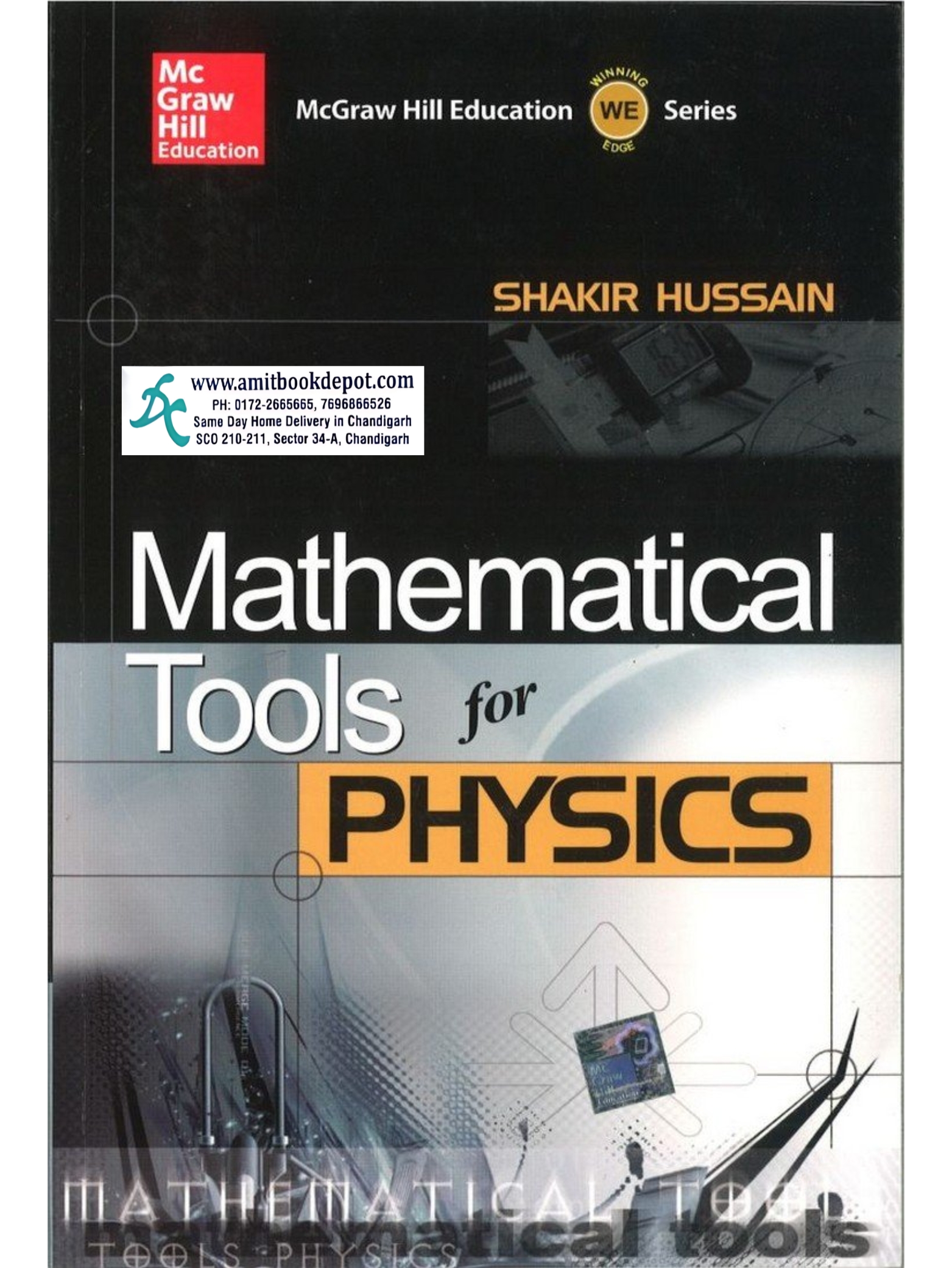
The book covers dy/dx as a rate measure (velocity, acceleration) and for finding maximum and minimum values of a function (optimization in physics).
Yes, Chapter Eight details the geometrical meaning of definite integration as the area under a curve, including graphical problems on kinematics.
The text explains both products of two vectors: scalar (dot) product and vector (cross) product, with applications to physical quantities.
It provides compound angles, multiple and sub-multiple angle formulae, and properties of triangles—essential for wave and rotational motion.
It covers physical quantities, units, dimensions, errors in measurement, and significant figures for experimental data analysis.
Yes, the Differentiation chapter includes a dedicated section on differentiation of implicit functions along with the chain rule.
Standard geometrical curves, exponential, logarithmic, trigonometric functions, and modulus of a function are all graphed.
Yes, under applications of integration, it explains centre of mass of a body using definite integrals.
Yes, the meaning of the second derivative is explained geometrically (concavity) and physically (acceleration as derivative of velocity).
Yes, graphical problems on kinematics use slope and area concepts to interpret position, velocity, and acceleration graphs.
No Description Added
The book covers dy/dx as a rate measure (velocity, acceleration) and for finding maximum and minimum values of a function (optimization in physics).
Yes, Chapter Eight details the geometrical meaning of definite integration as the area under a curve, including graphical problems on kinematics.
The text explains both products of two vectors: scalar (dot) product and vector (cross) product, with applications to physical quantities.
It provides compound angles, multiple and sub-multiple angle formulae, and properties of triangles—essential for wave and rotational motion.
It covers physical quantities, units, dimensions, errors in measurement, and significant figures for experimental data analysis.
Yes, the Differentiation chapter includes a dedicated section on differentiation of implicit functions along with the chain rule.
Standard geometrical curves, exponential, logarithmic, trigonometric functions, and modulus of a function are all graphed.
Yes, under applications of integration, it explains centre of mass of a body using definite integrals.
Yes, the meaning of the second derivative is explained geometrically (concavity) and physically (acceleration as derivative of velocity).
Yes, graphical problems on kinematics use slope and area concepts to interpret position, velocity, and acceleration graphs.