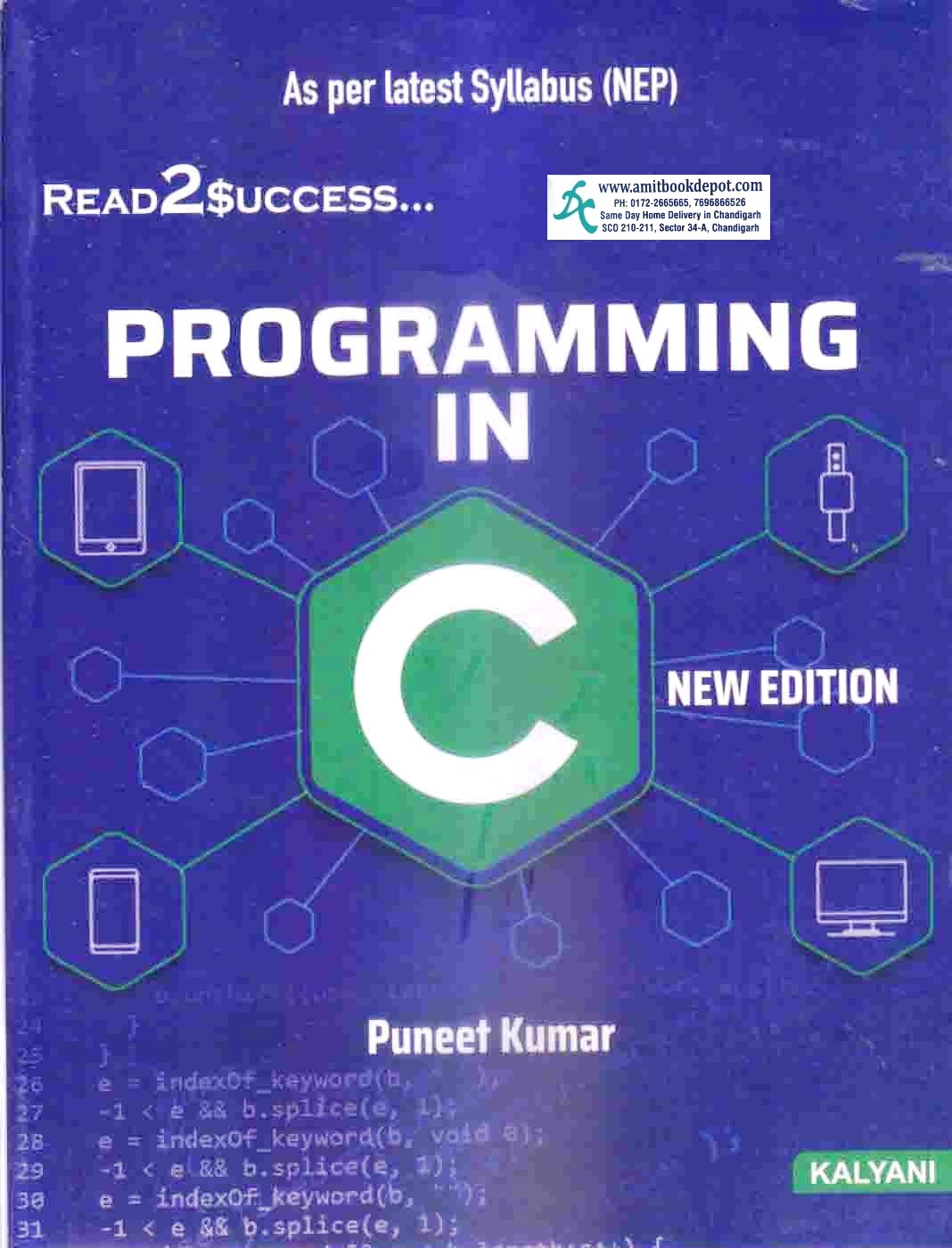
Yes, this "New Edition" is meticulously crafted to cover the entire MAC-DSC-4: Programming in C syllabus prescribed for Panjab University Chandigarh, including all four units and their specified chapters.
Absolutely. The book features a dedicated Appendix I containing numerous C Programs for hands-on practice and an Appendix II with Viva-Voce questions to prepare for lab assessments.
The book dedicates its first chapter to the Programming Process, with detailed sections on Data Flow Diagrams, Algorithm Development, Flowcharts, and Pseudo Code, ensuring a strong analytical foundation.
Yes, the chapters on Pointers and Structures and Unions are broken down with clear explanations of declaration, operators (like & and *), initialization, and practical examples to make these concepts accessible to beginners.
Yes, Unit IV of the syllabus includes a section on Files in C, covering introduction, opening/closing files, and basic I/O operations, which is included in the book's content.
The book's structure, with chapters mapped to specific units and a compulsory question covering the whole syllabus, inherently helps students prepare for the exam pattern described in the instructions.
Yes, the chapter on 'C' Fundamentals includes a section on the History of C, providing context for the language's development and significance.
Yes, the chapter on Structure and Union covers the declaration, initialization, and usage of both, allowing students to understand the key differences and when to use each.
Yes, this book is designed for undergraduate students beginning their programming journey. It starts from the very basics of the programming process and fundamentals, making it suitable for absolute beginners.
Yes, the String Manipulation chapter covers Standard Library String Functions in detail, which are essential for efficient string handling.
No Description Added
Yes, this "New Edition" is meticulously crafted to cover the entire MAC-DSC-4: Programming in C syllabus prescribed for Panjab University Chandigarh, including all four units and their specified chapters.
Absolutely. The book features a dedicated Appendix I containing numerous C Programs for hands-on practice and an Appendix II with Viva-Voce questions to prepare for lab assessments.
The book dedicates its first chapter to the Programming Process, with detailed sections on Data Flow Diagrams, Algorithm Development, Flowcharts, and Pseudo Code, ensuring a strong analytical foundation.
Yes, the chapters on Pointers and Structures and Unions are broken down with clear explanations of declaration, operators (like & and *), initialization, and practical examples to make these concepts accessible to beginners.
Yes, Unit IV of the syllabus includes a section on Files in C, covering introduction, opening/closing files, and basic I/O operations, which is included in the book's content.
The book's structure, with chapters mapped to specific units and a compulsory question covering the whole syllabus, inherently helps students prepare for the exam pattern described in the instructions.
Yes, the chapter on 'C' Fundamentals includes a section on the History of C, providing context for the language's development and significance.
Yes, the chapter on Structure and Union covers the declaration, initialization, and usage of both, allowing students to understand the key differences and when to use each.
Yes, this book is designed for undergraduate students beginning their programming journey. It starts from the very basics of the programming process and fundamentals, making it suitable for absolute beginners.
Yes, the String Manipulation chapter covers Standard Library String Functions in detail, which are essential for efficient string handling.