Categories
College Bookssss >
BA PU Chandigarh
BSC PU Chandigarh
MSC PU Chandigarh
BBA PU Chandigarh
MA PU Chandigarh
Medical Books
Engineering Books
Management Books
PGDCA Books
BCOM PU Chandigarh
MCOM PU Chandigarh
BCA PU Chandigarh
MCA PU Chandigarh
animate-books

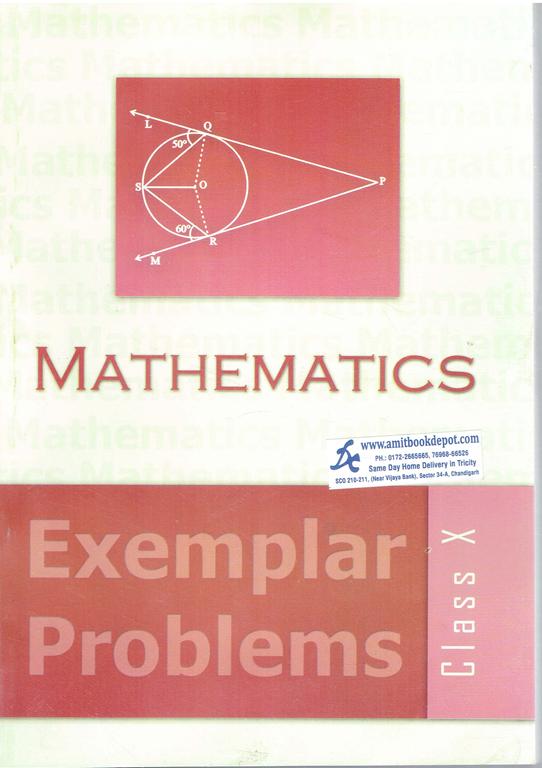
NCERT Mathematics Exemplar Problems Class 10th

by Madhurima
₹130 ₹130.00(-/ off)

Rating & Reviews

23 Customer Review

NCERT Mathematics Exemplar Problems Class 10th is an official practice book by NCERT designed for CBSE Board and competitive exam aspirants. This book goes beyond standard textbook exercises to provide multiple-choice questions (MCQs), case-based problems, and high-order thinking questions covering all 13 chapters—from real numbers, polynomials, and quadratic equations to triangles, coordinate geometry, trigonometry, circles, areas related to circles, surface areas & volumes, and statistics & probability. It includes detailed answers, two question paper designs, and focuses on key topics like the discriminant, tangent properties, trigonometric identities, and probability.

Have Doubts Regarding This Product ? Ask Your Question

  • Q1
    What is the main focus of NCERT Mathematics Exemplar Class 10?
    A1

    To develop high-order thinking skills through MCQs, short, and long answer problems aligned with CBSE syllabus.

  • Q2
    Does this book cover proofs of irrational numbers?
    A2

    Yes, it includes proofs of irrationality of square roots of 2, 3, and 5 using the Fundamental Theorem of Arithmetic.

  • Q3
    Which chapter discusses the relationship between zeros and coefficients?
    A3

    Chapter 2 (Polynomials) covers the relationship between zeros and coefficients of quadratic polynomials.

  • Q4
    Are arithmetic progressions covered with real-life applications?
    A4

    Yes, derivation of nth term and sum of first n terms of A.P. is linked to daily life problems.

  • Q5
    What coordinate geometry formulas are included?
    A5

    The book provides practice on the distance formula and section formula for internal division.

  • Q6
    Does it prove the tangent-radius theorem?
    A6

    Yes, it proves that the tangent at any point of a circle is perpendicular to the radius through that point.

  • Q7
    Are trigonometric identities included?
    A7

    Yes, proof and applications of sin²A + cos²A = 1 with simple identities are given.

  • Q8
    Does the book cover area of a circle segment?
    A8

    Yes, for central angles 60°, 90°, and 120° only, as per syllabus guidelines.

  • Q9
    Which solids are combined for surface area problems?
    A9

    Combinations of cubes, cuboids, spheres, hemispheres, cylinders, and right circular cones.

  • Q10
    Does it contain solved question paper designs?
    A10

    Yes, two sets of "Design of the Question Paper" (Set I and II) are provided for exam practice.

0.00

0 Overall Rating
  • 5
    0
  • 4
    0
  • 3
    0
  • 2
    0
  • 1
    0

Try this product & share your review & thoughts

Chapter 1. Real Numbers
Chapter 2. Polynomials
Chapter 3. Pair of Linear Equations in Two Variables
Chapter 4. Quadratic Equations
Chapter 5. Arithmetic Progressions
Chapter 6. Triangles
Chapter 7. Coordinate Geometry
Chapter 8. Introduction to Trigonometry and Its Applications
Chapter 9. Circles
Chapter 10: Constructions
Chapter 11. Area Related to Circles
Chapter 12. Surface Areas and Volumes
Chapter 13. Statistics and Probability

Answers
- Design of the Question Paper, Set - I
- Design of the Question Paper, Set - II

NCERT Mathematics Exemplar Problems Class 10th


UNIT I: NUMBER SYSTEMS

1. REAL NUMBER 
Fundamental Theorem of Arithmetic—statements after reviewing work done earlier and after illustrating and motivating through examples, proofs of the irrationality of the square roots of 2, 3, and 5.

UNIT II: ALGEBRA

1. POLYNOMIALS
Zeros of a polynomial. Relationship between zeros and coefficients of quadratic polynomials.

2. PAIR OF LINEAR EQUATIONS IN TWO VARIABLES 
A pair of linear equations in two variables and the graphical method of their solution, consistency/inconsistency.
Algebraic conditions for the number of solutions. Solution of a pair of linear equations in two variables algebraically—by substitution, by elimination. Simple situational problems.

3. QUADRATIC EQUATIONS (15) Periods
The standard form of a quadratic equation is ax² + bx + c = 0 (a ≠ 0). Solutions of quadratic equations (only real roots) by factorization and by using the quadratic formula. Relationship between the discriminant and the nature of roots. Situational problems based on quadratic equations related to day-to-day activities to be
incorporated.

4. ARITHMETIC PROGRESSIONS 
Motivation for studying arithmetic progression Derivation of the nth term and sum of the first n terms of A.P. and their application in solving daily life problems.

UNIT III: COORDINATE GEOMETRY
Coordinate Geometry
Review: Concepts of coordinate geometry, graphs of linear equations. Distance formula. Section formula (internal division)

UNIT IV: GEOMETRY

1. TRIANGLES 
Definitions, examples, and counterexamples of similar triangles.

1. (Prove) If a line is drawn parallel to one side of a triangle to intersect the other two sides at distinct points, the other two sides are divided in the same ratio.
2. (Motivate) If a line divides two sides of a triangle in the same ratio, the line is parallel to the third side.
3. (Motivate) If in two triangles, the corresponding angles are equal, their corresponding sides are proportional, and the triangles are similar.
4. (Motivate) If the corresponding sides of two triangles are proportional, their corresponding angles are equal, and the two triangles are similar.
5. (Motivate) If one angle of a triangle is equal to one angle of another triangle and the sides including these angles are proportional, the two triangles are similar.

2. CIRCLES 
Tangent to a circle at the point of contact

1. (Prove) The tangent at any point of a circle is perpendicular to the radius through the point of contact.
2. (Prove) The lengths of tangents drawn from an external point to a circle are equal.

UNIT V: TRIGONOMETRY

1. INTRODUCTION TO TRIGONOMETRY 
Trigonometric ratios of an acute angle of a right-angled triangle. Proof of their existence (well defined); motivate the ratios, whichever are defined at 0° and 90°. Values of the trigonometric ratios of 30, 45 and 60. Relationships between the ratios.

2. TRIGONOMETRIC IDENTITIES 
Proof and applications of the identity sin²A + cos²A = 1. Only simple identities are to be given.

3. HEIGHTS AND DISTANCES: Angle of elevation, angle of depression. 
Simple problems on heights and distances. Problems should not involve more than two right triangles. Angles of elevation/depression should be only 30°, 45°, and 60°.

UNIT VI: MENSURATION

1. AREAS RELATED TO CIRCLES 
Area of sectors and segments of a circle. Problems based on areas and perimeter/circumference of the above-mentioned plane figures. (In calculating the area of a segment of a circle, problems should be restricted to central angles of 60°, 90°, and 120° only.).

2. SURFACE AREAS AND VOLUMES
Surface areas and volumes of combinations of any two of the following: cubes, cuboids, spheres, hemispheres, and right circular cylinders/cones.

UNIT VII: STATISTICS AND PROBABILITY

1. STATISTICS 
Mean, median, and mode of grouped data (bimodal situation to be avoided).

2. PROBABILITY 
Classical definition of probability. Simple problems on finding the probability of an event.

Master the fundamentals of Class 10 Mathematics with the NCERT Mathematics Exemplar Problems Class 10th, an essential resource published by the National Council of Educational Research and Training (NCERT). This book is meticulously designed to bridge the gap between conceptual understanding and advanced problem-solving, making it indispensable for students preparing for the CBSE Board Examinations and various competitive exams like JEE Foundation, NTSE, and Olympiads.

Unlike standard textbooks, this exemplar focuses on higher-order thinking skills (HOTS) by presenting a vast array of multiple-choice questions (MCQs), short answer questions, and long answer questions. It strictly follows the CBSE syllabus and the latest question paper design, ensuring complete alignment with the Class 10th curriculum.

Comprehensive Coverage of Key Units:

The book systematically covers all seven units of the syllabus. In Unit I: Number Systems, you will explore real numbers and the fundamental theorem of arithmetic, including proofs of the irrationality of √2, √3, and √5. Unit II: Algebra dives deep into Polynomials (relationship between zeros and coefficients), Pair of Linear Equations in Two Variables (algebraic and graphical solutions), Quadratic Equations (solving via factorisation and quadratic formula with discriminant analysis), and Arithmetic Progressions (derivation of nth term and sum of first n terms).

Geometry, Trigonometry, and Beyond:

Unit III: Coordinate Geometry reinforces the distance formula and section formula. Unit IV: Geometry covers triangles (similarity criteria, Thales' theorem) and circles (tangent properties and theorems). Unit V: Trigonometry provides rigors practice on trigonometric ratios, identities (sin²A + cos²A = 1), and heights and distances problems involving angles of elevation and depression (30°, 45°, 60°).

Mensuration, Statistics, and Probability:

Unit VI: Mensuration focuses on areas related to circles (sectors, segments with central angles 60°, 90°, 120°) and surface areas and volumes (combinations of cubes, cuboids, spheres, hemispheres, cylinders, and cones). Finally, Unit VII: Statistics and Probability covers the mean, median, and mode of grouped data, along with the classical definition of probability through simple real-life events.

Key Features & Benefits:

1. Error-Free Content: Authored by NCERT, ensuring 100% authentic and accurate content.
2. Exam-Oriented: Includes two sets of "Design of the Question Paper" (Set I & II) to familiarise students with marking schemes and blueprints.
3. Solutions Included: Detailed answers at the end of the book for self-assessment and doubt clarification.
4. Conceptual Clarity: Each chapter from 1 to 13 (Real Numbers to Statistics and Probability) contains problems graded from easy to challenging.

This NCERT Exemplar is not just a practice book; it is a strategic tool for scoring 95+ marks in the final exam. It is a must-have for every Class 10 student who aims to build a strong mathematical foundation and excel in competitive assessments.

Chapter 1. Real Numbers
Chapter 2. Polynomials
Chapter 3. Pair of Linear Equations in Two Variables
Chapter 4. Quadratic Equations
Chapter 5. Arithmetic Progressions
Chapter 6. Triangles
Chapter 7. Coordinate Geometry
Chapter 8. Introduction to Trigonometry and Its Applications
Chapter 9. Circles
Chapter 10: Constructions
Chapter 11. Area Related to Circles
Chapter 12. Surface Areas and Volumes
Chapter 13. Statistics and Probability

Answers
- Design of the Question Paper, Set - I
- Design of the Question Paper, Set - II

Have Doubts Regarding This Product ? Ask Your Question

  • Q1
    What is the main focus of NCERT Mathematics Exemplar Class 10?
    A1

    To develop high-order thinking skills through MCQs, short, and long answer problems aligned with CBSE syllabus.

  • Q2
    Does this book cover proofs of irrational numbers?
    A2

    Yes, it includes proofs of irrationality of square roots of 2, 3, and 5 using the Fundamental Theorem of Arithmetic.

  • Q3
    Which chapter discusses the relationship between zeros and coefficients?
    A3

    Chapter 2 (Polynomials) covers the relationship between zeros and coefficients of quadratic polynomials.

  • Q4
    Are arithmetic progressions covered with real-life applications?
    A4

    Yes, derivation of nth term and sum of first n terms of A.P. is linked to daily life problems.

  • Q5
    What coordinate geometry formulas are included?
    A5

    The book provides practice on the distance formula and section formula for internal division.

  • Q6
    Does it prove the tangent-radius theorem?
    A6

    Yes, it proves that the tangent at any point of a circle is perpendicular to the radius through that point.

  • Q7
    Are trigonometric identities included?
    A7

    Yes, proof and applications of sin²A + cos²A = 1 with simple identities are given.

  • Q8
    Does the book cover area of a circle segment?
    A8

    Yes, for central angles 60°, 90°, and 120° only, as per syllabus guidelines.

  • Q9
    Which solids are combined for surface area problems?
    A9

    Combinations of cubes, cuboids, spheres, hemispheres, cylinders, and right circular cones.

  • Q10
    Does it contain solved question paper designs?
    A10

    Yes, two sets of "Design of the Question Paper" (Set I and II) are provided for exam practice.

NCERT Mathematics Exemplar Problems Class 10th


UNIT I: NUMBER SYSTEMS

1. REAL NUMBER 
Fundamental Theorem of Arithmetic—statements after reviewing work done earlier and after illustrating and motivating through examples, proofs of the irrationality of the square roots of 2, 3, and 5.

UNIT II: ALGEBRA

1. POLYNOMIALS
Zeros of a polynomial. Relationship between zeros and coefficients of quadratic polynomials.

2. PAIR OF LINEAR EQUATIONS IN TWO VARIABLES 
A pair of linear equations in two variables and the graphical method of their solution, consistency/inconsistency.
Algebraic conditions for the number of solutions. Solution of a pair of linear equations in two variables algebraically—by substitution, by elimination. Simple situational problems.

3. QUADRATIC EQUATIONS (15) Periods
The standard form of a quadratic equation is ax² + bx + c = 0 (a ≠ 0). Solutions of quadratic equations (only real roots) by factorization and by using the quadratic formula. Relationship between the discriminant and the nature of roots. Situational problems based on quadratic equations related to day-to-day activities to be
incorporated.

4. ARITHMETIC PROGRESSIONS 
Motivation for studying arithmetic progression Derivation of the nth term and sum of the first n terms of A.P. and their application in solving daily life problems.

UNIT III: COORDINATE GEOMETRY
Coordinate Geometry
Review: Concepts of coordinate geometry, graphs of linear equations. Distance formula. Section formula (internal division)

UNIT IV: GEOMETRY

1. TRIANGLES 
Definitions, examples, and counterexamples of similar triangles.

1. (Prove) If a line is drawn parallel to one side of a triangle to intersect the other two sides at distinct points, the other two sides are divided in the same ratio.
2. (Motivate) If a line divides two sides of a triangle in the same ratio, the line is parallel to the third side.
3. (Motivate) If in two triangles, the corresponding angles are equal, their corresponding sides are proportional, and the triangles are similar.
4. (Motivate) If the corresponding sides of two triangles are proportional, their corresponding angles are equal, and the two triangles are similar.
5. (Motivate) If one angle of a triangle is equal to one angle of another triangle and the sides including these angles are proportional, the two triangles are similar.

2. CIRCLES 
Tangent to a circle at the point of contact

1. (Prove) The tangent at any point of a circle is perpendicular to the radius through the point of contact.
2. (Prove) The lengths of tangents drawn from an external point to a circle are equal.

UNIT V: TRIGONOMETRY

1. INTRODUCTION TO TRIGONOMETRY 
Trigonometric ratios of an acute angle of a right-angled triangle. Proof of their existence (well defined); motivate the ratios, whichever are defined at 0° and 90°. Values of the trigonometric ratios of 30, 45 and 60. Relationships between the ratios.

2. TRIGONOMETRIC IDENTITIES 
Proof and applications of the identity sin²A + cos²A = 1. Only simple identities are to be given.

3. HEIGHTS AND DISTANCES: Angle of elevation, angle of depression. 
Simple problems on heights and distances. Problems should not involve more than two right triangles. Angles of elevation/depression should be only 30°, 45°, and 60°.

UNIT VI: MENSURATION

1. AREAS RELATED TO CIRCLES 
Area of sectors and segments of a circle. Problems based on areas and perimeter/circumference of the above-mentioned plane figures. (In calculating the area of a segment of a circle, problems should be restricted to central angles of 60°, 90°, and 120° only.).

2. SURFACE AREAS AND VOLUMES
Surface areas and volumes of combinations of any two of the following: cubes, cuboids, spheres, hemispheres, and right circular cylinders/cones.

UNIT VII: STATISTICS AND PROBABILITY

1. STATISTICS 
Mean, median, and mode of grouped data (bimodal situation to be avoided).

2. PROBABILITY 
Classical definition of probability. Simple problems on finding the probability of an event.

0.00

0 Overall Rating
  • 5
    0
  • 4
    0
  • 3
    0
  • 2
    0
  • 1
    0

Try this product & share your review & thoughts

Top Trending Product

Related Product

Related Product

Related Blog Posts

Latest Blogs

Latest Blogs

blog-img
Classic Literature Reimagined: Discuss modern twists on classic novels.
Lorem ipsum dolor sit amet, consectetur adipiscing elit, sed do eiusmod tempor incididunt ut labore et dolore magna aliqua. Ut enim ad minim veniam, quis nostrud exercitation ullamco Lorem ipsum dolor sit amet, consectetur adipiscing elit, sed do eiusmod tempor incididunt ut labore et dolore magna aliqua. Utenim ad minim veniam, quis nostrud exercitation ullamco Lorem ipsum dolor sit amet, consecte...
Read more
Author name | 10 jan, 2025
blog-img
Classic Literature Reimagined: Discuss modern twists on classic novels.
Lorem ipsum dolor sit amet, consectetur adipiscing elit, sed do eiusmod tempor incididunt ut labore et dolore magna aliqua. Ut enim ad minim veniam, quis nostrud exercitation ullamco Lorem ipsum dolor sit amet, consectetur adipiscing elit, sed do eiusmod tempor incididunt ut labore et dolore magna aliqua. Utenim ad minim veniam, quis nostrud exercitation ullamco Lorem ipsum dolor sit amet, consecte...
Read more
Author name | 10 jan, 2025
blog-img
Classic Literature Reimagined: Discuss modern twists on classic novels.
Lorem ipsum dolor sit amet, consectetur adipiscing elit, sed do eiusmod tempor incididunt ut labore et dolore magna aliqua. Ut enim ad minim veniam, quis nostrud exercitation ullamco Lorem ipsum dolor sit amet, consectetur adipiscing elit, sed do eiusmod tempor incididunt ut labore et dolore magna aliqua. Utenim ad minim veniam, quis nostrud exercitation ullamco Lorem ipsum dolor sit amet, consecte...
Read more
Author name | 10 jan, 2025
blog-img
Classic Literature Reimagined: Discuss modern twists on classic novels.
Lorem ipsum dolor sit amet, consectetur adipiscing elit...
Read more
Author Name | 10 Jan, 2025
blog-img
Classic Literature Reimagined: Discuss modern twists on classic novels.
Lorem ipsum dolor sit amet, consectetur adipiscing elit...
Read more
Author Name | 10 Jan, 2025
blog-img
Classic Literature Reimagined: Discuss modern twists on classic novels.
Lorem ipsum dolor sit amet, consectetur adipiscing elit...
Read more
Author Name | 10 Jan, 2025
blog-img
Classic Literature Reimagined: Discuss modern twists on classic novels.
Lorem ipsum dolor sit amet, consectetur adipiscing elit...
Read more
Author Name | 10 Jan, 2025
blog-img
Classic Literature Reimagined: Discuss modern twists on classic novels.
Lorem ipsum dolor sit amet, consectetur adipiscing elit...
Read more
Author Name | 10 Jan, 2025
blog-img
Classic Literature Reimagined: Discuss modern twists on classic novels.
Lorem ipsum dolor sit amet, consectetur adipiscing elit...
Read more
Author Name | 10 Jan, 2025
blog-img
Classic Literature Reimagined: Discuss modern twists on classic novels.
Lorem ipsum dolor sit amet, consectetur adipiscing elit...
Read more
Author Name | 10 Jan, 2025
blog-img
Classic Literature Reimagined: Discuss modern twists on classic novels.
Lorem ipsum dolor sit amet, consectetur adipiscing elit...
Read more
Author Name | 10 Jan, 2025
blog-img
Classic Literature Reimagined: Discuss modern twists on classic novels.
Lorem ipsum dolor sit amet, consectetur adipiscing elit...
Read more
Author Name | 10 Jan, 2025