Categories
College Bookssss >
BA PU Chandigarh
BSC PU Chandigarh
MSC PU Chandigarh
BBA PU Chandigarh
MA PU Chandigarh
Medical Books
Engineering Books
Management Books
PGDCA Books
BCOM PU Chandigarh
MCOM PU Chandigarh
BCA PU Chandigarh
MCA PU Chandigarh
animate-books

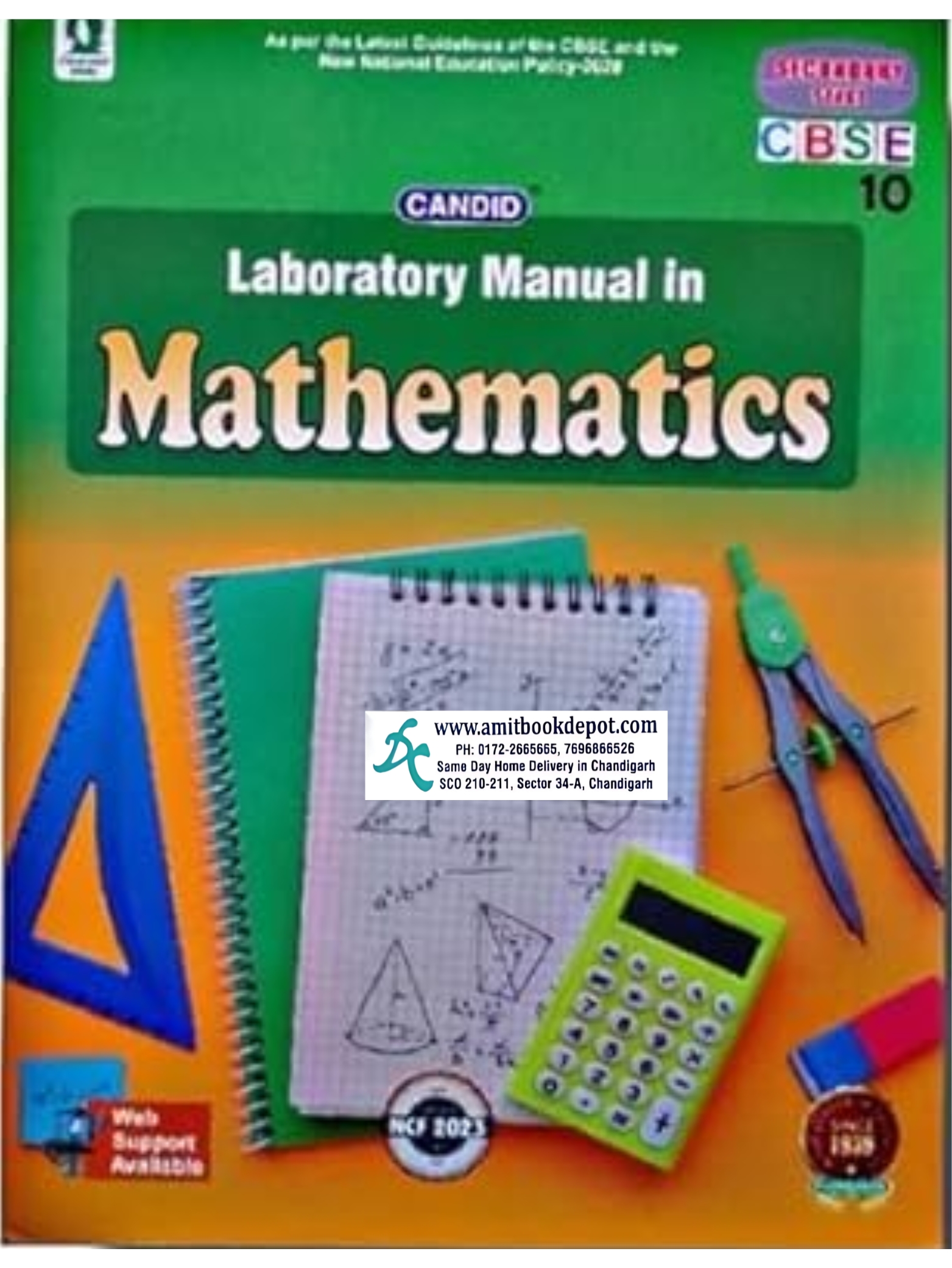
CANDI Laboratory Manual in Mathematics Class 10th

by Madhurima
₹480 ₹480.00(-/ off)

Rating & Reviews

23 Customer Review

Evergreen CANDI Laboratory Manual in Mathematics Class 10th by Arvind Nagpal and Amit Prashar, published by Evergreen Publications, is a complete activity-based guide for CBSE practical exams. This Mathematics Lab Manual covers 23 hands-on activities and 7 projects, including the graph of a quadratic polynomial, verification of arithmetic progression by paper cutting, the basic proportionality theorem, and construction of a centroid of a triangle. It provides step-by-step methods to explore the area of a circle, the volume of a right circular cylinder and cone, and the surface area of a sphere. The manual also includes practical probability experiments and a project on mathematical designs using arithmetic progression.

Have Doubts Regarding This Product ? Ask Your Question

  • Q1
    Which activity verifies Thales' theorem?
    A1

    Activity 6: Basic Proportionality Theorem for a Triangle verifies Thales' theorem using a triangle and parallel lines.

  • Q2
    How does Activity 2 check consistency of linear equations?
    A2

    By graphical method; intersecting lines mean unique solution, parallel lines mean no solution, coincident lines mean infinite solutions.

  • Q3
    Which two activities derive the area of a circle?
    A3

    Activity 11 (coiling method) and Activity 12 (paper cutting and pasting) derive the area of a circle.

  • Q4
    Which activity finds the sum of first n natural numbers?
    A4

    Activity 4 finds the sum of first n natural numbers using visual representation and formula derivation.

  • Q5
    Where is the centroid of a triangle located?
    A5

    Activity 9 shows centroid is the intersection point of all three medians, located two-thirds from each vertex.

  • Q6
    What property of tangents is verified in Activity 10?
    A6

    Tangents drawn from an external point to a circle are equal in length and subtend equal angles at center.

  • Q7
    How does Activity 14 compare cylinder surface areas?
    A7

    It compares lateral and total surface area of a right circular cylinder by cutting and rearranging its net.

  • Q8
    Which activity verifies if a sequence is an arithmetic progression?
    A8

    Activity 3 uses paper cutting and pasting to check constant common difference in an arithmetic progression.

  • Q9
    What is demonstrated in Activity 7: A System of Similar Triangles?
    A9

    It demonstrates that triangles formed by drawing a line parallel to one side of a triangle are similar.

  • Q10
    Which project analyzes letter frequency in a language text?
    A10

    Project 6: Frequency of Letters / Words in a Language Text, useful for understanding statistical distributions.

0.00

0 Overall Rating
  • 5
    0
  • 4
    0
  • 3
    0
  • 2
    0
  • 1
    0

Try this product & share your review & thoughts

ACTIVITIES

1. Graph of a Quadratic Polynomial.
2. To find the conditions for consistency and inconsistency for a system of linear equations in two variables by graphical method.
3. To verify the given sequence is an arithmetic progression by the paper cutting and pasting method.
4. To find the sum of the first n natural numbers by activity.
5. Sum of odd natural numbers.
6. Basic Proportionality Theorem for a Triangle.
7. A System of Similar Triangles.
8. Similarity of Two Triangles.
9. Centroid of a triangle.
10. Tangents drawn from an external point.
11. Area of a circle (by coiling method).
12. Area of a circle (by paper cutting and pasting).
13. Areas of sectors formed at the vertices of a triangle.
14. Comparison of surface area of a right circular cylinder.
15. Right circular cylinder.
16. Volume of a right circular cylinder.
17. Right circular cone.
18. Lateral surface area of a right circular cone.
19. Volume of right circular cone.
20. Surface area of a sphere.
21. Volume of a sphere.
22. Probability.
23. Making of clinometer.

PROJECTS

1. Geometry in real life.
2. Displacement and rotation of a geometrical figure.
3. Project in the History of Mathematics.
4. Efficiency in Packing.
5. Experiment on Probability.
6. Frequency of Letters / Words in a Language Text.
7. Mathematical Designs and Patterns using arithmetic progression.

The Evergreen CANDI Laboratory Manual in Mathematics for Class 10th is a comprehensive, activity-driven guide designed to bridge the gap between theoretical mathematical concepts and their practical application. Authored by renowned educators Arvind Nagpal and Amit Prashar, this manual strictly adheres to the latest CBSE curriculum requirements, making it an indispensable resource for students aiming to excel in their practical examinations and internal assessments.

This Mathematics Lab Manual emphasizes "learning by doing," a pedagogical approach proven to enhance retention and conceptual clarity. It systematically covers 23 graded activities and 7 interdisciplinary projects, each mapped to key Class 10 topics. The manual focuses on high-weightage areas including Quadratic Polynomials, Systems of Linear Equations in two variables, Arithmetic Progression, and the Basic Proportionality Theorem (Thales' Theorem). Students gain hands-on experience verifying geometric principles such as the properties of tangents drawn from an external point to a circle, the construction of the centroid of a triangle, and the conditions for similarity of two triangles.

A significant portion of the manual is dedicated to mensuration, offering unique activity-based methods to derive formulas. For example, students explore the area of a circle through both the coiling method and the paper cutting and pasting method. Further activities cover the surface area of a right circular cylinder, the volume of a right circular cone, the lateral surface area of a right circular cone, and both the surface area and volume of a sphere. The cone and cylinder sections are presented in comparative exercises to reinforce formula differentiation.

Beyond geometry and algebra, the manual includes practical work on probability using experimental approaches and a unique activity on making a clinometer for height measurement. The Projects section encourages higher-order thinking with topics like Geometry in real life, Efficiency in Packing, Frequency of Letters/Words in a Language Text, and Mathematical Designs and Patterns using arithmetic progression.

Key Features:

- Step-by-step instructions with diagrammatic aids.
- Observation table and calculation sheet formats.
- Viva-voce questions integrated within activities.
- Space for student recordings.
- Published by Evergreen Publications, a trusted name in educational books.

This lab manual in mathematics is not merely a record book; it is a practical toolkit to build analytical skills, secure full marks in practical exams, and prepare for competency-based questions in the Class 10 board examinations.

ACTIVITIES

1. Graph of a Quadratic Polynomial.
2. To find the conditions for consistency and inconsistency for a system of linear equations in two variables by graphical method.
3. To verify the given sequence is an arithmetic progression by the paper cutting and pasting method.
4. To find the sum of the first n natural numbers by activity.
5. Sum of odd natural numbers.
6. Basic Proportionality Theorem for a Triangle.
7. A System of Similar Triangles.
8. Similarity of Two Triangles.
9. Centroid of a triangle.
10. Tangents drawn from an external point.
11. Area of a circle (by coiling method).
12. Area of a circle (by paper cutting and pasting).
13. Areas of sectors formed at the vertices of a triangle.
14. Comparison of surface area of a right circular cylinder.
15. Right circular cylinder.
16. Volume of a right circular cylinder.
17. Right circular cone.
18. Lateral surface area of a right circular cone.
19. Volume of right circular cone.
20. Surface area of a sphere.
21. Volume of a sphere.
22. Probability.
23. Making of clinometer.

PROJECTS

1. Geometry in real life.
2. Displacement and rotation of a geometrical figure.
3. Project in the History of Mathematics.
4. Efficiency in Packing.
5. Experiment on Probability.
6. Frequency of Letters / Words in a Language Text.
7. Mathematical Designs and Patterns using arithmetic progression.
Have Doubts Regarding This Product ? Ask Your Question

  • Q1
    Which activity verifies Thales' theorem?
    A1

    Activity 6: Basic Proportionality Theorem for a Triangle verifies Thales' theorem using a triangle and parallel lines.

  • Q2
    How does Activity 2 check consistency of linear equations?
    A2

    By graphical method; intersecting lines mean unique solution, parallel lines mean no solution, coincident lines mean infinite solutions.

  • Q3
    Which two activities derive the area of a circle?
    A3

    Activity 11 (coiling method) and Activity 12 (paper cutting and pasting) derive the area of a circle.

  • Q4
    Which activity finds the sum of first n natural numbers?
    A4

    Activity 4 finds the sum of first n natural numbers using visual representation and formula derivation.

  • Q5
    Where is the centroid of a triangle located?
    A5

    Activity 9 shows centroid is the intersection point of all three medians, located two-thirds from each vertex.

  • Q6
    What property of tangents is verified in Activity 10?
    A6

    Tangents drawn from an external point to a circle are equal in length and subtend equal angles at center.

  • Q7
    How does Activity 14 compare cylinder surface areas?
    A7

    It compares lateral and total surface area of a right circular cylinder by cutting and rearranging its net.

  • Q8
    Which activity verifies if a sequence is an arithmetic progression?
    A8

    Activity 3 uses paper cutting and pasting to check constant common difference in an arithmetic progression.
  • Q9
    What is demonstrated in Activity 7: A System of Similar Triangles?
    A9

    It demonstrates that triangles formed by drawing a line parallel to one side of a triangle are similar.

  • Q10
    Which project analyzes letter frequency in a language text?
    A10

    Project 6: Frequency of Letters / Words in a Language Text, useful for understanding statistical distributions.

No Syllabus Added

0.00

0 Overall Rating
  • 5
    0
  • 4
    0
  • 3
    0
  • 2
    0
  • 1
    0

Try this product & share your review & thoughts

Top Trending Product

Related Product

Related Product

Related Blog Posts

Latest Blogs

Latest Blogs

blog-img
Classic Literature Reimagined: Discuss modern twists on classic novels.
Lorem ipsum dolor sit amet, consectetur adipiscing elit, sed do eiusmod tempor incididunt ut labore et dolore magna aliqua. Ut enim ad minim veniam, quis nostrud exercitation ullamco Lorem ipsum dolor sit amet, consectetur adipiscing elit, sed do eiusmod tempor incididunt ut labore et dolore magna aliqua. Utenim ad minim veniam, quis nostrud exercitation ullamco Lorem ipsum dolor sit amet, consecte...
Read more
Author name | 10 jan, 2025
blog-img
Classic Literature Reimagined: Discuss modern twists on classic novels.
Lorem ipsum dolor sit amet, consectetur adipiscing elit, sed do eiusmod tempor incididunt ut labore et dolore magna aliqua. Ut enim ad minim veniam, quis nostrud exercitation ullamco Lorem ipsum dolor sit amet, consectetur adipiscing elit, sed do eiusmod tempor incididunt ut labore et dolore magna aliqua. Utenim ad minim veniam, quis nostrud exercitation ullamco Lorem ipsum dolor sit amet, consecte...
Read more
Author name | 10 jan, 2025
blog-img
Classic Literature Reimagined: Discuss modern twists on classic novels.
Lorem ipsum dolor sit amet, consectetur adipiscing elit, sed do eiusmod tempor incididunt ut labore et dolore magna aliqua. Ut enim ad minim veniam, quis nostrud exercitation ullamco Lorem ipsum dolor sit amet, consectetur adipiscing elit, sed do eiusmod tempor incididunt ut labore et dolore magna aliqua. Utenim ad minim veniam, quis nostrud exercitation ullamco Lorem ipsum dolor sit amet, consecte...
Read more
Author name | 10 jan, 2025
blog-img
Classic Literature Reimagined: Discuss modern twists on classic novels.
Lorem ipsum dolor sit amet, consectetur adipiscing elit...
Read more
Author Name | 10 Jan, 2025
blog-img
Classic Literature Reimagined: Discuss modern twists on classic novels.
Lorem ipsum dolor sit amet, consectetur adipiscing elit...
Read more
Author Name | 10 Jan, 2025
blog-img
Classic Literature Reimagined: Discuss modern twists on classic novels.
Lorem ipsum dolor sit amet, consectetur adipiscing elit...
Read more
Author Name | 10 Jan, 2025
blog-img
Classic Literature Reimagined: Discuss modern twists on classic novels.
Lorem ipsum dolor sit amet, consectetur adipiscing elit...
Read more
Author Name | 10 Jan, 2025
blog-img
Classic Literature Reimagined: Discuss modern twists on classic novels.
Lorem ipsum dolor sit amet, consectetur adipiscing elit...
Read more
Author Name | 10 Jan, 2025
blog-img
Classic Literature Reimagined: Discuss modern twists on classic novels.
Lorem ipsum dolor sit amet, consectetur adipiscing elit...
Read more
Author Name | 10 Jan, 2025
blog-img
Classic Literature Reimagined: Discuss modern twists on classic novels.
Lorem ipsum dolor sit amet, consectetur adipiscing elit...
Read more
Author Name | 10 Jan, 2025
blog-img
Classic Literature Reimagined: Discuss modern twists on classic novels.
Lorem ipsum dolor sit amet, consectetur adipiscing elit...
Read more
Author Name | 10 Jan, 2025
blog-img
Classic Literature Reimagined: Discuss modern twists on classic novels.
Lorem ipsum dolor sit amet, consectetur adipiscing elit...
Read more
Author Name | 10 Jan, 2025