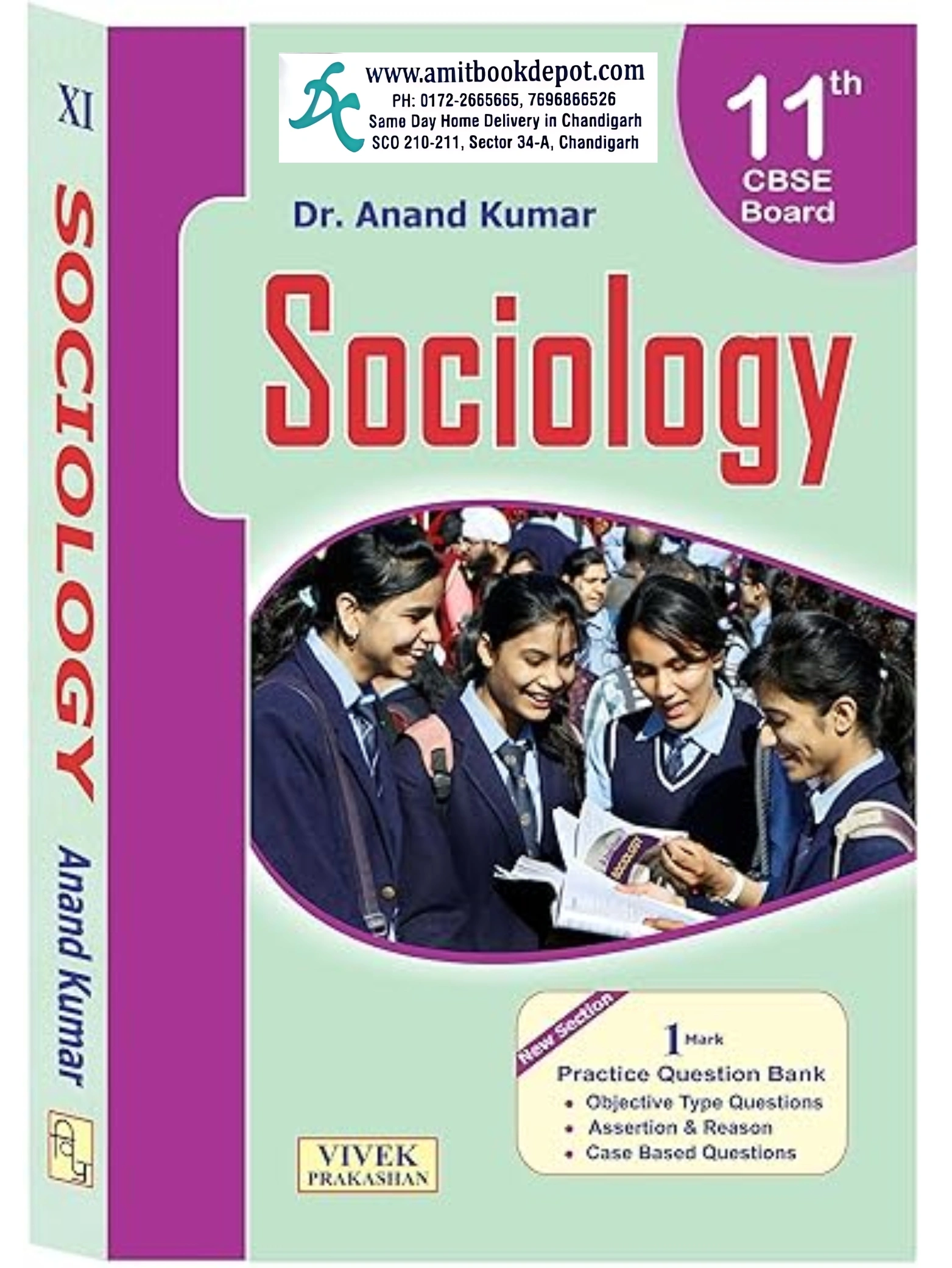
Sociology for Class 11 by Anand Kumar (Vivek Prakashan) is the complete CBSE-aligned book for building a strong foundation in sociology. It comprehensively covers the syllabus through two parts: Introducing Sociology (key concepts, social institutions, culture, and socialization) and Understanding Society (social change, social order, and Western and Indian sociologists). With clear explanations of thinkers like Marx, Durkheim, Weber, Ghurye, and Srinivas, this book simplifies complex ideas. It is an essential resource for Class 11 students to develop critical thinking, excel academically, and understand the dynamics of society, social stratification, and social control.
Sociology for Class 11 by Anand Kumar, published by Vivek Prakashan, is a meticulously crafted book designed to provide a comprehensive and foundational understanding of sociology for senior secondary students. This book strictly adheres to the latest CBSE syllabus, ensuring complete coverage of all prescribed topics, concepts, and thinkers. It serves as an essential academic resource for building a robust conceptual framework in sociology, bridging everyday life with sociological perspectives.
Structured into two clear sections—Part A: Introducing Sociology and Part B: Understanding Society—the book methodically guides learners from basic concepts to more complex analyses. Part A lays the groundwork by exploring the fundamental question: "What is sociology?" It begins by examining the relationship between the individual and society, introducing students to the unique sociological imagination. The narrative then delves into the emergence, nature, and scope of sociology, clearly distinguishing it from other social science disciplines like psychology, history, and political science. This comparative approach solidifies the student's understanding of sociology's distinct perspective.
The core of sociological inquiry is built through dedicated units on essential terms and concepts. Key chapters on social groups, status and role, social stratification, and social control are explained with clarity, using relatable examples to demystify abstract ideas. This foundational knowledge is crucial for analyzing the structures that shape human behavior. The unit on Understanding Social Institutions provides an in-depth look at the pillars of society: marriage, family, and kinship; work & economic life; political institutions; religion; and education. Each institution is dissected to reveal its functions, structures, and evolving nature in the contemporary world.
Further strengthening the foundational base, the book explores culture & socialization. It breaks down the components of culture, values, and norms and explains the critical process of socialization—how individuals learn to become functional members of their society. This prepares the student to comprehend the dynamics of social change and social order, which form the crux of Part B.
Part B: Understanding Society shifts the focus to macro-level analysis and sociological theory. It empowers students to understand the forces that drive and stabilize societies. The unit on Social Change & Social Order examines the types, causes, and consequences of social change, alongside concepts of domination, authority, law, contestation, crime, and violence. This theoretical framework is then applied practically to understand social order in rural and urban society, highlighting the contrasts and connections between village and city life.
A significant portion of the curriculum is dedicated to seminal thinkers. The unit Introducing Western Sociologists offers accessible introductions to the foundational ideas of Karl Marx on class conflict, Emile Durkheim on division of labor and solidarity, and Max Weber on interpretive sociology, ideal types, and bureaucracy. Complementing this, the unit on Indian sociologists grounds the study in the local context, presenting the pioneering work of G. S. Ghurye, D. P. Mukerji, A. R. Desai, and M. N. Srinivas on caste, tradition, change, the state, and the village. This dual focus ensures students appreciate both global sociological thought and its Indian interpretations.
Sociology for Class 11 by Vivek Prakashan is characterized by its lucid language, logical progression of topics, and pedagogical effectiveness. It includes key terms, chapter summaries, and thought-provoking questions that aid in revision and self-assessment. More than just a book, it is a tool to develop a critical sociological perspective, enabling students to analyze social phenomena, inequalities, and institutions in the world around them. It is the definitive guide for CBSE Class 11 students aiming for academic excellence and a deeper understanding of the social world.
Does this textbook by Anand Kumar cover the entire CBSE Class 11 Sociology syllabus for the current academic year?
A1
Yes, this book is meticulously structured to provide 100% coverage of the latest CBSE Class 11 Sociology syllabus, including all units, concepts, and thinkers.
Q2
How does the book introduce students to the difference between sociology and other subjects like psychology or history?
A2
Unit 1 specifically discusses the nature, scope, and relationship of sociology with other social science disciplines, clearly highlighting its unique perspective on society.
Q3
Are the complex concepts like 'social stratification' and 'status and role' explained with examples?
A3
Absolutely. The book dedicates entire chapters to these key terms and concepts, using relatable examples and simple language to ensure conceptual clarity for beginners.
Q4
How is the topic of 'Social Change' presented?
A4
Unit 7 thoroughly examines social change, discussing its types, causes, and consequences, and contrasts it with the mechanisms that maintain social order.
Q5
Does the book apply sociological concepts to both rural and urban Indian contexts?
A5
Yes, it specifically includes a section on Social Order in Rural and Urban Society, helping students compare and contrast social dynamics in villages, towns, and cities.
Q6
Which Western sociologists are covered, and what are the key focuses?
A6
The book features dedicated chapters on Karl Marx (class conflict), Emile Durkheim (division of labor), and Max Weber (interpretive sociology, bureaucracy).
Q7
Is this book suitable for someone entirely new to the subject of sociology?
A7
Yes, it is designed as an introductory textbook. Part A: Introducing Sociology starts from the very basics, making it perfect for Class 11 students beginning their sociology journey.
Q8
How does the author, Anand Kumar, present the relationship between individual lives and larger social forces?
A8
The book consistently encourages the development of a sociological imagination, helping students connect personal experiences to broader social structures, inequalities, and historical changes.
Q9
Are contemporary social issues or changes reflected in the discussion of institutions like family or work?
A9
While covering core concepts, the book's analysis of institutions like family and work & economic life acknowledges their evolving nature in modern society.
Q10
Is Vivek Prakashan known for quality educational books, and is this a standalone text or does it require a guide?
A10
Vivek Prakashan is a reputable educational publisher. This textbook is a comprehensive, self-contained resource designed to be the primary study material for CBSE Class 11 Sociology.
Sociology for Class 11 by Anand Kumar, published by Vivek Prakashan, is a meticulously crafted book designed to provide a comprehensive and foundational understanding of sociology for senior secondary students. This book strictly adheres to the latest CBSE syllabus, ensuring complete coverage of all prescribed topics, concepts, and thinkers. It serves as an essential academic resource for building a robust conceptual framework in sociology, bridging everyday life with sociological perspectives.
Structured into two clear sections—Part A: Introducing Sociology and Part B: Understanding Society—the book methodically guides learners from basic concepts to more complex analyses. Part A lays the groundwork by exploring the fundamental question: "What is sociology?" It begins by examining the relationship between the individual and society, introducing students to the unique sociological imagination. The narrative then delves into the emergence, nature, and scope of sociology, clearly distinguishing it from other social science disciplines like psychology, history, and political science. This comparative approach solidifies the student's understanding of sociology's distinct perspective.
The core of sociological inquiry is built through dedicated units on essential terms and concepts. Key chapters on social groups, status and role, social stratification, and social control are explained with clarity, using relatable examples to demystify abstract ideas. This foundational knowledge is crucial for analyzing the structures that shape human behavior. The unit on Understanding Social Institutions provides an in-depth look at the pillars of society: marriage, family, and kinship; work & economic life; political institutions; religion; and education. Each institution is dissected to reveal its functions, structures, and evolving nature in the contemporary world.
Further strengthening the foundational base, the book explores culture & socialization. It breaks down the components of culture, values, and norms and explains the critical process of socialization—how individuals learn to become functional members of their society. This prepares the student to comprehend the dynamics of social change and social order, which form the crux of Part B.
Part B: Understanding Society shifts the focus to macro-level analysis and sociological theory. It empowers students to understand the forces that drive and stabilize societies. The unit on Social Change & Social Order examines the types, causes, and consequences of social change, alongside concepts of domination, authority, law, contestation, crime, and violence. This theoretical framework is then applied practically to understand social order in rural and urban society, highlighting the contrasts and connections between village and city life.
A significant portion of the curriculum is dedicated to seminal thinkers. The unit Introducing Western Sociologists offers accessible introductions to the foundational ideas of Karl Marx on class conflict, Emile Durkheim on division of labor and solidarity, and Max Weber on interpretive sociology, ideal types, and bureaucracy. Complementing this, the unit on Indian sociologists grounds the study in the local context, presenting the pioneering work of G. S. Ghurye, D. P. Mukerji, A. R. Desai, and M. N. Srinivas on caste, tradition, change, the state, and the village. This dual focus ensures students appreciate both global sociological thought and its Indian interpretations.
Sociology for Class 11 by Vivek Prakashan is characterized by its lucid language, logical progression of topics, and pedagogical effectiveness. It includes key terms, chapter summaries, and thought-provoking questions that aid in revision and self-assessment. More than just a book, it is a tool to develop a critical sociological perspective, enabling students to analyze social phenomena, inequalities, and institutions in the world around them. It is the definitive guide for CBSE Class 11 students aiming for academic excellence and a deeper understanding of the social world.
Does this textbook by Anand Kumar cover the entire CBSE Class 11 Sociology syllabus for the current academic year?
A1
Yes, this book is meticulously structured to provide 100% coverage of the latest CBSE Class 11 Sociology syllabus, including all units, concepts, and thinkers.
Q2
How does the book introduce students to the difference between sociology and other subjects like psychology or history?
A2
Unit 1 specifically discusses the nature, scope, and relationship of sociology with other social science disciplines, clearly highlighting its unique perspective on society.
Q3
Are the complex concepts like 'social stratification' and 'status and role' explained with examples?
A3
Absolutely. The book dedicates entire chapters to these key terms and concepts, using relatable examples and simple language to ensure conceptual clarity for beginners.
Q4
How is the topic of 'Social Change' presented?
A4
Unit 7 thoroughly examines social change, discussing its types, causes, and consequences, and contrasts it with the mechanisms that maintain social order.
Q5
Does the book apply sociological concepts to both rural and urban Indian contexts?
A5
Yes, it specifically includes a section on Social Order in Rural and Urban Society, helping students compare and contrast social dynamics in villages, towns, and cities.
Q6
Which Western sociologists are covered, and what are the key focuses?
A6
The book features dedicated chapters on Karl Marx (class conflict), Emile Durkheim (division of labor), and Max Weber (interpretive sociology, bureaucracy).
Q7
Is this book suitable for someone entirely new to the subject of sociology?
A7
Yes, it is designed as an introductory textbook. Part A: Introducing Sociology starts from the very basics, making it perfect for Class 11 students beginning their sociology journey.
Q8
How does the author, Anand Kumar, present the relationship between individual lives and larger social forces?
A8
The book consistently encourages the development of a sociological imagination, helping students connect personal experiences to broader social structures, inequalities, and historical changes.
Q9
Are contemporary social issues or changes reflected in the discussion of institutions like family or work?
A9
While covering core concepts, the book's analysis of institutions like family and work & economic life acknowledges their evolving nature in modern society.
Q10
Is Vivek Prakashan known for quality educational books, and is this a standalone text or does it require a guide?
A10
Vivek Prakashan is a reputable educational publisher. This textbook is a comprehensive, self-contained resource designed to be the primary study material for CBSE Class 11 Sociology.
Latest Syllabus of Sociology for Class 11th CBSE Board
A. INTRODUCING SOCIOLOGY (44 Marks)
Unit 1: Sociology, Society, and Its Relationship with Other Social Sciences
- Introducing Society: Individuals and collectivities. Pluralities and inequalities among societies.
- Introducing Sociology: Emergence. Nature and Scope.
- Relationship with other social science disciplines
Unit 2 Terms, Concepts, and Their Use in Sociology
- Social Groups and Society
- Social Stratification
- Status and Role
- Society & Social Control
Unit 3: Understanding Social Institutions
- Family, Marriage, and Kinship
- Work & Economic Life
- Political Institutions
- Religion as a Social Institution
- Education as a Social Institution
Unit 4: Culture and Socialization
- Defining Culture
- Dimensions of Culture
- Socialization
- Agencies of Socialization & Sociology
B. UNDERSTANDING SOCIETY (36 Marks)
Unit 7: Social Change and Social Order in Rural and Urban Society
- Social Change: Types, Causes, and Consequences
- Social Order: Domination, Authority, and Law; Contestation, Crime, and Violence
- Concepts: Village, Town, and City
- Social Order and Social Change in Rural and Urban Areas
Unit 9: Introducing Western Sociologists
- The Context of Sociology
- Karl Marx on Class Conflict
- Emile Durkheim: Division of Labor in Society
- Max Weber: Interpretive Sociology, Ideal Type & Bureaucracy
Unit 10: Indian Sociologists
- G.S. Ghurye on Caste and Race
- D.P. Mukherjee on Tradition and Change
- A.R. Desai on the State
- M.N. Srinivas on the Village
0.00
0 Overall Rating
5
0
4
0
3
0
2
0
1
0
Try this product & share your review &
thoughts
Top Trending Product
Related
Product
Related Product
Related Blog Posts
Latest Blogs
Latest Blogs
Classic Literature Reimagined: Discuss modern twists on classic novels.
Lorem ipsum dolor sit amet, consectetur adipiscing elit, sed
do
eiusmod tempor incididunt ut labore et dolore magna aliqua. Ut enim ad minim
veniam, quis nostrud exercitation ullamco Lorem ipsum dolor sit amet,
consectetur adipiscing elit, sed do eiusmod tempor incididunt ut labore et
dolore magna aliqua. Utenim ad minim veniam, quis nostrud exercitation
ullamco
Lorem ipsum dolor sit amet, consecte...
Classic Literature Reimagined: Discuss modern twists on classic novels.
Lorem ipsum dolor sit amet, consectetur adipiscing elit, sed
do
eiusmod tempor incididunt ut labore et dolore magna aliqua. Ut enim ad minim
veniam, quis nostrud exercitation ullamco Lorem ipsum dolor sit amet,
consectetur adipiscing elit, sed do eiusmod tempor incididunt ut labore et
dolore magna aliqua. Utenim ad minim veniam, quis nostrud exercitation
ullamco
Lorem ipsum dolor sit amet, consecte...
Classic Literature Reimagined: Discuss modern twists on classic novels.
Lorem ipsum dolor sit amet, consectetur adipiscing elit, sed
do
eiusmod tempor incididunt ut labore et dolore magna aliqua. Ut enim ad minim
veniam, quis nostrud exercitation ullamco Lorem ipsum dolor sit amet,
consectetur adipiscing elit, sed do eiusmod tempor incididunt ut labore et
dolore magna aliqua. Utenim ad minim veniam, quis nostrud exercitation
ullamco
Lorem ipsum dolor sit amet, consecte...