Categories
College Bookssss >
BA PU Chandigarh
BSC PU Chandigarh
MSC PU Chandigarh
BBA PU Chandigarh
MA PU Chandigarh
Medical Books
Engineering Books
Management Books
PGDCA Books
BCOM PU Chandigarh
MCOM PU Chandigarh
BCA PU Chandigarh
MCA PU Chandigarh
animate-books

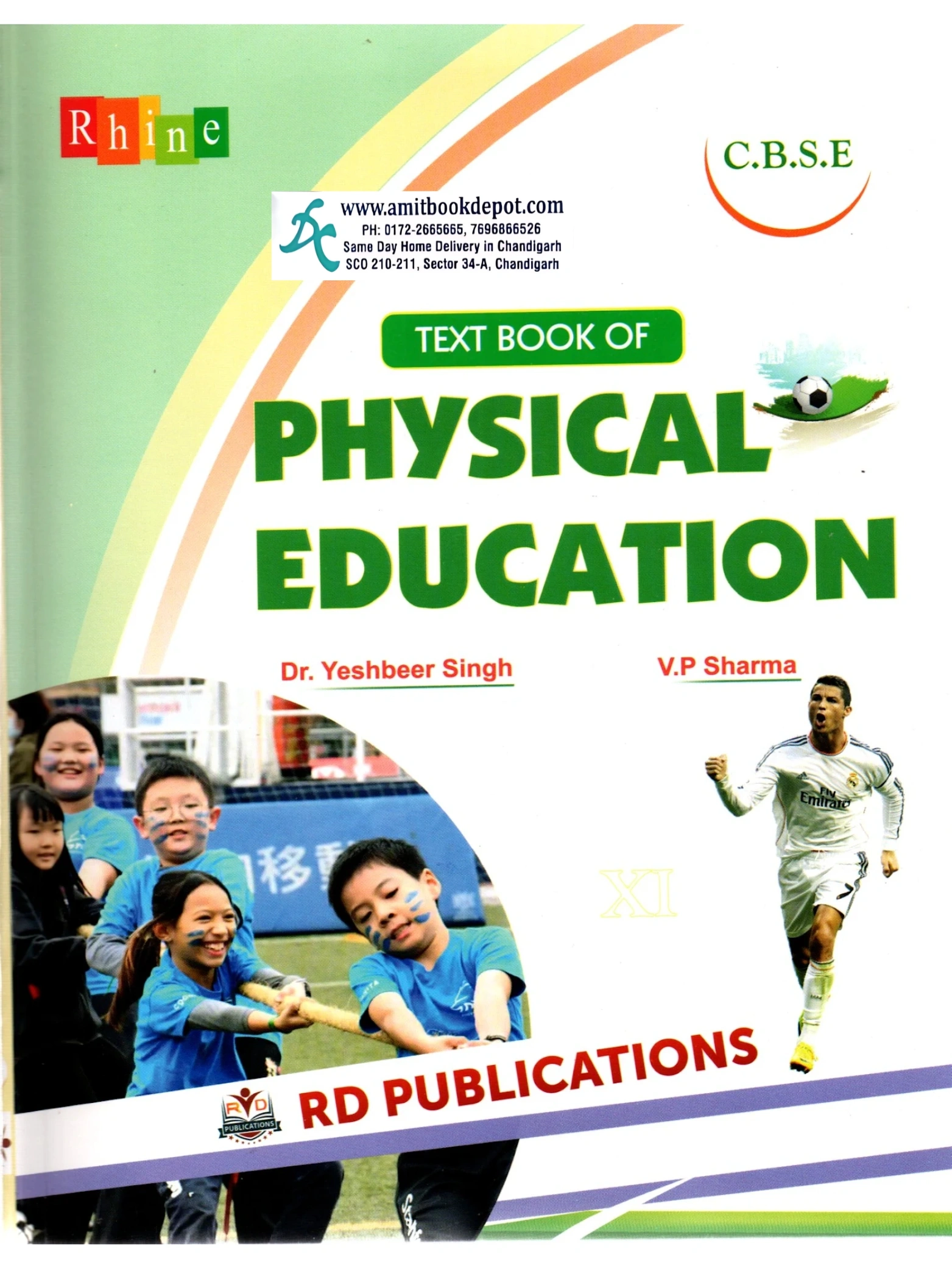
R D Text Book Of Physical Education For Class 11th

by Madhurima
₹490 ₹490.00(-/ off)

Rating & Reviews

23 Customer Review

R D Text Book of Physical Education for Class 11th by Dr Yeshbeer Singh and V.P. Sharma (R D PUBLICATIONS) is a complete syllabus-aligned guide for CBSE Class XI. Covering all ten units—from Changing Trends & Careers in Physical Education and Olympism Value Education to Yoga, Anatomy and Physiology, Kinesiology and Biomechanics, Psychology and Sports, and Training and Doping in Sports—this book integrates theory with practical applications. Learn BMI calculation, skinfold measurement, somatotypes, Yogic Kriyas, pranayama, disability etiquette, and first aid – PRICE – through clear explanations. Includes chapter answers and a sample question paper. Essential for academic exams and foundational knowledge in sports science, Khelo India, and Fit India programmes.

Have Doubts Regarding This Product ? Ask Your Question

  • Q1
    What are the four career options in physical education mentioned in the book?
    A1

    Coaching, sports journalism, physical education teaching, fitness training, and sports administration are key career options covered in Unit 1.

  • Q2
    Which Olympic values are explained under Olympism Value Education?
    A2

    Excellence, Friendship, and Respect are the core Olympic values, along with joy of effort, fair play, and balance among body, will, and mind.

  • Q3
    What is the aim of adaptive physical education for special needs children?
    A3

    To provide modified physical activities ensuring inclusive participation, skill development, and fitness for children with intellectual or physical disabilities.

  • Q4
    Define the PRICE first aid technique explained in Unit 5.
    A4

    Protection, Rest, Ice, Compression, and Elevation – a five-step acute injury management protocol for sports-related soft tissue damage.

  • Q5
    How is waist-hip ratio calculated according to the textbook?
    A5

    Waist circumference divided by hip circumference. It assesses fat distribution and predicts lifestyle disease risk.

  • Q6
    Name three types of somatotypes described in the measurement unit.
    A6

    Endomorphy (round physique), Mesomorphy (muscular build), and Ectomorphy (lean frame) – the three body type classifications.

  • Q7
    Differentiate between kinetics and kinematics in biomechanics.
    A7

    Kinetics studies forces causing motion (gravity, friction). Kinematics describes motion parameters like displacement, velocity, and acceleration without forces.

  • Q8
    Which anatomical movements are termed supination and pronation?
    A8

    Supination – outward rotation of forearm or foot; pronation – inward rotation. Both occur at radioulnar and subtalar joints.

  • Q9
    Define training load and its three components from Unit 10.
    A9

    Training load is the total stress applied to an athlete. Components: overload (exceeding limits), adaptation (positive change), and recovery (rest period).

  • Q10
    What is the difference between a disorder and a disability as per Unit 4?
    A10

    A disorder is a functional abnormality; disability is a restriction in performing normal activities due to physical or intellectual impairment.


0.00

0 Overall Rating
  • 5
    0
  • 4
    0
  • 3
    0
  • 2
    0
  • 1
    0

Try this product & share your review & thoughts

1. Changing Trends & Careers in Physical Education
2. Olympism Value Education
3. Yoga
4. Physical Education and Sports for Children With Special Needs
5. Physical Fitness, Wellness and Lifestyle
6. Test, Measurements and Evaluation
7. Fundamentals of Anatomy and Physiology in Sports
8. Fundamentals of Kinesiology and Biomechanics in Sports
9. Psychology and Sports
10. Training and Doping in Sports 

- Answers
- Sample Question Paper
CLASS XI

UNIT 1. CHANGING TRENDS AND CAREERS IN PHYSICAL EDUCATION

1. Concept, Aims and Objectives of Physical Education
2. Development of Physical Education in India-Post Independence
3. Changing trends in sports playing surfaces, wearable gear and sports equipment. technological advancements.
4 career options in physical education
5. Khelo India Programme and Fit India Programme

UNIT 2. OLYMPISM VALUE EDUCATION

1. Olympism Concept and Olympic Values (Excellence, Friendship and Respect)
2. Olympic Value Education Joy of Effort, Fair Play, Respect for Others, Pursuit of Excellence, Balance Among Body, Will and Mind
3. Ancient and Modern Olympics
4 Olympic Symbols, Motto, Flag, Oath and Anthem
5. Olympic Movement Structure IOC, NOC, IFS, Other members

UNIT 3: YOGA

1. Meaning and importance of yoga
2. Introduction to Astanga Yoga
3. Yogic Kriyas (Shat Karma)
4. Pranayama and its types.
5. Active lifestyle and stress management through yoga

UNIT 4: PHYSICAL EDUCATION AND SPORTS FOR CHILDREN WITH SPECIAL NEEDS

1. Concept of Disability and Disorder
2. Types of disability, its causes and nature (intellectual disability, physical disability)
3. Disability Etiquette
4. Aim and objectives of adaptive physical education.
5. Role of various professionals for children with special needs (counsellor, occupational therapist, physiotherapist, physical education teacher, speech therapist, and special educator)

UNIT 5: PHYSICAL FITNESS, WELLNESS AND LIFESTYLE

1. Meaning and importance of wellness, health and physical fitness
2. Component/Dimensions of Wellness, Health and Physical Fitness 2
3. Traditional Sports and Regional Games for promoting wellness
4. Leadership through Physical Activity and Sports
5. Introduction to First Aid – PRICE

UNIT 6: TEST, MEASUREMENT AND EVALUATION

1. Define 'test', 'measurements' and 'evaluation'.
2. Importance of Tests, Measurements and Evaluation in Sports
3. Calculation of BMI, waist-hip ratio, and skinfold measurement (3-site)
4. Somatotypes (Endomorphy, Mesomorphy and Ectomorphy)
5. Measurements of health-related fitness

UNIT 7: FUNDAMENTALS OF ANATOMY AND PHYSIOLOGY IN SPORTS

1. Definition and importance of anatomy and physiology in exercise and sports.
2. Functions of Skeletal System, Classification of Bones and Types of Joints.
3. Properties and Functions of Muscles,
4. Structure and Functions of the Circulatory System and Heart.
5. Structure and Functions of the Respiratory System.

UNIT 8: FUNDAMENTALS OF KINESIOLOGY AND BIOMECHANICS IN SPORTS

1. Definition and Importance of Kinesiology and Biomechanics in Sports.
2. Principles of Biomechanics
3. Kinetics and Kinematics in Sports
4. Types of Body Movements Flexion, Extension, Abduction, Adduction, Rotation, Circumduction, Supination and Pronation
5. Axis and Planes Concept and its application in body movements.

UNIT 9: PSYCHOLOGY AND SPORTS

1. Definition and Importance of Psychology in Physical Education and Sports,
2. Developmental Characteristics at Different Stages of Development;
3. Adolescent Problems and their Management.
4. Team Cohesion and Sports;
5. Introduction to Psychological Attributes: Attention, Resilience, Mental Toughness

UNIT 10 TRAINING AND DOPING IN SPORTS

1. Concept and Principles of Sports Training
2. Training Load: Overload, Adaptation and Recovery
3. Warming Up and Limbering Down: Types, Method and Importance
4. Concept of Skill, Technique, Tactics and Strategies
5. Concept of doping and its disadvantages

Product: R D Text Book of Physical Education for Class 11
Authors: Dr Yeshbeer Singh & V.P. Sharma
Publisher: R D PUBLICATIONS

The RD Textbook of Physical Education for Class 11 is a meticulously crafted curriculum companion designed specifically for students following the latest CBSE syllabus. Authored by renowned academics Dr Yeshbeer Singh and V.P. Sharma and published by R D PUBLICATIONS, this volume delivers a comprehensive understanding of physical education, bridging theoretical concepts with practical sports applications. It serves as an indispensable resource for academic success and competitive exam preparation.

This book systematically addresses all ten core units mandated for Class XI, beginning with Changing Trends & Careers in Physical Education, where learners explore post-independence development, the Khelo India Programme, the Fit India Programme, and diverse career options in physical education. The text then transitions into Olympism Value Education, covering Olympic symbols, motto, flag, oath, anthem, and the structure of the IOC, NOCs, and IFs. Students gain deep insights into Olympic values such as excellence, friendship, respect, and the joy of effort.

A dedicated section on yoga explains the meaning, importance, Astanga yoga, yogic kriyas (Shat Karma), types of pranayama, and stress management through an active lifestyle. Significantly, the book addresses physical education and sports for children with special needs, covering disability etiquette, types of disability (intellectual and physical), adaptive physical education aims, and the role of professionals including counsellors, occupational therapists, physiotherapists, and special educators.

The syllabus further explores physical fitness, wellness and lifestyle by defining components of wellness, health and physical fitness along with traditional sports and first aid – PRICE. For assessment-focused learning, the Test, Measurements and Evaluation unit provides practical knowledge on BMI calculation, waist-hip ratio, skinfold measurement (3-site), somatotypes (endomorphy, mesomorphy, and ectomorphy), and measurements of health-related fitness.

Foundational science chapters include Fundamentals of Anatomy and Physiology in Sports, covering the skeletal system, classification of bones, types of joints, properties and functions of muscles, and the structure of the circulatory and respiratory systems. The Fundamentals of Kinesiology and Biomechanics in Sports section explains kinetics, kinematics, types of body movements (flexion, extension, abduction, adduction, rotation, circumduction, supination, and pronation), and the axis and planes concept. Psychology and sports cover developmental characteristics, adolescent problems, team cohesion, attention, resilience, and mental toughness. Finally, Training and Doping in Sports details sports training principles, training load (overload, adaptation, and recovery), warming up, limbering down, and the disadvantages of doping.

The book includes answers to all chapter-end questions and a sample question paper for exam practice. Ideal for Class 11 students, physical education teachers, and aspirants of sports-related competitive exams, this R.D. PUBLICATIONS title ensures complete syllabus coverage with clarity and depth.

1. Changing Trends & Careers in Physical Education
2. Olympism Value Education
3. Yoga
4. Physical Education and Sports for Children With Special Needs
5. Physical Fitness, Wellness and Lifestyle
6. Test, Measurements and Evaluation
7. Fundamentals of Anatomy and Physiology in Sports
8. Fundamentals of Kinesiology and Biomechanics in Sports
9. Psychology and Sports
10. Training and Doping in Sports 

- Answers
- Sample Question Paper

Have Doubts Regarding This Product ? Ask Your Question

  • Q1
    What are the four career options in physical education mentioned in the book?
    A1

    Coaching, sports journalism, physical education teaching, fitness training, and sports administration are key career options covered in Unit 1.

  • Q2
    Which Olympic values are explained under Olympism Value Education?
    A2

    Excellence, Friendship, and Respect are the core Olympic values, along with joy of effort, fair play, and balance among body, will, and mind.

  • Q3
    What is the aim of adaptive physical education for special needs children?
    A3

    To provide modified physical activities ensuring inclusive participation, skill development, and fitness for children with intellectual or physical disabilities.

  • Q4
    Define the PRICE first aid technique explained in Unit 5.
    A4

    Protection, Rest, Ice, Compression, and Elevation – a five-step acute injury management protocol for sports-related soft tissue damage.

  • Q5
    How is waist-hip ratio calculated according to the textbook?
    A5

    Waist circumference divided by hip circumference. It assesses fat distribution and predicts lifestyle disease risk.

  • Q6
    Name three types of somatotypes described in the measurement unit.
    A6

    Endomorphy (round physique), Mesomorphy (muscular build), and Ectomorphy (lean frame) – the three body type classifications.

  • Q7
    Differentiate between kinetics and kinematics in biomechanics.
    A7

    Kinetics studies forces causing motion (gravity, friction). Kinematics describes motion parameters like displacement, velocity, and acceleration without forces.

  • Q8
    Which anatomical movements are termed supination and pronation?
    A8

    Supination – outward rotation of forearm or foot; pronation – inward rotation. Both occur at radioulnar and subtalar joints.

  • Q9
    Define training load and its three components from Unit 10.
    A9

    Training load is the total stress applied to an athlete. Components: overload (exceeding limits), adaptation (positive change), and recovery (rest period).

  • Q10
    What is the difference between a disorder and a disability as per Unit 4?
    A10

    A disorder is a functional abnormality; disability is a restriction in performing normal activities due to physical or intellectual impairment.

CLASS XI

UNIT 1. CHANGING TRENDS AND CAREERS IN PHYSICAL EDUCATION

1. Concept, Aims and Objectives of Physical Education
2. Development of Physical Education in India-Post Independence
3. Changing trends in sports playing surfaces, wearable gear and sports equipment. technological advancements.
4 career options in physical education
5. Khelo India Programme and Fit India Programme

UNIT 2. OLYMPISM VALUE EDUCATION

1. Olympism Concept and Olympic Values (Excellence, Friendship and Respect)
2. Olympic Value Education Joy of Effort, Fair Play, Respect for Others, Pursuit of Excellence, Balance Among Body, Will and Mind
3. Ancient and Modern Olympics
4 Olympic Symbols, Motto, Flag, Oath and Anthem
5. Olympic Movement Structure IOC, NOC, IFS, Other members

UNIT 3: YOGA

1. Meaning and importance of yoga
2. Introduction to Astanga Yoga
3. Yogic Kriyas (Shat Karma)
4. Pranayama and its types.
5. Active lifestyle and stress management through yoga

UNIT 4: PHYSICAL EDUCATION AND SPORTS FOR CHILDREN WITH SPECIAL NEEDS

1. Concept of Disability and Disorder
2. Types of disability, its causes and nature (intellectual disability, physical disability)
3. Disability Etiquette
4. Aim and objectives of adaptive physical education.
5. Role of various professionals for children with special needs (counsellor, occupational therapist, physiotherapist, physical education teacher, speech therapist, and special educator)

UNIT 5: PHYSICAL FITNESS, WELLNESS AND LIFESTYLE

1. Meaning and importance of wellness, health and physical fitness
2. Component/Dimensions of Wellness, Health and Physical Fitness 2
3. Traditional Sports and Regional Games for promoting wellness
4. Leadership through Physical Activity and Sports
5. Introduction to First Aid – PRICE

UNIT 6: TEST, MEASUREMENT AND EVALUATION

1. Define 'test', 'measurements' and 'evaluation'.
2. Importance of Tests, Measurements and Evaluation in Sports
3. Calculation of BMI, waist-hip ratio, and skinfold measurement (3-site)
4. Somatotypes (Endomorphy, Mesomorphy and Ectomorphy)
5. Measurements of health-related fitness

UNIT 7: FUNDAMENTALS OF ANATOMY AND PHYSIOLOGY IN SPORTS

1. Definition and importance of anatomy and physiology in exercise and sports.
2. Functions of Skeletal System, Classification of Bones and Types of Joints.
3. Properties and Functions of Muscles,
4. Structure and Functions of the Circulatory System and Heart.
5. Structure and Functions of the Respiratory System.

UNIT 8: FUNDAMENTALS OF KINESIOLOGY AND BIOMECHANICS IN SPORTS

1. Definition and Importance of Kinesiology and Biomechanics in Sports.
2. Principles of Biomechanics
3. Kinetics and Kinematics in Sports
4. Types of Body Movements Flexion, Extension, Abduction, Adduction, Rotation, Circumduction, Supination and Pronation
5. Axis and Planes Concept and its application in body movements.

UNIT 9: PSYCHOLOGY AND SPORTS

1. Definition and Importance of Psychology in Physical Education and Sports,
2. Developmental Characteristics at Different Stages of Development;
3. Adolescent Problems and their Management.
4. Team Cohesion and Sports;
5. Introduction to Psychological Attributes: Attention, Resilience, Mental Toughness

UNIT 10 TRAINING AND DOPING IN SPORTS

1. Concept and Principles of Sports Training
2. Training Load: Overload, Adaptation and Recovery
3. Warming Up and Limbering Down: Types, Method and Importance
4. Concept of Skill, Technique, Tactics and Strategies
5. Concept of doping and its disadvantages

0.00

0 Overall Rating
  • 5
    0
  • 4
    0
  • 3
    0
  • 2
    0
  • 1
    0

Try this product & share your review & thoughts

Top Trending Product

Related Product

Related Product

Related Blog Posts

Latest Blogs

Latest Blogs

blog-img
Classic Literature Reimagined: Discuss modern twists on classic novels.
Lorem ipsum dolor sit amet, consectetur adipiscing elit, sed do eiusmod tempor incididunt ut labore et dolore magna aliqua. Ut enim ad minim veniam, quis nostrud exercitation ullamco Lorem ipsum dolor sit amet, consectetur adipiscing elit, sed do eiusmod tempor incididunt ut labore et dolore magna aliqua. Utenim ad minim veniam, quis nostrud exercitation ullamco Lorem ipsum dolor sit amet, consecte...
Read more
Author name | 10 jan, 2025
blog-img
Classic Literature Reimagined: Discuss modern twists on classic novels.
Lorem ipsum dolor sit amet, consectetur adipiscing elit, sed do eiusmod tempor incididunt ut labore et dolore magna aliqua. Ut enim ad minim veniam, quis nostrud exercitation ullamco Lorem ipsum dolor sit amet, consectetur adipiscing elit, sed do eiusmod tempor incididunt ut labore et dolore magna aliqua. Utenim ad minim veniam, quis nostrud exercitation ullamco Lorem ipsum dolor sit amet, consecte...
Read more
Author name | 10 jan, 2025
blog-img
Classic Literature Reimagined: Discuss modern twists on classic novels.
Lorem ipsum dolor sit amet, consectetur adipiscing elit, sed do eiusmod tempor incididunt ut labore et dolore magna aliqua. Ut enim ad minim veniam, quis nostrud exercitation ullamco Lorem ipsum dolor sit amet, consectetur adipiscing elit, sed do eiusmod tempor incididunt ut labore et dolore magna aliqua. Utenim ad minim veniam, quis nostrud exercitation ullamco Lorem ipsum dolor sit amet, consecte...
Read more
Author name | 10 jan, 2025
blog-img
Classic Literature Reimagined: Discuss modern twists on classic novels.
Lorem ipsum dolor sit amet, consectetur adipiscing elit...
Read more
Author Name | 10 Jan, 2025
blog-img
Classic Literature Reimagined: Discuss modern twists on classic novels.
Lorem ipsum dolor sit amet, consectetur adipiscing elit...
Read more
Author Name | 10 Jan, 2025
blog-img
Classic Literature Reimagined: Discuss modern twists on classic novels.
Lorem ipsum dolor sit amet, consectetur adipiscing elit...
Read more
Author Name | 10 Jan, 2025
blog-img
Classic Literature Reimagined: Discuss modern twists on classic novels.
Lorem ipsum dolor sit amet, consectetur adipiscing elit...
Read more
Author Name | 10 Jan, 2025
blog-img
Classic Literature Reimagined: Discuss modern twists on classic novels.
Lorem ipsum dolor sit amet, consectetur adipiscing elit...
Read more
Author Name | 10 Jan, 2025
blog-img
Classic Literature Reimagined: Discuss modern twists on classic novels.
Lorem ipsum dolor sit amet, consectetur adipiscing elit...
Read more
Author Name | 10 Jan, 2025
blog-img
Classic Literature Reimagined: Discuss modern twists on classic novels.
Lorem ipsum dolor sit amet, consectetur adipiscing elit...
Read more
Author Name | 10 Jan, 2025
blog-img
Classic Literature Reimagined: Discuss modern twists on classic novels.
Lorem ipsum dolor sit amet, consectetur adipiscing elit...
Read more
Author Name | 10 Jan, 2025
blog-img
Classic Literature Reimagined: Discuss modern twists on classic novels.
Lorem ipsum dolor sit amet, consectetur adipiscing elit...
Read more
Author Name | 10 Jan, 2025