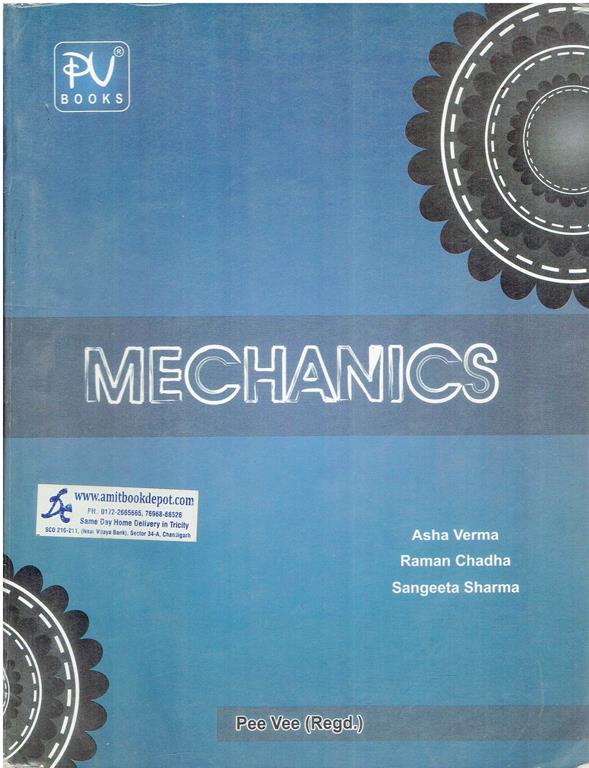
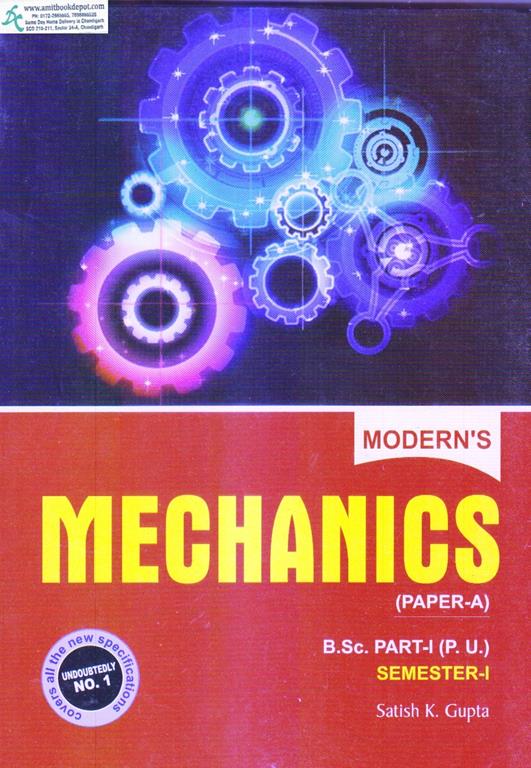
Yes, this book is meticulously crafted to cover all units and topics outlined in the latest Panjab University syllabus for BSc (General) First Year Mechanics.
Absolutely. These important applications of the Coriolis force in non-inertial frames are covered in detail in Chapter 4 (Frames of Reference).
The book logically progresses from Newtonian mechanics to the need for relativity, dedicating chapters to the Michelson-Morley Experiment (Chapter 7) and the Special Theory of Relativity (Chapter 8), ensuring a smooth conceptual transition.
Yes, Chapter 6 on Dynamics of Rigid Bodies provides a detailed discussion on rotational motion, principal axes, and Euler's equations of motion.
Yes, the section on collisions in Chapter 5 covers scattering cross-sections and includes a detailed analysis of Rutherford scattering.
The book is written in a clear, student-friendly manner with step-by-step derivations and diagrams, making challenging topics like relativity accessible for self-study.
Comprehensively. Chapter 5 on Collisions dedicates a section to analyzing elastic collisions, deriving relationships between velocities and angles in both reference frames.
Yes, it not only derives the Coriolis force mathematically but also explains its manifestations in weather patterns, ocean currents, and the Foucault pendulum.
Yes, Chapter 7 provides a detailed description of the experiment, including its setup, theory, the null result, and its historical significance, supported by diagrams.
The book includes a detailed syllabus breakdown at the beginning, mapping each university unit to the corresponding chapters for easy reference and structured study.
No Description Added
Yes, this book is meticulously crafted to cover all units and topics outlined in the latest Panjab University syllabus for BSc (General) First Year Mechanics.
Absolutely. These important applications of the Coriolis force in non-inertial frames are covered in detail in Chapter 4 (Frames of Reference).
The book logically progresses from Newtonian mechanics to the need for relativity, dedicating chapters to the Michelson-Morley Experiment (Chapter 7) and the Special Theory of Relativity (Chapter 8), ensuring a smooth conceptual transition.
Yes, Chapter 6 on Dynamics of Rigid Bodies provides a detailed discussion on rotational motion, principal axes, and Euler's equations of motion.
Yes, the section on collisions in Chapter 5 covers scattering cross-sections and includes a detailed analysis of Rutherford scattering.
The book is written in a clear, student-friendly manner with step-by-step derivations and diagrams, making challenging topics like relativity accessible for self-study.
Comprehensively. Chapter 5 on Collisions dedicates a section to analyzing elastic collisions, deriving relationships between velocities and angles in both reference frames.
Yes, it not only derives the Coriolis force mathematically but also explains its manifestations in weather patterns, ocean currents, and the Foucault pendulum.
Yes, Chapter 7 provides a detailed description of the experiment, including its setup, theory, the null result, and its historical significance, supported by diagrams.
The book includes a detailed syllabus breakdown at the beginning, mapping each university unit to the corresponding chapters for easy reference and structured study.