Categories
College Bookssss >
BA PU Chandigarh
BSC PU Chandigarh
MSC PU Chandigarh
BBA PU Chandigarh
MA PU Chandigarh
Medical Books
Engineering Books
Management Books
PGDCA Books
BCOM PU Chandigarh
MCOM PU Chandigarh
BCA PU Chandigarh
MCA PU Chandigarh
animate-books

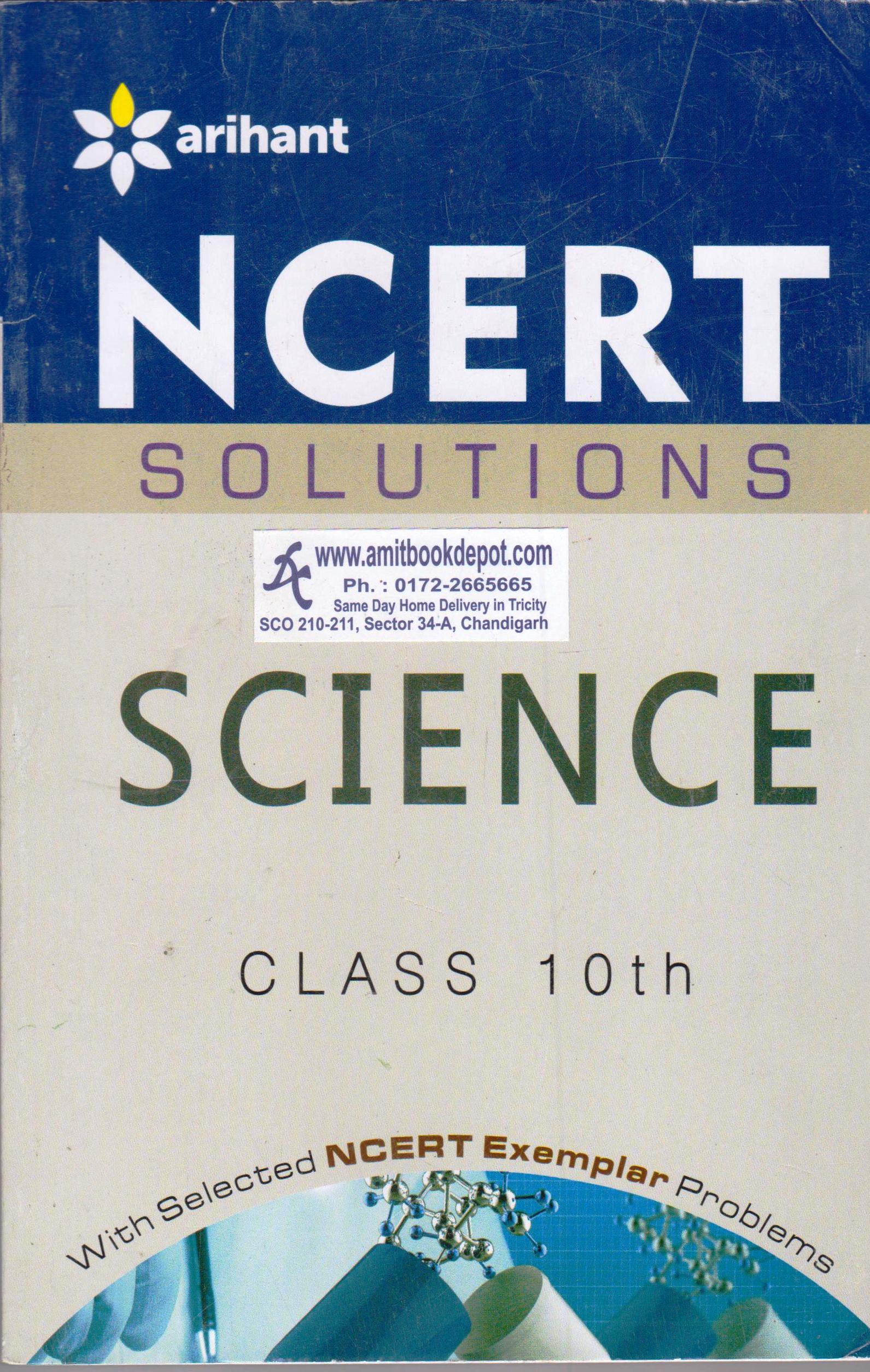
NCERT Solutions Science Class 10th

by Madhurima
₹180 ₹180.00(-/ off)

Rating & Reviews

23 Customer Review

NCERT Solutions Science Class 10 by Arihant Prakashan is the definitive guide for mastering the CBSE Class 10 Science syllabus. Covering Term I and Term II, this book provides clear, step-by-step solutions for all 16 chapters, from Chemical Reactions and Equations and Electricity to Heredity and Evolution and Our Environment. Designed by expert authors S. K. Singh, Dr Kanchan Upreti, and Geetika Khanna, it simplifies complex topics like the pH scale, Ohm’s law, metallurgical processes, and reproductive health. Perfect for exam preparation, it ensures a deep understanding of the NCERT curriculum, helping students build confidence and secure top marks.

Have Doubts Regarding This Product ? Ask Your Question

  • Q1
    Does this book cover both Term I and Term II syllabi?
    A1

    Yes, it is divided into two terms, covering all 16 chapters from the latest Class 10 Science curriculum.

  • Q2
    Are solutions provided for numerical problems in Physics?
    A2

    Yes, the book provides detailed solutions for numericals on Electricity, Ohm’s law, and Light reflection.

  • Q3
    Does it explain how to balance chemical equations?
    A3

    Yes, the first chapter on Chemical Reactions and Equations provides a thorough explanation of balancing chemical equations.

  • Q4
    Is the concept of the pH scale covered in detail?
    A4

    Yes, the Acids, Bases and Salts chapter explains the pH scale and its importance in everyday life.

  • Q5
    Does it cover the nomenclature of carbon compounds?
    A5

    Yes, the Carbon and Its Compounds chapter details the nomenclature for functional groups like alcohols and ketones.

  • Q6
    Are life processes like nutrition and respiration explained?
    A6

    Yes, the Life Processes chapter covers basic concepts of nutrition, respiration, transport, and excretion in detail.

  • Q7
    Does it cover the mirror formula and magnification?
    A7

    Yes, the Light: Reflection and Refraction chapter explains mirror formula, magnification, and spherical mirror applications.

  • Q8
    Does it differentiate between AC and DC current?
    A8

    Yes, the Magnetic Effects of Current chapter explains the difference between alternating current and direct current.

  • Q9
    Is the heating effect of electric current covered?
    A9

    Yes, the Electricity chapter covers the heating effect and its applications in daily life.

  • Q10
    Does this book discuss reproductive health and family planning?
    A10

    Yes, the Reproduction chapter covers reproductive health, family planning methods, and safe sex.

0.00

0 Overall Rating
  • 5
    0
  • 4
    0
  • 3
    0
  • 2
    0
  • 1
    0

Try this product & share your review & thoughts

TERM I

1. Chemical Reactions and Equations
2. Acids, Bases and Salts
3. Metals and Non-Metals
4. Life Processes
5. Control and Coordination
6. Electricity
7. Magnetic Effects of Electric Current
8. Sources of Energy

TERM II

9. Carbon and Its Compounds
10. Periodic Classification of Elements
11. How Do Organisms Reproduce?
12. Heredity and Evolution
13. Light: Reflection and Refraction
14. Human Eye and Colourful World
15. Management of Natural Resources
16. Our Environment

NCERT Science Textbook for Class 10


Unit I: Chemical Substances – Nature and Behaviour

Chapter 1: Chemical Reactions and Equations—Chemical Equation, Balanced Chemical Equation, implications of a balanced chemical equation, types of chemical reactions: combination, decomposition, displacement, double displacement, precipitation, endothermic and exothermic reactions, oxidation, and reduction

Chapter 2: Acids, Bases, and Salts—Their definitions in terms of furnishing of H⁺ and OH⁻ ions, general properties, examples and uses, neutralisation, concept of pH scale (definition relating to logarithm not required), importance of pH in everyday life; preparation and uses of sodium hydroxide, bleaching powder, Baking soda, washing soda, and plaster of Paris.

Chapter 3: Metals and Non-Metals—Properties of metals and non-metals; reactivity series; formation and properties of ionic compounds; basic metallurgical processes; corrosion and its prevention

Chapter 4: Carbon and its Compounds Covalent bonding in carbon compounds. Versatile nature of carbon. Homologous series. Nomenclature of carbon compounds containing functional groups (halogens, alcohol, ketones, aldehydes, alkanes, and alkynes, the difference between saturated hydrocarbons and unsaturated hydrocarbons. Chemical properties of carbon compounds (combustion, oxidation, addition, and substitution reaction). Ethanol and ethanoic acid (only properties and uses), soaps, and detergents.

Unit II: World of Living

Chapter 5: Life Processes—"Living Being". "Basic concepts of nutrition, respiration, transport, and excretion in plants and animals.

Chapter 6: Control and Coordination in Animals and Plants—Tropic Movements in Plants; Introduction of plant hormones; Control and coordination in animals: Nervous system: voluntary, involuntary, and reflex action; chemical coordination: animal hormones.

Ch-7: Reproduction—Reproduction in animals and plants (asexual and sexual); reproductive health—need and methods of family planning. Safe sex vs. HIV/AIDS. Childbearing and women’s health.

Ch-8: Heredity and Evolution—Heredity; Mendel’s Contribution—Laws for Inheritance of Traits: Sex determination: Brief introduction: (topics excluded—evolution, evolution and classification, and evolution should not be equated with progress).

Unit III: Natural Phenomenon

Chapter 9: Light—Reflection and Refraction Reflection of light by curved surfaces: images formed by spherical mirrors, centre of curvature, principal axis, principal focus, focal length, mirror formula (derivation not required), magnification, and application of spherical mirrors. 

Chapter 10: The Human Eye and the Colourful World
The functioning of a lens in the human eye, defects of vision, and their corrections, the refraction of light through a prism, dispersion of light, scattering of light, applications in daily life (excluding the colour of the sun at sunrise and sunset)…

Unit IV: Effects of Current

Chapter 11: Electricity—Electric current, potential difference, and electric current. Ohm’s law: Resistance, resistivity, and factors on which the resistance of a conductor depends. Series combination of resistors, parallel combination of resistors, and their applications in daily life. Heating effect of electric current and its applications in daily life. Electric power: interrelation between P, V, I, and R.

Chapter 12: Magnetic Effects of Current—Magnetic Field, Field Lines, Field Due to a Current-Carrying Conductor, Field Due to a Current-Carrying Coil or Solenoid, Force on a Current-Carrying Conductor, Fleming’s Left Hand Rule, Direct Current, Alternating Current, Frequency of AC, Advantage of AC over DC, and Domestic Electric Circuits.

Unit V: Natural Resources

Chapter 13: Our Environment—Ecosystem, Environmental Problems, Ozone Depletion, Waste Production, and Their Solutions. Biodegradable and non-biodegradable substances.

Master the fundamental concepts of science and excel in your board examinations with NCERT Solutions Science Class 10th from Arihant Prakashan. This comprehensive guide is meticulously designed to serve as the ultimate companion for students navigating the revised Class 10 Science syllabus. Authored by subject matter experts S. K. Singh, Dr Kanchan Upreti, and Geetika Khanna, this book provides a structured and clear approach to understanding the NCERT Science book, ensuring students are thoroughly prepared for their Term I and Term II examinations.

This edition stands out by offering a complete breakdown of the latest syllabus, covering all 16 chapters across the five key units: Chemical Substances, World of the Living, Natural Phenomena, Effects of Current, and Natural Resources. The book begins with Chemical Reactions and Equations, where students learn to balance chemical equations and identify types of reactions like displacement and oxidation. It then progresses to Acids, Bases and Salts, explaining the pH scale and the preparation of essential compounds like baking soda and Plaster of Paris. The detailed exploration of metals and non-metals covers the reactivity series, ionic compounds, and corrosion prevention, while carbon and its compounds demystify covalent bonding, homologous series, and the properties of ethanol and ethanoic acid.

In the Biology section, the book simplifies complex life processes such as nutrition, respiration, and excretion in Life Processes. It provides clarity on control and coordination, detailing both plant hormones and the animal nervous system, including reflex actions. The chapters on How Do Organisms Reproduce? and Heredity and Evolution cover crucial topics from asexual and sexual reproduction to Mendel’s laws of inheritance, emphasising reproductive health and family planning.

For the Physics curriculum, this guide offers step-by-step solutions for numerical and conceptual problems. The Electricity chapter thoroughly explains Ohm’s law, resistance, and the heating effect of electric current, while Magnetic Effects of Electric Current delves into magnetic fields, Fleming’s Left Hand Rule, and domestic electric circuits. The book also excels in explaining natural phenomena through chapters like Light: Reflection and Refraction, which covers mirror formula and magnification, and The Human Eye and the Colourful World, which discusses vision defects, prism refraction, and light scattering.

Finally, the text addresses environmental awareness with Management of Natural Resources and Our Environment, discussing ecosystems, ozone depletion, and biodegradable substances. Each chapter is structured to provide precise solutions to all NCERT book questions, making it an indispensable resource for practice and revision. By integrating keywords such as balanced chemical equation, pH scale, reactivity series, Ohm’s law, Mendel’s contributions, and domestic electric circuits, this guide ensures that students grasp the core terminology required for exams. With its syllabus-aligned content and clear explanations, NCERT Solutions Science Class 10th is the definitive tool for achieving academic success.

TERM I

1. Chemical Reactions and Equations
2. Acids, Bases and Salts
3. Metals and Non-Metals
4. Life Processes
5. Control and Coordination
6. Electricity
7. Magnetic Effects of Electric Current
8. Sources of Energy

TERM II

9. Carbon and Its Compounds
10. Periodic Classification of Elements
11. How Do Organisms Reproduce?
12. Heredity and Evolution
13. Light: Reflection and Refraction
14. Human Eye and Colourful World
15. Management of Natural Resources
16. Our Environment

Have Doubts Regarding This Product ? Ask Your Question

  • Q1
    Does this book cover both Term I and Term II syllabi?
    A1

    Yes, it is divided into two terms, covering all 16 chapters from the latest Class 10 Science curriculum.

  • Q2
    Are solutions provided for numerical problems in Physics?
    A2

    Yes, the book provides detailed solutions for numericals on Electricity, Ohm’s law, and Light reflection.

  • Q3
    Does it explain how to balance chemical equations?
    A3

    Yes, the first chapter on Chemical Reactions and Equations provides a thorough explanation of balancing chemical equations.

  • Q4
    Is the concept of the pH scale covered in detail?
    A4

    Yes, the Acids, Bases and Salts chapter explains the pH scale and its importance in everyday life.

  • Q5
    Does it cover the nomenclature of carbon compounds?
    A5

    Yes, the Carbon and Its Compounds chapter details the nomenclature for functional groups like alcohols and ketones.

  • Q6
    Are life processes like nutrition and respiration explained?
    A6

    Yes, the Life Processes chapter covers basic concepts of nutrition, respiration, transport, and excretion in detail.

  • Q7
    Does it cover the mirror formula and magnification?
    A7

    Yes, the Light: Reflection and Refraction chapter explains mirror formula, magnification, and spherical mirror applications.

  • Q8
    Does it differentiate between AC and DC current?
    A8

    Yes, the Magnetic Effects of Current chapter explains the difference between alternating current and direct current.

  • Q9
    Is the heating effect of electric current covered?
    A9

    Yes, the Electricity chapter covers the heating effect and its applications in daily life.

  • Q10
    Does this book discuss reproductive health and family planning?
    A10

    Yes, the Reproduction chapter covers reproductive health, family planning methods, and safe sex.

NCERT Science Textbook for Class 10


Unit I: Chemical Substances – Nature and Behaviour

Chapter 1: Chemical Reactions and Equations—Chemical Equation, Balanced Chemical Equation, implications of a balanced chemical equation, types of chemical reactions: combination, decomposition, displacement, double displacement, precipitation, endothermic and exothermic reactions, oxidation, and reduction

Chapter 2: Acids, Bases, and Salts—Their definitions in terms of furnishing of H⁺ and OH⁻ ions, general properties, examples and uses, neutralisation, concept of pH scale (definition relating to logarithm not required), importance of pH in everyday life; preparation and uses of sodium hydroxide, bleaching powder, Baking soda, washing soda, and plaster of Paris.

Chapter 3: Metals and Non-Metals—Properties of metals and non-metals; reactivity series; formation and properties of ionic compounds; basic metallurgical processes; corrosion and its prevention

Chapter 4: Carbon and its Compounds Covalent bonding in carbon compounds. Versatile nature of carbon. Homologous series. Nomenclature of carbon compounds containing functional groups (halogens, alcohol, ketones, aldehydes, alkanes, and alkynes, the difference between saturated hydrocarbons and unsaturated hydrocarbons. Chemical properties of carbon compounds (combustion, oxidation, addition, and substitution reaction). Ethanol and ethanoic acid (only properties and uses), soaps, and detergents.

Unit II: World of Living

Chapter 5: Life Processes—"Living Being". "Basic concepts of nutrition, respiration, transport, and excretion in plants and animals.

Chapter 6: Control and Coordination in Animals and Plants—Tropic Movements in Plants; Introduction of plant hormones; Control and coordination in animals: Nervous system: voluntary, involuntary, and reflex action; chemical coordination: animal hormones.

Ch-7: Reproduction—Reproduction in animals and plants (asexual and sexual); reproductive health—need and methods of family planning. Safe sex vs. HIV/AIDS. Childbearing and women’s health.

Ch-8: Heredity and Evolution—Heredity; Mendel’s Contribution—Laws for Inheritance of Traits: Sex determination: Brief introduction: (topics excluded—evolution, evolution and classification, and evolution should not be equated with progress).

Unit III: Natural Phenomenon

Chapter 9: Light—Reflection and Refraction Reflection of light by curved surfaces: images formed by spherical mirrors, centre of curvature, principal axis, principal focus, focal length, mirror formula (derivation not required), magnification, and application of spherical mirrors. 

Chapter 10: The Human Eye and the Colourful World
The functioning of a lens in the human eye, defects of vision, and their corrections, the refraction of light through a prism, dispersion of light, scattering of light, applications in daily life (excluding the colour of the sun at sunrise and sunset)…

Unit IV: Effects of Current

Chapter 11: Electricity—Electric current, potential difference, and electric current. Ohm’s law: Resistance, resistivity, and factors on which the resistance of a conductor depends. Series combination of resistors, parallel combination of resistors, and their applications in daily life. Heating effect of electric current and its applications in daily life. Electric power: interrelation between P, V, I, and R.

Chapter 12: Magnetic Effects of Current—Magnetic Field, Field Lines, Field Due to a Current-Carrying Conductor, Field Due to a Current-Carrying Coil or Solenoid, Force on a Current-Carrying Conductor, Fleming’s Left Hand Rule, Direct Current, Alternating Current, Frequency of AC, Advantage of AC over DC, and Domestic Electric Circuits.

Unit V: Natural Resources

Chapter 13: Our Environment—Ecosystem, Environmental Problems, Ozone Depletion, Waste Production, and Their Solutions. Biodegradable and non-biodegradable substances.
0.00

0 Overall Rating
  • 5
    0
  • 4
    0
  • 3
    0
  • 2
    0
  • 1
    0

Try this product & share your review & thoughts

Top Trending Product

Related Product

Related Product

Related Blog Posts

Latest Blogs

Latest Blogs

blog-img
Classic Literature Reimagined: Discuss modern twists on classic novels.
Lorem ipsum dolor sit amet, consectetur adipiscing elit, sed do eiusmod tempor incididunt ut labore et dolore magna aliqua. Ut enim ad minim veniam, quis nostrud exercitation ullamco Lorem ipsum dolor sit amet, consectetur adipiscing elit, sed do eiusmod tempor incididunt ut labore et dolore magna aliqua. Utenim ad minim veniam, quis nostrud exercitation ullamco Lorem ipsum dolor sit amet, consecte...
Read more
Author name | 10 jan, 2025
blog-img
Classic Literature Reimagined: Discuss modern twists on classic novels.
Lorem ipsum dolor sit amet, consectetur adipiscing elit, sed do eiusmod tempor incididunt ut labore et dolore magna aliqua. Ut enim ad minim veniam, quis nostrud exercitation ullamco Lorem ipsum dolor sit amet, consectetur adipiscing elit, sed do eiusmod tempor incididunt ut labore et dolore magna aliqua. Utenim ad minim veniam, quis nostrud exercitation ullamco Lorem ipsum dolor sit amet, consecte...
Read more
Author name | 10 jan, 2025
blog-img
Classic Literature Reimagined: Discuss modern twists on classic novels.
Lorem ipsum dolor sit amet, consectetur adipiscing elit, sed do eiusmod tempor incididunt ut labore et dolore magna aliqua. Ut enim ad minim veniam, quis nostrud exercitation ullamco Lorem ipsum dolor sit amet, consectetur adipiscing elit, sed do eiusmod tempor incididunt ut labore et dolore magna aliqua. Utenim ad minim veniam, quis nostrud exercitation ullamco Lorem ipsum dolor sit amet, consecte...
Read more
Author name | 10 jan, 2025
blog-img
Classic Literature Reimagined: Discuss modern twists on classic novels.
Lorem ipsum dolor sit amet, consectetur adipiscing elit...
Read more
Author Name | 10 Jan, 2025
blog-img
Classic Literature Reimagined: Discuss modern twists on classic novels.
Lorem ipsum dolor sit amet, consectetur adipiscing elit...
Read more
Author Name | 10 Jan, 2025
blog-img
Classic Literature Reimagined: Discuss modern twists on classic novels.
Lorem ipsum dolor sit amet, consectetur adipiscing elit...
Read more
Author Name | 10 Jan, 2025
blog-img
Classic Literature Reimagined: Discuss modern twists on classic novels.
Lorem ipsum dolor sit amet, consectetur adipiscing elit...
Read more
Author Name | 10 Jan, 2025
blog-img
Classic Literature Reimagined: Discuss modern twists on classic novels.
Lorem ipsum dolor sit amet, consectetur adipiscing elit...
Read more
Author Name | 10 Jan, 2025
blog-img
Classic Literature Reimagined: Discuss modern twists on classic novels.
Lorem ipsum dolor sit amet, consectetur adipiscing elit...
Read more
Author Name | 10 Jan, 2025
blog-img
Classic Literature Reimagined: Discuss modern twists on classic novels.
Lorem ipsum dolor sit amet, consectetur adipiscing elit...
Read more
Author Name | 10 Jan, 2025
blog-img
Classic Literature Reimagined: Discuss modern twists on classic novels.
Lorem ipsum dolor sit amet, consectetur adipiscing elit...
Read more
Author Name | 10 Jan, 2025
blog-img
Classic Literature Reimagined: Discuss modern twists on classic novels.
Lorem ipsum dolor sit amet, consectetur adipiscing elit...
Read more
Author Name | 10 Jan, 2025