-
Mon-Fri: 10AM to 8PM 01722665665
-
My Account
-
-
0
Total :
₹ 0.00

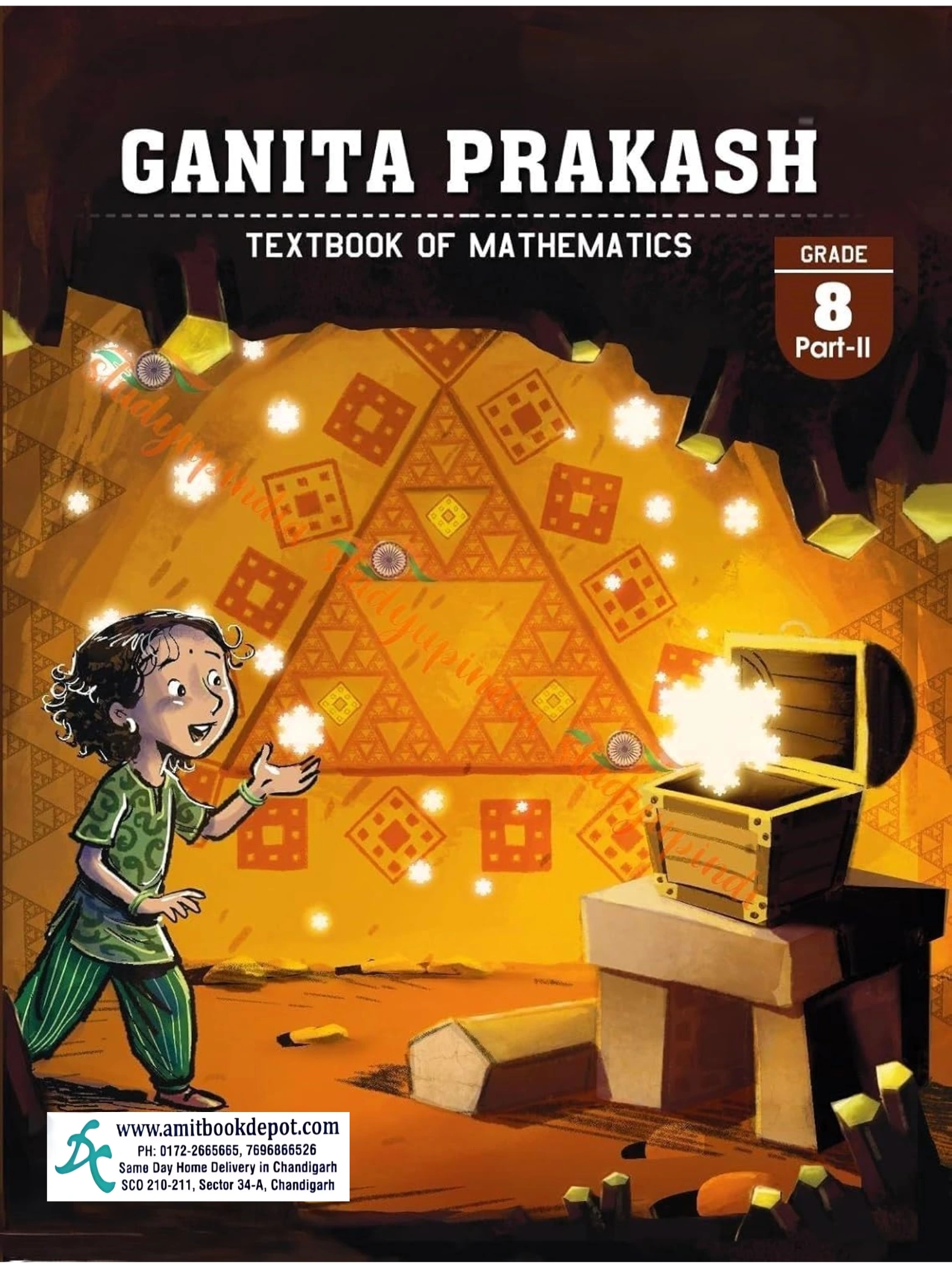





To make learning mathematics a journey of discovery through storytelling, hands-on activities, and real-life connections, rather than rote memorization .
It highlights ancient texts like the Baudhāyana Sulba Sutra and Kautilya's Arthashastra, showcasing India's historical contributions to geometry and arithmetic .
In Chapter 1, "Fractions in Disguise," which traces the concept of 'per hundred' back to the 4th century BC .
It focuses on the fundamental relationship between the sides of a right-angled triangle, as documented in Baudhāyana's ancient Sulba Sutra .
Yes, Chapter 4, "Exploring Some Geometric Themes," introduces self-similarity and fractals using examples like fern leaves and the Sierpinski Carpet .
It uses a playful, interactive approach with patterns and puzzles to help students understand variables and algebraic logic .
These exercises are placed within the lesson to encourage immediate application of concepts and promote active participation .
Yes, it is published by NCERT and is fully aligned with the new syllabus and the National Education Policy (NEP) 2020 .
While Part-II focuses on other areas, the series uses concepts like exponential notation and scientific notation to simplify large numbers .
It covers the same geometric principle but emphasizes its origins and expression in ancient Indian Vedic texts .
No Description Added
To make learning mathematics a journey of discovery through storytelling, hands-on activities, and real-life connections, rather than rote memorization .
It highlights ancient texts like the Baudhāyana Sulba Sutra and Kautilya's Arthashastra, showcasing India's historical contributions to geometry and arithmetic .
In Chapter 1, "Fractions in Disguise," which traces the concept of 'per hundred' back to the 4th century BC .
It focuses on the fundamental relationship between the sides of a right-angled triangle, as documented in Baudhāyana's ancient Sulba Sutra .
Yes, Chapter 4, "Exploring Some Geometric Themes," introduces self-similarity and fractals using examples like fern leaves and the Sierpinski Carpet .
It uses a playful, interactive approach with patterns and puzzles to help students understand variables and algebraic logic .
These exercises are placed within the lesson to encourage immediate application of concepts and promote active participation .
Yes, it is published by NCERT and is fully aligned with the new syllabus and the National Education Policy (NEP) 2020 .
While Part-II focuses on other areas, the series uses concepts like exponential notation and scientific notation to simplify large numbers .
It covers the same geometric principle but emphasizes its origins and expression in ancient Indian Vedic texts .