-
Mon-Fri: 10AM to 8PM 01722665665
-
My Account
-
-
0
Total :
₹ 0.00

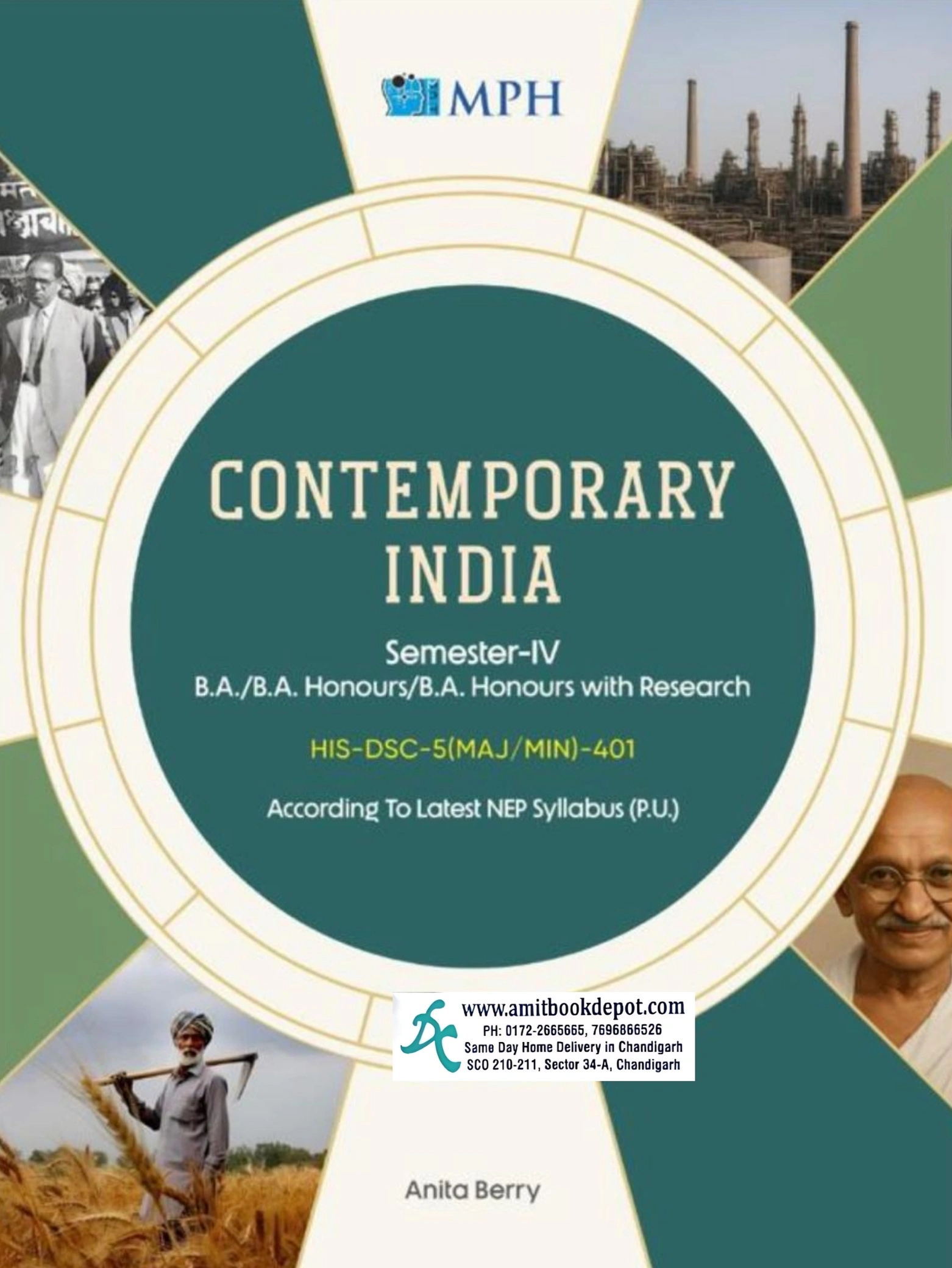
Yes, it is meticulously crafted to cover the entire latest syllabus for HIS-CI-302: Contemporary India as prescribed by Panjab University, Chandigarh, under the New Education Policy.
It covers the Green Revolution in depth, with a special reference to Punjab, providing crucial regional context that is highly relevant for Panjab University students.
Yes, the book is divided into clear chapters that cover all four units: Ideological Streams, Economic Planning & Growth, States Reorganization & Social Reform, and Regional Assertions.
Yes, the detailed content serves as an excellent resource for preparing written assignments, participating in tutorials, and writing term papers, which form part of the 20-mark internal assessment.
Yes, it covers the complete theory syllabus required for the 80-mark terminal examination. As a reappear candidate, your theory marks will be scaled proportionally in lieu of internal assessment.
Yes, Industrial Growth and the Liberalization of the Economy are covered in detail as part of Unit-II on economic development.
Yes, Unit-I provides dedicated analysis of the main ideological streams, including separate coverage of Swami Vivekananda, Mahatma Gandhi, Jawaharlal Nehru, and Dr. B. R. Ambedkar.
While maintaining academic rigor, the book presents complex historical events and concepts in a clear, accessible, and well-structured manner suitable for undergraduate students.
The book provides a thorough historical analysis of the Linguistic Division of States and subsequent reorganization, along with modern social reforms concerning feminism, anti-caste actions, and tribals.
Yes, its content is directly structured to help students understand major ideas at independence, economic planning, linguistic issues, and regional assertions—the key course outcomes listed in the syllabus.
No Description Added
Yes, it is meticulously crafted to cover the entire latest syllabus for HIS-CI-302: Contemporary India as prescribed by Panjab University, Chandigarh, under the New Education Policy.
It covers the Green Revolution in depth, with a special reference to Punjab, providing crucial regional context that is highly relevant for Panjab University students.
Yes, the book is divided into clear chapters that cover all four units: Ideological Streams, Economic Planning & Growth, States Reorganization & Social Reform, and Regional Assertions.
Yes, the detailed content serves as an excellent resource for preparing written assignments, participating in tutorials, and writing term papers, which form part of the 20-mark internal assessment.
Yes, it covers the complete theory syllabus required for the 80-mark terminal examination. As a reappear candidate, your theory marks will be scaled proportionally in lieu of internal assessment.
Yes, Industrial Growth and the Liberalization of the Economy are covered in detail as part of Unit-II on economic development.
Yes, Unit-I provides dedicated analysis of the main ideological streams, including separate coverage of Swami Vivekananda, Mahatma Gandhi, Jawaharlal Nehru, and Dr. B. R. Ambedkar.
While maintaining academic rigor, the book presents complex historical events and concepts in a clear, accessible, and well-structured manner suitable for undergraduate students.
The book provides a thorough historical analysis of the Linguistic Division of States and subsequent reorganization, along with modern social reforms concerning feminism, anti-caste actions, and tribals.
Yes, its content is directly structured to help students understand major ideas at independence, economic planning, linguistic issues, and regional assertions—the key course outcomes listed in the syllabus.