-
Mon-Fri: 10AM to 8PM 01722665665
-
My Account
-
-
0
Total :
₹ 0.00

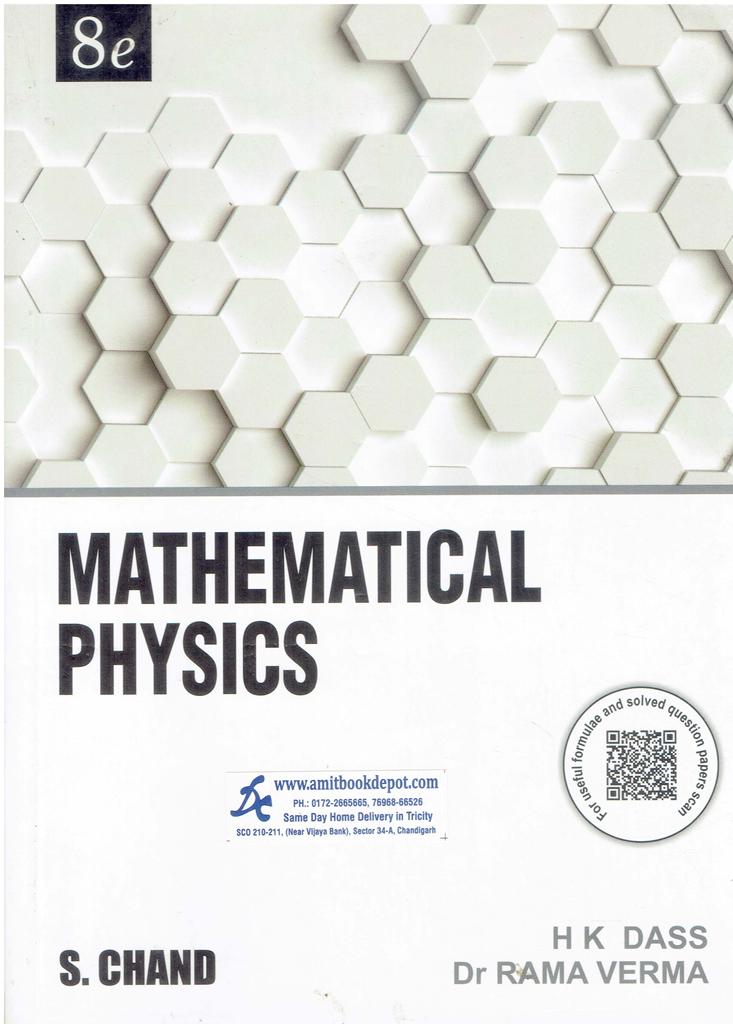
The 8th Edition of Mathematical Physics by H. K. Dass & Dr. Rama Verma from S. Chand Publishing is a complete book for vector calculus, differential equations, complex variables, linear algebra, and special functions. Ideal for B.Sc. Physics, B.E./B.Tech, and M.Sc. students, this mathematical methods guide covers gradient, divergence, curl, Fourier series, Legendre/Bessel functions, Laplace transforms, partial differential equations, and tensor analysis. With 49 chapters, solved examples, and physical applications, it is an essential physics reference book for mastering applied mathematics and engineering mathematics concepts for university exams and competitive tests.

Yes. Unit III includes complex integration with Cauchy’s integral theorem, Cauchy’s integral formula, and derivatives of analytic functions for problem-solving.
Yes. Chapter 4 covers orthogonal curvilinear coordinates, essential for understanding gradient, divergence, and curl in non-Cartesian systems like spherical and cylindrical coordinates.
Chapter 28-31 cover Legendre’s, Bessel’s, Hermite, and Laguerre functions with series solutions of second-order differential equations.
Yes. Chapters 46-47 cover Laplace and inverse Laplace transforms explicitly for solving differential equations, including the Dirac-Delta function.
Yes. Unit IV covers abstract vector spaces, linear transformations, null space, row space, column space, inner products, eigenvalues, and Cayley-Hamilton theorem.
Yes. Chapter 18 covers calculus of variation, including maxima/minima of two-variable functions, important for Lagrangian mechanics.
Yes. Chapters 5-8 cover double and triple integrals applied to area, center of gravity, mass, and volume calculation.
Yes. Chapter 27 details series solutions of second-order differential equations as a foundation for Legendre and Bessel functions.
Yes. Chapter 43 covers linear and non-linear PDEs with constant coefficients of 2nd order, plus applications in Chapter 44.
Yes. Chapter 23 explains conformal transformation as part of complex variable theory, useful for electrostatics and fluid flow.
Yes. Unit III includes complex integration with Cauchy’s integral theorem, Cauchy’s integral formula, and derivatives of analytic functions for problem-solving.
Yes. Chapter 4 covers orthogonal curvilinear coordinates, essential for understanding gradient, divergence, and curl in non-Cartesian systems like spherical and cylindrical coordinates.
Chapter 28-31 cover Legendre’s, Bessel’s, Hermite, and Laguerre functions with series solutions of second-order differential equations.
Yes. Chapters 46-47 cover Laplace and inverse Laplace transforms explicitly for solving differential equations, including the Dirac-Delta function.
Yes. Unit IV covers abstract vector spaces, linear transformations, null space, row space, column space, inner products, eigenvalues, and Cayley-Hamilton theorem.
Yes. Chapter 18 covers calculus of variation, including maxima/minima of two-variable functions, important for Lagrangian mechanics.
Yes. Chapters 5-8 cover double and triple integrals applied to area, center of gravity, mass, and volume calculation.
Yes. Chapter 27 details series solutions of second-order differential equations as a foundation for Legendre and Bessel functions.
Yes. Chapter 43 covers linear and non-linear PDEs with constant coefficients of 2nd order, plus applications in Chapter 44.
Yes. Chapter 23 explains conformal transformation as part of complex variable theory, useful for electrostatics and fluid flow.