Categories
College Bookssss >
BA PU Chandigarh
BSC PU Chandigarh
MSC PU Chandigarh
BBA PU Chandigarh
MA PU Chandigarh
Medical Books
Engineering Books
Management Books
PGDCA Books
BCOM PU Chandigarh
MCOM PU Chandigarh
BCA PU Chandigarh
MCA PU Chandigarh
animate-books

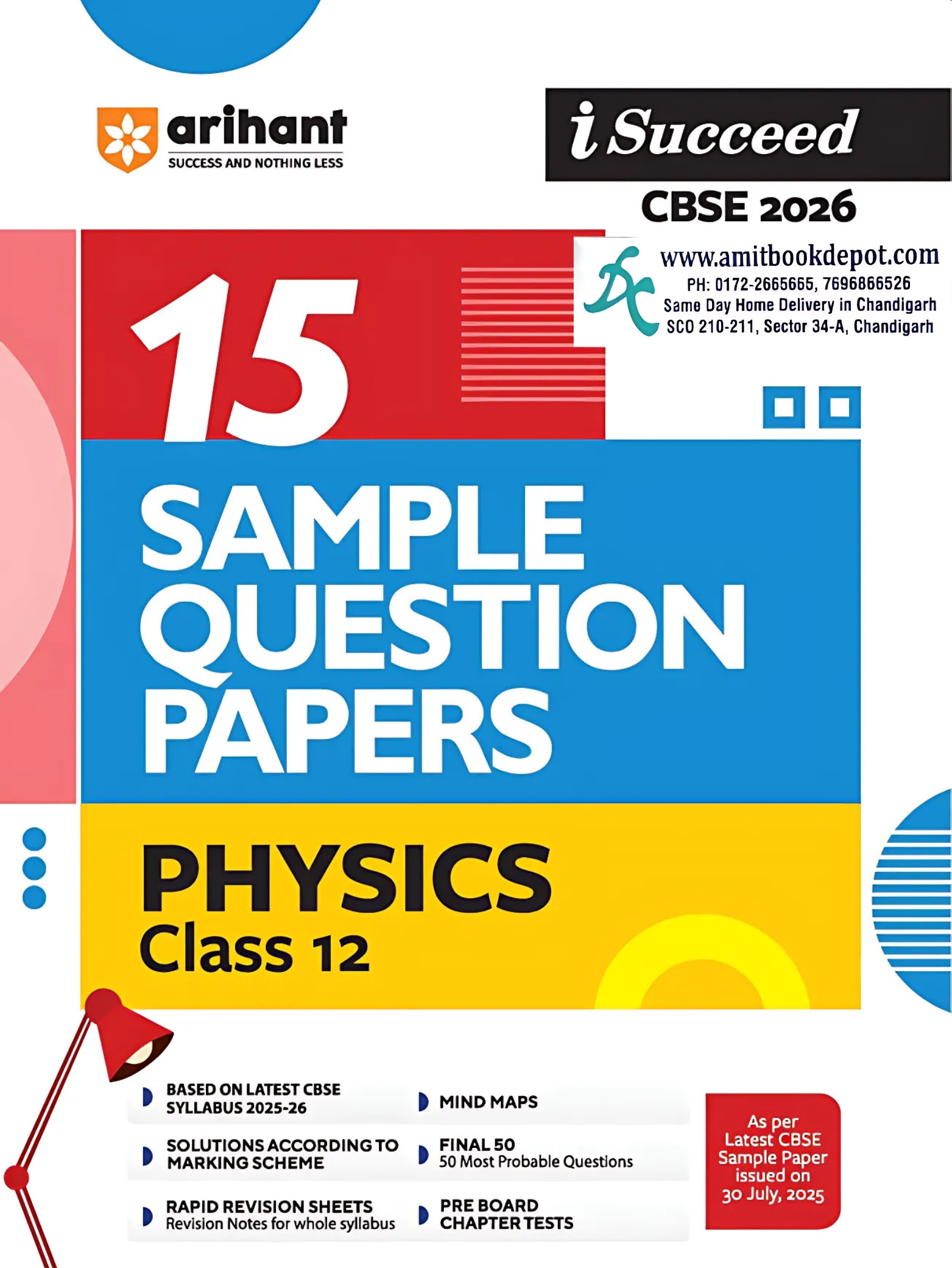
iSucceed 15 Sample Question Papers Physics for Class 12th

by Madhurima
โ‚น275 โ‚น275.00(-/ off)

Rating & Reviews

23 Customer Review

Ace your CBSE Class 12 Physics Board Exam with iSucceed 15 Sample Question Papers by Arihant Prakashan. This essential resource provides 15 fully solved sample papers designed as per the latest CBSE pattern and syllabus. Covering all unitsโ€”from electrostatics and current electricity to optics, dual nature of radiation, and semiconductor electronicsโ€”it ensures complete preparation. Includes a detailed chapter-wise syllabus for smart revision. Ideal for self-assessment, time management, and building exam confidence. The perfect tool for rigorous practice to secure maximum marks in the 2024-2025 Class 12 Physics exam.
Have Doubts Regarding This Product ? Ask Your Question

  • Q1
    Is this book based on the latest CBSE syllabus and exam pattern for the 2024-2025 academic session?
    A1

    Yes, the iSucceed Physics sample papers are meticulously crafted to align with the most recent CBSE Class 12 Physics syllabus, blueprint, and question paper design for the 2024-2025 board exams.

  • Q2
    Does the book provide solutions for all 15 sample papers?
    A2

    Absolutely. All 15 sample question papers come with detailed, step-by-step solutions to help you understand the methodology and presentation required for scoring full marks.

  • Q3
    Are numerical problems from chapters like Current Electricity and Optics adequately covered?
    A3

    Yes, the sample papers include a wide variety of numerical problems as per the CBSE emphasis, covering crucial chapters like Current Electricity (Kirchhoffโ€™s rules), Ray Optics (lens formula), and Alternating Current (LCR circuits).

  • Q4
    Is the derivation-heavy portion of the syllabus, such as from Electrostatics and Magnetism, well-represented?
    A4

    The papers include questions on important derivations and conceptual applications from units like Electrostatics (Gauss's law) and Moving Charges & Magnetism (Biot-Savart law), as per the board's scope.

  • Q5
    Can this book help me prepare for competitive exams like NEET or JEE alongside my boards?
    A5

    This book is primarily focused on the CBSE board exam pattern. While practicing these papers will strengthen your core Physics concepts, for competitive exams like NEET/JEE, you would require additional resources focused on their specific pattern and depth.

  • Q6
    Are diagrams, such as those for electric field lines, circuit diagrams, or ray diagrams, required to be drawn in the solutions?
    A6

    Yes, the solved papers include necessary diagrams where applicable (e.g., for Huygens' principle, electric dipoles, p-n junctions), demonstrating the expected presentation style for the board exam.

  • Q7
    Does it cover the practical syllabus or viva-based questions?
    A7

    This book focuses on the theoretical question papers. It does not cover the practical exam or viva voce section. You will need a separate lab manual for practical preparation.

  • Q8
    Is the language and difficulty level of the questions similar to what CBSE sets?
    A8

    The language, phrasing, and difficulty level of the questions are carefully designed to closely resemble the standard of the actual CBSE board examination papers.

  • Q9
    Is the semiconductor electronics chapter, which is both theoretical and application-based, covered properly?
    A9

    Yes, Unit IX on Semiconductor Electronics is well-covered with questions on energy bands, p-n junctions, diode characteristics, and rectifier applications, reflecting the board's focus.

  • Q10
    How does this book help in improving my answer writing speed?
    A10

    By repeatedly practicing complete 3-hour papers within the set time limit, you train yourself to allocate time wisely, think faster, and write answers concisely, thereby significantly improving your speed and accuracy.


0.00

0 Overall Rating
  • 5
    0
  • 4
    0
  • 3
    0
  • 2
    0
  • 1
    0

Try this product & share your review & thoughts

1. Electric Charges and Fields
2. Electrostatic Potential and Capacitance
3. Current Electricity
4. Moving Charges and Magnetism
5. Magnetism and Matter
6. Electromagnetic Induction
7. Alternating Current
8. Electromagnetic Waves 
9. Ray Optics and Optical Instruments
10. Wave Optics
11. Dual Nature of Radiation and Matter
12. Atoms
13. Nuclei
14. Semiconductor Electronics: Materials, Devices, and Simple Circuits

Latest CBSE Syllabus of Physics For Class 12th


Unit I: Electrostatics, 26 Periods
Chapter 1: Electric Charges and Fields
Electric charges, conservation of charge, Coulomb's law (force between two-point charges), forces between multiple charges, the superposition principle, and continuous charge distribution.
Electric field, electric field due to a point charge, electric field lines, electric dipole, electric field due to a dipole, torque on a dipole in a uniform electric field.
Electric flux, statement of Gauss's theorem, and its applications to find the field due to an infinitely long straight wire, uniformly charged infinite plane sheet, and uniformly charged thin spherical shell (field inside and outside).

Chapter 2: Electrostatic Potential and Capacitance
Electric potential, potential difference, electric potential due to a point charge, a dipole, and a system of charges; equipotential surfaces; electrical potential energy of a system of two-point charges and of an electric dipole in an electrostatic field.
Conductors and insulators, free charges, and bound charges inside a conductor. Dielectrics and electric polarization, capacitors and capacitance, combination of capacitors in series and in parallel, capacitance of a parallel plate capacitor with and without dielectric medium between the plates, energy stored in a capacitor (no derivation, formulae only).

Unit II: Current Electricity, 18 Periods
Chapter 3: Current Electricity
Electric current, the flow of electric charges in a metallic conductor, drift velocity, mobility, and their relation with electric current; Ohm's law, V-I characteristics (linear and non-linear), electrical energy and power, electrical resistivity and conductivity, temperature dependence of resistance, Internal resistance of a cell, potential difference and EMF of a cell, combination of cells in series and in parallel, Kirchhoff's rules, Wheatstone bridge.

Unit III: Magnetic Effects of Current and Magnetism, 25 Periods
Chapter 4: Moving Charges and Magnetism Concept of magnetic field, Oersted's experiment. Biot-Savart law and its application to a current-carrying circular loop. Ampere's law and its applications to infinitely long straight wire. Straight solenoid (only qualitative treatment), force on a moving charge in uniform magnetic and electric fields.
Force on a current-carrying conductor in a uniform magnetic field, force between two parallel current-carrying conductorsโ€”definition of ampere, torque experienced by a current loop in a uniform magnetic field; Current loop as a magnetic dipole and its magnetic dipole moment, moving coil galvanometerโ€”its current sensitivity and conversion to ammeter and voltmeter.

Chapter 5: Magnetism and Matter
Bar magnet, bar magnet as an equivalent solenoid (qualitative treatment only), magnetic field intensity due to a magnetic dipole (bar magnet) along its axis and perpendicular to its axis (qualitative treatment only), torque on a magnetic dipole (bar magnet) in a uniform magnetic field (qualitative treatment only), magnetic field lines.
Magnetic properties of materials: para-, dia-, and ferromagnetic substances with examples. Magnetization of materials, effect of temperature on magnetic properties.

Unit IV: Electromagnetic Induction and Alternating Currents, 24 Periods
Chapter 6: Electromagnetic Induction
Electromagnetic induction; Faraday's laws, induced EMF and current; Lenz's law, self-induction, and mutual induction.

Chapter 7: Alternating Current 
Alternating currents, peak and RMS value of alternating current/voltage; reactance and impedance; LCR series circuit (phasors only), resonance, power in AC circuits, power factor, wattless current.
AC generator, transformer.

Unit V: Electromagnetic Waves, 04 Periods
Chapter 8: Electromagnetic Waves
Basic idea of displacement current Electromagnetic waves, their characteristics, and their transverse nature (qualitative idea only). Electromagnetic spectrum (radio waves, microwaves, infrared, visible, ultraviolet, X-rays, gamma rays), including elementary facts about their uses.

Unit VI: Optics, 30 Periods
Chapter 9: Ray Optics and Optical Instruments
Ray Optics: Reflection of light, spherical mirrors, mirror formula, refraction of light, total internal reflection and optical fibers, refraction at spherical surfaces, lenses, thin lens formula, lens makerโ€™s formula, magnification, power of a lens, combination of thin lenses in contact, and refraction of light through a prism.
Optical instruments: Microscopes and astronomical telescopes (reflecting and refracting) and their magnifying powers.

Chapter 10: Wave Optics
Wave optics: Wavefront and Huygens principle, reflection and refraction of plane waves at a plane surface using wavefronts. Proof of laws of reflection and refraction using Huygens principle. Interference, Young's double-slit experiment, and expression for fringe width (no derivation, final expression only); coherent sources and sustained interference of light; diffraction due to a single slit; and width of central maxima (qualitative treatment only).

Unit VII: Dual Nature of Radiation and Matter, 08 Periods
Chapter 11: Dual Nature of Radiation and Matter
Dual nature of radiation, photoelectric effect, Hertz and Lenard's observations, and Einstein's photoelectric equationโ€”particle nature of light.
Experimental study of the photoelectric effect Matter waves: wave nature of particles, de Broglie relation.

Unit VIII: Atoms and Nuclei 15 Periods
Chapter 12: Atoms
Alpha-particle scattering experiment; Rutherford's model of the atom; Bohr model of the hydrogen atom; expression for the radius of the nth possible orbit; velocity and energy of the electron in the nth orbit; hydrogen line spectra (qualitative). treatment only).

Chapter 13: Nuclei
Composition and size of nucleus, nuclear force Mass-energy relation, mass defect, binding energy per nucleon and its variation with mass number, nuclear fission, and nuclear fusion.

Unit IX: Electronic Devices, 10 Periods
Chapter 14: Semiconductor Electronics: Materials, Devices, and Simple Circuits
Energy bands in conductors, semiconductors, and insulators (qualitative ideas only) Intrinsic and extrinsic semiconductorsโ€”p and n type, p-n junction Semiconductor diodeโ€”IV characteristics in forward and reverse bias, application of junction diode-diode as a rectifier.

Master the CBSE Class 12 Physics Board Exam with iSucceedโ€™s 15 Sample Question Papers by Arihant Prakashan.

Arihant Prakashanโ€™s iSucceed 15 Sample Question Papers for Class 12 Physics is a definitive and strategic resource engineered for students aiming to achieve excellence in their CBSE Board Examinations. This book is meticulously structured to transform preparation into performance, providing a comprehensive and exam-centric practice platform. It is not merely a collection of questions but an integrated learning system designed to build confidence, enhance speed, and solidify conceptual understanding across the entire CBSE Class 12 Physics Syllabus.

Exhaustive Coverage and Strict Syllabus Adherence

This guide is constructed in strict alignment with the latest CBSE Class 12 Physics curriculum. It encompasses all critical units and chapters prescribed by the board, ensuring no topic is left unaddressed. The content spans from electrostatics (electric charges and fields, electrostatic potential, and capacitance) and current electricity to the complexities of magnetic effects of current and magnetism (moving charges and magnetism, magnetism and matter). It further delves into electromagnetic induction and alternating currents, electromagnetic waves, optics (ray optics and optical instruments, wave optics), the dual nature of radiation and matter, atoms and nuclei, and semiconductor electronics. This exhaustive coverage guarantees that students are thoroughly prepared for every potential question in the 2024-2025 Board Exam.

Core Feature: 15 Sample Question Papers for Rigorous Practice

The heart of this book lies in its 15 fully solved sample question papers. These papers are crafted to mirror the exact pattern, marking scheme, difficulty level, and typology of questions as mandated by the CBSE. Engaging with these papers enables students to:

1. Simulate the Real Exam Environment: Practice under timed conditions to manage time effectively and reduce exam-day anxiety.
2. Understand Question Trends: Identify frequently asked questions, important formulas, and recurring concepts from each chapter.
3. Develop Analytical Skills: Learn to approach different types of questionsโ€”be they case-based, MCQs, short answer, or long answer questions.
4. Self-Assess and Revise: Each solved paper acts as a revision module, helping consolidate learning and identify areas requiring more focus.

Beyond Papers: Chapter-wise Syllabus and Conceptual Clarity

Prior to the sample papers, the book provides a detailed, chapter-wise CBSE Physics Syllabus breakdown. This section serves as a crucial checklist, allowing students to plan their revision systematically. It outlines the scope of each chapter, such as Gauss's Theorem applications in Electrostatics, Kirchhoff's rules in Current Electricity, Biot-Savart and Ampere's Law in Magnetism, Huygens Principle in Wave Optics, and Einstein's Photoelectric Equation in Dual Nature of Matter. This ensures students are aware of the depth of knowledge required for each topic, aligning their preparation with board expectations.

Ideal for Systematic Revision and Performance Maximization

This book is an indispensable tool for the crucial revision phase in the months and weeks leading up to the board exam. It transitions learning from theory to application. By progressively solving the sample papers, students can track their improvement, strengthen weak areas, and build unshakable confidence. The solutions are presented in a clear, step-by-step manner, aiding in understanding the ideal approach to writing precise, well-structured, and high-scoring answers.

Why Choose iSucceed 15 Sample Question Papers for CBSE Class 12 Physics?

1. Exam Blueprint Aligned: Strictly follows the latest CBSE sample paper design and curriculum.
2. Ample Practice Material: 15 sample papers offer extensive practice to master problem-solving.
3. Syllabus at a Glance: Easy-to-navigate syllabus outline for smart and efficient revision planning.
4. Enhances Exam Temperament: Regular practice under exam conditions improves speed and accuracy.
5. Boosts Confidence: Thorough preparation with this resource leads to increased self-assurance for the final board exam.

For every Class 12 science student aspiring for top scores in physics, iSucceed 15 Sample Question Papers is more than a bookโ€”it is a strategic partner for CBSE 2025 Board Exam success. Invest in this resource to practice, perfect, and perform.

1. Electric Charges and Fields
2. Electrostatic Potential and Capacitance
3. Current Electricity
4. Moving Charges and Magnetism
5. Magnetism and Matter
6. Electromagnetic Induction
7. Alternating Current
8. Electromagnetic Waves 
9. Ray Optics and Optical Instruments
10. Wave Optics
11. Dual Nature of Radiation and Matter
12. Atoms
13. Nuclei
14. Semiconductor Electronics: Materials, Devices, and Simple Circuits

Have Doubts Regarding This Product ? Ask Your Question

  • Q1
    Is this book based on the latest CBSE syllabus and exam pattern for the 2024-2025 academic session?
    A1

    Yes, the iSucceed Physics sample papers are meticulously crafted to align with the most recent CBSE Class 12 Physics syllabus, blueprint, and question paper design for the 2024-2025 board exams.

  • Q2
    Does the book provide solutions for all 15 sample papers?
    A2

    Absolutely. All 15 sample question papers come with detailed, step-by-step solutions to help you understand the methodology and presentation required for scoring full marks.

  • Q3
    Are numerical problems from chapters like Current Electricity and Optics adequately covered?
    A3

    Yes, the sample papers include a wide variety of numerical problems as per the CBSE emphasis, covering crucial chapters like Current Electricity (Kirchhoffโ€™s rules), Ray Optics (lens formula), and Alternating Current (LCR circuits).

  • Q4
    Is the derivation-heavy portion of the syllabus, such as from Electrostatics and Magnetism, well-represented?
    A4

    The papers include questions on important derivations and conceptual applications from units like Electrostatics (Gauss's law) and Moving Charges & Magnetism (Biot-Savart law), as per the board's scope.

  • Q5
    Can this book help me prepare for competitive exams like NEET or JEE alongside my boards?
    A5

    This book is primarily focused on the CBSE board exam pattern. While practicing these papers will strengthen your core Physics concepts, for competitive exams like NEET/JEE, you would require additional resources focused on their specific pattern and depth.

  • Q6
    Are diagrams, such as those for electric field lines, circuit diagrams, or ray diagrams, required to be drawn in the solutions?
    A6

    Yes, the solved papers include necessary diagrams where applicable (e.g., for Huygens' principle, electric dipoles, p-n junctions), demonstrating the expected presentation style for the board exam.

  • Q7
    Does it cover the practical syllabus or viva-based questions?
    A7

    This book focuses on the theoretical question papers. It does not cover the practical exam or viva voce section. You will need a separate lab manual for practical preparation.

  • Q8
    Is the language and difficulty level of the questions similar to what CBSE sets?
    A8

    The language, phrasing, and difficulty level of the questions are carefully designed to closely resemble the standard of the actual CBSE board examination papers.

  • Q9
    Is the semiconductor electronics chapter, which is both theoretical and application-based, covered properly?
    A9

    Yes, Unit IX on Semiconductor Electronics is well-covered with questions on energy bands, p-n junctions, diode characteristics, and rectifier applications, reflecting the board's focus.

  • Q10
    How does this book help in improving my answer writing speed?
    A10

    By repeatedly practicing complete 3-hour papers within the set time limit, you train yourself to allocate time wisely, think faster, and write answers concisely, thereby significantly improving your speed and accuracy.

Latest CBSE Syllabus of Physics For Class 12th


Unit I: Electrostatics, 26 Periods
Chapter 1: Electric Charges and Fields
Electric charges, conservation of charge, Coulomb's law (force between two-point charges), forces between multiple charges, the superposition principle, and continuous charge distribution.
Electric field, electric field due to a point charge, electric field lines, electric dipole, electric field due to a dipole, torque on a dipole in a uniform electric field.
Electric flux, statement of Gauss's theorem, and its applications to find the field due to an infinitely long straight wire, uniformly charged infinite plane sheet, and uniformly charged thin spherical shell (field inside and outside).

Chapter 2: Electrostatic Potential and Capacitance
Electric potential, potential difference, electric potential due to a point charge, a dipole, and a system of charges; equipotential surfaces; electrical potential energy of a system of two-point charges and of an electric dipole in an electrostatic field.
Conductors and insulators, free charges, and bound charges inside a conductor. Dielectrics and electric polarization, capacitors and capacitance, combination of capacitors in series and in parallel, capacitance of a parallel plate capacitor with and without dielectric medium between the plates, energy stored in a capacitor (no derivation, formulae only).

Unit II: Current Electricity, 18 Periods
Chapter 3: Current Electricity
Electric current, the flow of electric charges in a metallic conductor, drift velocity, mobility, and their relation with electric current; Ohm's law, V-I characteristics (linear and non-linear), electrical energy and power, electrical resistivity and conductivity, temperature dependence of resistance, Internal resistance of a cell, potential difference and EMF of a cell, combination of cells in series and in parallel, Kirchhoff's rules, Wheatstone bridge.

Unit III: Magnetic Effects of Current and Magnetism, 25 Periods
Chapter 4: Moving Charges and Magnetism Concept of magnetic field, Oersted's experiment. Biot-Savart law and its application to a current-carrying circular loop. Ampere's law and its applications to infinitely long straight wire. Straight solenoid (only qualitative treatment), force on a moving charge in uniform magnetic and electric fields.
Force on a current-carrying conductor in a uniform magnetic field, force between two parallel current-carrying conductorsโ€”definition of ampere, torque experienced by a current loop in a uniform magnetic field; Current loop as a magnetic dipole and its magnetic dipole moment, moving coil galvanometerโ€”its current sensitivity and conversion to ammeter and voltmeter.

Chapter 5: Magnetism and Matter
Bar magnet, bar magnet as an equivalent solenoid (qualitative treatment only), magnetic field intensity due to a magnetic dipole (bar magnet) along its axis and perpendicular to its axis (qualitative treatment only), torque on a magnetic dipole (bar magnet) in a uniform magnetic field (qualitative treatment only), magnetic field lines.
Magnetic properties of materials: para-, dia-, and ferromagnetic substances with examples. Magnetization of materials, effect of temperature on magnetic properties.

Unit IV: Electromagnetic Induction and Alternating Currents, 24 Periods
Chapter 6: Electromagnetic Induction
Electromagnetic induction; Faraday's laws, induced EMF and current; Lenz's law, self-induction, and mutual induction.

Chapter 7: Alternating Current 
Alternating currents, peak and RMS value of alternating current/voltage; reactance and impedance; LCR series circuit (phasors only), resonance, power in AC circuits, power factor, wattless current.
AC generator, transformer.

Unit V: Electromagnetic Waves, 04 Periods
Chapter 8: Electromagnetic Waves
Basic idea of displacement current Electromagnetic waves, their characteristics, and their transverse nature (qualitative idea only). Electromagnetic spectrum (radio waves, microwaves, infrared, visible, ultraviolet, X-rays, gamma rays), including elementary facts about their uses.

Unit VI: Optics, 30 Periods
Chapter 9: Ray Optics and Optical Instruments
Ray Optics: Reflection of light, spherical mirrors, mirror formula, refraction of light, total internal reflection and optical fibers, refraction at spherical surfaces, lenses, thin lens formula, lens makerโ€™s formula, magnification, power of a lens, combination of thin lenses in contact, and refraction of light through a prism.
Optical instruments: Microscopes and astronomical telescopes (reflecting and refracting) and their magnifying powers.

Chapter 10: Wave Optics
Wave optics: Wavefront and Huygens principle, reflection and refraction of plane waves at a plane surface using wavefronts. Proof of laws of reflection and refraction using Huygens principle. Interference, Young's double-slit experiment, and expression for fringe width (no derivation, final expression only); coherent sources and sustained interference of light; diffraction due to a single slit; and width of central maxima (qualitative treatment only).

Unit VII: Dual Nature of Radiation and Matter, 08 Periods
Chapter 11: Dual Nature of Radiation and Matter
Dual nature of radiation, photoelectric effect, Hertz and Lenard's observations, and Einstein's photoelectric equationโ€”particle nature of light.
Experimental study of the photoelectric effect Matter waves: wave nature of particles, de Broglie relation.

Unit VIII: Atoms and Nuclei 15 Periods
Chapter 12: Atoms
Alpha-particle scattering experiment; Rutherford's model of the atom; Bohr model of the hydrogen atom; expression for the radius of the nth possible orbit; velocity and energy of the electron in the nth orbit; hydrogen line spectra (qualitative). treatment only).

Chapter 13: Nuclei
Composition and size of nucleus, nuclear force Mass-energy relation, mass defect, binding energy per nucleon and its variation with mass number, nuclear fission, and nuclear fusion.

Unit IX: Electronic Devices, 10 Periods
Chapter 14: Semiconductor Electronics: Materials, Devices, and Simple Circuits
Energy bands in conductors, semiconductors, and insulators (qualitative ideas only) Intrinsic and extrinsic semiconductorsโ€”p and n type, p-n junction Semiconductor diodeโ€”IV characteristics in forward and reverse bias, application of junction diode-diode as a rectifier.

0.00

0 Overall Rating
  • 5
    0
  • 4
    0
  • 3
    0
  • 2
    0
  • 1
    0

Try this product & share your review & thoughts

Top Trending Product

Related Product

Related Product

Related Blog Posts

Latest Blogs

Latest Blogs

blog-img
Classic Literature Reimagined: Discuss modern twists on classic novels.
Lorem ipsum dolor sit amet, consectetur adipiscing elit, sed do eiusmod tempor incididunt ut labore et dolore magna aliqua. Ut enim ad minim veniam, quis nostrud exercitation ullamco Lorem ipsum dolor sit amet, consectetur adipiscing elit, sed do eiusmod tempor incididunt ut labore et dolore magna aliqua. Utenim ad minim veniam, quis nostrud exercitation ullamco Lorem ipsum dolor sit amet, consecte...
Read more
Author name | 10 jan, 2025
blog-img
Classic Literature Reimagined: Discuss modern twists on classic novels.
Lorem ipsum dolor sit amet, consectetur adipiscing elit, sed do eiusmod tempor incididunt ut labore et dolore magna aliqua. Ut enim ad minim veniam, quis nostrud exercitation ullamco Lorem ipsum dolor sit amet, consectetur adipiscing elit, sed do eiusmod tempor incididunt ut labore et dolore magna aliqua. Utenim ad minim veniam, quis nostrud exercitation ullamco Lorem ipsum dolor sit amet, consecte...
Read more
Author name | 10 jan, 2025
blog-img
Classic Literature Reimagined: Discuss modern twists on classic novels.
Lorem ipsum dolor sit amet, consectetur adipiscing elit, sed do eiusmod tempor incididunt ut labore et dolore magna aliqua. Ut enim ad minim veniam, quis nostrud exercitation ullamco Lorem ipsum dolor sit amet, consectetur adipiscing elit, sed do eiusmod tempor incididunt ut labore et dolore magna aliqua. Utenim ad minim veniam, quis nostrud exercitation ullamco Lorem ipsum dolor sit amet, consecte...
Read more
Author name | 10 jan, 2025
blog-img
Classic Literature Reimagined: Discuss modern twists on classic novels.
Lorem ipsum dolor sit amet, consectetur adipiscing elit...
Read more
Author Name | 10 Jan, 2025
blog-img
Classic Literature Reimagined: Discuss modern twists on classic novels.
Lorem ipsum dolor sit amet, consectetur adipiscing elit...
Read more
Author Name | 10 Jan, 2025
blog-img
Classic Literature Reimagined: Discuss modern twists on classic novels.
Lorem ipsum dolor sit amet, consectetur adipiscing elit...
Read more
Author Name | 10 Jan, 2025
blog-img
Classic Literature Reimagined: Discuss modern twists on classic novels.
Lorem ipsum dolor sit amet, consectetur adipiscing elit...
Read more
Author Name | 10 Jan, 2025
blog-img
Classic Literature Reimagined: Discuss modern twists on classic novels.
Lorem ipsum dolor sit amet, consectetur adipiscing elit...
Read more
Author Name | 10 Jan, 2025
blog-img
Classic Literature Reimagined: Discuss modern twists on classic novels.
Lorem ipsum dolor sit amet, consectetur adipiscing elit...
Read more
Author Name | 10 Jan, 2025
blog-img
Classic Literature Reimagined: Discuss modern twists on classic novels.
Lorem ipsum dolor sit amet, consectetur adipiscing elit...
Read more
Author Name | 10 Jan, 2025
blog-img
Classic Literature Reimagined: Discuss modern twists on classic novels.
Lorem ipsum dolor sit amet, consectetur adipiscing elit...
Read more
Author Name | 10 Jan, 2025
blog-img
Classic Literature Reimagined: Discuss modern twists on classic novels.
Lorem ipsum dolor sit amet, consectetur adipiscing elit...
Read more
Author Name | 10 Jan, 2025