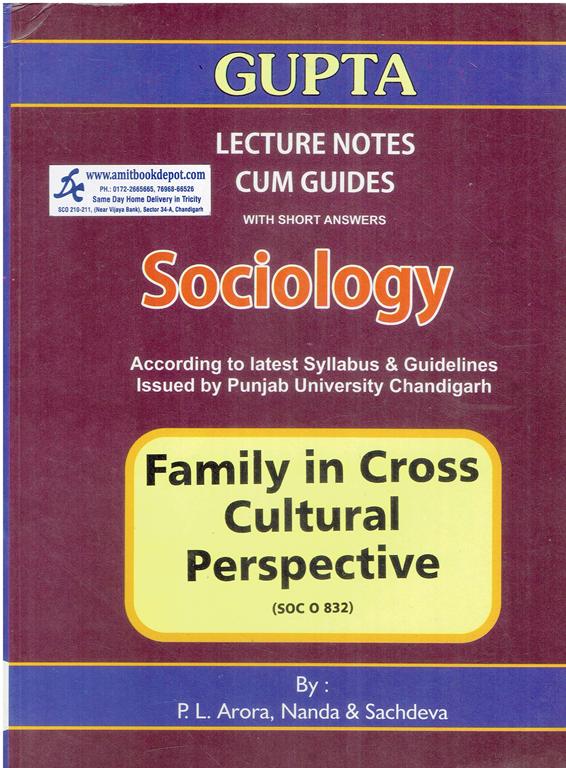
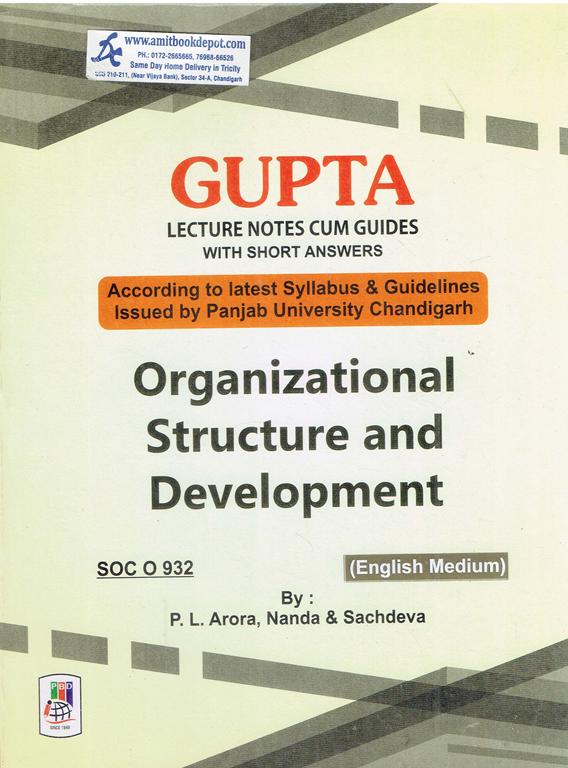
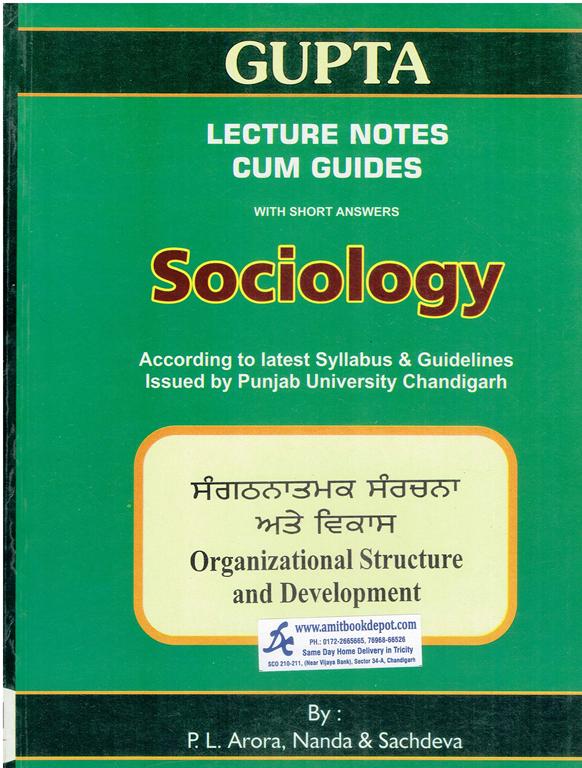
Gupta Problems of Urban India SOC O 732 MA Sociology 3rd Semester Panjab University Chandigarh (English Medium)
Gupta Problems of Urban India SOC O 732 MA Sociology 3rd Semester Panjab University Chandigarh (English Medium)
by Madhurima
₹500₹500.00(-/
off)
Rating & Reviews
23 Customer Review
“Problems of Urban India” by Gupta (Arora, Nanda, Sachdeva) is the prescribed book for SOC O 732, MA Sociology 3rd Semester at Panjab University, Chandigarh. Published by Pepsu Book Depot, this English medium book comprehensively covers the latest syllabus across four units: India’s Urbanization, Urban Basic Services and Pollution, Approaches to Urban Management, and Urban Poverty. It provides in-depth analysis of key topics like rural-urban migration, slums, environmental pollution, and community participation. Designed specifically for PU Chandigarh students, it includes essential short answer questions, making it an indispensable resource for exam preparation and mastering the sociological study of urban issues in India.
“Problems of Urban India” by Gupta, authored by P.L. Arora, Nanda, and Sachdeva, is the prescribed and comprehensive academic book for the course SOC O 732 in the MA Sociology (3rd Semester) program at Panjab University, Chandigarh. Published by Pepsu Book Depot, this English medium volume is meticulously structured to align with the latest university syllabus, serving as an indispensable resource for students seeking a deep and analytical understanding of India’s complex urban landscape. The book systematically addresses the historical, contemporary, and emerging challenges within Indian cities, providing a critical sociological lens essential for both examination success and scholarly insight.
The content is organized into four detailed units, each targeting specific core components of the syllabus. Unit-I: India’s Urbanization offers a foundational exploration, beginning with a historical account of urbanization in India, analyzing its trends and patterns, and defining key concepts like urbanism versus urbanization. It critically examines phenomena such as over-urbanization, delves into the drivers and impacts of rural-urban migration, and investigates the urban informal sector and tertiarization. The unit concludes with a focused study on the mega cities of India, providing a macro perspective on urban growth.
Unit-II: Urban Basic Services and Environment shifts focus to the critical infrastructure and environmental challenges plaguing Indian cities. It starts by defining Urban Basic Services (UBS) and discussing their inequitable distribution. Detailed chapters cover essential services including water supply, sanitation & sewerage, power supply, and solid waste management, alongside social services like education and healthcare in India. A significant portion is dedicated to environmental pollution in India, exploring the intrinsic link between cities and pollution, detailing its types, causes, and characteristics, and reviewing environmental remedies. This unit also tackles urban transport systems and the critical issue of traffic management.
Unit-III: Approaches to Urban Management equips students with knowledge of various governance and planning frameworks. It evaluates different approaches to urban management, comparing models of public provision, privatization, and people’s participation. A special emphasis is placed on community participation, analyzing its strengths and weaknesses, and deriving practical lessons from empirical cases. This theoretical and practical overview is crucial for understanding policy implementation and urban governance.
Unit-IV: Urban Poverty in India provides a nuanced sociological analysis of one of the most persistent urban issues. It begins with the concept of urban poverty and moves into theoretical explanations, contrasting structural and cultural theories of poverty. It discusses various economic and non-economic indicators of urban poverty in India and engages with the controversial culture of poverty thesis and its critiques. The unit grounds theory in reality by examining the empirical situation of urban poverty, with dedicated chapters on housing, slums—their features and causes—and the specific dimensions of women's poverty and child poverty in India.
The book concludes with a dedicated section of Short Answer Type Questions, a vital tool for exam preparation and self-assessment, helping students master concise answering techniques as required by the Panjab University question paper pattern. As a definitive guide for MA Sociology 3rd Semester students at PU Chandigarh, this book is not merely a compilation of facts but a critical academic companion. It enables learners to navigate the syllabus efficiently, develop robust research problems, and build a sophisticated understanding of the problems of urban India, making it essential for achieving academic excellence and fostering informed discourse on India's urban future.
Is this book the latest edition that strictly follows the current Panjab University MA Sociology 3rd Semester syllabus for SOC O 732?
A1
Yes, this edition by P.L. Arora, Nanda, and Sachdeva is structured precisely according to the latest prescribed syllabus and course outline for Problems of Urban India (SOC O 732) at Panjab University, Chandigarh.
Q2
I am a private candidate. Is this book sufficient for exam preparation without classroom coaching?
A2
Absolutely. This book is designed as a comprehensive guide aligned with the syllabus. Its structured units, detailed content, and question section make it a self-contained resource for private candidates.
Q3
How does the book's "Table of Contents" relate to the four "Units" mentioned in the PU syllabus?
A3
The book's chapters are directly grouped into the four units specified in the syllabus: Unit-I (Ch. 1-9), Unit-II (Ch. 10-21), Unit-III (Ch. 22-27), and Unit-IV (Ch. 28-40), ensuring seamless topic-wise study.
Q4
Are contemporary issues like environmental pollution and solid waste management covered in detail?
A4
Yes, Unit-II provides extensive coverage of urban environmental issues, including dedicated chapters on environmental pollution, its types and causes, solid waste management, and available remedies in the Indian context.
Q5
Does the book cover both theoretical perspectives and empirical cases on urban management?
A5
Yes, Unit-III on Approaches to Urban Management discusses theoretical models (Public, Private, Participatory) and concludes with lessons drawn from empirical cases, bridging theory and practice.
Q6
Is the topic of "Over-urbanization" explained in the context of India?
A6
Yes, Chapter 5 in Unit-I specifically addresses the concept of "Over-urbanization," analyzing it within the trends and patterns of Indian urbanization.
Q7
Does this book help in developing research problems for further specialization, as stated in the course objective?
A7
Yes, by exposing students to pertinent issues, controversies, and theoretical debates across various urban problems, the book provides a strong foundation for identifying and formulating research problems in urban sociology.
Q8
Are the mega cities of India discussed individually or as a collective phenomenon?
A8
Chapter 9 in Unit-I focuses on "Mega Cities of India," examining them as key nodes in the process of urbanization, highlighting their specific challenges and roles.
Q9
Is community participation as an approach to urban management critically analyzed?
A9
Yes, Chapters 25 & 26 specifically discuss Community Participation, evaluating its strengths and weaknesses in detail, moving beyond a mere descriptive approach.
Q10
Are the features and causes of Indian slums covered separately?
A10
Yes, Chapters 37 and 38 are specifically dedicated to Slums, detailing their features and analyzing the root causes behind their formation and persistence.
0.00
0 Overall Rating
5
0
4
0
3
0
2
0
1
0
Try this product & share your review &
thoughts
UNIT - I
1. Historical Account of Urbanization in India
2. Trends and Patterns of Indian Urbanization
3. Features of Indian Urbanization
4. Urbanism and Urbanization
5. Over-urbanization
6. Rural-Urban Migration
7. Urban Informal Sector in India
8. Tertiarization
9. Mega Cities of India
UNIT - II
10. Urban Basic Services (UBS): Definition
11. Water Supply, Sanitation & Sewerage
12. Power Supply
13. Solid Waste Management
14. Education in India
15. Healthcare in India
16. Environmental Pollution in India
17. Cities and Pollution
18. Pollution: Types, Causes, and Characteristics
19. Environmental Remedies in India
20. Urban Transport
21. Traffic Management
UNIT - III
22. Approaches to Urban Management
23. Public Provision
24. Privatization & People’s Participation
25. Community Participation
26. Community Participation: Strengths and Weaknesses
27. Lessons from Empirical Cases
UNIT - IV
28. Urban Poverty in India
29. Urban Poverty in India: Concept
30. Theoretical Explanations
31. Theories of Poverty: Structural and Cultural
32. Economic and Non-Economic Indicators of Urban Poverty in India
33. Culture of Poverty
34. Culture of Poverty: Critiques
35. Empirical Situation of Urban Poverty in India
36. Housing
37. Slums
38. Slums: Features and Causes
39. Women's Poverty in India
40. Child Poverty
Short Answer Type Questions
Latest Syllabus of Problems of Urban India SOC O 732 MA Sociology 3rd Semester Panjab University (PU) Chandigarh (English Medium)
SOC O 732: PROBLEMS OF URBAN INDIA
Objective
This course familiarizes the students with the contemporary urban situation in India, apart from the historical trends and patterns of urbanization in India. Focus shall be on the recently emerging urban problems and the approaches that have been used to tackle them. The students will be exposed to the most pertinent issues and controversies relating to the urban population of India so as to enable them to develop research problems for further specialization in the given area.
INSTRUCTIONS FOR THE PAPER-SETTER AND THE CANDIDATES
(i) The theory question paper will be of 80 marks, and 20 marks will be for internal assessment. The duration of the paper will be 3 hours.
(ii) For private candidates, who have not been assessed earlier for internal assessment, the marks secured by them in the theory paper will proportionately be increased to the maximum marks of the paper in lieu of internal assessment.
The paper setter must put note (ii) in the question paper.
The syllabus has been divided into four units.
There shall be 9 questions in all. The first question is compulsory and shall be a short answer type containing 10 short questions spread over the whole syllabus to be answered in about 30 to 35 words each, carrying 20 marks, i.e., 2 marks each. The rest of the paper shall contain 4 units. Each unit shall have two long questions, and the candidates shall be given an internal choice of attempting one question from each unit—4 in all. Each question will carry 15 marks.
“Problems of Urban India” by Gupta, authored by P.L. Arora, Nanda, and Sachdeva, is the prescribed and comprehensive academic book for the course SOC O 732 in the MA Sociology (3rd Semester) program at Panjab University, Chandigarh. Published by Pepsu Book Depot, this English medium volume is meticulously structured to align with the latest university syllabus, serving as an indispensable resource for students seeking a deep and analytical understanding of India’s complex urban landscape. The book systematically addresses the historical, contemporary, and emerging challenges within Indian cities, providing a critical sociological lens essential for both examination success and scholarly insight.
The content is organized into four detailed units, each targeting specific core components of the syllabus. Unit-I: India’s Urbanization offers a foundational exploration, beginning with a historical account of urbanization in India, analyzing its trends and patterns, and defining key concepts like urbanism versus urbanization. It critically examines phenomena such as over-urbanization, delves into the drivers and impacts of rural-urban migration, and investigates the urban informal sector and tertiarization. The unit concludes with a focused study on the mega cities of India, providing a macro perspective on urban growth.
Unit-II: Urban Basic Services and Environment shifts focus to the critical infrastructure and environmental challenges plaguing Indian cities. It starts by defining Urban Basic Services (UBS) and discussing their inequitable distribution. Detailed chapters cover essential services including water supply, sanitation & sewerage, power supply, and solid waste management, alongside social services like education and healthcare in India. A significant portion is dedicated to environmental pollution in India, exploring the intrinsic link between cities and pollution, detailing its types, causes, and characteristics, and reviewing environmental remedies. This unit also tackles urban transport systems and the critical issue of traffic management.
Unit-III: Approaches to Urban Management equips students with knowledge of various governance and planning frameworks. It evaluates different approaches to urban management, comparing models of public provision, privatization, and people’s participation. A special emphasis is placed on community participation, analyzing its strengths and weaknesses, and deriving practical lessons from empirical cases. This theoretical and practical overview is crucial for understanding policy implementation and urban governance.
Unit-IV: Urban Poverty in India provides a nuanced sociological analysis of one of the most persistent urban issues. It begins with the concept of urban poverty and moves into theoretical explanations, contrasting structural and cultural theories of poverty. It discusses various economic and non-economic indicators of urban poverty in India and engages with the controversial culture of poverty thesis and its critiques. The unit grounds theory in reality by examining the empirical situation of urban poverty, with dedicated chapters on housing, slums—their features and causes—and the specific dimensions of women's poverty and child poverty in India.
The book concludes with a dedicated section of Short Answer Type Questions, a vital tool for exam preparation and self-assessment, helping students master concise answering techniques as required by the Panjab University question paper pattern. As a definitive guide for MA Sociology 3rd Semester students at PU Chandigarh, this book is not merely a compilation of facts but a critical academic companion. It enables learners to navigate the syllabus efficiently, develop robust research problems, and build a sophisticated understanding of the problems of urban India, making it essential for achieving academic excellence and fostering informed discourse on India's urban future.
UNIT - I
1. Historical Account of Urbanization in India
2. Trends and Patterns of Indian Urbanization
3. Features of Indian Urbanization
4. Urbanism and Urbanization
5. Over-urbanization
6. Rural-Urban Migration
7. Urban Informal Sector in India
8. Tertiarization
9. Mega Cities of India
UNIT - II
10. Urban Basic Services (UBS): Definition
11. Water Supply, Sanitation & Sewerage
12. Power Supply
13. Solid Waste Management
14. Education in India
15. Healthcare in India
16. Environmental Pollution in India
17. Cities and Pollution
18. Pollution: Types, Causes, and Characteristics
19. Environmental Remedies in India
20. Urban Transport
21. Traffic Management
UNIT - III
22. Approaches to Urban Management
23. Public Provision
24. Privatization & People’s Participation
25. Community Participation
26. Community Participation: Strengths and Weaknesses
27. Lessons from Empirical Cases
UNIT - IV
28. Urban Poverty in India
29. Urban Poverty in India: Concept
30. Theoretical Explanations
31. Theories of Poverty: Structural and Cultural
32. Economic and Non-Economic Indicators of Urban Poverty in India
Is this book the latest edition that strictly follows the current Panjab University MA Sociology 3rd Semester syllabus for SOC O 732?
A1
Yes, this edition by P.L. Arora, Nanda, and Sachdeva is structured precisely according to the latest prescribed syllabus and course outline for Problems of Urban India (SOC O 732) at Panjab University, Chandigarh.
Q2
I am a private candidate. Is this book sufficient for exam preparation without classroom coaching?
A2
Absolutely. This book is designed as a comprehensive guide aligned with the syllabus. Its structured units, detailed content, and question section make it a self-contained resource for private candidates.
Q3
How does the book's "Table of Contents" relate to the four "Units" mentioned in the PU syllabus?
A3
The book's chapters are directly grouped into the four units specified in the syllabus: Unit-I (Ch. 1-9), Unit-II (Ch. 10-21), Unit-III (Ch. 22-27), and Unit-IV (Ch. 28-40), ensuring seamless topic-wise study.
Q4
Are contemporary issues like environmental pollution and solid waste management covered in detail?
A4
Yes, Unit-II provides extensive coverage of urban environmental issues, including dedicated chapters on environmental pollution, its types and causes, solid waste management, and available remedies in the Indian context.
Q5
Does the book cover both theoretical perspectives and empirical cases on urban management?
A5
Yes, Unit-III on Approaches to Urban Management discusses theoretical models (Public, Private, Participatory) and concludes with lessons drawn from empirical cases, bridging theory and practice.
Q6
Is the topic of "Over-urbanization" explained in the context of India?
A6
Yes, Chapter 5 in Unit-I specifically addresses the concept of "Over-urbanization," analyzing it within the trends and patterns of Indian urbanization.
Q7
Does this book help in developing research problems for further specialization, as stated in the course objective?
A7
Yes, by exposing students to pertinent issues, controversies, and theoretical debates across various urban problems, the book provides a strong foundation for identifying and formulating research problems in urban sociology.
Q8
Are the mega cities of India discussed individually or as a collective phenomenon?
A8
Chapter 9 in Unit-I focuses on "Mega Cities of India," examining them as key nodes in the process of urbanization, highlighting their specific challenges and roles.
Q9
Is community participation as an approach to urban management critically analyzed?
A9
Yes, Chapters 25 & 26 specifically discuss Community Participation, evaluating its strengths and weaknesses in detail, moving beyond a mere descriptive approach.
Q10
Are the features and causes of Indian slums covered separately?
A10
Yes, Chapters 37 and 38 are specifically dedicated to Slums, detailing their features and analyzing the root causes behind their formation and persistence.
Latest Syllabus of Problems of Urban India SOC O 732 MA Sociology 3rd Semester Panjab University (PU) Chandigarh (English Medium)
SOC O 732: PROBLEMS OF URBAN INDIA
Objective
This course familiarizes the students with the contemporary urban situation in India, apart from the historical trends and patterns of urbanization in India. Focus shall be on the recently emerging urban problems and the approaches that have been used to tackle them. The students will be exposed to the most pertinent issues and controversies relating to the urban population of India so as to enable them to develop research problems for further specialization in the given area.
INSTRUCTIONS FOR THE PAPER-SETTER AND THE CANDIDATES
(i) The theory question paper will be of 80 marks, and 20 marks will be for internal assessment. The duration of the paper will be 3 hours.
(ii) For private candidates, who have not been assessed earlier for internal assessment, the marks secured by them in the theory paper will proportionately be increased to the maximum marks of the paper in lieu of internal assessment.
The paper setter must put note (ii) in the question paper.
The syllabus has been divided into four units.
There shall be 9 questions in all. The first question is compulsory and shall be a short answer type containing 10 short questions spread over the whole syllabus to be answered in about 30 to 35 words each, carrying 20 marks, i.e., 2 marks each. The rest of the paper shall contain 4 units. Each unit shall have two long questions, and the candidates shall be given an internal choice of attempting one question from each unit—4 in all. Each question will carry 15 marks.
Water Supply, Power, Sanitation and Sewerage, Solid Waste Management, Education,
Health, etc.
Environmental Pollution
Cities and Pollution: Causes, Types, and Remedies.
Urban Transport and Traffic Management.
Unit III
Approaches to Urban Management
Approaches:
Public Provision, Privatization, and People’s Participation,
Community Participation—Strengths and Weaknesses.
Lessons from Empirical Cases
Unit IV
Urban Poverty in India
Concept of Urban Poverty: Theoretical Explanations—Structural and Cultural,
Economic and noneconomic indicators.
Culture of Poverty, Critique.
Empirical situation of urban poverty in India, housing, slums, features of Indian slums, and
Causes: Women and Child Poverty.
0.00
0 Overall Rating
5
0
4
0
3
0
2
0
1
0
Try this product & share your review &
thoughts
Top Trending Product
Related
Product
Related Product
Related Blog Posts
Latest Blogs
Latest Blogs
Classic Literature Reimagined: Discuss modern twists on classic novels.
Lorem ipsum dolor sit amet, consectetur adipiscing elit, sed
do
eiusmod tempor incididunt ut labore et dolore magna aliqua. Ut enim ad minim
veniam, quis nostrud exercitation ullamco Lorem ipsum dolor sit amet,
consectetur adipiscing elit, sed do eiusmod tempor incididunt ut labore et
dolore magna aliqua. Utenim ad minim veniam, quis nostrud exercitation
ullamco
Lorem ipsum dolor sit amet, consecte...
Classic Literature Reimagined: Discuss modern twists on classic novels.
Lorem ipsum dolor sit amet, consectetur adipiscing elit, sed
do
eiusmod tempor incididunt ut labore et dolore magna aliqua. Ut enim ad minim
veniam, quis nostrud exercitation ullamco Lorem ipsum dolor sit amet,
consectetur adipiscing elit, sed do eiusmod tempor incididunt ut labore et
dolore magna aliqua. Utenim ad minim veniam, quis nostrud exercitation
ullamco
Lorem ipsum dolor sit amet, consecte...
Classic Literature Reimagined: Discuss modern twists on classic novels.
Lorem ipsum dolor sit amet, consectetur adipiscing elit, sed
do
eiusmod tempor incididunt ut labore et dolore magna aliqua. Ut enim ad minim
veniam, quis nostrud exercitation ullamco Lorem ipsum dolor sit amet,
consectetur adipiscing elit, sed do eiusmod tempor incididunt ut labore et
dolore magna aliqua. Utenim ad minim veniam, quis nostrud exercitation
ullamco
Lorem ipsum dolor sit amet, consecte...