-
Mon-Fri: 10AM to 8PM 01722665665
-
My Account
-
-
0
Total :
₹ 0.00

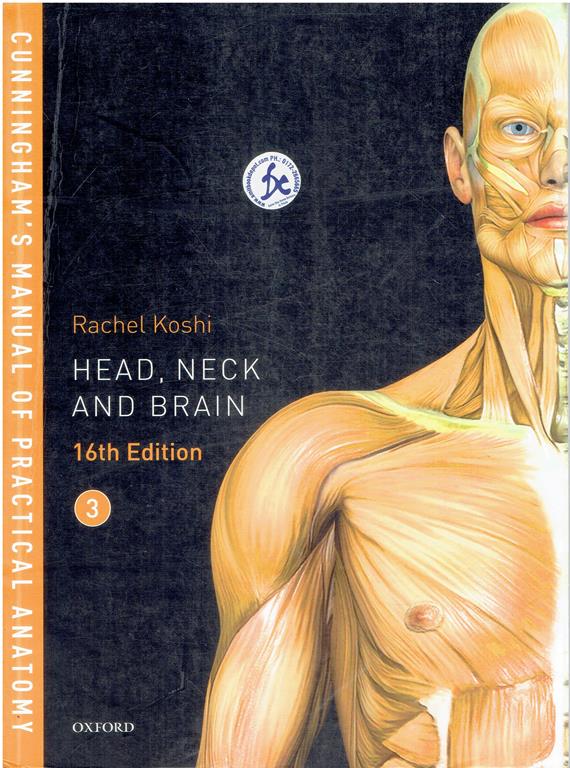




Yes, this is the current edition authored by Dr. Rachel Koshi and published by Oxford University Press, continuing the trusted legacy of the Cunningham’s series.
Absolutely. Part 2 is entirely dedicated to the brain and spinal cord, providing detailed, dissection-based guides to neuroanatomy, including the brainstem, cerebellum, and cerebrum.
Yes, Chapter 11 covers the orbit and Chapter 12 provides a detailed dissection guide for the eyeball, complete with relevant anatomy and clinical notes.
Part 3 consists of a dedicated chapter on cross-sectional anatomy of the head and neck, which directly correlates anatomical structures with the views seen in CT and MRI scans.
Yes, these are covered in detail in Chapter 15: "The temporal and infratemporal regions."
Yes, it is well-illustrated with clear, high-quality diagrams and photographs that complement the step-by-step dissection instructions.
While it is primarily a dissection guide, its comprehensive and systematic coverage of neuroanatomy makes it an excellent primary or essential companion text for practical neuroanatomy courses.
Yes, Chapters 17 (mouth and pharynx) and 20 (the larynx) offer comprehensive dissection-based coverage of these regions.
Definitely. Its detailed, regional approach to the head and neck, including deep dissections of the neck, parotid region, and pharyngo-laryngeal anatomy, provides a superb anatomical foundation for ENT.
Yes, the cranial nerves are systematically covered within the specific regional chapters where they are dissected and are also integrated within the neuroanatomy section.
No Description Added
Yes, this is the current edition authored by Dr. Rachel Koshi and published by Oxford University Press, continuing the trusted legacy of the Cunningham’s series.
Absolutely. Part 2 is entirely dedicated to the brain and spinal cord, providing detailed, dissection-based guides to neuroanatomy, including the brainstem, cerebellum, and cerebrum.
Yes, Chapter 11 covers the orbit and Chapter 12 provides a detailed dissection guide for the eyeball, complete with relevant anatomy and clinical notes.
Part 3 consists of a dedicated chapter on cross-sectional anatomy of the head and neck, which directly correlates anatomical structures with the views seen in CT and MRI scans.
Yes, these are covered in detail in Chapter 15: "The temporal and infratemporal regions."
Yes, it is well-illustrated with clear, high-quality diagrams and photographs that complement the step-by-step dissection instructions.
While it is primarily a dissection guide, its comprehensive and systematic coverage of neuroanatomy makes it an excellent primary or essential companion text for practical neuroanatomy courses.
Yes, Chapters 17 (mouth and pharynx) and 20 (the larynx) offer comprehensive dissection-based coverage of these regions.
Definitely. Its detailed, regional approach to the head and neck, including deep dissections of the neck, parotid region, and pharyngo-laryngeal anatomy, provides a superb anatomical foundation for ENT.
Yes, the cranial nerves are systematically covered within the specific regional chapters where they are dissected and are also integrated within the neuroanatomy section.