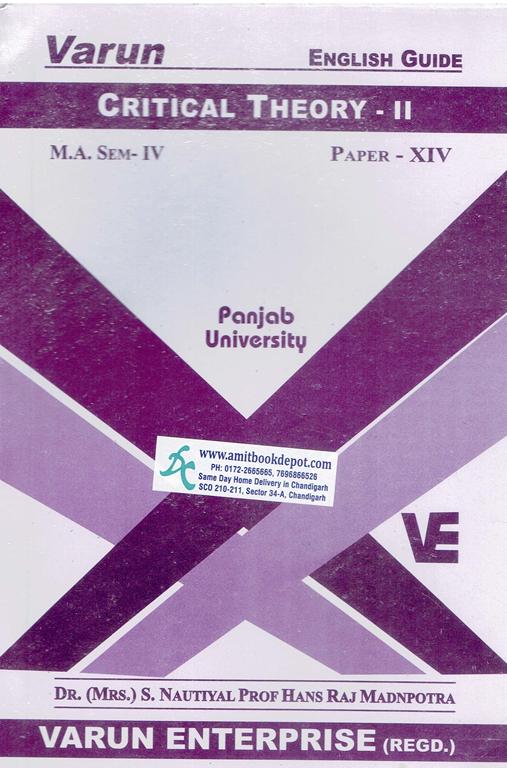
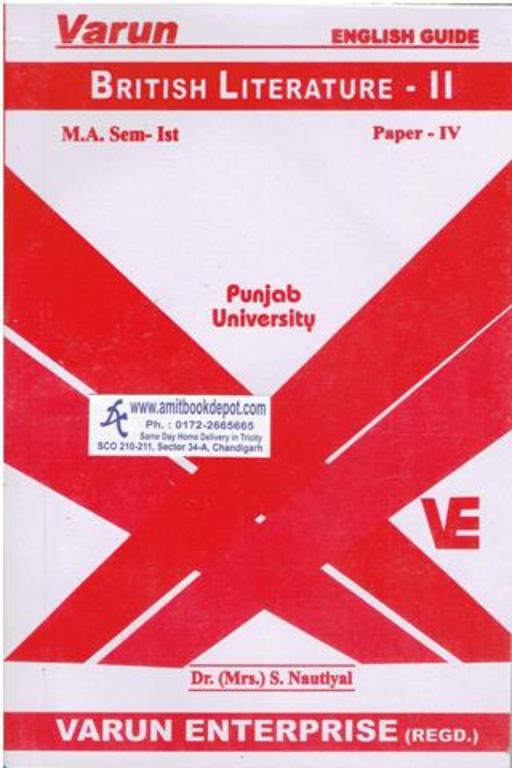
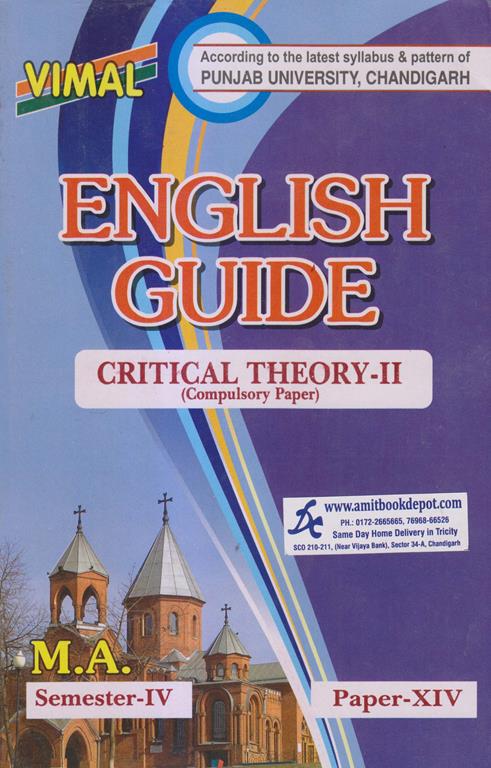
Varun English Guide Critical Theory - II For MA 4th Paper 14 Panjab University Chandigarh
Varun English Guide Critical Theory - II For MA 4th Paper 14 Panjab University Chandigarh
by Madhurima
₹350₹350.00(-/
off)
Rating & Reviews
23 Customer Review
The Varun English Guide: Critical Theory - II by Dr. S. Nautiyal is the definitive study companion for Panjab University's MA English Semester IV, Paper 14. This essential guide provides comprehensive, unit-wise coverage of complex theorists like Hayden White, Raymond Williams, Judith Butler, Homi Bhabha, and Aijaz Ahmad. It simplifies advanced concepts in historiography, cultural materialism, gender performativity, postcolonial theory, and Marxist critique. With detailed summaries, keyword explanations, and exam-oriented content, this book is meticulously designed to help postgraduate students master the syllabus and achieve academic excellence. Published by Varun Enterprises.
Varun English Guide: Critical Theory - II for M.A. 4th Semester, Paper 14 - Panjab University, Chandigarh by Dr. S. Nautiyal is an indispensable academic resource meticulously crafted for postgraduate students navigating the complex terrain of contemporary literary and cultural theory. Published by Varun Enterprises, this guide is specifically aligned with the prescribed syllabus of Panjab University, offering a structured, in-depth, and student-centric approach to mastering the compulsory Paper XIV.
The field of literary theory has undergone a significant transformation post-1980, moving beyond the analysis of purely literary texts to interrogate broader discourses of history, colonialism, gender, and ideology. This guide is designed to map these subsequent developments and new interrogations, building upon the foundations laid in Literary Theory-I. It provides a crucial key to understanding how theoretical frameworks have reshaped our conceptualization of culture, power, and identity. Each unit in this book is treated as a comprehensive module, breaking down dense theoretical concepts into digestible, exam-focused content.
Unit I delves into Hayden White's groundbreaking essay, "Historical Text as Literary Artifact." This guide elucidates White's central argument that historical narratives are not neutral reports but are structured through literary tropes and emplotted like stories. Students will gain a clear understanding of concepts such as employment, tropology, and the metahistorical basis of historical writing, crucial for appreciating the blurred lines between history and literature.
Unit II focuses on the seminal work of Raymond Williams, specifically the concepts from "From Reflection to Mediation" and "Dominant, Residual, and Emergent." The guide provides a thorough explanation of Williams' move from a simplistic reflection model to a more complex theory of mediation. It clearly defines and differentiates the key categories of the dominant, residual, and emergent cultural forces, enabling students to analyze cultural processes dynamically and within their ideological contexts.
Unit III is dedicated to Judith Butler's revolutionary essay, "Performative Acts and Gender Constitution." This guide offers a precise and accessible exploration of Butler's theory of gender performativity. It carefully explains the distinction between performance and performativity, the role of repetition in constituting gender identity, and the implications of this theory for feminist and queer theory, making this challenging text highly approachable for students.
Unit IV tackles Homi Bhabha's complex concept of colonial mimicry in "Of Mimicry and Man." The guide masterfully clarifies Bhabha's ideas on the ambivalence at the heart of colonial discourse. It explains how mimicry—the desire for a reformed, recognizable Other—produces a subject that is almost the same, but not quite, and explores the subversive potential of this slippage for anti-colonial resistance.
Unit V engages with Aijaz Ahmad's critical intervention in "Literary Theory and Third World Literature." This guide provides a balanced analysis of Ahmad's critique of Eurocentric theorizing, particularly his challenges to the category of "Third World Literature" and his critique of Fredric Jameson. It helps students grasp the debates surrounding nationalism, postcoloniality, and the institutionalization of theory.
This Varun English Guide is more than a summary; it is a critical companion. It features detailed chapter-wise summaries, critical commentary, explanations of key terms and concepts, potential exam questions, and model answers. Its structured format saves students valuable research time and provides the clarity and depth needed to excel in their examinations. For any MA English student at Panjab University, this guide is an essential investment for academic success in Critical Theory-II.
Does this guide include the full text of the original theoretical essays by authors like Judith Butler and Homi Bhabha?
A1
No, this guide is a critical companion and study aid. It contains detailed summaries, explanations, and analyses of the prescribed essays but does not reproduce the full text of the original essays, for which students should refer to the primary sources.
Q2
How does this guide help in understanding difficult concepts like "gender performativity" or "colonial mimicry"?
A2
The guide breaks down each complex theory into simpler, layered explanations. It uses clear definitions, real-world examples, and contrasts concepts with related ideas to build a solid and accessible understanding for students encountering these theories for the first time.
Q3
Is this book updated according to the latest syllabus of Panjab University?
A3
This guide is specifically written for the current Paper XIV (Critical Theory – II) syllabus for MA English Semester IV at Panjab University, Chandigarh. It is always recommended to cross-check with the university's latest syllabus bulletin.
Q4
How is the section on Aijaz Ahmad's critique presented? Does the guide take a side in the debate?
A4
The guide presents Aijaz Ahmad's arguments objectively, explaining his critique of Eurocentric theory and the "Third World Literature" category. It aims to clarify the debate rather than take a side, empowering students to form their own informed opinions.
Q5
Does the guide explain the connection between the five units and the overall theme of the paper?
A5
Yes, the introduction or a separate section often contextualizes how the five units—covering history, ideology, gender, colonialism, and their critiques—collectively represent the "new interrogations" and widened ambit of post-1980 literary and cultural theory.
Q6
Is the language used in the guide academic or simplified for better comprehension?
A6
The guide strikes a balance. It maintains academic rigor by using necessary theoretical terminology but is written in a clear, explanatory style designed to simplify the original dense texts and enhance student comprehension.
Q7
How does the guide handle the theoretical differences between, for example, Homi Bhabha and Aijaz Ahmad?
A7
The guide treats each theorist within their own unit. However, it may provide comparative insights or highlight points of contention (like Ahmad's critique of certain postcolonial theorists) to give students a more holistic view of the theoretical landscape.
Q8
Is the content relevant for students other than those from Panjab University?
A8
While tailored for Panjab University, the content covers foundational texts in modern critical theory. Students from other universities with similar syllabi covering these specific theorists and essays may also find it highly beneficial.
Q9
How is the unit on Hayden White's "Historical Text as Literary Artifact" presented?
A9
The guide explains White's core argument that historians use literary techniques (employment, tropes) to construct meaning. It clarifies his taxonomy of employment types (romance, tragedy, comedy, satire) and how this challenges the objectivity of historical narratives.
Q10
What makes this Varun Guide a better choice than other generic notes on critical theory?
A10
This guide's primary advantage is its precise and exclusive focus on the Panjab University syllabus. It saves students time by providing targeted analysis on the exact essays and page numbers prescribed, with a consistent structure and exam-oriented approach that generic notes may lack.
0.00
0 Overall Rating
5
0
4
0
3
0
2
0
1
0
Try this product & share your review &
thoughts
UNIT - I
Hayden White: Historical Text as Literary Artifact
UNIT - II
Raymond Williams: From Reflection to Mediation, Dominant, Residual, and Emergent
UNIT - III
Judith Butler: Performative Acts and Gender Constitution
UNIT - IV
Homi Bhabha: Of Mimicry and Man
UNIT - V
Aijaz Ahmad: Literary Theory and Third World Literature
Latest Syllabus of English Guide Critical Theory - II For MA 4th Paper 14 Panjab University (PU) Chandigarh
M.A. II
Semester IV
Compulsory Paper
Paper XIV
Critical Theory – II
Post-1980, the gap between literary theory and cultural theory has narrowed down. Literary theory is no longer contained to our thinking about the production or
reception of literary works alone; rather, it has brought about changes in the ways in which we conceptualize larger discourses of history, colonialism, gender, and
ideology. The ambit of theory has further widened due to a strident inner questioning. This paper, to be seen in conjunction with Literary Theory—I, maps the subsequent development and new interrogations in the field. The collation of texts is with the intent of exposing students to later developments in the field of literary theory. The paper focuses on essays that deal with theoretical understanding of history, ideology, gender, and colonialism.
Unit I
Hayden White: “Historical Text as Literary Artifact,” Tropics of Discourse: Essays in Cultural Criticism (The John Hopkins University Press, 1986), 81-100.
Unit II
Raymond Williams, “From Reflection to Mediation” (95-100), “Dominant, Residual and Emergent” (121-127), Marxism and Literature (Oxford and New York: OUP, 1977)
Unit III
Judith Butler, “Performative Acts and Gender Constitution: An Essay in Phenomenology and Feminist Theory,” Theatre Journal, Vol. 40, No. 4 (Dec., 1988), 519-531.
Unit IV
Homi Bhabha, “Of Mimicry and Man: The Ambivalence of Colonial Discourse,” October, Vol. 28, Discipleship: A Special Issue on Psychoanalysis (Spring, 1984),
125-133
Unit V
Aijaz Ahmad, “Literary Theory and Third World Literature,” In Theory: Classes, Nations, Literatures (London & New York: Verso, 1992) 2000 rpt. 43-71 & 327-330.
Varun English Guide: Critical Theory - II for M.A. 4th Semester, Paper 14 - Panjab University, Chandigarh by Dr. S. Nautiyal is an indispensable academic resource meticulously crafted for postgraduate students navigating the complex terrain of contemporary literary and cultural theory. Published by Varun Enterprises, this guide is specifically aligned with the prescribed syllabus of Panjab University, offering a structured, in-depth, and student-centric approach to mastering the compulsory Paper XIV.
The field of literary theory has undergone a significant transformation post-1980, moving beyond the analysis of purely literary texts to interrogate broader discourses of history, colonialism, gender, and ideology. This guide is designed to map these subsequent developments and new interrogations, building upon the foundations laid in Literary Theory-I. It provides a crucial key to understanding how theoretical frameworks have reshaped our conceptualization of culture, power, and identity. Each unit in this book is treated as a comprehensive module, breaking down dense theoretical concepts into digestible, exam-focused content.
Unit I delves into Hayden White's groundbreaking essay, "Historical Text as Literary Artifact." This guide elucidates White's central argument that historical narratives are not neutral reports but are structured through literary tropes and emplotted like stories. Students will gain a clear understanding of concepts such as employment, tropology, and the metahistorical basis of historical writing, crucial for appreciating the blurred lines between history and literature.
Unit II focuses on the seminal work of Raymond Williams, specifically the concepts from "From Reflection to Mediation" and "Dominant, Residual, and Emergent." The guide provides a thorough explanation of Williams' move from a simplistic reflection model to a more complex theory of mediation. It clearly defines and differentiates the key categories of the dominant, residual, and emergent cultural forces, enabling students to analyze cultural processes dynamically and within their ideological contexts.
Unit III is dedicated to Judith Butler's revolutionary essay, "Performative Acts and Gender Constitution." This guide offers a precise and accessible exploration of Butler's theory of gender performativity. It carefully explains the distinction between performance and performativity, the role of repetition in constituting gender identity, and the implications of this theory for feminist and queer theory, making this challenging text highly approachable for students.
Unit IV tackles Homi Bhabha's complex concept of colonial mimicry in "Of Mimicry and Man." The guide masterfully clarifies Bhabha's ideas on the ambivalence at the heart of colonial discourse. It explains how mimicry—the desire for a reformed, recognizable Other—produces a subject that is almost the same, but not quite, and explores the subversive potential of this slippage for anti-colonial resistance.
Unit V engages with Aijaz Ahmad's critical intervention in "Literary Theory and Third World Literature." This guide provides a balanced analysis of Ahmad's critique of Eurocentric theorizing, particularly his challenges to the category of "Third World Literature" and his critique of Fredric Jameson. It helps students grasp the debates surrounding nationalism, postcoloniality, and the institutionalization of theory.
This Varun English Guide is more than a summary; it is a critical companion. It features detailed chapter-wise summaries, critical commentary, explanations of key terms and concepts, potential exam questions, and model answers. Its structured format saves students valuable research time and provides the clarity and depth needed to excel in their examinations. For any MA English student at Panjab University, this guide is an essential investment for academic success in Critical Theory-II.
UNIT - I
Hayden White: Historical Text as Literary Artifact
UNIT - II
Raymond Williams: From Reflection to Mediation, Dominant, Residual, and Emergent
UNIT - III
Judith Butler: Performative Acts and Gender Constitution
UNIT - IV
Homi Bhabha: Of Mimicry and Man
UNIT - V
Aijaz Ahmad: Literary Theory and Third World Literature
Does this guide include the full text of the original theoretical essays by authors like Judith Butler and Homi Bhabha?
A1
No, this guide is a critical companion and study aid. It contains detailed summaries, explanations, and analyses of the prescribed essays but does not reproduce the full text of the original essays, for which students should refer to the primary sources.
Q2
How does this guide help in understanding difficult concepts like "gender performativity" or "colonial mimicry"?
A2
The guide breaks down each complex theory into simpler, layered explanations. It uses clear definitions, real-world examples, and contrasts concepts with related ideas to build a solid and accessible understanding for students encountering these theories for the first time.
Q3
Is this book updated according to the latest syllabus of Panjab University?
A3
This guide is specifically written for the current Paper XIV (Critical Theory – II) syllabus for MA English Semester IV at Panjab University, Chandigarh. It is always recommended to cross-check with the university's latest syllabus bulletin.
Q4
How is the section on Aijaz Ahmad's critique presented? Does the guide take a side in the debate?
A4
The guide presents Aijaz Ahmad's arguments objectively, explaining his critique of Eurocentric theory and the "Third World Literature" category. It aims to clarify the debate rather than take a side, empowering students to form their own informed opinions.
Q5
Does the guide explain the connection between the five units and the overall theme of the paper?
A5
Yes, the introduction or a separate section often contextualizes how the five units—covering history, ideology, gender, colonialism, and their critiques—collectively represent the "new interrogations" and widened ambit of post-1980 literary and cultural theory.
Q6
Is the language used in the guide academic or simplified for better comprehension?
A6
The guide strikes a balance. It maintains academic rigor by using necessary theoretical terminology but is written in a clear, explanatory style designed to simplify the original dense texts and enhance student comprehension.
Q7
How does the guide handle the theoretical differences between, for example, Homi Bhabha and Aijaz Ahmad?
A7
The guide treats each theorist within their own unit. However, it may provide comparative insights or highlight points of contention (like Ahmad's critique of certain postcolonial theorists) to give students a more holistic view of the theoretical landscape.
Q8
Is the content relevant for students other than those from Panjab University?
A8
While tailored for Panjab University, the content covers foundational texts in modern critical theory. Students from other universities with similar syllabi covering these specific theorists and essays may also find it highly beneficial.
Q9
How is the unit on Hayden White's "Historical Text as Literary Artifact" presented?
A9
The guide explains White's core argument that historians use literary techniques (employment, tropes) to construct meaning. It clarifies his taxonomy of employment types (romance, tragedy, comedy, satire) and how this challenges the objectivity of historical narratives.
Q10
What makes this Varun Guide a better choice than other generic notes on critical theory?
A10
This guide's primary advantage is its precise and exclusive focus on the Panjab University syllabus. It saves students time by providing targeted analysis on the exact essays and page numbers prescribed, with a consistent structure and exam-oriented approach that generic notes may lack.
Latest Syllabus of English Guide Critical Theory - II For MA 4th Paper 14 Panjab University (PU) Chandigarh
M.A. II
Semester IV
Compulsory Paper
Paper XIV
Critical Theory – II
Post-1980, the gap between literary theory and cultural theory has narrowed down. Literary theory is no longer contained to our thinking about the production or
reception of literary works alone; rather, it has brought about changes in the ways in which we conceptualize larger discourses of history, colonialism, gender, and
ideology. The ambit of theory has further widened due to a strident inner questioning. This paper, to be seen in conjunction with Literary Theory—I, maps the subsequent development and new interrogations in the field. The collation of texts is with the intent of exposing students to later developments in the field of literary theory. The paper focuses on essays that deal with theoretical understanding of history, ideology, gender, and colonialism.
Unit I
Hayden White: “Historical Text as Literary Artifact,” Tropics of Discourse: Essays in Cultural Criticism (The John Hopkins University Press, 1986), 81-100.
Unit II
Raymond Williams, “From Reflection to Mediation” (95-100), “Dominant, Residual and Emergent” (121-127), Marxism and Literature (Oxford and New York: OUP, 1977)
Unit III
Judith Butler, “Performative Acts and Gender Constitution: An Essay in Phenomenology and Feminist Theory,” Theatre Journal, Vol. 40, No. 4 (Dec., 1988), 519-531.
Unit IV
Homi Bhabha, “Of Mimicry and Man: The Ambivalence of Colonial Discourse,” October, Vol. 28, Discipleship: A Special Issue on Psychoanalysis (Spring, 1984),
125-133
Unit V
Aijaz Ahmad, “Literary Theory and Third World Literature,” In Theory: Classes, Nations, Literatures (London & New York: Verso, 1992) 2000 rpt. 43-71 & 327-330.
0.00
0 Overall Rating
5
0
4
0
3
0
2
0
1
0
Try this product & share your review &
thoughts
Top Trending Product
Related
Product
Related Product
Related Blog Posts
Latest Blogs
Latest Blogs
Classic Literature Reimagined: Discuss modern twists on classic novels.
Lorem ipsum dolor sit amet, consectetur adipiscing elit, sed
do
eiusmod tempor incididunt ut labore et dolore magna aliqua. Ut enim ad minim
veniam, quis nostrud exercitation ullamco Lorem ipsum dolor sit amet,
consectetur adipiscing elit, sed do eiusmod tempor incididunt ut labore et
dolore magna aliqua. Utenim ad minim veniam, quis nostrud exercitation
ullamco
Lorem ipsum dolor sit amet, consecte...
Classic Literature Reimagined: Discuss modern twists on classic novels.
Lorem ipsum dolor sit amet, consectetur adipiscing elit, sed
do
eiusmod tempor incididunt ut labore et dolore magna aliqua. Ut enim ad minim
veniam, quis nostrud exercitation ullamco Lorem ipsum dolor sit amet,
consectetur adipiscing elit, sed do eiusmod tempor incididunt ut labore et
dolore magna aliqua. Utenim ad minim veniam, quis nostrud exercitation
ullamco
Lorem ipsum dolor sit amet, consecte...
Classic Literature Reimagined: Discuss modern twists on classic novels.
Lorem ipsum dolor sit amet, consectetur adipiscing elit, sed
do
eiusmod tempor incididunt ut labore et dolore magna aliqua. Ut enim ad minim
veniam, quis nostrud exercitation ullamco Lorem ipsum dolor sit amet,
consectetur adipiscing elit, sed do eiusmod tempor incididunt ut labore et
dolore magna aliqua. Utenim ad minim veniam, quis nostrud exercitation
ullamco
Lorem ipsum dolor sit amet, consecte...



.jpg)