-
Mon-Fri: 10AM to 8PM 01722665665
-
My Account
-
-
0
Total :
₹ 0.00

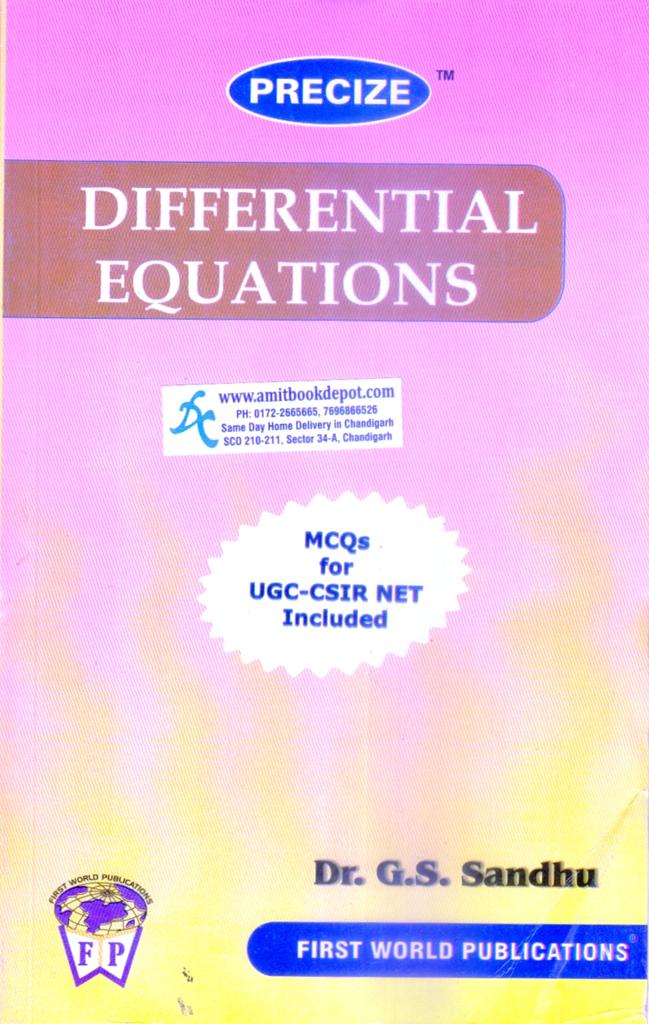

Yes, this book is specifically authored and structured to provide 100% coverage of the Panjab University syllabus for the Math 603S: Differential Equations course.
Absolutely. The book is comprehensively divided into sections that cover all topics from Unit-I (ODEs, Existence Theorems, Sturm-Liouville) and Unit-II (First and Second-Order PDEs) as prescribed.
Yes, the book dedicates a significant portion to PDEs of higher order with constant coefficients, providing systematic methods for finding their solutions, which is a key part of the syllabus.
While the focus is on delivering precise theoretical understanding as required for an MSc level, the book explains solution methodologies in a clear, application-oriented context relevant to the theorems.
The product description highlights its focus on theoretical exposition and syllabus coverage. For a wide range of practice problems, students might need to supplement it with additional problem books, as this text is designed for conceptual mastery.
Yes, the classification of second-order PDEs into parabolic, hyperbolic, and elliptic types is covered in detail, as it is a critical component of the syllabus.
Yes, the language is academic and rigorous, perfectly suited for MSc-level students, ensuring clarity while maintaining the depth required for advanced mathematics.
Yes, the first chapter is entirely dedicated to the Existence and Uniqueness of Solutions for first-order ODEs, providing a solid foundation before moving on to more advanced topics.
Yes, this often-challenging topic is addressed in a dedicated chapter, explaining the concepts and solution techniques for ordinary differential equations involving multiple variables.
The content is organized per the exam structure, emphasizing key areas from which questions are frequently drawn. Its precise nature aids in efficient revision and tackling both short and long-answer questions.
Yes, this book is specifically authored and structured to provide 100% coverage of the Panjab University syllabus for the Math 603S: Differential Equations course.
Absolutely. The book is comprehensively divided into sections that cover all topics from Unit-I (ODEs, Existence Theorems, Sturm-Liouville) and Unit-II (First and Second-Order PDEs) as prescribed.
Yes, the book dedicates a significant portion to PDEs of higher order with constant coefficients, providing systematic methods for finding their solutions, which is a key part of the syllabus.
While the focus is on delivering precise theoretical understanding as required for an MSc level, the book explains solution methodologies in a clear, application-oriented context relevant to the theorems.
The product description highlights its focus on theoretical exposition and syllabus coverage. For a wide range of practice problems, students might need to supplement it with additional problem books, as this text is designed for conceptual mastery.
Yes, the classification of second-order PDEs into parabolic, hyperbolic, and elliptic types is covered in detail, as it is a critical component of the syllabus.
Yes, the language is academic and rigorous, perfectly suited for MSc-level students, ensuring clarity while maintaining the depth required for advanced mathematics.
Yes, the first chapter is entirely dedicated to the Existence and Uniqueness of Solutions for first-order ODEs, providing a solid foundation before moving on to more advanced topics.
Yes, this often-challenging topic is addressed in a dedicated chapter, explaining the concepts and solution techniques for ordinary differential equations involving multiple variables.
The content is organized per the exam structure, emphasizing key areas from which questions are frequently drawn. Its precise nature aids in efficient revision and tackling both short and long-answer questions.