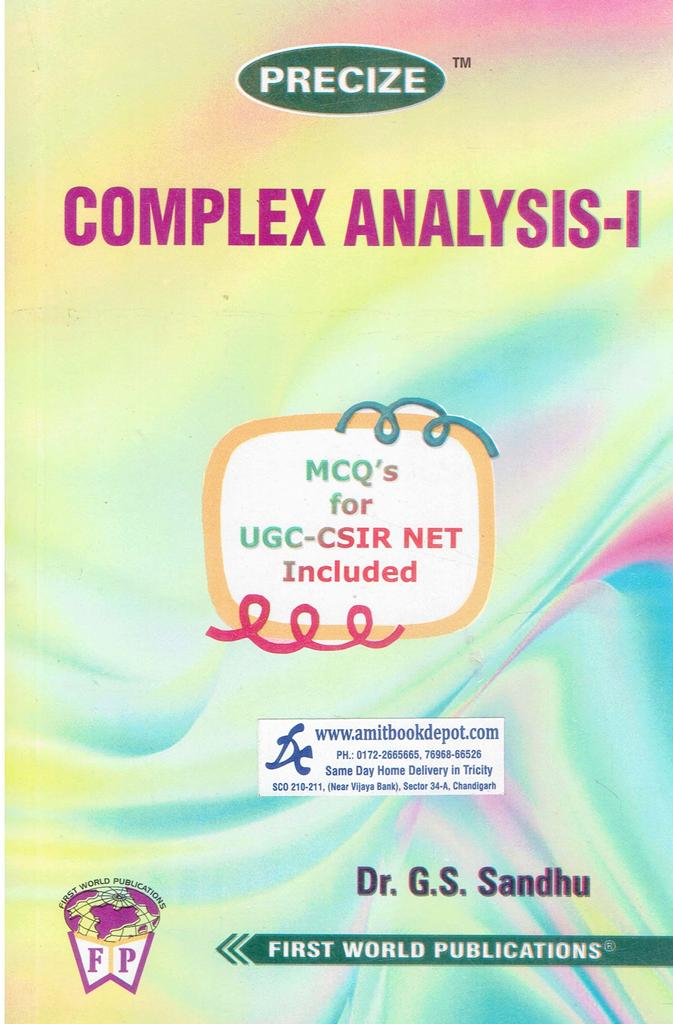
Precize Complex Analysis 1 for MSc Mathematics of Panjab University Chandigarh
Precize Complex Analysis 1 for MSc Mathematics of Panjab University Chandigarh
by Madhurima
₹395₹395.00(-/
off)
Rating & Reviews
23 Customer Review
Precise Complex Analysis 1 for MSc Mathematics by Dr G. S. Sandhu is a comprehensive book tailored for Panjab University, Chandigarh's latest syllabus. This guide offers a clear and rigors exploration of core topics, starting with the complex plane, topology, and analytic functions before advancing to complex integration, Cauchy's theorem, and Liouville’s theorem. Designed for exam success, it includes solved examples, derivations of key results like the Cauchy-Riemann equations, and a dedicated section of UGC NET MCQs. An indispensable resource for MSc students aiming to master complex analysis.
Precise Complex Analysis 1 for MSc Mathematics (Panjab University Chandigarh) is a meticulously crafted book designed to cater to the specific academic requirements of postgraduate mathematics students. Authored by Dr G. S. Sandhu and published by First World Publications, this book serves as an indispensable resource for mastering the foundational principles of complex analysis as prescribed by the latest syllabus of Panjab University, Chandigarh.
Aligned strictly with the Math 604S: Complex Analysis-I syllabus, this volume provides a focused and in-depth exploration of the subject. The book’s structure is carefully organised to facilitate progressive learning, beginning with the fundamental building blocks of the complex number system and advancing to sophisticated theorems and their applications.
The journey begins in Unit-I, where the text establishes a strong geometrical and topological foundation. Students are introduced to the complex plane and the geometric representation of complex numbers, including the joint equations of circles and straight lines. A significant emphasis is placed on visualising concepts like stereographic projection and the extended complex plane, which are crucial for advanced study. The discussion on the topology of the complex plane covers essential ideas such as connectedness, simply connected sets, and compactness, ensuring learners are well-versed in the properties of complex-valued functions, their limits, and continuity.
Building on this groundwork, the book delves into the core of the subject with a thorough examination of analytic functions. It meticulously explains the Cauchy-Riemann equations, their role in determining differentiability, and the derivation of harmonic functions and their conjugates. The exploration of power series establishes them as analytic functions within their radius of convergence, seamlessly leading to the study of elementary functions. This section provides a detailed analysis of the exponential function, trigonometric functions, hyperbolic functions, and the multi-valued nature of logarithmic functions and their branches, including logz and az.
Unit II of the book is dedicated to the powerful machinery of complex integration. It guides students through the computation of complex line integrals and presents the cornerstone of the subject: the Cauchy-Goursat theorem. The text clarifies the conditions and implications of Cauchy's theorem for rectangles and discs, leading to the concept of the winding number (index) of a curve. The profound results derived from these theorems are then explored, including Cauchy's integral formula and its generalisation, which allows for the calculation of higher-order derivatives of analytic functions. The theoretical power of complex analysis is fully displayed through subsequent topics like Liouville’s theorem, which is elegantly applied to prove the Fundamental Theorem of Algebra. The text also covers other essential results, such as Morera’s theorem, completing the comprehensive overview of integration theory.
A standout feature of this book is its exam-oriented approach. It includes a dedicated section of MCQs for UGC NET, providing students with valuable practice for competitive examinations. The content is presented in a clear, precise, and accessible manner, with numerous solved examples and step-by-step derivations that illuminate complex concepts. By strictly adhering to the Panjab University syllabus and incorporating the scope of key reference texts like "Foundations of Complex Analysis" by Ponnusamy S. and "Complex Analysis" by L. V. Ahlfors, Dr Sandhu has created a definitive guide that is both a perfect book for classroom study and an invaluable resource for exam preparation.
How does this book address the Panjab University syllabus for Math 604S?
A1
The book is strictly aligned with the latest Panjab University syllabus, organizing its content into two distinct units that mirror the official course structure.
Q2
What is the significance of the Cauchy-Riemann equations as explained in the book?
A2
The book explains the Cauchy-Riemann equations as the fundamental condition for determining the differentiability of a complex function, leading to the concept of analyticity.
Q3
How does the text explain the geometric representation of complex numbers?
A3
It dedicates a full chapter to geometric representation, covering the complex plane, stereographic projection, and the equations of straight lines and circles.
Q4
What advanced topics in complex integration are covered in Unit-II?
A4
Unit-II covers complex line integrals, Cauchy-Goursat theorem, Cauchy's integral formula, and the general form of Cauchy's theorem.
Q5
Does the book cover multi-valued functions like the complex logarithm?
A5
Yes, it provides a detailed analysis of elementary functions, including logarithmic functions, their branches, and inverse trigonometric functions.
Q6
How does the book define and use the concept of a curve's winding number?
A6
It introduces the winding number (index) of a curve as a crucial tool for the general statement of Cauchy's theorem and integral formula.
Q7
Are there practice questions specifically for competitive exams like UGC NET?
A7
Yes, the book includes a dedicated section of multiple-choice questions (MCQs) designed for UGC NET and other competitive examinations.
Q8
What preliminary topics on topology are covered before introducing analytic functions?
A8
It covers essential topology including open and closed sets, connectedness, compactness, and continuity to build a rigorous foundation.
Q9
Does the book cover power series and their properties as analytic functions?
A9
A dedicated chapter explores power series, demonstrating how they represent analytic functions within their radius of convergence.
Q10
How does the book help in understanding the geometric transformation of the complex plane?
A10
Through topics like stereographic projection and the representation of curves, it provides strong geometric intuition for complex mappings.
0.00
0 Overall Rating
5
0
4
0
3
0
2
0
1
0
Try this product & share your review &
thoughts
1. COMPLEX NUMBERS
- 1. Introduction
- 2. Complex Field
- 3. Geometric Representation of Complex Numbers
- 4. Square Roots of a Complex Number
- 5. Rational Powers of a Complex Number
- 6. Straight Line and Circle in Complex Plane
- 7. Extended Complex Plane
- 8. Stereographic Projection
2. TOPOLOGY ON THE COMPLEX PLANE
- 1. Metric Space
- 2. Some Basic Definitions
- 3. Open and Closed Sets
- 4. Connectedness
- 5. Bolzano-Weierstrass Theorem
- 6. Compactness
- 7. Complex Valued Functions
- 8. Limit
- 9. Continuity
- 10. Uniform Continuity
- 11. Curve
- 12. Connectivity Through Polygonal Lines
3. ANALYTIC FUNCTIONS
- 1. Differentiability
- 2. Analytic Functions
- 3. Harmonic Function
4. POWER SERIES
- 1. Power Series as an Analytic Function
5. ELEMENTARY FUNCTIONS OF A COMPLEX VARIABLE
- 1. Exponential Function
- 2. Trigonometric Functions
- 3. Hyperbolic Functions
- 4. Logarithmic Functions
- 5. Inverse Trigonometric Functions
6. COMPLEX INTEGRATION
- 1. Curves in the Complex Plane
- 2. Complex Line Integral
- 3. Cauchy Theorem or Cauchy-Goursat Theorem
- 4. Simply Connected Domains
- 5. Winding Number (Index) of a Curve
- 6. Cauchy’s Integral Formula
- 7. General Form of Cauchy’s Theorem
- 8. Liouville’s Theorem
- 9. Fundamental Theorem of Algebra
MCQs for UGC NET
Latest Syllabus of Complex Analysis 1 for MSc Mathematics of Panjab University Chandigarh
Math 604S: Complex Analysis- I
Total Marks: 100
Theory: 80 Marks
Internal Assessment: 20 Marks
Time: 3 hrs.
Note:
1. The question paper will consist of 9 questions. Candidates will attempt a total of five questions.
2. Question No. 1 is compulsory and will consist of short answer-type questions covering the whole syllabus.
3. There will be four questions from each unit, and the candidates will be required to attempt two questions from each unit.
4. All questions carry equal marks.
UNIT-I
Complex plane, geometric representation of complex numbers, joint equation of circle and straight line, stereographic projection and the spherical representation of the extended complex plane. Topology on the complex plane, connected and simply connected sets. Complex-valued functions and their continuity. Curves, connectivity through polygonal lines. Analytic functions, Cauchy-Riemann equations, harmonic functions and harmonic conjugates. Power series, exponential and trigonometric functions, arg z, log z, az and their continuous branches.
(Scope as in “Foundations of Complex Analysis” by Ponnusamy S., Chapter 1, (§1.1-§1.5), Chapter 2 (§2.2, §2.3), Chapter 3 (§3.1-§3.5), and Chapter 4 (§4.9).)
UNIT-II
Complex integration, line integral, Cauchy’s theorem for a rectangle, Cauchy’s theorem in a disc, index of a point with respect to a closed curve, Cauchy’s integral formula, higher derivatives, Morera's theorem, Liouville’s theorem, and the fundamental theorem of algebra. The general form of Cauchy’s theorem.
(Scope as in “Foundations of Complex Analysis” by Ponnusamy S., Chapter 4, (§4.1-§4.1-§4.8), Chapter 6 (§6.4, §6.6).). ”Complex Analysis” by L. V. Ahlfors, Chapter 4 (§1, 2, 4.1 to 4.5 and §5.1)
Precise Complex Analysis 1 for MSc Mathematics (Panjab University Chandigarh) is a meticulously crafted book designed to cater to the specific academic requirements of postgraduate mathematics students. Authored by Dr G. S. Sandhu and published by First World Publications, this book serves as an indispensable resource for mastering the foundational principles of complex analysis as prescribed by the latest syllabus of Panjab University, Chandigarh.
Aligned strictly with the Math 604S: Complex Analysis-I syllabus, this volume provides a focused and in-depth exploration of the subject. The book’s structure is carefully organised to facilitate progressive learning, beginning with the fundamental building blocks of the complex number system and advancing to sophisticated theorems and their applications.
The journey begins in Unit-I, where the text establishes a strong geometrical and topological foundation. Students are introduced to the complex plane and the geometric representation of complex numbers, including the joint equations of circles and straight lines. A significant emphasis is placed on visualising concepts like stereographic projection and the extended complex plane, which are crucial for advanced study. The discussion on the topology of the complex plane covers essential ideas such as connectedness, simply connected sets, and compactness, ensuring learners are well-versed in the properties of complex-valued functions, their limits, and continuity.
Building on this groundwork, the book delves into the core of the subject with a thorough examination of analytic functions. It meticulously explains the Cauchy-Riemann equations, their role in determining differentiability, and the derivation of harmonic functions and their conjugates. The exploration of power series establishes them as analytic functions within their radius of convergence, seamlessly leading to the study of elementary functions. This section provides a detailed analysis of the exponential function, trigonometric functions, hyperbolic functions, and the multi-valued nature of logarithmic functions and their branches, including logz and az.
Unit II of the book is dedicated to the powerful machinery of complex integration. It guides students through the computation of complex line integrals and presents the cornerstone of the subject: the Cauchy-Goursat theorem. The text clarifies the conditions and implications of Cauchy's theorem for rectangles and discs, leading to the concept of the winding number (index) of a curve. The profound results derived from these theorems are then explored, including Cauchy's integral formula and its generalisation, which allows for the calculation of higher-order derivatives of analytic functions. The theoretical power of complex analysis is fully displayed through subsequent topics like Liouville’s theorem, which is elegantly applied to prove the Fundamental Theorem of Algebra. The text also covers other essential results, such as Morera’s theorem, completing the comprehensive overview of integration theory.
A standout feature of this book is its exam-oriented approach. It includes a dedicated section of MCQs for UGC NET, providing students with valuable practice for competitive examinations. The content is presented in a clear, precise, and accessible manner, with numerous solved examples and step-by-step derivations that illuminate complex concepts. By strictly adhering to the Panjab University syllabus and incorporating the scope of key reference texts like "Foundations of Complex Analysis" by Ponnusamy S. and "Complex Analysis" by L. V. Ahlfors, Dr Sandhu has created a definitive guide that is both a perfect book for classroom study and an invaluable resource for exam preparation.
How does this book address the Panjab University syllabus for Math 604S?
A1
The book is strictly aligned with the latest Panjab University syllabus, organizing its content into two distinct units that mirror the official course structure.
Q2
What is the significance of the Cauchy-Riemann equations as explained in the book?
A2
The book explains the Cauchy-Riemann equations as the fundamental condition for determining the differentiability of a complex function, leading to the concept of analyticity.
Q3
How does the text explain the geometric representation of complex numbers?
A3
It dedicates a full chapter to geometric representation, covering the complex plane, stereographic projection, and the equations of straight lines and circles.
Q4
What advanced topics in complex integration are covered in Unit-II?
A4
Unit-II covers complex line integrals, Cauchy-Goursat theorem, Cauchy's integral formula, and the general form of Cauchy's theorem.
Q5
Does the book cover multi-valued functions like the complex logarithm?
A5
Yes, it provides a detailed analysis of elementary functions, including logarithmic functions, their branches, and inverse trigonometric functions.
Q6
How does the book define and use the concept of a curve's winding number?
A6
It introduces the winding number (index) of a curve as a crucial tool for the general statement of Cauchy's theorem and integral formula.
Q7
Are there practice questions specifically for competitive exams like UGC NET?
A7
Yes, the book includes a dedicated section of multiple-choice questions (MCQs) designed for UGC NET and other competitive examinations.
Q8
What preliminary topics on topology are covered before introducing analytic functions?
A8
It covers essential topology including open and closed sets, connectedness, compactness, and continuity to build a rigorous foundation.
Q9
Does the book cover power series and their properties as analytic functions?
A9
A dedicated chapter explores power series, demonstrating how they represent analytic functions within their radius of convergence.
Q10
How does the book help in understanding the geometric transformation of the complex plane?
A10
Through topics like stereographic projection and the representation of curves, it provides strong geometric intuition for complex mappings.
Latest Syllabus of Complex Analysis 1 for MSc Mathematics of Panjab University Chandigarh
Math 604S: Complex Analysis- I
Total Marks: 100
Theory: 80 Marks
Internal Assessment: 20 Marks
Time: 3 hrs.
Note:
1. The question paper will consist of 9 questions. Candidates will attempt a total of five questions.
2. Question No. 1 is compulsory and will consist of short answer-type questions covering the whole syllabus.
3. There will be four questions from each unit, and the candidates will be required to attempt two questions from each unit.
4. All questions carry equal marks.
UNIT-I
Complex plane, geometric representation of complex numbers, joint equation of circle and straight line, stereographic projection and the spherical representation of the extended complex plane. Topology on the complex plane, connected and simply connected sets. Complex-valued functions and their continuity. Curves, connectivity through polygonal lines. Analytic functions, Cauchy-Riemann equations, harmonic functions and harmonic conjugates. Power series, exponential and trigonometric functions, arg z, log z, az and their continuous branches.
(Scope as in “Foundations of Complex Analysis” by Ponnusamy S., Chapter 1, (§1.1-§1.5), Chapter 2 (§2.2, §2.3), Chapter 3 (§3.1-§3.5), and Chapter 4 (§4.9).)
UNIT-II
Complex integration, line integral, Cauchy’s theorem for a rectangle, Cauchy’s theorem in a disc, index of a point with respect to a closed curve, Cauchy’s integral formula, higher derivatives, Morera's theorem, Liouville’s theorem, and the fundamental theorem of algebra. The general form of Cauchy’s theorem.
(Scope as in “Foundations of Complex Analysis” by Ponnusamy S., Chapter 4, (§4.1-§4.1-§4.8), Chapter 6 (§6.4, §6.6).). ”Complex Analysis” by L. V. Ahlfors, Chapter 4 (§1, 2, 4.1 to 4.5 and §5.1)
0.00
0 Overall Rating
5
0
4
0
3
0
2
0
1
0
Try this product & share your review &
thoughts
Top Trending Product
Related
Product
Related Product
Related Blog Posts
Latest Blogs
Latest Blogs
Classic Literature Reimagined: Discuss modern twists on classic novels.
Lorem ipsum dolor sit amet, consectetur adipiscing elit, sed
do
eiusmod tempor incididunt ut labore et dolore magna aliqua. Ut enim ad minim
veniam, quis nostrud exercitation ullamco Lorem ipsum dolor sit amet,
consectetur adipiscing elit, sed do eiusmod tempor incididunt ut labore et
dolore magna aliqua. Utenim ad minim veniam, quis nostrud exercitation
ullamco
Lorem ipsum dolor sit amet, consecte...
Classic Literature Reimagined: Discuss modern twists on classic novels.
Lorem ipsum dolor sit amet, consectetur adipiscing elit, sed
do
eiusmod tempor incididunt ut labore et dolore magna aliqua. Ut enim ad minim
veniam, quis nostrud exercitation ullamco Lorem ipsum dolor sit amet,
consectetur adipiscing elit, sed do eiusmod tempor incididunt ut labore et
dolore magna aliqua. Utenim ad minim veniam, quis nostrud exercitation
ullamco
Lorem ipsum dolor sit amet, consecte...
Classic Literature Reimagined: Discuss modern twists on classic novels.
Lorem ipsum dolor sit amet, consectetur adipiscing elit, sed
do
eiusmod tempor incididunt ut labore et dolore magna aliqua. Ut enim ad minim
veniam, quis nostrud exercitation ullamco Lorem ipsum dolor sit amet,
consectetur adipiscing elit, sed do eiusmod tempor incididunt ut labore et
dolore magna aliqua. Utenim ad minim veniam, quis nostrud exercitation
ullamco
Lorem ipsum dolor sit amet, consecte...



.jpg)