Categories
College Bookssss >
BA PU Chandigarh
BSC PU Chandigarh
MSC PU Chandigarh
BBA PU Chandigarh
MA PU Chandigarh
Medical Books
Engineering Books
Management Books
PGDCA Books
BCOM PU Chandigarh
MCOM PU Chandigarh
BCA PU Chandigarh
MCA PU Chandigarh
animate-books

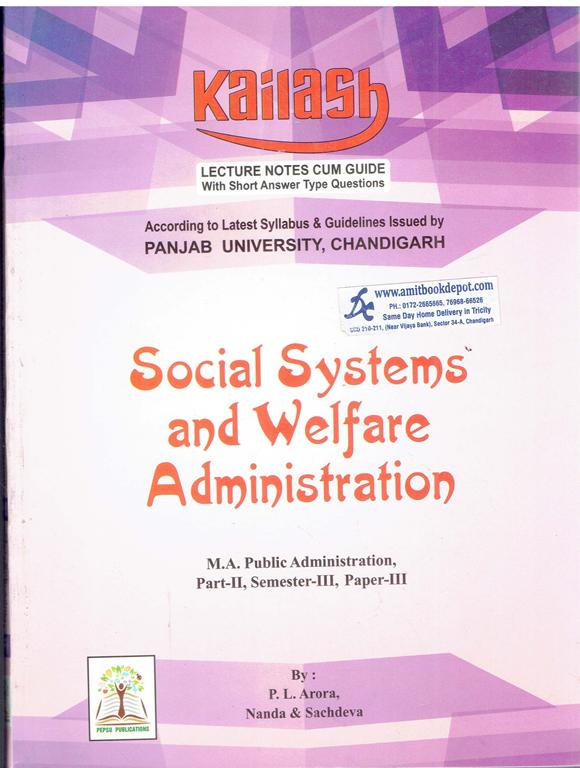
Kailash Social Systems and Welfare Administration For MA Public Administration 3rd Semester Paper 3 Panjab University Chandigarh (Punjabi Medium)

by Madhurima
₹500 ₹500.00(-/ off)

Rating & Reviews

23 Customer Review

Kailash Social Systems and Welfare Administration is the prescribed Punjabi-medium book for MA Public Administration, 3rd Semester, Paper 3 at Panjab University, Chandigarh. Authored by P. L. Arora, Nanda, and Sachdeva and published by Pepsu Book Depot, it provides complete coverage of the syllabus. The book expertly explains the relevance of sociology to public administration, core concepts like social structure, stratification (caste & class), social change, key social policies, legislation (SDGs, Domestic Violence Act, Juvenile Justice Act), and the structure of welfare administration in India. Its Q&A format is ideal for exam preparation.

Have Doubts Regarding This Product ? Ask Your Question

  • Q1
    Is this book the latest edition and perfectly aligned with the current MA Public Administration 3rd Semester syllabus for Punjabi Medium at Panjab University?
    A1

    Yes, this book is specifically compiled and updated to match the prescribed syllabus and paper pattern for Panjab University's Punjabi Medium MA Public Administration, Semester 3, Paper 3.

  • Q2
    Does the book cover all four units of the "Social Systems and Welfare Administration" syllabus, including recent policies?
    A2

    Absolutely. The book is divided into four units covering Social Structure, Social Change, Social Policy & Legislation, and Welfare Administration, including contemporary focuses like Sustainable Development Goals (SDGs) and recent acts.

  • Q3
    How is the content presented? Is it in a theory-heavy format or more exam-focused?
    A3

    The content is highly exam-centric. The Table of Contents itself is structured in a Q&A format, listing potential long and short answer questions directly, making revision and preparation systematic.

  • Q4
    Are concepts like Westernization, Sanskritization, and Secularization explained in the context of Indian society?
    A4

    Yes, Unit II has dedicated sections that explain these key processes of social change in Contemporary Indian Society, discussing their features, impacts, and relevance to administration.

  • Q5
    Does the book provide a critical analysis of the Reservation policy for SC, ST, and OBCs?
    A5

    Yes, Unit III includes a section titled "Reservation for SC, ST and OBC: Critical Analysis of Policy and Administration," which discusses various perspectives and administrative aspects.

  • Q6
    Are important legislations like the Domestic Violence Act and Juvenile Justice Act included?
    A6

    Yes, the book contains separate chapters detailing the Protection of Women from Domestic Violence Act, 2005, and The Juvenile Justice (Care and Protection of Children) Act, 2015.

  • Q7
    Does the book help in answering short-answer-type questions for the compulsory part of the exam?
    A7

    Yes, the book includes a dedicated section for "Short Answer Type Questions" covering the entire syllabus, which is crucial for the compulsory question paper section.

  • Q8
    Is the language clear and tailored for Punjabi-medium students who might be learning these sociological concepts for the first time?
    A8

    The book is written in clear, academic Punjabi, designed to make complex sociological and administrative concepts accessible to students of the medium.

  • Q9
    Does it discuss the practical implementation of social welfare programs by the Union Ministry of Social Justice?
    A9

    Yes, Unit IV includes an analysis of the Union Ministry of Social Justice and Empowerment, discussing its aims, provisions, and major programs implemented.

  • Q10
    Is Marx's theory of Class Struggle covered as per the syllabus?
    A10

    Yes, there is a complete chapter on "Violent Class Struggle" that examines Marx's theory in detail, as required in Unit II of the syllabus.


0.00

0 Overall Rating
  • 5
    0
  • 4
    0
  • 3
    0
  • 2
    0
  • 1
    0

Try this product & share your review & thoughts

UNIT - I
1. Relevance of Sociology to Public Administration
Q. Discuss the Relevance of Sociology to Public Administration.
or 
Describe the meaning and definitions of Public Administration and Sociology and also discuss its relationship.
or 
Give meaning and definitions of Public Administration and Sociology.

Q. Discuss the meaning of Public Administration.
Q. Define Public Administration. Discuss its Scope and Importance.
Or
Define Public Administration. Discuss its Nature and Scope.
Q. Discuss the Importance of Public Administration.
Q. Define Sociology. Discuss is its scope.

2. (Concept and Elements of Social Structure)

Q. Define Social Structure. Discuss its Characteristics.
Q. What is meant by Social Structure? Describe its main Elements.
or
Describe the kinds and levels of Social Structure.

3. (Social Structure : Groups)

Q. Discuss the meaning of Social Group and give the Characteristics.
or
Define Social Group. Examine the main characteristics of Group.

Q. Define Group and give the Classification of Groups.
or
What do you mean by Group ? Describe Its kinds.

Q. What do you know about Primary Group? Describe its Characteristics.
or 
Define Primary Group. Discuss the main Features and Functions or Importance.

Q. Define Secondary Group. Describe its Characteristics.
or
What do you know about Secondary Groups ? Discuss the main Characteristics and Importance of Secondary Groups.

Q. Define Social Group. Describe the Ingroup and Out Group.
or
Write a note on In Group and Out Groups.

4. (Elements of Social Structure : Status and Role)

Q. What is meant by Status? Describe its Determinants.
or
Define Status. How is Status determined?
or
What is meant by Status? Discuss its characteristics or essential elements.

Q. Describe the main Kinds of Status.
Q. What is meant by Ascribed Status? Describe its main Basis.
Q. What is meant by Achieved Status? Describe the main basis of Achieved status.
Q. Define Status. Describe the Differences and Inter-relationship between Ascribed and Achieved Status.
Q. What do you understand by Role? Describe its Characteristics.
or
Define Role. Discuss the Sociological Importance of Role Performance.

5. (Norms and Values)

Q. Define Social Norms. Discuss its main characteristics.
or
What do you mean by Social Norms. Describe its essential features. 

Q. Classify the Norms.
or
Describe the Types of Norms.

Q. Discuss the Sociological Importance of Social Norms.
Q. Define Social Values. Discuss its main features.
Q. What is meant by Values? Describe the Classification of Values.
Q. Describe the Functions or Importance of Values.

6. (Social Stratification : Concept)

Q. What is meant by Social Stratification?
or
Describe the meanings of Social Stratification.

Q. What is meant by Social Stratification? Describe the various features of Social Stratification.
or
Discuss characteristics of Social Stratification.
or
Define Social Stratification. Discuss its main characteristics.

Q. What is meant by Social Stratification? Discuss the main bases of Social Stratification.
Q. Explain the various forms of Social Stratification.
Q. What do you mean by Social Stratification? Discuss its Functions.
or
What do you understand by Social Stratification? Discuss its Features and Functions.
or
Discuss the Functions and Dysfunctions of Social Stratification.

Q. Enumerate the Consequences of Social Stratification.

7. (Social Stratification : Caste)
Q. Describe stratification based on Caste.

8. (Social Stratification : Class)

Q. What do you understand by Class? Differentiate between the Class and Caste.
or
Define Class. Discuss main Characteristics of Social Class.
or
Explain the Concept of Class.

9. (Difference and Convergence between Caste and Class)
Q.  Discuss about difference and convergence between Caste and Class in Social Stratification.
or
Write a note upon difference and convergence between Caste and Class.

10. (Welfare State : Concept and Philosophy)
Q. What is meant by Welfare State. Describe its Aims.
or
Discuss on the Concept and Philosophy of Welfare State.
or
Defining Welfare State describe about its Aims.

Q. :- Describe about Functions of Modern Welfare State.

UNIT-II
11. (Social Change: Concept, Sources, Resistance)

Q. Clarify the meaning of Social Change. Discuss its various kinds.
or
Define Social Change.

Q. :- Define Social Change. Discuss its Nature.
Q. :- Define Social Change. Discuss its Characteristics.
Q. :- Describe about the Sources of Social Change.
or
What do you know about the Sources of Social Change.

Q. :- Discuss the main resistance of Social Change.
or
What do you know about Resistance of Social Change.

12. (Social Change in Contemporary Indian Society)
Q. :- Clarify the meaning of Social Change. Discuss its various kinds.
or
Define Social Change.

Q. What do you mean by Westernization? Discuss its features and elements.
or
What is meant by Westernization? What are its features?

Q. Describe the Impacts and Consequences of Westernization.
Q. Discuss the effect of Westernization on Family and Marriage.
Q. Define Modernisation. Discuss its characteristics.
or
Define Modernisation. What are the features of Modernisation in India?

Q. :- Describe the process of Modernization in India.
Q. :-What do you mean by Sanskritization? How does it bring Social Change?
Q. :-What do you mean by Secularization? Discuss its reasons. How does it bring social changes?
or
Describe the main features of Secularization.

13. (Social Tension and Resolutions: Communalism)
Q. :- What is the meaning of Communalism. Discuss the causes of its rise in India.
Q. :- Discuss the Characteristics of Communalism.
Q. :- Write a note upon Causes of Communalism.
Q. :- Write about Evil Consequences of Communalism.

14. (Social Tensions and Resolutions : Regionalism)
Q. :- Write a detailed note on the Regionalism in India.
or
What is the meaning of Regionalism? Discuss the causes of its rise in India..
or
Define Regionalism. Discuss its causes and Evil Consequences. Describe some measures to solve this problem.

Q. :- Discuss on the Kinds of Regionalism.

15. (Violent Class Struggle)
Q. :- Discuss Marx's theory of Class and Violent Class Struggle.
or
Examine Marx's views on Class Struggle.
or
Write a note on the theory of Class Struggle as expounded by Marx
or
Discuss Marx's concept of Class War. How did it reflect in his views on State.

UNIT-III
16. (Social Policy and Legislation in India: Sustainable Development Goals, SDG)

Q. :-Write an Essay upon the Concept and Significance of Sustainable Development.
Q. :-Describe Social, Economic and Political approaches of the Sustainable Development.
Q. :-Throw light upon Sustainable Development Goals.
or
What do you mean by Sustainable Development Goals?

17. (Reservation for SC, ST and OBC: Critical Analysis of Policy and Administration)

Q. :- Discuss the effects of the Dalits / Backward Classes & Reservation.
or
Make a care far and against Reservation.

18. (Protection of Women from Domestic Violence Act, 2005)

Q. :- What is meant by Domestic Violence. Discuss its meaning and Definitions.

19. (The Juvenile Justice (Care and Protection of Children) Act, 2015)

Q. :- Discuss about the Juvenile Justice (Care and Protection of Children) Act 2015.
or
Write a note upon provisions of Juvenile Justice (Care and Protection of Children) Act, 2015.

UNIT-IV
20. (Union Ministry of Social Justice and Empowerment)

Q. :- Write a note upon Union Ministry of Social Justice and Empowerment.
or
Discuss on the policies and Aims of Union Ministry of Social Justice and Empowerment.
or
Give introduction about Union Ministry of Social Justice and Empowerment.

Q.:- Write a short note on the aims of Social Welfare Administration at Union Level?

21. (State Social Welfare Department)
Q.:- Write an essay upon State Social Welfare Department.

22. (Central Social Welfare Board)
Q.:- Describe the composition, functions and achievements of Central Social Welfare Board.
Q. :- Discuss on Central Social Welfare Board.

23. (State Social Welfare Board)
Q. :- Write an essay on State Social Welfare Advisory Board.
Q. :- Give Introduction about State Social Welfare Board.

(Short Answer Type Questions)

Latest Syllabus of Social Systems and Welfare Administration For MA Public Administration 3rd Semester Paper 3 Panjab University (PU) Chandigarh (Punjabi Medium)


PAPER–III
Social Systems and Welfare Administration

INSTRUCTIONS FOR PAPER-SETTERS AND CANDIDATES
- The maximum marks for the paper will be 100. The question paper will be of 80 marks and the internal assessment of 20 marks. Time allowed will be 3 hours. For
private students who have not been assessed for the internal assessment, the marks secured by them in the paper will be proportionately increased in lieu of the internal assessment.

The paper-setter must put a note in the question paper in this regard.
- The candidate shall attempt 5 questions in all (one compulsory and one each from four units). The compulsory question shall comprise 15 short-answer-type 
questions, covering the whole syllabus, to be answered in 25-30 words each, out of which the candidate would be required to attempt any 10. Each question will carry 2 marks. The rest of the paper shall contain 4 units, each unit having two questions, out of which the candidate would be expected to attempt one. Each question from the units will carry 15 marks. 
Objectives of the Paper: The endeavor is to make the student understand the multidisciplinary nature of the subject of public administration and the relationship between sociology and public administration. The students will be apprised about the basic concepts of social structure, social change in contemporary Indian society, and social tensions and their relevance in the field of public administration. Apart from the lecture methods, presentations and documentaries (audio-visual aids), case studies, and special lectures by experts will be organized. The students will develop public speaking and analytical skills to understand Indian society and link this with social policy and administration. 

Unit I

Relevance of Sociology to Public Administration
Concept and Elements of Social Structure: Groups, Status and Role, Norms and Values
Social Stratification: Caste and Class—Difference and Convergence
Welfare State: Concept & Philosophy

Unit II

Social Change: Concept; Sources; Resistance
Social Change in Contemporary Indian Society
Social Tensions and Resolutions – Communalism; Regionalism; Violent Class Struggle

Unit III

Social Policy and Legislation in India: An Overview with Special Focus on SDGs
Reservation for SC, ST, and OBC: Critical Analysis of Policy and Administration
Protection of Women from Domestic Violence Act, 2005
The Juvenile Justice (Care and Protection of Children) Act, 2013

Unit IV

Union Ministry of Social Justice and Empowerment: An Analysis of Provisions and
Implementation Structures for Social Policy: Major programs implemented
State Social Welfare Department
Central Social Welfare Board; State Social Welfare Board 

Kailash Social Systems and Welfare Administration is a comprehensive and authoritative book meticulously designed for students pursuing an MA in Public Administration, 3rd Semester, Paper 3 at Panjab University, Chandigarh, specifically for the Punjabi Medium curriculum. Authored by the esteemed scholars P. L. Arora, Nanda, and Sachdeva, and published by Pepsu Book Depot, this book is an indispensable resource that bridges the critical gap between sociological theory and the practical realm of public administration and social welfare.

This book is structured to align perfectly with the prescribed university syllabus, providing exhaustive coverage of all four units. It begins by establishing the relevance of sociology to public administration, exploring foundational concepts such as social structure, including groups (primary and secondary, in-group and out-group), status and role, social norms, and values. It delves deeply into social stratification, offering detailed analyses of caste and class systems, and examines their difference and convergence. The unit concludes with a philosophical and functional exploration of the welfare state.

Unit II focuses on dynamics, beginning with the concept, sources, and resistance to social change. It provides a crucial understanding of transformative processes in contemporary Indian society, including Westernization, modernization, Sanskritization, and secularization. This unit is vital for administrators, as it addresses pressing social tensions and resolutions, with dedicated chapters on communalism, regionalism, and Marx's theory of violent class struggle.

Moving from theory to policy, Unit III offers an in-depth overview of social policy and legislation in India. It includes a focused discussion on the Sustainable Development Goals (SDGs) and their significance. The book provides a critical analysis of the policy and administration of reservation for SC, ST, and OBC. Furthermore, it contains detailed explanations of key legislation: the Protection of Women from Domestic Violence Act, 2005, and the Juvenile Justice (Care and Protection of Children) Act, 2015, equipping future administrators with essential legal knowledge.

Unit IV immerses the student in the practical machinery of Welfare Administration. It features an analytical study of the Union Ministry of Social Justice and Empowerment, its programs, and implementation structures. The administrative framework is further detailed with chapters on the State Social Welfare Department, the Central Social Welfare Board, and the State Social Welfare Board.

The unique pedagogical strength of this book lies in its examination-oriented presentation. The Table of Contents is organized as a direct reflection of probable university questions, with each heading presented in a clear Q&A format. This includes both long essay-type questions and short answer-type questions, making it an exceptional tool for systematic revision and exam preparation. The content is tailored to help students develop the analytical skills required to link sociological concepts with administrative practice, as outlined in the paper's objectives.

For MA Public Administration students at Panjab University, this Punjabi-medium book is not merely a book but a complete guide. It serves as a one-stop solution for mastering Paper 3, ensuring conceptual clarity on social systems and practical knowledge of welfare administration in the Indian context. Published by Pepsu Book Depot, this volume stands as the definitive and most reliable resource for achieving academic success in this interdisciplinary and critically important subject.

UNIT - I
1. Relevance of Sociology to Public Administration
Q. Discuss the Relevance of Sociology to Public Administration.
or 
Describe the meaning and definitions of Public Administration and Sociology and also discuss its relationship.
or 
Give meaning and definitions of Public Administration and Sociology.

Q. Discuss the meaning of Public Administration.
Q. Define Public Administration. Discuss its Scope and Importance.
Or
Define Public Administration. Discuss its Nature and Scope.
Q. Discuss the Importance of Public Administration.
Q. Define Sociology. Discuss is its scope.

2. (Concept and Elements of Social Structure)

Q. Define Social Structure. Discuss its Characteristics.
Q. What is meant by Social Structure? Describe its main Elements.
or
Describe the kinds and levels of Social Structure.

3. (Social Structure : Groups)

Q. Discuss the meaning of Social Group and give the Characteristics.
or
Define Social Group. Examine the main characteristics of Group.

Q. Define Group and give the Classification of Groups.
or
What do you mean by Group ? Describe Its kinds.

Q. What do you know about Primary Group? Describe its Characteristics.
or 
Define Primary Group. Discuss the main Features and Functions or Importance.

Q. Define Secondary Group. Describe its Characteristics.
or
What do you know about Secondary Groups ? Discuss the main Characteristics and Importance of Secondary Groups.

Q. Define Social Group. Describe the Ingroup and Out Group.
or
Write a note on In Group and Out Groups.

4. (Elements of Social Structure : Status and Role)

Q. What is meant by Status? Describe its Determinants.
or
Define Status. How is Status determined?
or
What is meant by Status? Discuss its characteristics or essential elements.

Q. Describe the main Kinds of Status.
Q. What is meant by Ascribed Status? Describe its main Basis.
Q. What is meant by Achieved Status? Describe the main basis of Achieved status.
Q. Define Status. Describe the Differences and Inter-relationship between Ascribed and Achieved Status.
Q. What do you understand by Role? Describe its Characteristics.
or
Define Role. Discuss the Sociological Importance of Role Performance.

5. (Norms and Values)

Q. Define Social Norms. Discuss its main characteristics.
or
What do you mean by Social Norms. Describe its essential features. 

Q. Classify the Norms.
or
Describe the Types of Norms.

Q. Discuss the Sociological Importance of Social Norms.
Q. Define Social Values. Discuss its main features.
Q. What is meant by Values? Describe the Classification of Values.
Q. Describe the Functions or Importance of Values.

6. (Social Stratification : Concept)

Q. What is meant by Social Stratification?
or
Describe the meanings of Social Stratification.

Q. What is meant by Social Stratification? Describe the various features of Social Stratification.
or
Discuss characteristics of Social Stratification.
or
Define Social Stratification. Discuss its main characteristics.

Q. What is meant by Social Stratification? Discuss the main bases of Social Stratification.
Q. Explain the various forms of Social Stratification.
Q. What do you mean by Social Stratification? Discuss its Functions.
or
What do you understand by Social Stratification? Discuss its Features and Functions.
or
Discuss the Functions and Dysfunctions of Social Stratification.

Q. Enumerate the Consequences of Social Stratification.

7. (Social Stratification : Caste)
Q. Describe stratification based on Caste.

8. (Social Stratification : Class)

Q. What do you understand by Class? Differentiate between the Class and Caste.
or
Define Class. Discuss main Characteristics of Social Class.
or
Explain the Concept of Class.

9. (Difference and Convergence between Caste and Class)
Q.  Discuss about difference and convergence between Caste and Class in Social Stratification.
or
Write a note upon difference and convergence between Caste and Class.

10. (Welfare State : Concept and Philosophy)
Q. What is meant by Welfare State. Describe its Aims.
or
Discuss on the Concept and Philosophy of Welfare State.
or
Defining Welfare State describe about its Aims.

Q. :- Describe about Functions of Modern Welfare State.

UNIT-II
11. (Social Change: Concept, Sources, Resistance)

Q. Clarify the meaning of Social Change. Discuss its various kinds.
or
Define Social Change.

Q. :- Define Social Change. Discuss its Nature.
Q. :- Define Social Change. Discuss its Characteristics.
Q. :- Describe about the Sources of Social Change.
or
What do you know about the Sources of Social Change.

Q. :- Discuss the main resistance of Social Change.
or
What do you know about Resistance of Social Change.

12. (Social Change in Contemporary Indian Society)
Q. :- Clarify the meaning of Social Change. Discuss its various kinds.
or
Define Social Change.

Q. What do you mean by Westernization? Discuss its features and elements.
or
What is meant by Westernization? What are its features?

Q. Describe the Impacts and Consequences of Westernization.
Q. Discuss the effect of Westernization on Family and Marriage.
Q. Define Modernisation. Discuss its characteristics.
or
Define Modernisation. What are the features of Modernisation in India?

Q. :- Describe the process of Modernization in India.
Q. :-What do you mean by Sanskritization? How does it bring Social Change?
Q. :-What do you mean by Secularization? Discuss its reasons. How does it bring social changes?
or
Describe the main features of Secularization.

13. (Social Tension and Resolutions: Communalism)
Q. :- What is the meaning of Communalism. Discuss the causes of its rise in India.
Q. :- Discuss the Characteristics of Communalism.
Q. :- Write a note upon Causes of Communalism.
Q. :- Write about Evil Consequences of Communalism.

14. (Social Tensions and Resolutions : Regionalism)
Q. :- Write a detailed note on the Regionalism in India.
or
What is the meaning of Regionalism? Discuss the causes of its rise in India..
or
Define Regionalism. Discuss its causes and Evil Consequences. Describe some measures to solve this problem.

Q. :- Discuss on the Kinds of Regionalism.

15. (Violent Class Struggle)
Q. :- Discuss Marx's theory of Class and Violent Class Struggle.
or
Examine Marx's views on Class Struggle.
or
Write a note on the theory of Class Struggle as expounded by Marx
or
Discuss Marx's concept of Class War. How did it reflect in his views on State.

UNIT-III
16. (Social Policy and Legislation in India: Sustainable Development Goals, SDG)

Q. :-Write an Essay upon the Concept and Significance of Sustainable Development.
Q. :-Describe Social, Economic and Political approaches of the Sustainable Development.
Q. :-Throw light upon Sustainable Development Goals.
or
What do you mean by Sustainable Development Goals?

17. (Reservation for SC, ST and OBC: Critical Analysis of Policy and Administration)

Q. :- Discuss the effects of the Dalits / Backward Classes & Reservation.
or
Make a care far and against Reservation.

18. (Protection of Women from Domestic Violence Act, 2005)

Q. :- What is meant by Domestic Violence. Discuss its meaning and Definitions.

19. (The Juvenile Justice (Care and Protection of Children) Act, 2015)

Q. :- Discuss about the Juvenile Justice (Care and Protection of Children) Act 2015.
or
Write a note upon provisions of Juvenile Justice (Care and Protection of Children) Act, 2015.

UNIT-IV
20. (Union Ministry of Social Justice and Empowerment)

Q. :- Write a note upon Union Ministry of Social Justice and Empowerment.
or
Discuss on the policies and Aims of Union Ministry of Social Justice and Empowerment.
or
Give introduction about Union Ministry of Social Justice and Empowerment.

Q.:- Write a short note on the aims of Social Welfare Administration at Union Level?

21. (State Social Welfare Department)
Q.:- Write an essay upon State Social Welfare Department.

22. (Central Social Welfare Board)
Q.:- Describe the composition, functions and achievements of Central Social Welfare Board.
Q. :- Discuss on Central Social Welfare Board.

23. (State Social Welfare Board)
Q. :- Write an essay on State Social Welfare Advisory Board.
Q. :- Give Introduction about State Social Welfare Board.

(Short Answer Type Questions)

Have Doubts Regarding This Product ? Ask Your Question

  • Q1
    Is this book the latest edition and perfectly aligned with the current MA Public Administration 3rd Semester syllabus for Punjabi Medium at Panjab University?
    A1

    Yes, this book is specifically compiled and updated to match the prescribed syllabus and paper pattern for Panjab University's Punjabi Medium MA Public Administration, Semester 3, Paper 3.

  • Q2
    Does the book cover all four units of the "Social Systems and Welfare Administration" syllabus, including recent policies?
    A2

    Absolutely. The book is divided into four units covering Social Structure, Social Change, Social Policy & Legislation, and Welfare Administration, including contemporary focuses like Sustainable Development Goals (SDGs) and recent acts.

  • Q3
    How is the content presented? Is it in a theory-heavy format or more exam-focused?
    A3

    The content is highly exam-centric. The Table of Contents itself is structured in a Q&A format, listing potential long and short answer questions directly, making revision and preparation systematic.

  • Q4
    Are concepts like Westernization, Sanskritization, and Secularization explained in the context of Indian society?
    A4

    Yes, Unit II has dedicated sections that explain these key processes of social change in Contemporary Indian Society, discussing their features, impacts, and relevance to administration.

  • Q5
    Does the book provide a critical analysis of the Reservation policy for SC, ST, and OBCs?
    A5

    Yes, Unit III includes a section titled "Reservation for SC, ST and OBC: Critical Analysis of Policy and Administration," which discusses various perspectives and administrative aspects.

  • Q6
    Are important legislations like the Domestic Violence Act and Juvenile Justice Act included?
    A6

    Yes, the book contains separate chapters detailing the Protection of Women from Domestic Violence Act, 2005, and The Juvenile Justice (Care and Protection of Children) Act, 2015.

  • Q7
    Does the book help in answering short-answer-type questions for the compulsory part of the exam?
    A7

    Yes, the book includes a dedicated section for "Short Answer Type Questions" covering the entire syllabus, which is crucial for the compulsory question paper section.

  • Q8
    Is the language clear and tailored for Punjabi-medium students who might be learning these sociological concepts for the first time?
    A8

    The book is written in clear, academic Punjabi, designed to make complex sociological and administrative concepts accessible to students of the medium.

  • Q9
    Does it discuss the practical implementation of social welfare programs by the Union Ministry of Social Justice?
    A9

    Yes, Unit IV includes an analysis of the Union Ministry of Social Justice and Empowerment, discussing its aims, provisions, and major programs implemented.

  • Q10
    Is Marx's theory of Class Struggle covered as per the syllabus?
    A10

    Yes, there is a complete chapter on "Violent Class Struggle" that examines Marx's theory in detail, as required in Unit II of the syllabus.

Latest Syllabus of Social Systems and Welfare Administration For MA Public Administration 3rd Semester Paper 3 Panjab University (PU) Chandigarh (Punjabi Medium)


PAPER–III
Social Systems and Welfare Administration

INSTRUCTIONS FOR PAPER-SETTERS AND CANDIDATES
- The maximum marks for the paper will be 100. The question paper will be of 80 marks and the internal assessment of 20 marks. Time allowed will be 3 hours. For
private students who have not been assessed for the internal assessment, the marks secured by them in the paper will be proportionately increased in lieu of the internal assessment.

The paper-setter must put a note in the question paper in this regard.
- The candidate shall attempt 5 questions in all (one compulsory and one each from four units). The compulsory question shall comprise 15 short-answer-type 
questions, covering the whole syllabus, to be answered in 25-30 words each, out of which the candidate would be required to attempt any 10. Each question will carry 2 marks. The rest of the paper shall contain 4 units, each unit having two questions, out of which the candidate would be expected to attempt one. Each question from the units will carry 15 marks. 
Objectives of the Paper: The endeavor is to make the student understand the multidisciplinary nature of the subject of public administration and the relationship between sociology and public administration. The students will be apprised about the basic concepts of social structure, social change in contemporary Indian society, and social tensions and their relevance in the field of public administration. Apart from the lecture methods, presentations and documentaries (audio-visual aids), case studies, and special lectures by experts will be organized. The students will develop public speaking and analytical skills to understand Indian society and link this with social policy and administration. 

Unit I

Relevance of Sociology to Public Administration
Concept and Elements of Social Structure: Groups, Status and Role, Norms and Values
Social Stratification: Caste and Class—Difference and Convergence
Welfare State: Concept & Philosophy

Unit II

Social Change: Concept; Sources; Resistance
Social Change in Contemporary Indian Society
Social Tensions and Resolutions – Communalism; Regionalism; Violent Class Struggle

Unit III

Social Policy and Legislation in India: An Overview with Special Focus on SDGs
Reservation for SC, ST, and OBC: Critical Analysis of Policy and Administration
Protection of Women from Domestic Violence Act, 2005
The Juvenile Justice (Care and Protection of Children) Act, 2013

Unit IV

Union Ministry of Social Justice and Empowerment: An Analysis of Provisions and
Implementation Structures for Social Policy: Major programs implemented
State Social Welfare Department
Central Social Welfare Board; State Social Welfare Board 

0.00

0 Overall Rating
  • 5
    0
  • 4
    0
  • 3
    0
  • 2
    0
  • 1
    0

Try this product & share your review & thoughts

Top Trending Product

Related Product

Related Product

Related Blog Posts

Latest Blogs

Latest Blogs

blog-img
Classic Literature Reimagined: Discuss modern twists on classic novels.
Lorem ipsum dolor sit amet, consectetur adipiscing elit, sed do eiusmod tempor incididunt ut labore et dolore magna aliqua. Ut enim ad minim veniam, quis nostrud exercitation ullamco Lorem ipsum dolor sit amet, consectetur adipiscing elit, sed do eiusmod tempor incididunt ut labore et dolore magna aliqua. Utenim ad minim veniam, quis nostrud exercitation ullamco Lorem ipsum dolor sit amet, consecte...
Read more
Author name | 10 jan, 2025
blog-img
Classic Literature Reimagined: Discuss modern twists on classic novels.
Lorem ipsum dolor sit amet, consectetur adipiscing elit, sed do eiusmod tempor incididunt ut labore et dolore magna aliqua. Ut enim ad minim veniam, quis nostrud exercitation ullamco Lorem ipsum dolor sit amet, consectetur adipiscing elit, sed do eiusmod tempor incididunt ut labore et dolore magna aliqua. Utenim ad minim veniam, quis nostrud exercitation ullamco Lorem ipsum dolor sit amet, consecte...
Read more
Author name | 10 jan, 2025
blog-img
Classic Literature Reimagined: Discuss modern twists on classic novels.
Lorem ipsum dolor sit amet, consectetur adipiscing elit, sed do eiusmod tempor incididunt ut labore et dolore magna aliqua. Ut enim ad minim veniam, quis nostrud exercitation ullamco Lorem ipsum dolor sit amet, consectetur adipiscing elit, sed do eiusmod tempor incididunt ut labore et dolore magna aliqua. Utenim ad minim veniam, quis nostrud exercitation ullamco Lorem ipsum dolor sit amet, consecte...
Read more
Author name | 10 jan, 2025
blog-img
Classic Literature Reimagined: Discuss modern twists on classic novels.
Lorem ipsum dolor sit amet, consectetur adipiscing elit...
Read more
Author Name | 10 Jan, 2025
blog-img
Classic Literature Reimagined: Discuss modern twists on classic novels.
Lorem ipsum dolor sit amet, consectetur adipiscing elit...
Read more
Author Name | 10 Jan, 2025
blog-img
Classic Literature Reimagined: Discuss modern twists on classic novels.
Lorem ipsum dolor sit amet, consectetur adipiscing elit...
Read more
Author Name | 10 Jan, 2025
blog-img
Classic Literature Reimagined: Discuss modern twists on classic novels.
Lorem ipsum dolor sit amet, consectetur adipiscing elit...
Read more
Author Name | 10 Jan, 2025
blog-img
Classic Literature Reimagined: Discuss modern twists on classic novels.
Lorem ipsum dolor sit amet, consectetur adipiscing elit...
Read more
Author Name | 10 Jan, 2025
blog-img
Classic Literature Reimagined: Discuss modern twists on classic novels.
Lorem ipsum dolor sit amet, consectetur adipiscing elit...
Read more
Author Name | 10 Jan, 2025
blog-img
Classic Literature Reimagined: Discuss modern twists on classic novels.
Lorem ipsum dolor sit amet, consectetur adipiscing elit...
Read more
Author Name | 10 Jan, 2025
blog-img
Classic Literature Reimagined: Discuss modern twists on classic novels.
Lorem ipsum dolor sit amet, consectetur adipiscing elit...
Read more
Author Name | 10 Jan, 2025
blog-img
Classic Literature Reimagined: Discuss modern twists on classic novels.
Lorem ipsum dolor sit amet, consectetur adipiscing elit...
Read more
Author Name | 10 Jan, 2025