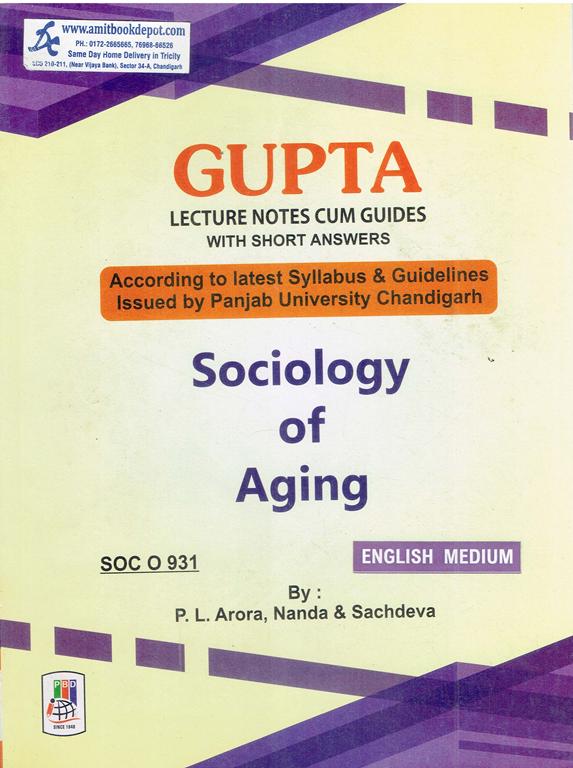
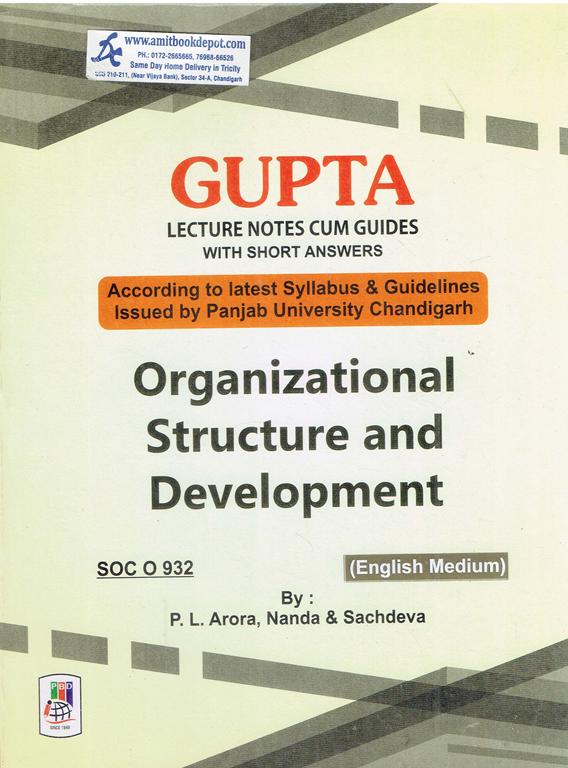
Gupta Sociology of Aging SOC O 931 MA Sociology 3rd Semester Panjab University Chandigarh (English Medium)
Gupta Sociology of Aging SOC O 931 MA Sociology 3rd Semester Panjab University Chandigarh (English Medium)
by Madhurima
₹500₹500.00(-/
off)
Rating & Reviews
23 Customer Review
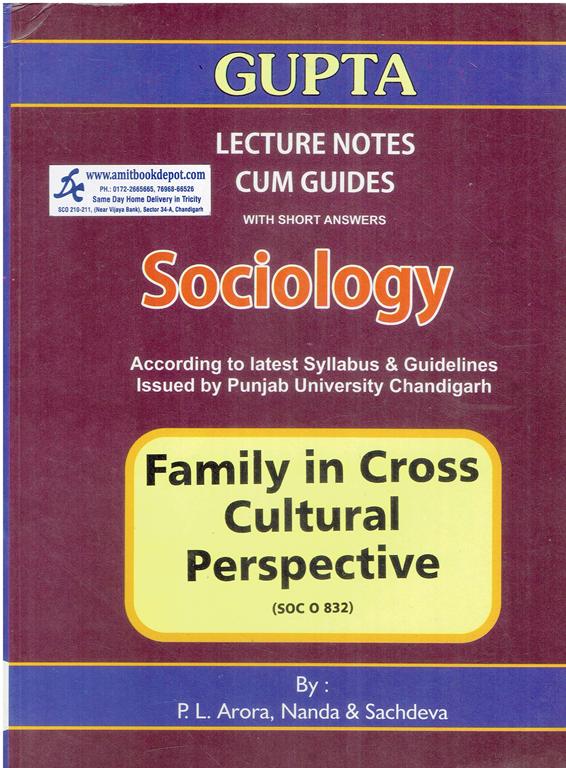
The "Gupta Sociology of Aging" is the prescribed book for MA Sociology 3rd Semester students of Panjab University, Chandigarh, for paper SOC O 931. Authored by P.L. Arora, Nanda, and Sachdeva, this comprehensive guide covers the entire latest syllabus. It explores biological, social, and psychological aspects of aging; key sociological perspectives (disengagement, activity, and modernization theory); the status of the aged in family and society; and critical economic, health, & social problems. Essential for exam preparation, it includes theories, contemporary issues, and an overview of Social Security Schemes. Published by Pepsu Book Depot, it is the definitive resource for mastering the sociology of aging.
"Gupta Sociology of Aging" for SOC O 931 is the prescribed and authoritative book meticulously crafted for Master of Arts (MA) students in the 3rd Semester of Sociology at Panjab University, Chandigarh. Authored by the esteemed scholars P. L. Arora, Nanda, and Sachdeva, and published by the reputable Pepsu Book Depot, this comprehensive volume serves as an indispensable academic resource. It is specifically designed to align with the latest syllabus mandated by Panjab University (PU), ensuring complete coverage of all theoretical concepts, perspectives, and contemporary issues related to gerontology from a sociological lens.
This book provides an in-depth exploration of the multifaceted concept of aging. It begins by establishing a solid foundational understanding in Unit I, delving into the biological concept of aging, the physiological concept of aging, and the crucial social and psychological aspects of growing old. It effectively dispels common myths and facts of aging and presents a clear analysis of the demographic dimensions of the elderly, highlighting the significant and growing proportion of the aging population in India and worldwide. This unit equips students with the essential vocabulary and frameworks needed to comprehend the aging process beyond mere chronology.
Unit II is dedicated to the core sociological perspectives of aging, offering students a critical toolkit for analysis. It systematically explains key micro-theories such as role theory, disengagement theory, and activity theory, which focus on the individual's experience. Furthermore, it expands the scope to macro-perspectives, including modernization theory, age stratification theory, and political economy theory, enabling students to understand aging as a phenomenon shaped by larger social structures, economic forces, and historical change. This theoretical grounding is vital for a nuanced understanding of the subject.
Moving from theory to social context, Unit III examines the critical interface of society, family, and aging. It investigates the evolving status of the aged in both urban and rural family settings, addressing the sensitive yet important issue of neglect and abuse of elderly in the family. The book offers a comparative view by discussing the aged in different societies—tribal, traditional, and modern—with a specific focus on the status & treatment in traditional Hindu society. This unit helps students contextualize the experiences of the elderly within specific cultural and familial frameworks.
Finally, Unit IV addresses the practical and pressing social problems of the aged. It provides a detailed classification and examination of economic problems, health problems, and socio-psychological and emotional problems, often highlighting their interconnected nature as multiple problems. The text analytically discusses the emerging factors responsible for aggravating problems of the aged in contemporary society. Crucially, it does not stop at identifying problems; it proactively outlines strategies for coping and reviews existing social security schemes and other developmental programs aimed at rehabilitation and welfare, linking academic study to policy and intervention.
Structured to aid both learning and examination preparation, the book includes a concise Table of Contents for easy navigation and a dedicated section of Short Answer Type Questions to help students test their knowledge and prepare for the exam pattern. The content is presented in clear, accessible English, making complex theories understandable. For any MA Sociology student at Panjab University preparing for their SOC O 931 paper, this book is not just a recommendation but an essential requirement. It is the definitive guide to mastering the sociology of aging, ensuring academic rigor, syllabus compliance, and a profound understanding of the challenges and realities faced by the elderly in a rapidly changing world.
Is this book strictly aligned with the current syllabus for SOC O 931 at Panjab University?
A1
Yes, this book is meticulously crafted to cover the entire latest syllabus prescribed by Panjab University for MA Sociology (3rd Semester), paper code SOC O 931.
Q2
Does the book cover both micro and macro sociological theories of aging?
A2
Absolutely. Unit II is dedicated to sociological perspectives, comprehensively covering micro-theories (Role, Disengagement, Activity) and macro-theories (Modernization, Age Stratification, Political Economy).
Q3
How does this book help in understanding the demographic aspect of aging?
A3
Unit I includes a specific chapter on the Demographic Dimensions of the Elderly, providing data and analysis on the aging population trends relevant to India and the world.
Q4
Does it include content on traditional Hindu society's treatment of the aged?
A4
Yes, the book provides specific insight into the Status and Treatment of the Aged in Traditional Hindu Society within a comparative framework of different societies.
Q5
Are practical coping strategies and government schemes for the elderly covered?
A5
Unit IV not only outlines problems but also details Strategies for Coping and reviews existing Social Security Schemes and Developmental Programs for rehabilitation and welfare.
Q6
Is the biological and physiological concept of aging explained for sociology students?
A6
Yes, the foundation is set in Unit I with clear explanations of the Biological and Physiological Concepts of Aging, making it accessible for students from a social science background.
Q7
Is the modernization theory as it relates to aging explained in this book?
A7
Yes, Modernization Theory is covered in detail as one of the key macro-sociological perspectives explaining the changing status of the elderly in Unit II.
Q8
How does the book address the psychological aspects of aging?
A8
Psychological Aspects of aging are a core part of Unit I, and socio-psychological problems are further explored in Unit IV, providing a holistic view.
Q9
Is the internal assessment pattern for the paper explained in the book?
A9
While the book covers the academic syllabus comprehensively, the specific exam pattern and instructions for paper-setters (including the note on internal assessment for private candidates) are detailed in the syllabus section provided at the beginning, keeping students informed.
Q10
Are the differences in aging experiences in tribal, traditional, and modern societies compared?
A10
Unit III includes a comparative analysis of the Aged in Different Societies, specifically tribal, traditional, and modern contexts.
0.00
0 Overall Rating
5
0
4
0
3
0
2
0
1
0
Try this product & share your review &
thoughts
UNIT - I
1. Sociology of Aging
2. Biological Concept of Aging
3. Physiological Concept of Aging
4. Social Concept of Aging
5. Psychological Aspects
6. Myths and Facts of Aging
7. Demographic Dimensions of the Elderly
UNIT - II
8. Sociological Perspectives of Aging and Role Theory
9. Disengagement and Activity Theory
10. Modernization Theory
11. Age Stratification Theory
12. Political Economy Theory
UNIT - III
13. Society, Family, and Aging
14. Neglect and Abuse of Elderly in Family
15. Aged in Different Societies
16. Status & Treatment, which they get in Traditional Hindu Society
UNIT - IV
17. Social Problems of the Aged
18. Socio-Psychological and Emotional Problems of the Aged
19. Economic Problems of the Aged
20. Health Problems of the Aged
21. Multiple Problems of the Aged
22. Emerging Factors Responsible for Aggravating Problems of the Aged
23. Strategies for Coping with Problems of the Aged
24. Social Security Schemes and Other Developmental Programs
Short Answer Type Questions
Latest Syllabus of Sociology of Aging SOC O 931 MA Sociology 3rd Semester Panjab University (PU) Chandigarh (English Medium)
SOC O 931: SOCIOLOGY OF AGING
Objective
Owing to the breakdown of traditional values and institutional frameworks in societies such as India, the aged are facing a number of socio-economic and
psycho-medical problems. The worldwide trends indicate that the proportion of aged people in the populations of different societies is ever increasing. This has far-reaching implications for the societies across the world. Social scientists are looking at this issue as a matter of serious concern. So, there is an urgent need to study the aged to understand their plight and problems, to study the problems created by the increasing aging population, and to formulate possible interventions for their welfare. This course is an attempt in this direction.
INSTRUCTIONS FOR THE PAPER-SETTER AND THE CANDIDATES
(i) The theory question paper will be of 80 marks, and 20 marks will be for internal assessment. The duration of the paper will be 3 hours.
(ii) For private candidates, who have not been assessed earlier for internal assessment, the marks secured by them in the theory paper will proportionately be increased to the maximum marks of the paper in lieu of internal assessment.
The paper setter must put note (ii) in the question paper.
The syllabus has been divided into four units.
There shall be 9 questions in all. The first question is compulsory and shall be a short answer type containing 10 short questions spread over the whole syllabus to
be answered in about 30 to 35 words each, carrying 20 marks, i.e., 2 marks each. The rest of the paper shall contain 4 units. Each unit shall have two long questions.
and the candidates shall be given an internal choice of attempting one question from each unit—4 in all. Each question will carry 15 marks.
Course Outline
Unit-I
Concept of Aging:
- Biological & Physiological, Social, and Psychological Aging
- Myths and Facts about Old Age
- Demographic Dimensions of the Elderly
Unit II
Sociological Perspectives of Aging
Micro-Perspectives:
- Role Theory (Aging and the Individual),
- Activity Theory,
- Disengagement Theory,
Macro Perspectives:
- Modernization Theory,
- Age Stratification Theory,
- Political Economy Theory
Unit III
Society, Family, and Aging:
- Status of the Aged in the Family—Urban and Rural Settings.
- Neglect and Abuse of Elderly in Family.
- Aged in Different Societies—Tribal, Traditional, and Modern.
- Status and treatment that they get in traditional Hindu society.
Unit IV
Problems of Aging and Rehabilitation:
- Economic, social, physical, and psychological problems.
- Emerging Factors Responsible for Aggravating Problems of the Aged.
- Strategies for Coping with the Problems of the Aged, Social Security Schemes, and other developmental programs.
"Gupta Sociology of Aging" for SOC O 931 is the prescribed and authoritative book meticulously crafted for Master of Arts (MA) students in the 3rd Semester of Sociology at Panjab University, Chandigarh. Authored by the esteemed scholars P. L. Arora, Nanda, and Sachdeva, and published by the reputable Pepsu Book Depot, this comprehensive volume serves as an indispensable academic resource. It is specifically designed to align with the latest syllabus mandated by Panjab University (PU), ensuring complete coverage of all theoretical concepts, perspectives, and contemporary issues related to gerontology from a sociological lens.
This book provides an in-depth exploration of the multifaceted concept of aging. It begins by establishing a solid foundational understanding in Unit I, delving into the biological concept of aging, the physiological concept of aging, and the crucial social and psychological aspects of growing old. It effectively dispels common myths and facts of aging and presents a clear analysis of the demographic dimensions of the elderly, highlighting the significant and growing proportion of the aging population in India and worldwide. This unit equips students with the essential vocabulary and frameworks needed to comprehend the aging process beyond mere chronology.
Unit II is dedicated to the core sociological perspectives of aging, offering students a critical toolkit for analysis. It systematically explains key micro-theories such as role theory, disengagement theory, and activity theory, which focus on the individual's experience. Furthermore, it expands the scope to macro-perspectives, including modernization theory, age stratification theory, and political economy theory, enabling students to understand aging as a phenomenon shaped by larger social structures, economic forces, and historical change. This theoretical grounding is vital for a nuanced understanding of the subject.
Moving from theory to social context, Unit III examines the critical interface of society, family, and aging. It investigates the evolving status of the aged in both urban and rural family settings, addressing the sensitive yet important issue of neglect and abuse of elderly in the family. The book offers a comparative view by discussing the aged in different societies—tribal, traditional, and modern—with a specific focus on the status & treatment in traditional Hindu society. This unit helps students contextualize the experiences of the elderly within specific cultural and familial frameworks.
Finally, Unit IV addresses the practical and pressing social problems of the aged. It provides a detailed classification and examination of economic problems, health problems, and socio-psychological and emotional problems, often highlighting their interconnected nature as multiple problems. The text analytically discusses the emerging factors responsible for aggravating problems of the aged in contemporary society. Crucially, it does not stop at identifying problems; it proactively outlines strategies for coping and reviews existing social security schemes and other developmental programs aimed at rehabilitation and welfare, linking academic study to policy and intervention.
Structured to aid both learning and examination preparation, the book includes a concise Table of Contents for easy navigation and a dedicated section of Short Answer Type Questions to help students test their knowledge and prepare for the exam pattern. The content is presented in clear, accessible English, making complex theories understandable. For any MA Sociology student at Panjab University preparing for their SOC O 931 paper, this book is not just a recommendation but an essential requirement. It is the definitive guide to mastering the sociology of aging, ensuring academic rigor, syllabus compliance, and a profound understanding of the challenges and realities faced by the elderly in a rapidly changing world.
UNIT - I
1. Sociology of Aging
2. Biological Concept of Aging
3. Physiological Concept of Aging
4. Social Concept of Aging
5. Psychological Aspects
6. Myths and Facts of Aging
7. Demographic Dimensions of the Elderly
UNIT - II
8. Sociological Perspectives of Aging and Role Theory
9. Disengagement and Activity Theory
10. Modernization Theory
11. Age Stratification Theory
12. Political Economy Theory
UNIT - III
13. Society, Family, and Aging
14. Neglect and Abuse of Elderly in Family
15. Aged in Different Societies
16. Status & Treatment, which they get in Traditional Hindu Society
UNIT - IV
17. Social Problems of the Aged
18. Socio-Psychological and Emotional Problems of the Aged
19. Economic Problems of the Aged
20. Health Problems of the Aged
21. Multiple Problems of the Aged
22. Emerging Factors Responsible for Aggravating Problems of the Aged
23. Strategies for Coping with Problems of the Aged
24. Social Security Schemes and Other Developmental Programs
Is this book strictly aligned with the current syllabus for SOC O 931 at Panjab University?
A1
Yes, this book is meticulously crafted to cover the entire latest syllabus prescribed by Panjab University for MA Sociology (3rd Semester), paper code SOC O 931.
Q2
Does the book cover both micro and macro sociological theories of aging?
A2
Absolutely. Unit II is dedicated to sociological perspectives, comprehensively covering micro-theories (Role, Disengagement, Activity) and macro-theories (Modernization, Age Stratification, Political Economy).
Q3
How does this book help in understanding the demographic aspect of aging?
A3
Unit I includes a specific chapter on the Demographic Dimensions of the Elderly, providing data and analysis on the aging population trends relevant to India and the world.
Q4
Does it include content on traditional Hindu society's treatment of the aged?
A4
Yes, the book provides specific insight into the Status and Treatment of the Aged in Traditional Hindu Society within a comparative framework of different societies.
Q5
Are practical coping strategies and government schemes for the elderly covered?
A5
Unit IV not only outlines problems but also details Strategies for Coping and reviews existing Social Security Schemes and Developmental Programs for rehabilitation and welfare.
Q6
Is the biological and physiological concept of aging explained for sociology students?
A6
Yes, the foundation is set in Unit I with clear explanations of the Biological and Physiological Concepts of Aging, making it accessible for students from a social science background.
Q7
Is the modernization theory as it relates to aging explained in this book?
A7
Yes, Modernization Theory is covered in detail as one of the key macro-sociological perspectives explaining the changing status of the elderly in Unit II.
Q8
How does the book address the psychological aspects of aging?
A8
Psychological Aspects of aging are a core part of Unit I, and socio-psychological problems are further explored in Unit IV, providing a holistic view.
Q9
Is the internal assessment pattern for the paper explained in the book?
A9
While the book covers the academic syllabus comprehensively, the specific exam pattern and instructions for paper-setters (including the note on internal assessment for private candidates) are detailed in the syllabus section provided at the beginning, keeping students informed.
Q10
Are the differences in aging experiences in tribal, traditional, and modern societies compared?
A10
Unit III includes a comparative analysis of the Aged in Different Societies, specifically tribal, traditional, and modern contexts.
Latest Syllabus of Sociology of Aging SOC O 931 MA Sociology 3rd Semester Panjab University (PU) Chandigarh (English Medium)
SOC O 931: SOCIOLOGY OF AGING
Objective
Owing to the breakdown of traditional values and institutional frameworks in societies such as India, the aged are facing a number of socio-economic and
psycho-medical problems. The worldwide trends indicate that the proportion of aged people in the populations of different societies is ever increasing. This has far-reaching implications for the societies across the world. Social scientists are looking at this issue as a matter of serious concern. So, there is an urgent need to study the aged to understand their plight and problems, to study the problems created by the increasing aging population, and to formulate possible interventions for their welfare. This course is an attempt in this direction.
INSTRUCTIONS FOR THE PAPER-SETTER AND THE CANDIDATES
(i) The theory question paper will be of 80 marks, and 20 marks will be for internal assessment. The duration of the paper will be 3 hours.
(ii) For private candidates, who have not been assessed earlier for internal assessment, the marks secured by them in the theory paper will proportionately be increased to the maximum marks of the paper in lieu of internal assessment.
The paper setter must put note (ii) in the question paper.
The syllabus has been divided into four units.
There shall be 9 questions in all. The first question is compulsory and shall be a short answer type containing 10 short questions spread over the whole syllabus to
be answered in about 30 to 35 words each, carrying 20 marks, i.e., 2 marks each. The rest of the paper shall contain 4 units. Each unit shall have two long questions.
and the candidates shall be given an internal choice of attempting one question from each unit—4 in all. Each question will carry 15 marks.
Course Outline
Unit-I
Concept of Aging:
- Biological & Physiological, Social, and Psychological Aging
- Myths and Facts about Old Age
- Demographic Dimensions of the Elderly
Unit II
Sociological Perspectives of Aging
Micro-Perspectives:
- Role Theory (Aging and the Individual),
- Activity Theory,
- Disengagement Theory,
Macro Perspectives:
- Modernization Theory,
- Age Stratification Theory,
- Political Economy Theory
Unit III
Society, Family, and Aging:
- Status of the Aged in the Family—Urban and Rural Settings.
- Neglect and Abuse of Elderly in Family.
- Aged in Different Societies—Tribal, Traditional, and Modern.
- Status and treatment that they get in traditional Hindu society.
Unit IV
Problems of Aging and Rehabilitation:
- Economic, social, physical, and psychological problems.
- Emerging Factors Responsible for Aggravating Problems of the Aged.
- Strategies for Coping with the Problems of the Aged, Social Security Schemes, and other developmental programs.
0.00
0 Overall Rating
5
0
4
0
3
0
2
0
1
0
Try this product & share your review &
thoughts
Top Trending Product
Related
Product
Related Product
Related Blog Posts
Latest Blogs
Latest Blogs
Classic Literature Reimagined: Discuss modern twists on classic novels.
Lorem ipsum dolor sit amet, consectetur adipiscing elit, sed
do
eiusmod tempor incididunt ut labore et dolore magna aliqua. Ut enim ad minim
veniam, quis nostrud exercitation ullamco Lorem ipsum dolor sit amet,
consectetur adipiscing elit, sed do eiusmod tempor incididunt ut labore et
dolore magna aliqua. Utenim ad minim veniam, quis nostrud exercitation
ullamco
Lorem ipsum dolor sit amet, consecte...
Classic Literature Reimagined: Discuss modern twists on classic novels.
Lorem ipsum dolor sit amet, consectetur adipiscing elit, sed
do
eiusmod tempor incididunt ut labore et dolore magna aliqua. Ut enim ad minim
veniam, quis nostrud exercitation ullamco Lorem ipsum dolor sit amet,
consectetur adipiscing elit, sed do eiusmod tempor incididunt ut labore et
dolore magna aliqua. Utenim ad minim veniam, quis nostrud exercitation
ullamco
Lorem ipsum dolor sit amet, consecte...
Classic Literature Reimagined: Discuss modern twists on classic novels.
Lorem ipsum dolor sit amet, consectetur adipiscing elit, sed
do
eiusmod tempor incididunt ut labore et dolore magna aliqua. Ut enim ad minim
veniam, quis nostrud exercitation ullamco Lorem ipsum dolor sit amet,
consectetur adipiscing elit, sed do eiusmod tempor incididunt ut labore et
dolore magna aliqua. Utenim ad minim veniam, quis nostrud exercitation
ullamco
Lorem ipsum dolor sit amet, consecte...