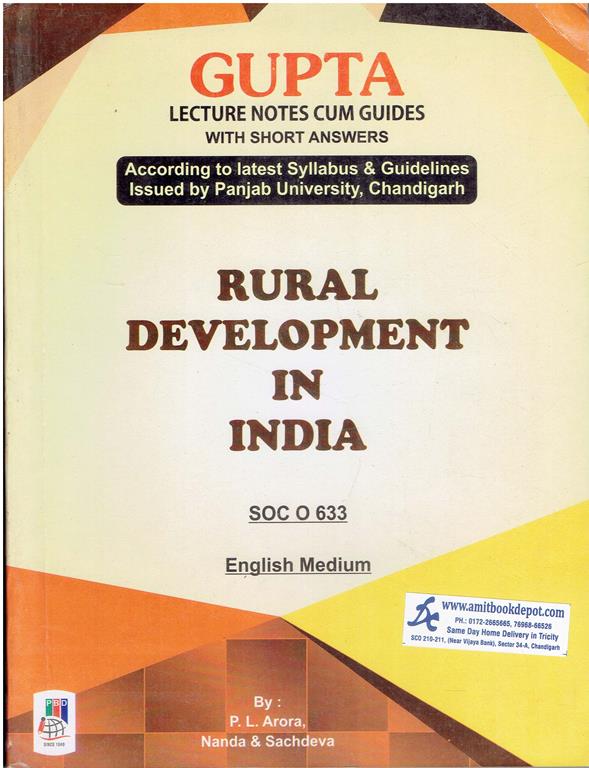
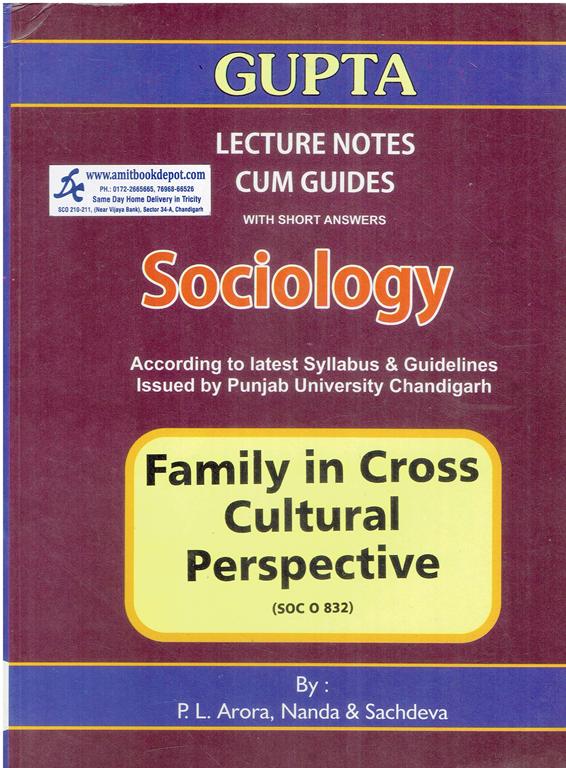
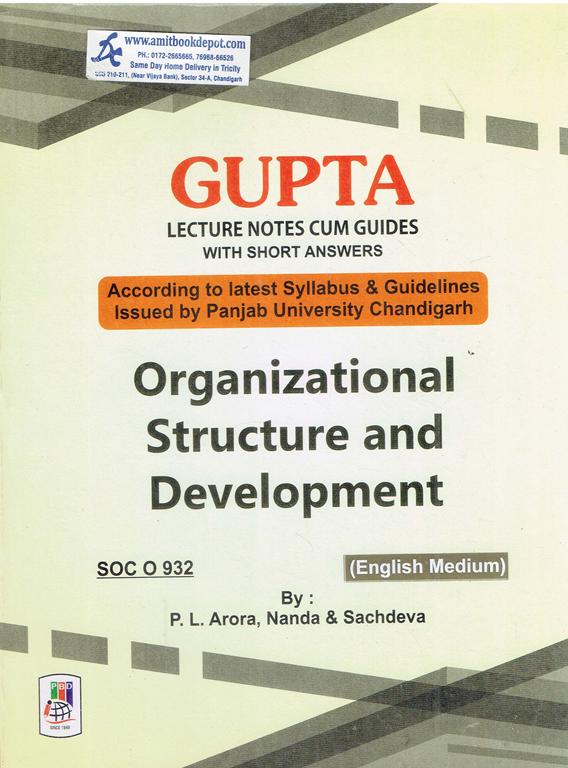
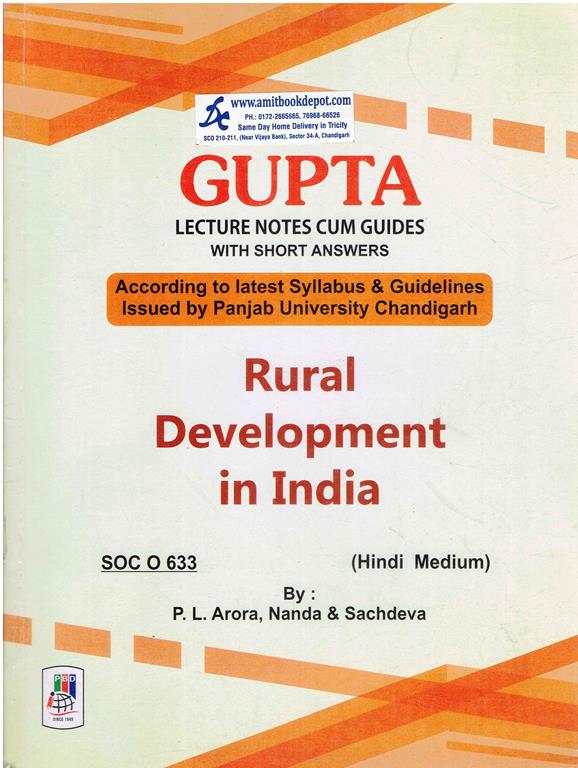
Gupta Rural Development in India for MA Sociology 3rd Semester Panjab University Chandigarh (English Medium)
Gupta Rural Development in India for MA Sociology 3rd Semester Panjab University Chandigarh (English Medium)
by Madhurima
₹600₹600.00(-/
off)
Rating & Reviews
23 Customer Review
Gupta Rural Development in India is the prescribed book for MA Sociology 3rd Semester students of Panjab University, Chandigarh (Course SOC O 633). Authored by P.L. Arora, Nanda, and Sachdeva, this comprehensive guide covers the entire syllabus in four detailed units: Perspectives (Liberal, Marxist, Gandhian), the State's Role (Land Reforms, Poverty Programs, Panchayati Raj), Peasant Movements (Pre- & Post-Independence), and Market Forces (Green Revolution, Globalization, WTO, Sustainability). Published by Pepsu Book Depot, it includes short-answer questions and is tailored for the PU exam pattern, making it an essential resource for mastering rural development in India.
Gupta Rural Development in India is an authoritative and comprehensive book meticulously crafted for students pursuing the Master of Arts in Sociology from Panjab University, Chandigarh. Specifically tailored for the third semester under the course code SOC O 633, this book is an indispensable resource that aligns perfectly with the latest prescribed syllabus. Authored by the esteemed scholars P. L. Arora, Nanda, and Sachdeva, and published by Pepsu Book Depot, this volume offers an in-depth, structured, and critical examination of the multifaceted domain of rural development in the Indian context.
The book is systematically organized into four cohesive units, each addressing a core thematic pillar of the syllabus. Unit I lays the foundational theoretical framework by exploring the seminal Perspectives on Rural Development in India. It provides a critical comparative analysis of the liberal perspective, the Marxist perspective, and the Gandhian perspective, enabling students to understand the ideological underpinnings that have shaped policy and discourse. This unit equips learners with the analytical tools necessary to deconstruct various approaches to rural transformation.
Unit II delves into the pivotal role of the state in rural development. It offers a detailed historical and contemporary analysis of key state-led interventions, beginning with Land Reforms and Community Development Programmes (CDP). The unit provides exhaustive coverage of major poverty alleviation and welfare schemes such as the Swarnjayanti Gram Swarozgar Yojana (SGSY), Indira Awaas Yojana (IAY), Employment Assurance Scheme (EAS), and Jawahar Rozgar Yojana (JRY). Furthermore, it examines the state's role in educating the rural masses and the evolving role of Panchayati Raj Institutions in decentralized governance and development, making it a vital resource for understanding institutional mechanisms.
Moving from institutions to social movements, Unit III investigates the dynamic role of peasant movements in shaping rural development trajectories. It comprehensively covers both pre-independence and post-independence agrarian unrest, including tribal revolts, the formation of the Kisan Sabha, Gandhi's mobilization of peasants, and the historic Telangana Uprising. The analysis extends to post-colonial movements like the Tenant Movement, the Naxalite Movement, and contemporary Farmers' Movements, alongside discussions on the persistent demands for fresh land reforms. This unit highlights the agency of rural populations as active participants in their development.
Unit IV addresses the complex interplay between rural development and market forces. It critically assesses the transformative yet dual impact of the Green Revolution on rural society. The book then navigates the profound changes ushered in by globalization and the commercialization of agriculture, analyzing their impact on non-farm employment and issues of distributive justice. A dedicated chapter on the World Trade Organization (WTO) elucidates its implications for Indian agriculture, leading to an exploration of the process of marginalization. The unit concludes by confronting the pressing challenges of sustainable rural development, balancing economic growth with ecological and social equity.
To aid in examination preparation, the book includes a dedicated section of Short Answer Type Questions that help students revise key concepts and practice for the compulsory short-answer section of the PU MA Sociology paper. The content is presented in clear, accessible English, with complex sociological concepts explained in a lucid manner. Structured to meet the exact requirements of the Panjab University examination pattern—with its blend of short and long answer questions—this book is more than a book; it is a complete guide for achieving academic excellence. For any student of MA Sociology, Panjab University, seeking a thorough, reliable, and syllabus-specific resource on Rural Development in India, this book by Gupta is the definitive choice.
Is this book strictly as per the latest syllabus of Panjab University's MA Sociology 3rd Semester?
A1
Yes, this book is meticulously structured to cover 100% of the latest prescribed syllabus for paper SOC O 633: Rural Development in India for Panjab University, Chandigarh.
Q2
Does it include the chapter on the WTO and Globalization as mentioned in the syllabus?
A2
Absolutely. Unit IV of the book contains dedicated chapters on Globalization and the World Trade Organization (WTO), analyzing their impact on Indian agriculture and rural society.
Q3
Are all the government schemes like SGSY, IAY, EAS, and JRY explained in detail?
A3
Yes, Unit II provides detailed coverage of these key poverty alleviation programs—Swarnjayanti Gram Swarozgar Yojana (SGSY), Indira Awaas Yojana (IAY), Employment Assurance Scheme (EAS), and Jawahar Rozgar Yojana (JRY)—within the context of state-led rural development.
Q4
How does the book handle the theoretical perspectives on rural development?
A4
Unit I is entirely devoted to a critical exposition of the three core perspectives: Liberal, Marxist, and Gandhian, providing a solid theoretical foundation for the course.
Q5
Is the section on peasant movements comprehensive, covering both historical and recent movements?
A5
Yes, Unit III covers a wide spectrum, from pre-independence movements (Tribal Revolts, Kisan Sabha, Telangana) to post-independence ones (Naxalite Movement, contemporary Farmers' Movements), offering a historical continuum.
Q6
I am a private candidate. Is this book sufficient for exam preparation without classroom coaching?
A6
Yes, this book is designed as a self-contained guide that covers the entire syllabus in a structured, student-friendly manner, making it highly suitable for private candidates.
Q7
Is the language accessible for English medium students?
A7
The book is written in clear, academic English, explaining complex sociological concepts in an accessible way, perfectly suited for the English medium curriculum.
Q8
Does it explain the impact of the Green Revolution beyond agricultural productivity?
A8
Unit IV contains a detailed chapter on The Green Revolution and Its Impact on Rural Society, examining its socio-economic and environmental consequences comprehensively.
Q9
Is the role of Panchayati Raj Institutions in development adequately covered?
A9
Yes, a dedicated chapter in Unit II analyzes the evolving Role of Panchayati Raj Institutions in decentralized planning and rural governance.
Q10
Can this book be useful for competitive exams like UGC-NET that have a section on rural sociology?
A10
While tailored for Panjab University, the comprehensive coverage of themes like development perspectives, agrarian movements, and globalization makes it a valuable reference for competitive exams with similar syllabi.
0.00
0 Overall Rating
5
0
4
0
3
0
2
0
1
0
Try this product & share your review &
thoughts
UNIT - I
1. Perspectives on Rural Development in India
2. Liberal Perspectives on Rural Development
3. Marxist Perspective
4. Gandhian Perspective on Rural Development
UNIT - II
5. State and Rural Development
6. Land Reforms
7. Community Development Programmes (CDP)
8. State and Alleviation of Rural Poverty through Various Programs
9. Swarnjayanti Gram Swarozgar Yojana (SGSY)
10. IAY—Indira Awaas Yojana
11. Employment Assurance Scheme (EAS)
12. Jawahar Rozgar Yojana (JRY)
13. State and Education of Rural Masses
14. Role of Panchayati Raj Institutions
UNIT - III
15. Rural Development and the Role of Peasant Movements
16. Tribal Revolts
17. Kisan Sabha
18. Gandhi and Peasants
19. Telangana Uprising
20. Post-Independence Period: Tenant Movement
21. Naxalite Movement
22. Fresh Move for Land Reforms
23. Farmers Movement
UNIT - IV
24. Rural Development and the Market Forces
25. The Green Revolution and Its Impact on Rural Society
26. Globalization
27. Commercialization of Agriculture
28. Impact on Non-Farm Employment
29. Distributive Justice
30. W.T.O. (World Trade Organization)
31. Process of Marginalization
32. Challenges of Sustainable Rural Development
Short Answer Type Questions
Latest Syllabus of Rural Development in India for MA Sociology 3rd Semester, Panjab University (PU), Chandigarh (English Medium)
SOC O 633: RURAL DEVELOPMENT IN INDIA
Objective
The objective of the course is to familiarize the students with the history of rural development in India, the role of the state and farmers in it, and the impact of market forces on agriculture.
INSTRUCTIONS FOR THE PAPER-SETTER AND THE CANDIDATES
(i) The theory question paper will be of 80 marks, and 20 marks will be for internal assessment. The duration of the paper will be 3 hours.
(ii) For private candidates, who have not been assessed earlier for internal assessment, the marks secured by them in the theory paper will proportionately be increased to the maximum marks of the paper in lieu of internal assessment.
The paper setter must put note (ii) in the question paper.
The syllabus has been divided into four units.
There shall be 9 questions in all. The first question is compulsory and shall be a short answer type containing 10 short questions spread over the whole syllabus to be answered in about 30 to 35 words each, carrying 20 marks, i.e., 2 marks each. The rest of the paper shall contain 4 units. Each unit shall have two long questions and the Candidates shall be given an internal choice of attempting one question from each unit—4 in all. Each question will carry 15 marks.
Course Outline
Unit-I
Perspectives on Rural Development:
Liberal, Marxist, Gandhian
Unit II
State and Rural Development: Land Reforms
Community Development Programs
State and Alleviation of Rural Poverty through Various Programs: SGSY, IAY, EAS, JRY, etc.
State and Education of Rural Masses
Role of Panchayati Raj Institutions
Unit III
Rural Development and the Role of Peasant Movements:
Pre-Independence Period: Tribal Revolts, Kisan Sabha, Gandhi and Peasants, and Telangana Uprising
Post-Independence Period: Tenant Movement, Naxalite Movement, and Fresh Move for Land Reforms, Farmers Movement.
Unit IV
Rural Development and the Market Forces:
The Green Revolution and Its Impact on Rural Society
Globalization, Commercialization of Agriculture,
Impact on Non-Farm Employment and Distributive Justice
Gupta Rural Development in India is an authoritative and comprehensive book meticulously crafted for students pursuing the Master of Arts in Sociology from Panjab University, Chandigarh. Specifically tailored for the third semester under the course code SOC O 633, this book is an indispensable resource that aligns perfectly with the latest prescribed syllabus. Authored by the esteemed scholars P. L. Arora, Nanda, and Sachdeva, and published by Pepsu Book Depot, this volume offers an in-depth, structured, and critical examination of the multifaceted domain of rural development in the Indian context.
The book is systematically organized into four cohesive units, each addressing a core thematic pillar of the syllabus. Unit I lays the foundational theoretical framework by exploring the seminal Perspectives on Rural Development in India. It provides a critical comparative analysis of the liberal perspective, the Marxist perspective, and the Gandhian perspective, enabling students to understand the ideological underpinnings that have shaped policy and discourse. This unit equips learners with the analytical tools necessary to deconstruct various approaches to rural transformation.
Unit II delves into the pivotal role of the state in rural development. It offers a detailed historical and contemporary analysis of key state-led interventions, beginning with Land Reforms and Community Development Programmes (CDP). The unit provides exhaustive coverage of major poverty alleviation and welfare schemes such as the Swarnjayanti Gram Swarozgar Yojana (SGSY), Indira Awaas Yojana (IAY), Employment Assurance Scheme (EAS), and Jawahar Rozgar Yojana (JRY). Furthermore, it examines the state's role in educating the rural masses and the evolving role of Panchayati Raj Institutions in decentralized governance and development, making it a vital resource for understanding institutional mechanisms.
Moving from institutions to social movements, Unit III investigates the dynamic role of peasant movements in shaping rural development trajectories. It comprehensively covers both pre-independence and post-independence agrarian unrest, including tribal revolts, the formation of the Kisan Sabha, Gandhi's mobilization of peasants, and the historic Telangana Uprising. The analysis extends to post-colonial movements like the Tenant Movement, the Naxalite Movement, and contemporary Farmers' Movements, alongside discussions on the persistent demands for fresh land reforms. This unit highlights the agency of rural populations as active participants in their development.
Unit IV addresses the complex interplay between rural development and market forces. It critically assesses the transformative yet dual impact of the Green Revolution on rural society. The book then navigates the profound changes ushered in by globalization and the commercialization of agriculture, analyzing their impact on non-farm employment and issues of distributive justice. A dedicated chapter on the World Trade Organization (WTO) elucidates its implications for Indian agriculture, leading to an exploration of the process of marginalization. The unit concludes by confronting the pressing challenges of sustainable rural development, balancing economic growth with ecological and social equity.
To aid in examination preparation, the book includes a dedicated section of Short Answer Type Questions that help students revise key concepts and practice for the compulsory short-answer section of the PU MA Sociology paper. The content is presented in clear, accessible English, with complex sociological concepts explained in a lucid manner. Structured to meet the exact requirements of the Panjab University examination pattern—with its blend of short and long answer questions—this book is more than a book; it is a complete guide for achieving academic excellence. For any student of MA Sociology, Panjab University, seeking a thorough, reliable, and syllabus-specific resource on Rural Development in India, this book by Gupta is the definitive choice.
UNIT - I
1. Perspectives on Rural Development in India
2. Liberal Perspectives on Rural Development
3. Marxist Perspective
4. Gandhian Perspective on Rural Development
UNIT - II
5. State and Rural Development
6. Land Reforms
7. Community Development Programmes (CDP)
8. State and Alleviation of Rural Poverty through Various Programs
9. Swarnjayanti Gram Swarozgar Yojana (SGSY)
10. IAY—Indira Awaas Yojana
11. Employment Assurance Scheme (EAS)
12. Jawahar Rozgar Yojana (JRY)
13. State and Education of Rural Masses
14. Role of Panchayati Raj Institutions
UNIT - III
15. Rural Development and the Role of Peasant Movements
16. Tribal Revolts
17. Kisan Sabha
18. Gandhi and Peasants
19. Telangana Uprising
20. Post-Independence Period: Tenant Movement
21. Naxalite Movement
22. Fresh Move for Land Reforms
23. Farmers Movement
UNIT - IV
24. Rural Development and the Market Forces
25. The Green Revolution and Its Impact on Rural Society
Is this book strictly as per the latest syllabus of Panjab University's MA Sociology 3rd Semester?
A1
Yes, this book is meticulously structured to cover 100% of the latest prescribed syllabus for paper SOC O 633: Rural Development in India for Panjab University, Chandigarh.
Q2
Does it include the chapter on the WTO and Globalization as mentioned in the syllabus?
A2
Absolutely. Unit IV of the book contains dedicated chapters on Globalization and the World Trade Organization (WTO), analyzing their impact on Indian agriculture and rural society.
Q3
Are all the government schemes like SGSY, IAY, EAS, and JRY explained in detail?
A3
Yes, Unit II provides detailed coverage of these key poverty alleviation programs—Swarnjayanti Gram Swarozgar Yojana (SGSY), Indira Awaas Yojana (IAY), Employment Assurance Scheme (EAS), and Jawahar Rozgar Yojana (JRY)—within the context of state-led rural development.
Q4
How does the book handle the theoretical perspectives on rural development?
A4
Unit I is entirely devoted to a critical exposition of the three core perspectives: Liberal, Marxist, and Gandhian, providing a solid theoretical foundation for the course.
Q5
Is the section on peasant movements comprehensive, covering both historical and recent movements?
A5
Yes, Unit III covers a wide spectrum, from pre-independence movements (Tribal Revolts, Kisan Sabha, Telangana) to post-independence ones (Naxalite Movement, contemporary Farmers' Movements), offering a historical continuum.
Q6
I am a private candidate. Is this book sufficient for exam preparation without classroom coaching?
A6
Yes, this book is designed as a self-contained guide that covers the entire syllabus in a structured, student-friendly manner, making it highly suitable for private candidates.
Q7
Is the language accessible for English medium students?
A7
The book is written in clear, academic English, explaining complex sociological concepts in an accessible way, perfectly suited for the English medium curriculum.
Q8
Does it explain the impact of the Green Revolution beyond agricultural productivity?
A8
Unit IV contains a detailed chapter on The Green Revolution and Its Impact on Rural Society, examining its socio-economic and environmental consequences comprehensively.
Q9
Is the role of Panchayati Raj Institutions in development adequately covered?
A9
Yes, a dedicated chapter in Unit II analyzes the evolving Role of Panchayati Raj Institutions in decentralized planning and rural governance.
Q10
Can this book be useful for competitive exams like UGC-NET that have a section on rural sociology?
A10
While tailored for Panjab University, the comprehensive coverage of themes like development perspectives, agrarian movements, and globalization makes it a valuable reference for competitive exams with similar syllabi.
Latest Syllabus of Rural Development in India for MA Sociology 3rd Semester, Panjab University (PU), Chandigarh (English Medium)
SOC O 633: RURAL DEVELOPMENT IN INDIA
Objective
The objective of the course is to familiarize the students with the history of rural development in India, the role of the state and farmers in it, and the impact of market forces on agriculture.
INSTRUCTIONS FOR THE PAPER-SETTER AND THE CANDIDATES
(i) The theory question paper will be of 80 marks, and 20 marks will be for internal assessment. The duration of the paper will be 3 hours.
(ii) For private candidates, who have not been assessed earlier for internal assessment, the marks secured by them in the theory paper will proportionately be increased to the maximum marks of the paper in lieu of internal assessment.
The paper setter must put note (ii) in the question paper.
The syllabus has been divided into four units.
There shall be 9 questions in all. The first question is compulsory and shall be a short answer type containing 10 short questions spread over the whole syllabus to be answered in about 30 to 35 words each, carrying 20 marks, i.e., 2 marks each. The rest of the paper shall contain 4 units. Each unit shall have two long questions and the Candidates shall be given an internal choice of attempting one question from each unit—4 in all. Each question will carry 15 marks.
Course Outline
Unit-I
Perspectives on Rural Development:
Liberal, Marxist, Gandhian
Unit II
State and Rural Development: Land Reforms
Community Development Programs
State and Alleviation of Rural Poverty through Various Programs: SGSY, IAY, EAS, JRY, etc.
State and Education of Rural Masses
Role of Panchayati Raj Institutions
Unit III
Rural Development and the Role of Peasant Movements:
Pre-Independence Period: Tribal Revolts, Kisan Sabha, Gandhi and Peasants, and Telangana Uprising
Post-Independence Period: Tenant Movement, Naxalite Movement, and Fresh Move for Land Reforms, Farmers Movement.
Unit IV
Rural Development and the Market Forces:
The Green Revolution and Its Impact on Rural Society
Globalization, Commercialization of Agriculture,
Impact on Non-Farm Employment and Distributive Justice
W.T.O. and the Process of Marginalization
Challenges of Sustainable Rural Development
0.00
0 Overall Rating
5
0
4
0
3
0
2
0
1
0
Try this product & share your review &
thoughts
Top Trending Product
Related
Product
Related Product
Related Blog Posts
Latest Blogs
Latest Blogs
Classic Literature Reimagined: Discuss modern twists on classic novels.
Lorem ipsum dolor sit amet, consectetur adipiscing elit, sed
do
eiusmod tempor incididunt ut labore et dolore magna aliqua. Ut enim ad minim
veniam, quis nostrud exercitation ullamco Lorem ipsum dolor sit amet,
consectetur adipiscing elit, sed do eiusmod tempor incididunt ut labore et
dolore magna aliqua. Utenim ad minim veniam, quis nostrud exercitation
ullamco
Lorem ipsum dolor sit amet, consecte...
Classic Literature Reimagined: Discuss modern twists on classic novels.
Lorem ipsum dolor sit amet, consectetur adipiscing elit, sed
do
eiusmod tempor incididunt ut labore et dolore magna aliqua. Ut enim ad minim
veniam, quis nostrud exercitation ullamco Lorem ipsum dolor sit amet,
consectetur adipiscing elit, sed do eiusmod tempor incididunt ut labore et
dolore magna aliqua. Utenim ad minim veniam, quis nostrud exercitation
ullamco
Lorem ipsum dolor sit amet, consecte...
Classic Literature Reimagined: Discuss modern twists on classic novels.
Lorem ipsum dolor sit amet, consectetur adipiscing elit, sed
do
eiusmod tempor incididunt ut labore et dolore magna aliqua. Ut enim ad minim
veniam, quis nostrud exercitation ullamco Lorem ipsum dolor sit amet,
consectetur adipiscing elit, sed do eiusmod tempor incididunt ut labore et
dolore magna aliqua. Utenim ad minim veniam, quis nostrud exercitation
ullamco
Lorem ipsum dolor sit amet, consecte...



.jpg)