Categories
College Bookssss >
BA PU Chandigarh
BSC PU Chandigarh
MSC PU Chandigarh
BBA PU Chandigarh
MA PU Chandigarh
Medical Books
Engineering Books
Management Books
PGDCA Books
BCOM PU Chandigarh
MCOM PU Chandigarh
BCA PU Chandigarh
MCA PU Chandigarh
animate-books

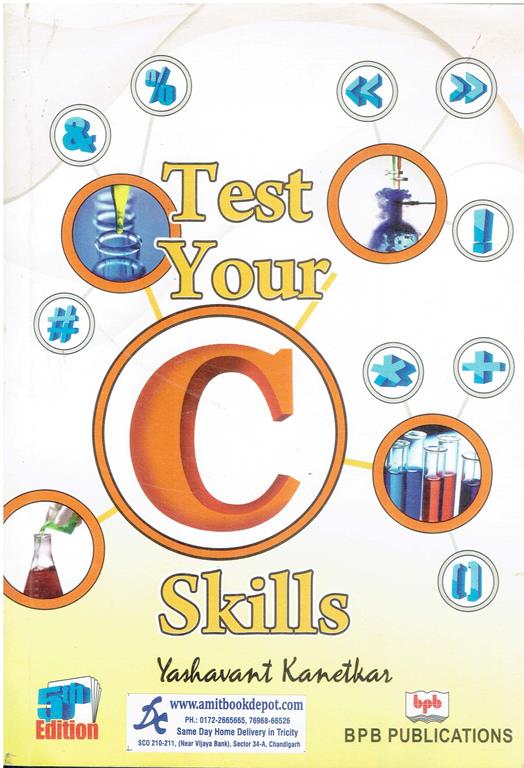
Test Your C Skills 5th Edition

by Madhurima
₹243 ₹270.00(-/ off)

Rating & Reviews

23 Customer Review

Test Your C Skills 5th Edition by Yashavant Kanetkar (BPB Publications) is an essential self-assessment guide for mastering C programming nuances. Covering declarations, pointers, memory allocation, bitwise operators, and complicated declarations, this book uses hundreds of question-answer pairs to expose common pitfalls. Ideal for interview preparation, exam revision, and debugging practice, each chapter—from control instructions to library functions—tests conceptual clarity over rote learning. Updated for modern compilers, this edition helps programmers avoid undefined behaviour, understand const-correctness, and write robust C code. Perfect for students and professionals seeking to validate and sharpen their C language skills efficiently.
Have Doubts Regarding This Product ? Ask Your Question

  • Q1
    What does int *ptr[10] declare?
    A1

    An array of 10 integer pointers. [] has higher precedence than *, so ptr is an array first, each element pointing to an integer.

  • Q2
    Why should you avoid comparing floating-point numbers using ==?
    A2

    Precision errors from binary representation make exact equality rare. Use a tolerance like fabs(a - b) < 1e-9 instead.

  • Q3
    Can const int x; be modified later without pointer tricks?
    A3

    No. const prevents direct modification. Using pointer casting invokes undefined behavior, violating type safety.

  • Q4
    How does typedef int (*funcPtr)(int, int); help?
    A4

    It creates an alias funcPtr for a function pointer returning int and taking two int parameters, simplifying declarations.

  • Q5
    Why does #define SQUARE(x) x*x produce SQUARE(2+3) as 11?
    A5

    Macro expands textually to 2+3*2+3 = 2+6+3 = 11. Use #define SQUARE(x) ((x)*(x)) for correctness.

  • Q6
    What is a memory leak in C?
    A6

    Occurs when dynamically allocated memory (malloc) is not freed before program exits or pointer goes out of scope.

  • Q7
    Which bitwise operator tests if a flag is set in flags & mask?
    A7

    Bitwise AND (&). Result equals mask if all bits in mask are set in flags; otherwise, non-zero but less than mask.

  • Q8
    How does const int *p differ from int * const p?
    A8

    const int *p – pointer to constant integer (value can’t change). int * const p – constant pointer (address can’t change).

  • Q9
    Why does char *str = "Hello"; str[0] = 'h'; cause a crash?
    A9

    String literals may be stored in read-only memory. Modifying them invokes undefined behavior, often a segmentation fault.

  • Q10
    What does printf("%d", (int)(2.5 + 3.7)); print?
    A10

    6. Floating addition gives 6.2, then casting to int truncates toward zero, discarding 0.2.

0.00

0 Overall Rating
  • 5
    0
  • 4
    0
  • 3
    0
  • 2
    0
  • 1
    0

Try this product & share your review & thoughts

- Introduction
0. Before we begin
1. Declarations and Initialisations
2. Control Instructions
3. Expressions
4. Floating Point Issues
5. Functions
6. The C Preprocessor
7. Pointers
8. Arrays
9. Strings
10. Structures, Unions and Enums
11. Input/Output
12. Command Line Arguments
13. Bitwise Operators
14. Subtleties of typedef
15. The const Phenomenon
16. Memory Allocation
17. Variable Number of Arguments
18. Complicated Declarations
19. Library Functions

Test Your C Skills 5th Edition by Yashavant Kanetkar is a definitive, problem-solving guide designed for C programming aspirants, job seekers, and working professionals. Published by BPB Publications, this edition has been thoroughly updated to address the most common, tricky, and often misunderstood aspects of the C language. Unlike conventional books that focus only on syntax, this book adopts an intensive, question-answer, and skill-evaluation methodology to solidify conceptual understanding.

The book systematically deconstructs core and advanced C topics through over 600+ real-world problems, code snippets, and multiple-choice questions. It begins with declarations and initialisations, clarifying how variables are created and assigned values—a frequent source of bugs for beginners. The Control Instructions chapter examines if, switch, for, while, and do-while loops through edge cases that expose logical flaws in code. A dedicated section on expressions reveals how operator precedence and associativity can alter programme output unexpectedly.

For professional developers, floating-point precision issues often lead to subtle errors. The Floating Point Issues chapter dissects equality checks, rounding errors, and IEEE representation. Similarly, Functions covers parameter passing, recursion, scope, and storage classes, while The C Preprocessor delves into macros, conditional compilation, and the pitfalls of #define.

Pointers and memory management remain the most challenging areas for C programmers. The Pointers chapter explains pointer arithmetic, multiple indirection, and pointer-to-function declarations. Arrays and strings are treated in depth, covering array decay, multidimensional arrays, and safe string handling using library functions like strcpy() and strlen(). Structures, unions, and enums clarify memory layout, padding, and bit-fields.

The book does not ignore system-level programming. Input/Output covers file operations, formatted I/O pitfalls, and stream buffering. Command Line Arguments shows how to parse argc and argv correctly. Bitwise operators demonstrate masks, toggles, and shifts for low-level hardware control. Lesser-known but critical topics—subtleties of typedef, the const phenomenon, memory allocation (malloc, calloc, free, and memory leaks), and variable number of arguments (stdarg.h macros)—are each given standalone chapters to reinforce mastery.

Advanced chapters like Complicated Declarations train readers to decipher constructs such as int (*arr)[10] or char (func)(void). The final chapter, Library Functions, reviews standard library behaviours, including assert(), setjmp(), longjmp(), and signal handling. Every chapter includes a "Before we begin" section, setting a clear learning roadmap.

Key benefits and keywords:

- C programming interview preparation – Covers questions frequently asked by top tech companies.
- Debugging C code – Learn to spot logical errors, segmentation faults, and undefined behaviour.
- Memory management in C – Deep dive into dynamic allocation and pointer safety.
- C language nuances – Understand const vs. #define, typedef vs. macro, and volatile keyword.
- Self-assessment tool – Each question comes with an answer and explanation, enabling independent learning.

Whether you are preparing for campus placements, technical certifications, or coding interviews, Test Your C Skills 5th Edition serves as a rigors benchmarking tool. The book’s structure allows you to attempt questions first, then verify answers—promoting active recall. It assumes no prior test-taking experience, starting from fundamental declarations to expert-level complicated declarations.

- Introduction
0. Before we begin
1. Declarations and Initialisations
2. Control Instructions
3. Expressions
4. Floating Point Issues
5. Functions
6. The C Preprocessor
7. Pointers
8. Arrays
9. Strings
10. Structures, Unions and Enums
11. Input/Output
12. Command Line Arguments
13. Bitwise Operators
14. Subtleties of typedef
15. The const Phenomenon
16. Memory Allocation
17. Variable Number of Arguments
18. Complicated Declarations
19. Library Functions

Have Doubts Regarding This Product ? Ask Your Question

  • Q1
    What does int *ptr[10] declare?
    A1

    An array of 10 integer pointers. [] has higher precedence than *, so ptr is an array first, each element pointing to an integer.

  • Q2
    Why should you avoid comparing floating-point numbers using ==?
    A2

    Precision errors from binary representation make exact equality rare. Use a tolerance like fabs(a - b) < 1e-9 instead.

  • Q3
    Can const int x; be modified later without pointer tricks?
    A3

    No. const prevents direct modification. Using pointer casting invokes undefined behavior, violating type safety.

  • Q4
    How does typedef int (*funcPtr)(int, int); help?
    A4

    It creates an alias funcPtr for a function pointer returning int and taking two int parameters, simplifying declarations.

  • Q5
    Why does #define SQUARE(x) x*x produce SQUARE(2+3) as 11?
    A5

    Macro expands textually to 2+3*2+3 = 2+6+3 = 11. Use #define SQUARE(x) ((x)*(x)) for correctness.

  • Q6
    What is a memory leak in C?
    A6

    Occurs when dynamically allocated memory (malloc) is not freed before program exits or pointer goes out of scope.

  • Q7
    Which bitwise operator tests if a flag is set in flags & mask?
    A7

    Bitwise AND (&). Result equals mask if all bits in mask are set in flags; otherwise, non-zero but less than mask.

  • Q8
    How does const int *p differ from int * const p?
    A8

    const int *p – pointer to constant integer (value can’t change). int * const p – constant pointer (address can’t change).

  • Q9
    Why does char *str = "Hello"; str[0] = 'h'; cause a crash?
    A9

    String literals may be stored in read-only memory. Modifying them invokes undefined behavior, often a segmentation fault.

  • Q10
    What does printf("%d", (int)(2.5 + 3.7)); print?
    A10

    6. Floating addition gives 6.2, then casting to int truncates toward zero, discarding 0.2.
No Syllabus Added

0.00

0 Overall Rating
  • 5
    0
  • 4
    0
  • 3
    0
  • 2
    0
  • 1
    0

Try this product & share your review & thoughts

Top Trending Product

Related Product

Related Product

Related Blog Posts

Latest Blogs

Latest Blogs

blog-img
Classic Literature Reimagined: Discuss modern twists on classic novels.
Lorem ipsum dolor sit amet, consectetur adipiscing elit, sed do eiusmod tempor incididunt ut labore et dolore magna aliqua. Ut enim ad minim veniam, quis nostrud exercitation ullamco Lorem ipsum dolor sit amet, consectetur adipiscing elit, sed do eiusmod tempor incididunt ut labore et dolore magna aliqua. Utenim ad minim veniam, quis nostrud exercitation ullamco Lorem ipsum dolor sit amet, consecte...
Read more
Author name | 10 jan, 2025
blog-img
Classic Literature Reimagined: Discuss modern twists on classic novels.
Lorem ipsum dolor sit amet, consectetur adipiscing elit, sed do eiusmod tempor incididunt ut labore et dolore magna aliqua. Ut enim ad minim veniam, quis nostrud exercitation ullamco Lorem ipsum dolor sit amet, consectetur adipiscing elit, sed do eiusmod tempor incididunt ut labore et dolore magna aliqua. Utenim ad minim veniam, quis nostrud exercitation ullamco Lorem ipsum dolor sit amet, consecte...
Read more
Author name | 10 jan, 2025
blog-img
Classic Literature Reimagined: Discuss modern twists on classic novels.
Lorem ipsum dolor sit amet, consectetur adipiscing elit, sed do eiusmod tempor incididunt ut labore et dolore magna aliqua. Ut enim ad minim veniam, quis nostrud exercitation ullamco Lorem ipsum dolor sit amet, consectetur adipiscing elit, sed do eiusmod tempor incididunt ut labore et dolore magna aliqua. Utenim ad minim veniam, quis nostrud exercitation ullamco Lorem ipsum dolor sit amet, consecte...
Read more
Author name | 10 jan, 2025
blog-img
Classic Literature Reimagined: Discuss modern twists on classic novels.
Lorem ipsum dolor sit amet, consectetur adipiscing elit...
Read more
Author Name | 10 Jan, 2025
blog-img
Classic Literature Reimagined: Discuss modern twists on classic novels.
Lorem ipsum dolor sit amet, consectetur adipiscing elit...
Read more
Author Name | 10 Jan, 2025
blog-img
Classic Literature Reimagined: Discuss modern twists on classic novels.
Lorem ipsum dolor sit amet, consectetur adipiscing elit...
Read more
Author Name | 10 Jan, 2025
blog-img
Classic Literature Reimagined: Discuss modern twists on classic novels.
Lorem ipsum dolor sit amet, consectetur adipiscing elit...
Read more
Author Name | 10 Jan, 2025
blog-img
Classic Literature Reimagined: Discuss modern twists on classic novels.
Lorem ipsum dolor sit amet, consectetur adipiscing elit...
Read more
Author Name | 10 Jan, 2025
blog-img
Classic Literature Reimagined: Discuss modern twists on classic novels.
Lorem ipsum dolor sit amet, consectetur adipiscing elit...
Read more
Author Name | 10 Jan, 2025
blog-img
Classic Literature Reimagined: Discuss modern twists on classic novels.
Lorem ipsum dolor sit amet, consectetur adipiscing elit...
Read more
Author Name | 10 Jan, 2025
blog-img
Classic Literature Reimagined: Discuss modern twists on classic novels.
Lorem ipsum dolor sit amet, consectetur adipiscing elit...
Read more
Author Name | 10 Jan, 2025
blog-img
Classic Literature Reimagined: Discuss modern twists on classic novels.
Lorem ipsum dolor sit amet, consectetur adipiscing elit...
Read more
Author Name | 10 Jan, 2025