Categories
College Bookssss >
BA PU Chandigarh
BSC PU Chandigarh
MSC PU Chandigarh
BBA PU Chandigarh
MA PU Chandigarh
Medical Books
Engineering Books
Management Books
PGDCA Books
BCOM PU Chandigarh
MCOM PU Chandigarh
BCA PU Chandigarh
MCA PU Chandigarh
animate-books

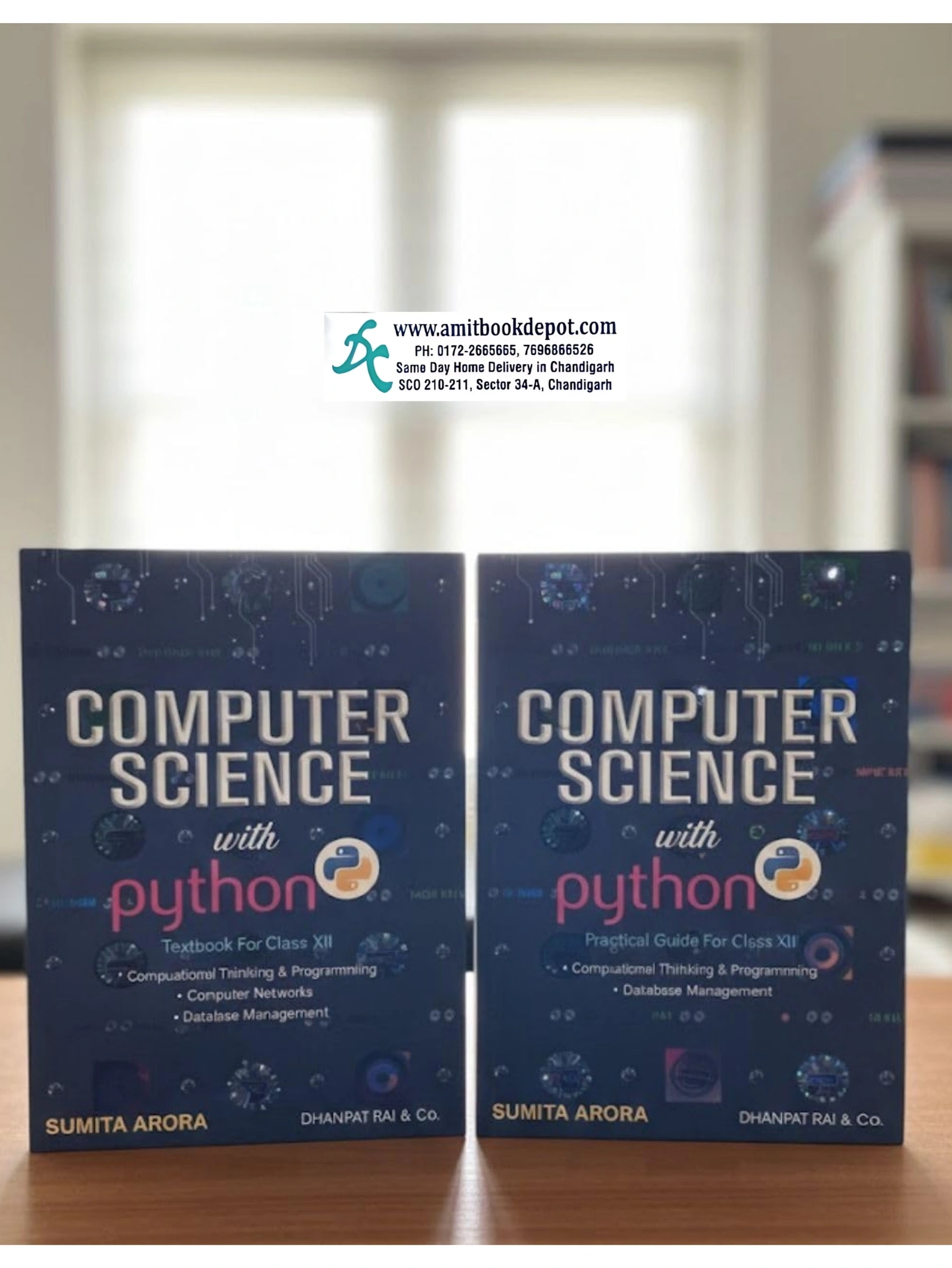
Sumit Arora Computer Science with Python for Class 12th

by Madhurima
₹628 ₹695.00(-/ off)

Rating & Reviews

23 Customer Review

Computer Science with Python for Class 12 by Sumita Arora (Dhanpat Rai & Co.) is the definitive book for CBSE Class 12 Computer Science (Code 083). Fully updated for the latest syllabus, this book provides a comprehensive understanding of key topics, including Python revision tours, working with functions, file handling (text, binary, and CSV), and data structures like stacks. It also offers deep insights into computer networks, relational databases, and SQL commands. A key highlight is the practical guide to interfacing Python with MySQL, essential for database connectivity. Packed with solved examples, case studies, and previous years' board papers, this book is your complete resource for exam success. 
Have Doubts Regarding This Product ? Ask Your Question

  • Q1
    Does this book cover the latest CBSE Class 12 Computer Science syllabus?
    A1

    Yes, it strictly adheres to the latest CBSE curriculum for Code 083, including updated content for board exams.

  • Q2
    What are the main units covered in the book?
    A2

    The book covers three main units: Computational Thinking and Programming - 2, Computer Networks, and Database Management.

  • Q3
    Does the book explain how to work with binary files in Python?
    A3

    Yes, it comprehensively covers binary file operations using the pickle module's dump() and load() methods.

  • Q4
    Are there objective-type questions for board exam practice?
    A4

    Yes, the book includes multiple-choice questions (MCQs) and objective-type questions across all chapters.

  • Q5
    What topics in Computer Networks are included?
    A5

    It covers evolution, protocols (TCP/IP, HTTP), devices (router, switch), and topologies (star, bus) in detail.

  • Q6
    Does the book contain previous years' CBSE board papers?
    A6

    Yes, this edition includes the CBSE Annual Papers for 2024, 2025, and a sample paper for 2025-26.

  • Q7
    Does the book cover SQL commands like joins and grouping?
    A7

    Absolutely. Chapter 13 is dedicated to grouping records, joins in SQL, and aggregate functions.

  • Q8
    What does the book teach about exception handling?
    A8

    It covers handling runtime errors using try, except, and finally blocks with practical code examples.

  • Q9
    Are there any appendices for additional learning?
    A9

    Yes, it includes appendices on installing MySQL connectors, project creation, and utility modules.

  • Q10
    Is this book useful for learning string and list manipulation?
    A10

    Yes, Python Revision Tour II thoroughly covers strings, lists, tuples, and dictionaries with multiple examples.

0.00

0 Overall Rating
  • 5
    0
  • 4
    0
  • 3
    0
  • 2
    0
  • 1
    0

Try this product & share your review & thoughts

1. Python Revision Tour - I
2. Python Revision Tour - II
3. Working with Functions
4. Using Python Libraries
5. Exception Handling 
6. File Handling
7. Data Structure 
8. Computer Network - I
9.  Computer Network - II
10. Relational Databases
11. Simple Queries in SQL
12. Table Creation and Data Manipulation Commands
13. Grouping Records, Joins in SQL
14. Interface Python with MySOL
Case Study Based Question
UNIT III : Database Management
APPENDICES
Appendix A : Utility of Module,s_name_
Appendix B : Working with a Useful Python Library - tkinter
Appendix C : Installing MySQL Pythons Connectors
Appendix D : Data Structure : Queues
Answer to Objective Type Questions (OTQs)
CBSE Annual Paper 2024
CBSE Annual Paper 2025
CBSE Annual Paper 2025-26

Latest Syllabus of Sumit Arora Computer Science with Python for Class 12th


Unit 1: Computational Thinking and Programming - 2

- Revision of Python topics covered in Class XI.
- Functions: Types of function (built-in functions, functions defined in module, user-defined functions), creating user-defined functions, arguments and parameters, default parameters, positional parameters, functions returning value(s), flow of execution, scope of a variable (global scope, local scope).
- Exception Handling: Introduction, handling exceptions using try-except-finally blocks.
- Introduction to files, types of files (text file, binary file, CSV file), relative and absolute paths.
- Text file: opening a text file, text files open modes (r, r+, w, w+, a, a+), closing a text file, opening a file using the with clause, writing/appending data to a text file using write() and writelines(), reading from a text file using read(), readline() and readlines(), seek and tell methods, manipulation of data in a text file.
- Binary File: basic operations on a binary file: open using file open modes (rb, rb+, wb, wb+, ab, ab+), close a binary file, import pickle module, dump ( ) and load ( ) methods, and read, write/create, search, append and update operations in a binary file.
- CSV file: import the csv module, open/close the csv file, write into a csv file using writer(), writerow(), and writerows(), and read from a csv file using reader().
- Data Structure: Stack, operations on stack (push & pop), implementation of stack using list.

Unit 2: Computer Networks

- Evolution of Networking: Introduction of computer networks, evolution of networking (ARPANET, NSFNET, INTERNET).
- Data Communication terminologies: concept of communication, components of data communication (sender, receiver, message, communication media, protocols), measuring capacity of communication media (bandwidth, data transfer rate), IP address, and switching techniques (circuit switching, packet switching).
- Transmission media: Wired communication media (twisted pair cable, coaxial cable, fibre-optic cable), wireless media (radio waves, microwaves, infrared waves).
- Network devices: modem, Ethernet card, RJ45, repeater, hub, switch, router, gateway, and WiFi card.
- Network Topologies and Network Types: types of networks (PAN, LAN, MAN, WAN) and networking topologies (bus, star, tree).
- Network Protocol: HTTP, FTP, PPP, SMTP, TCP/IP, POP3, HTTPS, TELNET, VoIP.
- Introduction to Web Services: WWW, Hyper Text Markup Language (HTML), Extensible Markup Language (XML), domain names, URL, website, web browser, web servers, web hosting.

Unit 3: Database Management

- Database Concepts: Introduction to database concepts and its need
- Relational data model: relation, attribute, tuple, domain, degree, cardinality, keys (candidate key, primary key, alternate key and foreign key).
- Structured Query Language: Introduction, Data Definition Language and Data Manipulation Language, data type (char(n), varchar(n), int, float, date), constraints (not null, unique, primary key), create database, use database, show databases, drop database, show tables, insert, delete, select, operators (mathematical, not null, like, update command, delete command), aggregate functions (max, min, avg, sum, count), group by, having clauses, joins: cartesian product on two tables, equi-join and natural join.
- Interface of Python with an SQL database: connecting SQL with Python, performing insert, update, and delete queries using a cursor, and displaying data by using connect(), cursor(), execute(), commit(), fetchone(), fetchall(), and rowcount, and creating database connectivity applications. Use of the %s format specifier or format() to perform queries.

Computer Science with Python for Class 12 by Sumita Arora (Latest Edition)

Published by Dhanpat Rai & Co. Pvt. Ltd.

Prepare effectively for your CBSE Class 12 Computer Science (Code 083) board examination with the most authoritative and updated book on the market. "Computer Science with Python for Class 12" by Sumita Arora, published by Dhanpat Rai & Co. Pvt. Ltd., is a comprehensive resource meticulously designed to align with the latest CBSE curriculum. This book is an essential guide for students aiming to build a strong foundation in Python programming, database management, and computer networks.

The book is structured to provide a step-by-step learning approach, starting with fundamental concepts and progressively moving to advanced topics. The content begins with crucial Python Revision Tours (Chapters 1 & 2), ensuring students are comfortable with Class XI syllabus basics before diving into new concepts. It then delves into core Python programming concepts, offering an in-depth exploration of Working with Functions (Chapter 3), including parameter passing, scope of variables, and the LEGB rule. A dedicated chapter on Using Python Libraries (Chapter 4) helps learners understand modular programming.

A key highlight of this book is its practical approach to data management. It provides comprehensive coverage of file handling (Chapter 6), teaching students how to perform read, write, and append operations on text files, binary files using the pickle module, and CSV files using the csv module. The book also introduces essential concepts of data structure (Chapter 7), with a clear focus on the implementation of a stack using lists and its operations (push and pop). 

In line with the CBSE syllabus, the book dedicates extensive sections to computer networks (Chapters 8 & 9), explaining everything from the evolution of the internet (ARPANET) to modern communication protocols like TCP/IP, HTTP, and SMTP. Students will gain a clear understanding of network devices, topologies, and transmission media.

The latter part of the book is devoted to database management (Chapters 10-14). It offers a thorough grounding in relational databases, the Structured Query Language (SQL), and the critical skill of interfacing Python with MySQL. Students will learn to execute simple and complex queries in SQL, perform table creation, use data manipulation commands, and implement joins. The chapter on interfacing Python with MySQL (Chapter 14) provides practical knowledge on connecting SQL with Python, performing database connectivity operations using connect(), cursor(), and execute(), which is vital for developing real-world applications. 

This updated edition is not just about theory; it is packed with practical application. It includes a dedicated section on case-study-based questions to help students tackle the new question paper pattern confidently. The book also features solved problems, multiple-choice questions (MCQs), and error-free programming examples. Appendices cover essential utility topics like installing MySQL connectors and project creation. To aid in exam preparation, the book includes the latest CBSE annual papers from 2024 and 2025 and a sample paper for 2025-26, along with answers to objective-type questions. 

Whether you are aiming for a perfect score in your boards or building a career in computer science, Sumita Arora's book is the most trusted companion for your academic journey.

Key Features:

1. Strictly as per the latest CBSE Class 12 Computer Science (083) syllabus.
2. Covers Python functions, file handling, data structures, and exception handling.
3. In-depth explanation of computer networks and database management with SQL.
4. Step-by-step guide on Python-MySQL connectivity.
5. Includes solved examples, practical exercises, and sample papers.

1. Python Revision Tour - I
2. Python Revision Tour - II
3. Working with Functions
4. Using Python Libraries
5. Exception Handling 
6. File Handling
7. Data Structure 
8. Computer Network - I
9.  Computer Network - II
10. Relational Databases
11. Simple Queries in SQL
12. Table Creation and Data Manipulation Commands
13. Grouping Records, Joins in SQL
14. Interface Python with MySOL
Case Study Based Question
UNIT III : Database Management
APPENDICES
Appendix A : Utility of Module,s_name_
Appendix B : Working with a Useful Python Library - tkinter
Appendix C : Installing MySQL Pythons Connectors
Appendix D : Data Structure : Queues
Answer to Objective Type Questions (OTQs)
CBSE Annual Paper 2024
CBSE Annual Paper 2025
CBSE Annual Paper 2025-26

Have Doubts Regarding This Product ? Ask Your Question

  • Q1
    Does this book cover the latest CBSE Class 12 Computer Science syllabus?
    A1

    Yes, it strictly adheres to the latest CBSE curriculum for Code 083, including updated content for board exams.

  • Q2
    What are the main units covered in the book?
    A2

    The book covers three main units: Computational Thinking and Programming - 2, Computer Networks, and Database Management.

  • Q3
    Does the book explain how to work with binary files in Python?
    A3

    Yes, it comprehensively covers binary file operations using the pickle module's dump() and load() methods.

  • Q4
    Are there objective-type questions for board exam practice?
    A4

    Yes, the book includes multiple-choice questions (MCQs) and objective-type questions across all chapters.

  • Q5
    What topics in Computer Networks are included?
    A5

    It covers evolution, protocols (TCP/IP, HTTP), devices (router, switch), and topologies (star, bus) in detail.

  • Q6
    Does the book contain previous years' CBSE board papers?
    A6

    Yes, this edition includes the CBSE Annual Papers for 2024, 2025, and a sample paper for 2025-26.

  • Q7
    Does the book cover SQL commands like joins and grouping?
    A7

    Absolutely. Chapter 13 is dedicated to grouping records, joins in SQL, and aggregate functions.

  • Q8
    What does the book teach about exception handling?
    A8

    It covers handling runtime errors using try, except, and finally blocks with practical code examples.

  • Q9
    Are there any appendices for additional learning?
    A9

    Yes, it includes appendices on installing MySQL connectors, project creation, and utility modules.

  • Q10
    Is this book useful for learning string and list manipulation?
    A10

    Yes, Python Revision Tour II thoroughly covers strings, lists, tuples, and dictionaries with multiple examples.

Latest Syllabus of Sumit Arora Computer Science with Python for Class 12th


Unit 1: Computational Thinking and Programming - 2

- Revision of Python topics covered in Class XI.
- Functions: Types of function (built-in functions, functions defined in module, user-defined functions), creating user-defined functions, arguments and parameters, default parameters, positional parameters, functions returning value(s), flow of execution, scope of a variable (global scope, local scope).
- Exception Handling: Introduction, handling exceptions using try-except-finally blocks.
- Introduction to files, types of files (text file, binary file, CSV file), relative and absolute paths.
- Text file: opening a text file, text files open modes (r, r+, w, w+, a, a+), closing a text file, opening a file using the with clause, writing/appending data to a text file using write() and writelines(), reading from a text file using read(), readline() and readlines(), seek and tell methods, manipulation of data in a text file.
- Binary File: basic operations on a binary file: open using file open modes (rb, rb+, wb, wb+, ab, ab+), close a binary file, import pickle module, dump ( ) and load ( ) methods, and read, write/create, search, append and update operations in a binary file.
- CSV file: import the csv module, open/close the csv file, write into a csv file using writer(), writerow(), and writerows(), and read from a csv file using reader().
- Data Structure: Stack, operations on stack (push & pop), implementation of stack using list.

Unit 2: Computer Networks

- Evolution of Networking: Introduction of computer networks, evolution of networking (ARPANET, NSFNET, INTERNET).
- Data Communication terminologies: concept of communication, components of data communication (sender, receiver, message, communication media, protocols), measuring capacity of communication media (bandwidth, data transfer rate), IP address, and switching techniques (circuit switching, packet switching).
- Transmission media: Wired communication media (twisted pair cable, coaxial cable, fibre-optic cable), wireless media (radio waves, microwaves, infrared waves).
- Network devices: modem, Ethernet card, RJ45, repeater, hub, switch, router, gateway, and WiFi card.
- Network Topologies and Network Types: types of networks (PAN, LAN, MAN, WAN) and networking topologies (bus, star, tree).
- Network Protocol: HTTP, FTP, PPP, SMTP, TCP/IP, POP3, HTTPS, TELNET, VoIP.
- Introduction to Web Services: WWW, Hyper Text Markup Language (HTML), Extensible Markup Language (XML), domain names, URL, website, web browser, web servers, web hosting.

Unit 3: Database Management

- Database Concepts: Introduction to database concepts and its need
- Relational data model: relation, attribute, tuple, domain, degree, cardinality, keys (candidate key, primary key, alternate key and foreign key).
- Structured Query Language: Introduction, Data Definition Language and Data Manipulation Language, data type (char(n), varchar(n), int, float, date), constraints (not null, unique, primary key), create database, use database, show databases, drop database, show tables, insert, delete, select, operators (mathematical, not null, like, update command, delete command), aggregate functions (max, min, avg, sum, count), group by, having clauses, joins: cartesian product on two tables, equi-join and natural join.
- Interface of Python with an SQL database: connecting SQL with Python, performing insert, update, and delete queries using a cursor, and displaying data by using connect(), cursor(), execute(), commit(), fetchone(), fetchall(), and rowcount, and creating database connectivity applications. Use of the %s format specifier or format() to perform queries.

0.00

0 Overall Rating
  • 5
    0
  • 4
    0
  • 3
    0
  • 2
    0
  • 1
    0

Try this product & share your review & thoughts

Top Trending Product

Related Product

Related Product

Related Blog Posts

Latest Blogs

Latest Blogs

blog-img
Classic Literature Reimagined: Discuss modern twists on classic novels.
Lorem ipsum dolor sit amet, consectetur adipiscing elit, sed do eiusmod tempor incididunt ut labore et dolore magna aliqua. Ut enim ad minim veniam, quis nostrud exercitation ullamco Lorem ipsum dolor sit amet, consectetur adipiscing elit, sed do eiusmod tempor incididunt ut labore et dolore magna aliqua. Utenim ad minim veniam, quis nostrud exercitation ullamco Lorem ipsum dolor sit amet, consecte...
Read more
Author name | 10 jan, 2025
blog-img
Classic Literature Reimagined: Discuss modern twists on classic novels.
Lorem ipsum dolor sit amet, consectetur adipiscing elit, sed do eiusmod tempor incididunt ut labore et dolore magna aliqua. Ut enim ad minim veniam, quis nostrud exercitation ullamco Lorem ipsum dolor sit amet, consectetur adipiscing elit, sed do eiusmod tempor incididunt ut labore et dolore magna aliqua. Utenim ad minim veniam, quis nostrud exercitation ullamco Lorem ipsum dolor sit amet, consecte...
Read more
Author name | 10 jan, 2025
blog-img
Classic Literature Reimagined: Discuss modern twists on classic novels.
Lorem ipsum dolor sit amet, consectetur adipiscing elit, sed do eiusmod tempor incididunt ut labore et dolore magna aliqua. Ut enim ad minim veniam, quis nostrud exercitation ullamco Lorem ipsum dolor sit amet, consectetur adipiscing elit, sed do eiusmod tempor incididunt ut labore et dolore magna aliqua. Utenim ad minim veniam, quis nostrud exercitation ullamco Lorem ipsum dolor sit amet, consecte...
Read more
Author name | 10 jan, 2025
blog-img
Classic Literature Reimagined: Discuss modern twists on classic novels.
Lorem ipsum dolor sit amet, consectetur adipiscing elit...
Read more
Author Name | 10 Jan, 2025
blog-img
Classic Literature Reimagined: Discuss modern twists on classic novels.
Lorem ipsum dolor sit amet, consectetur adipiscing elit...
Read more
Author Name | 10 Jan, 2025
blog-img
Classic Literature Reimagined: Discuss modern twists on classic novels.
Lorem ipsum dolor sit amet, consectetur adipiscing elit...
Read more
Author Name | 10 Jan, 2025
blog-img
Classic Literature Reimagined: Discuss modern twists on classic novels.
Lorem ipsum dolor sit amet, consectetur adipiscing elit...
Read more
Author Name | 10 Jan, 2025
blog-img
Classic Literature Reimagined: Discuss modern twists on classic novels.
Lorem ipsum dolor sit amet, consectetur adipiscing elit...
Read more
Author Name | 10 Jan, 2025
blog-img
Classic Literature Reimagined: Discuss modern twists on classic novels.
Lorem ipsum dolor sit amet, consectetur adipiscing elit...
Read more
Author Name | 10 Jan, 2025
blog-img
Classic Literature Reimagined: Discuss modern twists on classic novels.
Lorem ipsum dolor sit amet, consectetur adipiscing elit...
Read more
Author Name | 10 Jan, 2025
blog-img
Classic Literature Reimagined: Discuss modern twists on classic novels.
Lorem ipsum dolor sit amet, consectetur adipiscing elit...
Read more
Author Name | 10 Jan, 2025
blog-img
Classic Literature Reimagined: Discuss modern twists on classic novels.
Lorem ipsum dolor sit amet, consectetur adipiscing elit...
Read more
Author Name | 10 Jan, 2025