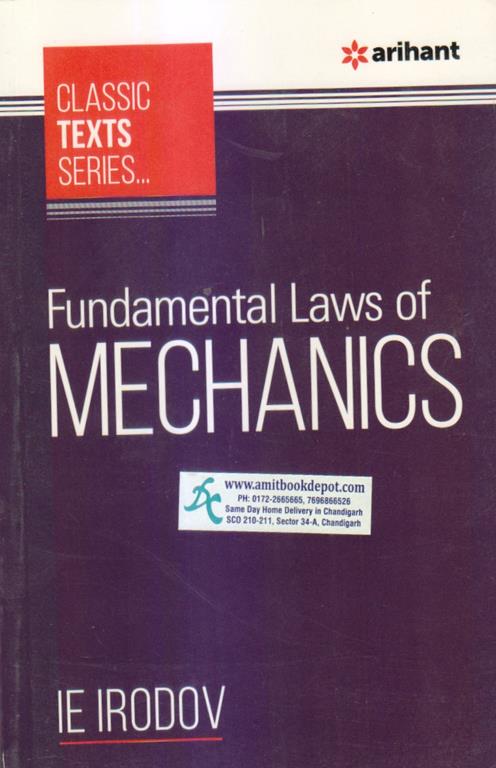
"Fundamental Laws of Mechanics" by I.E. Irodov is a seminal work that has established itself as the definitive text for students pursuing a deep and rigorous understanding of theoretical physics. Published by Arihant Prakashan, this edition presents a systematic and logical exploration of the core principles that govern mechanical systems, from the everyday to the relativistic. This book is not merely a book; it is a tool for building an unshakable foundation in mechanics, making it an indispensable resource for aspiring engineers and physicists aiming for top-tier competitive exams and university-level studies.
In-Depth Content and Structure:
The book is strategically divided into two comprehensive parts, guiding the reader from the fundamentals to advanced concepts.
Part One: Classical Mechanics delves into the mechanics of the macroscopic world, laying the groundwork for all physical sciences. It begins with "Essentials of Kinematics," providing a precise description of motion without considering its causes. This is followed by the cornerstone chapter, "The Basic Equation of Dynamics," which introduces Newton's laws and the concept of force. The subsequent chapters are dedicated to the powerful and universally applicable conservation laws: the "Energy Conservation Law," "The Law of Conservation of Momentum," and "The Law of Conservation of Angular Momentum." Irodov's treatment of these topics is renowned for its clarity and depth, emphasizing the theoretical framework and its practical application to complex problems.
Part Two: Relativistic Mechanics seamlessly transitions the reader into the modern era of physics. It covers "Kinematics in the Special Theory of Relativity," exploring concepts like time dilation and length contraction, and "Relativistic Dynamics," which modifies the classical laws of momentum and energy to be consistent with the principles of relativity. This section is crucial for students to bridge their understanding from Newtonian to Einsteinian physics.
Key Features and Benefits:
1. Unparalleled Conceptual Clarity: I.E., Irodov is celebrated for his ability to break down complex physical laws into logically structured, fundamental principles. The book focuses on strengthening conceptual understanding rather than rote learning.
2. Rigorous Problem-Solving Approach: While known for its problem sets, this book's primary strength is its theoretical exposition. It trains the mind to apply fundamental laws to analyze and solve intricate physical situations, a critical skill for IIT JEE Advanced and other premier engineering entrance examinations.
3. Systematic Progression: The content flows logically from basic kinematics to the conservation laws and finally to relativity. This structured approach ensures a solid grasp of each topic before moving to the next, building a coherent knowledge framework.
4. Ideal for Advanced Learners: This book is specifically designed for students who have completed their introductory physics courses and are ready to tackle higher-level, integrative concepts. It is a must-have for engineering students and physics majors.
5. Trusted Arihant Publication: This edition by Arihant ensures high-quality printing, clear diagrams, and easy accessibility for the Indian student community.
Target Audience:
This book is essential for:
1. Students preparing for IIT JEE (Main & Advanced)
2. Aspirants of other competitive exams like NEET, KVPY, and Olympiads
3. Undergraduate students of engineering and physics
4. Any individual seeking a profound understanding of the fundamental laws of physics
Invest in "Fundamental Laws of Mechanics" to build a powerful analytical mindset and achieve mastery over the principles that form the bedrock of physical science.
















.jpg)