Categories
College Bookssss >
BA PU Chandigarh
BSC PU Chandigarh
MSC PU Chandigarh
BBA PU Chandigarh
MA PU Chandigarh
Medical Books
Engineering Books
Management Books
PGDCA Books
BCOM PU Chandigarh
MCOM PU Chandigarh
BCA PU Chandigarh
MCA PU Chandigarh
animate-books

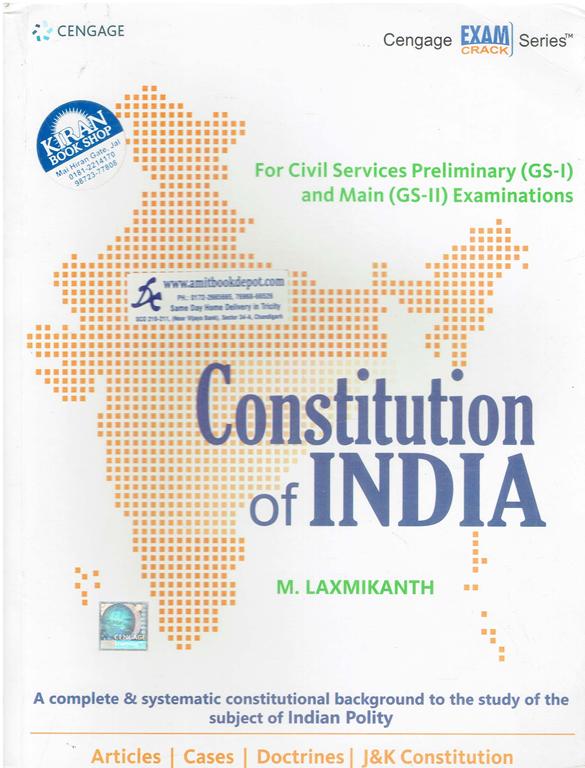
Cengage Constitution of India

by Madhurima
₹450 ₹450.00(-/ off)

Rating & Reviews

23 Customer Review

The Cengage Constitution of India by M. Laxmikanth is a definitive reference manual for the Indian Constitution. This exhaustive guide is structured for quick access, covering all articles, schedules, constitutional amendment acts, and landmark Supreme Court judgments. It includes dedicated sections on doctrines of constitutional interpretation, like the basic structure doctrine, and detailed constitutional prescriptions for exams. An essential resource for UPSC Civil Services, State PSCs, judicial services, and law students, this book is the authoritative compendium for mastering constitutional facts, amendments, and cases for competitive examinations and professional reference.


Have Doubts Regarding This Product ? Ask Your Question

  • Q1
    Who is the ideal target audience for this book?
    A1

    The book is ideal for civil service aspirants, law students, legal professionals, researchers, and anyone interested in gaining an in-depth understanding of the Indian Constitution and constitutional law.

  • Q2
    Does this edition include recent amendments and judicial decisions?
    A2

    Yes, the latest edition incorporates recent constitutional amendments, landmark judicial rulings, and updates on Jammu and Kashmir’s constitutional provisions, ensuring comprehensive and current coverage.

  • Q3
    Does the book cover case law and important judicial judgments?
    A3

    Absolutely. Section-B of the book provides summaries of significant constitutional cases and their judgments, highlighting judicial interpretations and their impact on constitutional law.

  • Q4
    Are there specific sections dedicated to constitutional doctrines?
    A4

    Yes, Section-D covers doctrines of constitutional interpretation such as Severability, Eclipse, Pith and Substance, and others, providing a solid theoretical foundation.

  • Q5
    Can this book be used as a quick reference for specific articles or schedules?
    A5

    Yes, the book offers an exhaustive article-wise and schedule-wise analysis, making it a valuable quick reference for scholars, students, and legal professionals.

  • Q6
    Is the content suitable for competitive exam preparation like UPSC and PSCs?
    A6

    Definitely. The book’s comprehensive coverage of articles, schedules, landmark cases, and doctrines makes it an essential resource for competitive exams.

  • Q7
    Does the book include comparative analysis with other constitutions or states?
    A7

    The book mainly focuses on the Indian Constitution and Jammu and Kashmir, with some comparative insights where relevant, especially in the context of amendments and special provisions.

  • Q8
    How is the book organized for easy understanding?
    A8

    The book is divided into well-structured sections covering introduction, case law, prescriptions, doctrines, articles, schedules, and special provisions, facilitating systematic learning.

  • Q9
    Does the book provide any practice questions or summaries?
    A9

    While primarily a comprehensive reference guide, the book includes case summaries, key points, and explanations that help reinforce understanding, suitable for self-study.

  • Q10
    Why should I choose this book over other constitutional law books?
    A10

    This book by M. Laxmikanth is renowned for its authoritative content, clarity, detailed analysis, and inclusion of landmark cases, making it the most trusted resource for aspirants and scholars.


0.00

0 Overall Rating
  • 5
    0
  • 4
    0
  • 3
    0
  • 2
    0
  • 1
    0

Try this product & share your review & thoughts

Preface
Acknowledgments

SECTION-A
INTRODUCTION
1. Indian Constitution: An Overview
2. Constitutional Amendment Acts: An Overview
3. Allied Amending Acts: An Overview
4. Acts Relating to the Salaries Under the Second Schedule
5. Acts Relating to the Composition of the Supreme Court
6. Constitutional Orders Relating to SCs and STs and Their Amendments

SECTION B
CONSTITUTIONAL CASES
7. Important Cases and Their Judgments at a Glance
8. Cases Expanding the Scope of Article 21
9. Cases Declaring Amendments as Unconstitutional
10. Cases Relating to the Validity of Amendments
11. Cases Leading to Constitutional Amendments

SECTION - C
CONSTITUTIONAL PRESCRIPTIONS
12. Constitutional Prescriptions with Respect to Compositions
13. Constitutional Prescriptions with Respect to Appointments
14. Constitutional Prescriptions with Respect to Age
15. Constitutional Prescriptions with Respect to Term
16. Constitutional Prescriptions with Respect to Salaries
17. Constitutional Prescriptions with Respect to Resignations
18. Constitutional Prescriptions with Respect to Removals and Dissolutions
19. Constitutional Prescriptions with Respect to Submission of Reports
20. Constitutional Prescriptions with Respect to Oaths
21. Constitutional Prescriptions with Respect to Special Majorities

SECTION D
DOCTRINES OF CONSTITUTIONAL INTERPRETATION
22. Doctrine of Severability
23. Doctrine of Waiver
24. Doctrine of Eclipse
25. Doctrine of Territorial Nexus
26. Doctrine of Pith and Substance
27. Doctrine of Colorable Legislation
28. Doctrine of Implied Powers
29. Doctrine of Incidental and Ancillary Powers
30. Doctrine of Precedent
31. Doctrine of Occupied Field
32. Doctrine of Prospective Overruling
33. Doctrine of Harmonious Construction
34. Doctrine of Liberal Interpretation

SECTION E
ARTICLES OF THE CONSTITUTION
35. Preamble
36. Part I—The Union and Its Territory (Articles 1 to 4)
37. Part II—Citizenship (Articles 5 to 11)
38. Part III—Fundamental Rights (Articles 12 to 35)
39. Part IV—Directive Principles of State Policy (Articles 36 to 51)
40. Part IVA—Fundamental Duties (Article 51.4)
41. Part V—The Union (Articles 52 to 151)
42. Part VI—The States (Articles 152 to 237)
43. Part VII—The States in Part B of the First Schedule (Repealed) (Article 238)
44. Part VIII—The Union Territories (Articles 239 to 242)
45. Part IX—The Panchayats (Articles 243 to 243-O)
46. Part IXA—The Municipalities (Articles 243P to 243ZG)
47. Part IXB—The Co-operative Societies (Articles 243ZH to 243ZI)
48. Part X—The Scheduled and Tribal Areas (Articles 244 to 244.4)
49. Part XI—Relations Between the Union and the States (Articles 245 to 263)
50. Part XII—Finance, Property, Contracts, and Suits (Articles 264 to 300A)
51. Part XIII—Trade, Commerce, and Intercourse Within the Territory of India (Articles 301 to 307)
52. Part XIV—Services Under the Union and the States (Articles 308 to 323)
53. Part XIVA—Tribunals (Articles 323A to 323B)
54. Part XV—Elections (Articles 324 to 3294)
55. Part XVI—Special Provisions Relating to Certain Classes (Articles 330 to 342)
56. Part XVII—Official Language (Articles 343 to 351)
57. Part XVIII—Emergency Provisions (Articles 352 to 360)
58. Part XIX—Miscellaneous (Articles 361 to 367)
59. Part XX—Amendment of the Constitution (Article 368)
60. Part XXI—Temporary, Transitional, and Special Provisions (Articles 369 to 392)
61. Part XXII—Short Title, Commencement, Authoritative Text in Hindi, and Repeals (Articles 393 to 395)

SECTION-F
SCHEDULES OF THE CONSTITUTION
62. First Schedule Names of States and Union Territories and Their Territorial Extent
63. Second Schedule—Salaries, Allowances, and Privileges of Certain Constitutional Functionaries
64. Third Schedule—Forms of Oaths or Affirmations
65. Fourth Schedule—Allocation of Seats in the Council of States
66. Fifth Schedule—Provisions as to the Administration and Control of Scheduled Areas and Scheduled Tribes
67. Sixth Schedule—Provisions as to the Administration of Tribal Areas in the States of Assam, Meghalaya, Tripura, and Mizoram
68. Seventh Schedule—Subject-Matter of Laws Made by Parliament and State Legislatures
69. Eighth Schedule - Languages
70. Ninth Schedule—Validation of Certain Acts and Regulations
71. Tenth Schedule—Provisions as to Disqualification on Ground of Defection
72. Eleventh Schedule—Powers, Authority, and Responsibilities of Panchayats
73. Twelfth Schedule—Powers, Authority, and Responsibilities of Municipalities, etc.

SECTION-G
APPLICATION OF THE INDIAN CONSTITUTION TO JAMMU AND KASHMIR
74. Constitution (Application to Jammu and Kashmir) Order, 1954
75. Re-statement, with Reference to the Present Text of the Constitution, of the Exceptions and Modifications Subject to Which the Constitution Applies to the State of Jammu and Kashmir
76. Article 35A of the Indian Constitution

SECTION-H
CONSTITUTION OF JAMMU AND KASHMIR
77. Constitution of Jammu and Kashmir
78. Sections of the Jammu and Kashmir Constitution and Their Corresponding Articles of the Indian Constitution
79. Schedules of the Jammu and Kashmir Constitution and Their Corresponding Schedules of the Indian Constitution
80. Amendments to the Constitution of Jammu and Kashmir: An Overview

APPENDICES
Appendix I: Original First Schedule of the Constitution
Appendix II: Original Fourth Schedule of the Constitution
Appendix III: Old Tenth Schedule of the Constitution

The Cengage Constitution of India by M. Laxmikanth is an authoritative and comprehensive guide essential for students, aspirants preparing for civil services, law enthusiasts, and anyone seeking an in-depth understanding of the Indian Constitution. Published by Cengage Learning, this book meticulously covers the entire spectrum of constitutional law, providing readers with a detailed exposition of the constitutional provisions, important cases, doctrines, and the historical evolution of India’s supreme legal document.

This edition is structured into well-organized sections, starting with an insightful introduction that provides an overview of the Indian Constitution, its significance, and the process of constitutional amendments. The book delves into the amendments enacted over the years, including allied amending acts and acts relating to the salaries of constitutional authorities, ensuring readers understand the dynamic nature of constitutional law in India.

In the Section-A, the book explores the foundational aspects, including the constitutional history, the framing process, and the evolution of the Constitution through various amendments. It also discusses amendments related to the composition of the Supreme Court, the Orders concerning Scheduled Castes and Scheduled Tribes, and other constitutional orders that have shaped India’s judicial and legislative landscape.

The Section-B offers a curated compilation of landmark constitutional cases and their judgments. This section is invaluable for understanding how judicial interpretation has expanded the scope of fundamental rights under Article 21, challenged constitutional amendments, and clarified the validity of legislative acts. It provides case summaries that are critical for aspirants preparing for competitive exams and legal studies, highlighting how judiciary has played a pivotal role in the development of constitutional law.

The Section-C deals with constitutional prescriptions that govern the functioning of various constitutional bodies and provisions. It covers topics such as the composition of the Parliament and State Legislatures, appointment procedures, age limits, tenure, salaries, resignation, removal procedures, submission of reports, oaths, and the requirements for constitutional amendments through special majorities. This section furnishes detailed insights into the procedural and substantive aspects of constitutional governance, making it an indispensable resource for students and scholars.

The Section-D elaborates on doctrines of constitutional interpretation, including the Doctrine of Severability, Eclipse, Pith and Substance, Colorable Legislation, and others. These doctrines form the theoretical foundation for judicial review and constitutional adjudication in India. Understanding these doctrines is crucial for legal professionals, law students, and anyone interested in constitutional law.

The Section-E provides an exhaustive article-wise analysis of the Indian Constitution, from the Preamble to the various parts and schedules. It covers key articles on fundamental rights, directive principles, the union and states' relations, emergency provisions, amendments, and language policies. This detailed section serves as a ready reference for constitutional scholars and aspirants preparing for competitive exams like UPSC, state PSCs, and judicial services.

The Section-F enumerates the schedules of the Constitution, detailing the distribution of powers, the structure of government, and provisions relating to the administration of tribal areas, languages, and other special provisions. It highlights the importance of schedules such as the First Schedule (States and Union Territories), Second Schedule (Salaries and allowances), and the Tenth Schedule (Disqualification on grounds of defection).

The Section-G addresses the application of the Indian Constitution to Jammu and Kashmir, including the special provisions, constitutional orders, and the unique status of the State. It explains the implications of the Constitution (Application to Jammu and Kashmir) Order, 1954, and the provisions related to Article 35A, which have been central to the constitutional and political discourse.

Finally, the Section-H provides an overview of the Constitution of Jammu and Kashmir, including its sections, schedules, and amendments, offering a comparative perspective with the Indian Constitution. The appendix sections include original schedules and amendments, serving as valuable references for researchers and students.

This edition of the Cengage Constitution of India is a comprehensive, well-researched, and user-friendly resource that combines theoretical knowledge with practical insights. It is an essential handbook for anyone aiming to master the intricacies of the Indian Constitution, whether for academic purposes, competitive exams, or professional legal practice.

Key features include:
1. Detailed coverage of constitutional articles, schedules, and doctrines
2. Summaries of landmark constitutional cases
3. Insights into constitutional amendments and judicial interpretations
4. Analytical explanations of doctrines of constitutional law
6. Up-to-date information on Jammu and Kashmir’s constitutional provisions
7. Clear, concise language suitable for learners at all levels

This book is a must-have for aspirants preparing for IAS, PSC, judicial exams, and law students seeking a definitive resource on India’s constitutional framework. It combines authoritative content with easy-to-understand presentation, making complex legal concepts accessible and memorable.

Preface
Acknowledgments

SECTION-A
INTRODUCTION
1. Indian Constitution: An Overview
2. Constitutional Amendment Acts: An Overview
3. Allied Amending Acts: An Overview
4. Acts Relating to the Salaries Under the Second Schedule
5. Acts Relating to the Composition of the Supreme Court
6. Constitutional Orders Relating to SCs and STs and Their Amendments

SECTION B
CONSTITUTIONAL CASES
7. Important Cases and Their Judgments at a Glance
8. Cases Expanding the Scope of Article 21
9. Cases Declaring Amendments as Unconstitutional
10. Cases Relating to the Validity of Amendments
11. Cases Leading to Constitutional Amendments

SECTION - C
CONSTITUTIONAL PRESCRIPTIONS
12. Constitutional Prescriptions with Respect to Compositions
13. Constitutional Prescriptions with Respect to Appointments
14. Constitutional Prescriptions with Respect to Age
15. Constitutional Prescriptions with Respect to Term
16. Constitutional Prescriptions with Respect to Salaries
17. Constitutional Prescriptions with Respect to Resignations
18. Constitutional Prescriptions with Respect to Removals and Dissolutions
19. Constitutional Prescriptions with Respect to Submission of Reports
20. Constitutional Prescriptions with Respect to Oaths
21. Constitutional Prescriptions with Respect to Special Majorities

SECTION D
DOCTRINES OF CONSTITUTIONAL INTERPRETATION
22. Doctrine of Severability
23. Doctrine of Waiver
24. Doctrine of Eclipse
25. Doctrine of Territorial Nexus
26. Doctrine of Pith and Substance
27. Doctrine of Colorable Legislation
28. Doctrine of Implied Powers
29. Doctrine of Incidental and Ancillary Powers
30. Doctrine of Precedent
31. Doctrine of Occupied Field
32. Doctrine of Prospective Overruling
33. Doctrine of Harmonious Construction
34. Doctrine of Liberal Interpretation

SECTION E
ARTICLES OF THE CONSTITUTION
35. Preamble
36. Part I—The Union and Its Territory (Articles 1 to 4)
37. Part II—Citizenship (Articles 5 to 11)
38. Part III—Fundamental Rights (Articles 12 to 35)
39. Part IV—Directive Principles of State Policy (Articles 36 to 51)
40. Part IVA—Fundamental Duties (Article 51.4)
41. Part V—The Union (Articles 52 to 151)
42. Part VI—The States (Articles 152 to 237)
43. Part VII—The States in Part B of the First Schedule (Repealed) (Article 238)
44. Part VIII—The Union Territories (Articles 239 to 242)
45. Part IX—The Panchayats (Articles 243 to 243-O)
46. Part IXA—The Municipalities (Articles 243P to 243ZG)
47. Part IXB—The Co-operative Societies (Articles 243ZH to 243ZI)
48. Part X—The Scheduled and Tribal Areas (Articles 244 to 244.4)
49. Part XI—Relations Between the Union and the States (Articles 245 to 263)
50. Part XII—Finance, Property, Contracts, and Suits (Articles 264 to 300A)
51. Part XIII—Trade, Commerce, and Intercourse Within the Territory of India (Articles 301 to 307)
52. Part XIV—Services Under the Union and the States (Articles 308 to 323)
53. Part XIVA—Tribunals (Articles 323A to 323B)
54. Part XV—Elections (Articles 324 to 3294)
55. Part XVI—Special Provisions Relating to Certain Classes (Articles 330 to 342)
56. Part XVII—Official Language (Articles 343 to 351)
57. Part XVIII—Emergency Provisions (Articles 352 to 360)
58. Part XIX—Miscellaneous (Articles 361 to 367)
59. Part XX—Amendment of the Constitution (Article 368)
60. Part XXI—Temporary, Transitional, and Special Provisions (Articles 369 to 392)
61. Part XXII—Short Title, Commencement, Authoritative Text in Hindi, and Repeals (Articles 393 to 395)

SECTION-F
SCHEDULES OF THE CONSTITUTION
62. First Schedule Names of States and Union Territories and Their Territorial Extent
63. Second Schedule—Salaries, Allowances, and Privileges of Certain Constitutional Functionaries
64. Third Schedule—Forms of Oaths or Affirmations
65. Fourth Schedule—Allocation of Seats in the Council of States
66. Fifth Schedule—Provisions as to the Administration and Control of Scheduled Areas and Scheduled Tribes
67. Sixth Schedule—Provisions as to the Administration of Tribal Areas in the States of Assam, Meghalaya, Tripura, and Mizoram
68. Seventh Schedule—Subject-Matter of Laws Made by Parliament and State Legislatures
69. Eighth Schedule - Languages
70. Ninth Schedule—Validation of Certain Acts and Regulations
71. Tenth Schedule—Provisions as to Disqualification on Ground of Defection
72. Eleventh Schedule—Powers, Authority, and Responsibilities of Panchayats
73. Twelfth Schedule—Powers, Authority, and Responsibilities of Municipalities, etc.

SECTION-G
APPLICATION OF THE INDIAN CONSTITUTION TO JAMMU AND KASHMIR
74. Constitution (Application to Jammu and Kashmir) Order, 1954
75. Re-statement, with Reference to the Present Text of the Constitution, of the Exceptions and Modifications Subject to Which the Constitution Applies to the State of Jammu and Kashmir
76. Article 35A of the Indian Constitution

SECTION-H
CONSTITUTION OF JAMMU AND KASHMIR
77. Constitution of Jammu and Kashmir
78. Sections of the Jammu and Kashmir Constitution and Their Corresponding Articles of the Indian Constitution
79. Schedules of the Jammu and Kashmir Constitution and Their Corresponding Schedules of the Indian Constitution
80. Amendments to the Constitution of Jammu and Kashmir: An Overview

APPENDICES
Appendix I: Original First Schedule of the Constitution
Appendix II: Original Fourth Schedule of the Constitution
Appendix III: Old Tenth Schedule of the Constitution

Have Doubts Regarding This Product ? Ask Your Question

  • Q1
    Who is the ideal target audience for this book?
    A1

    The book is ideal for civil service aspirants, law students, legal professionals, researchers, and anyone interested in gaining an in-depth understanding of the Indian Constitution and constitutional law.

  • Q2
    Does this edition include recent amendments and judicial decisions?
    A2

    Yes, the latest edition incorporates recent constitutional amendments, landmark judicial rulings, and updates on Jammu and Kashmir’s constitutional provisions, ensuring comprehensive and current coverage.

  • Q3
    Does the book cover case law and important judicial judgments?
    A3

    Absolutely. Section-B of the book provides summaries of significant constitutional cases and their judgments, highlighting judicial interpretations and their impact on constitutional law.

  • Q4
    Are there specific sections dedicated to constitutional doctrines?
    A4

    Yes, Section-D covers doctrines of constitutional interpretation such as Severability, Eclipse, Pith and Substance, and others, providing a solid theoretical foundation.

  • Q5
    Can this book be used as a quick reference for specific articles or schedules?
    A5

    Yes, the book offers an exhaustive article-wise and schedule-wise analysis, making it a valuable quick reference for scholars, students, and legal professionals.

  • Q6
    Is the content suitable for competitive exam preparation like UPSC and PSCs?
    A6

    Definitely. The book’s comprehensive coverage of articles, schedules, landmark cases, and doctrines makes it an essential resource for competitive exams.

  • Q7
    Does the book include comparative analysis with other constitutions or states?
    A7

    The book mainly focuses on the Indian Constitution and Jammu and Kashmir, with some comparative insights where relevant, especially in the context of amendments and special provisions.

  • Q8
    How is the book organized for easy understanding?
    A8

    The book is divided into well-structured sections covering introduction, case law, prescriptions, doctrines, articles, schedules, and special provisions, facilitating systematic learning.

  • Q9
    Does the book provide any practice questions or summaries?
    A9

    While primarily a comprehensive reference guide, the book includes case summaries, key points, and explanations that help reinforce understanding, suitable for self-study.

  • Q10
    Why should I choose this book over other constitutional law books?
    A10

    This book by M. Laxmikanth is renowned for its authoritative content, clarity, detailed analysis, and inclusion of landmark cases, making it the most trusted resource for aspirants and scholars.

No Syllabus Added

0.00

0 Overall Rating
  • 5
    0
  • 4
    0
  • 3
    0
  • 2
    0
  • 1
    0

Try this product & share your review & thoughts

Top Trending Product

Related Product

Related Product

Related Blog Posts

Latest Blogs

Latest Blogs

blog-img
Classic Literature Reimagined: Discuss modern twists on classic novels.
Lorem ipsum dolor sit amet, consectetur adipiscing elit, sed do eiusmod tempor incididunt ut labore et dolore magna aliqua. Ut enim ad minim veniam, quis nostrud exercitation ullamco Lorem ipsum dolor sit amet, consectetur adipiscing elit, sed do eiusmod tempor incididunt ut labore et dolore magna aliqua. Utenim ad minim veniam, quis nostrud exercitation ullamco Lorem ipsum dolor sit amet, consecte...
Read more
Author name | 10 jan, 2025
blog-img
Classic Literature Reimagined: Discuss modern twists on classic novels.
Lorem ipsum dolor sit amet, consectetur adipiscing elit, sed do eiusmod tempor incididunt ut labore et dolore magna aliqua. Ut enim ad minim veniam, quis nostrud exercitation ullamco Lorem ipsum dolor sit amet, consectetur adipiscing elit, sed do eiusmod tempor incididunt ut labore et dolore magna aliqua. Utenim ad minim veniam, quis nostrud exercitation ullamco Lorem ipsum dolor sit amet, consecte...
Read more
Author name | 10 jan, 2025
blog-img
Classic Literature Reimagined: Discuss modern twists on classic novels.
Lorem ipsum dolor sit amet, consectetur adipiscing elit, sed do eiusmod tempor incididunt ut labore et dolore magna aliqua. Ut enim ad minim veniam, quis nostrud exercitation ullamco Lorem ipsum dolor sit amet, consectetur adipiscing elit, sed do eiusmod tempor incididunt ut labore et dolore magna aliqua. Utenim ad minim veniam, quis nostrud exercitation ullamco Lorem ipsum dolor sit amet, consecte...
Read more
Author name | 10 jan, 2025
blog-img
Classic Literature Reimagined: Discuss modern twists on classic novels.
Lorem ipsum dolor sit amet, consectetur adipiscing elit...
Read more
Author Name | 10 Jan, 2025
blog-img
Classic Literature Reimagined: Discuss modern twists on classic novels.
Lorem ipsum dolor sit amet, consectetur adipiscing elit...
Read more
Author Name | 10 Jan, 2025
blog-img
Classic Literature Reimagined: Discuss modern twists on classic novels.
Lorem ipsum dolor sit amet, consectetur adipiscing elit...
Read more
Author Name | 10 Jan, 2025
blog-img
Classic Literature Reimagined: Discuss modern twists on classic novels.
Lorem ipsum dolor sit amet, consectetur adipiscing elit...
Read more
Author Name | 10 Jan, 2025
blog-img
Classic Literature Reimagined: Discuss modern twists on classic novels.
Lorem ipsum dolor sit amet, consectetur adipiscing elit...
Read more
Author Name | 10 Jan, 2025
blog-img
Classic Literature Reimagined: Discuss modern twists on classic novels.
Lorem ipsum dolor sit amet, consectetur adipiscing elit...
Read more
Author Name | 10 Jan, 2025
blog-img
Classic Literature Reimagined: Discuss modern twists on classic novels.
Lorem ipsum dolor sit amet, consectetur adipiscing elit...
Read more
Author Name | 10 Jan, 2025
blog-img
Classic Literature Reimagined: Discuss modern twists on classic novels.
Lorem ipsum dolor sit amet, consectetur adipiscing elit...
Read more
Author Name | 10 Jan, 2025
blog-img
Classic Literature Reimagined: Discuss modern twists on classic novels.
Lorem ipsum dolor sit amet, consectetur adipiscing elit...
Read more
Author Name | 10 Jan, 2025